AI Marketing · Automation Tools
Quick Answer
- HubSpot: best all-in-one choice for CRM-led marketing teams.
- ActiveCampaign: strong value for growing teams needing practical automation.
- Klaviyo: best fit for ecommerce lifecycle automation.
- Zapier or Make: best when AI must connect several marketing tools.
- For paid-media competitor intelligence, use the AdSpyder AI Competitor Analysis Agent.
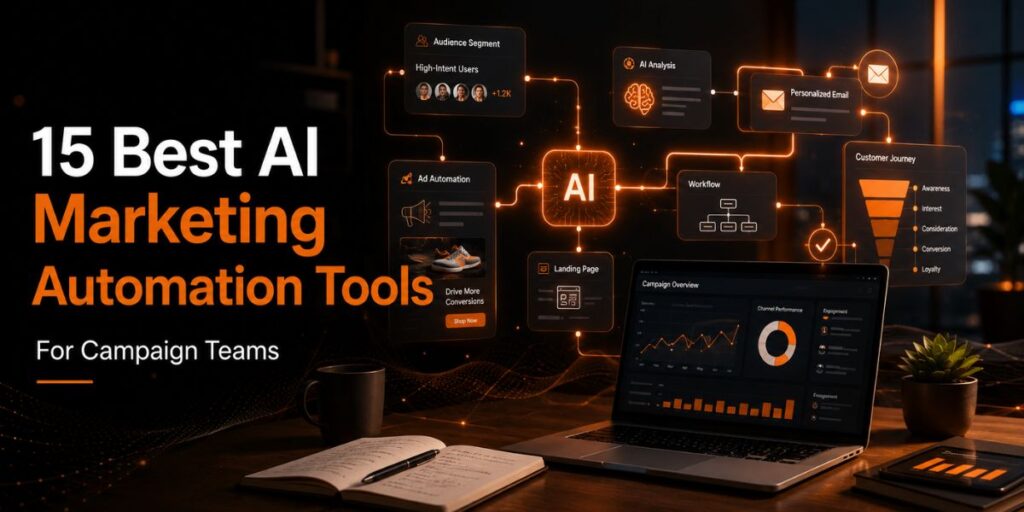
The best AI marketing automation tool is not the one with the longest AI feature list. Campaign teams need software that can reliably move from audience data to execution, approvals, measurement and follow-up without hiding important decisions inside a black box.
How We Evaluated the Tools
Each platform was assessed against six practical criteria instead of simply counting AI features.
- Workflow coverage: research, creation, journeys, messaging, analytics or orchestration.
- AI usefulness: whether AI does more than generate copy.
- Integration depth: how easily data moves between campaign, CRM and analytics tools.
- Transparency: whether marketers can review, approve and understand automated actions.
- Measurement: ability to connect automation with campaign or customer outcomes.
- Cost fit: whether pricing matches the target team’s scale and sophistication.
Paid-media teams should also compare external campaign activity with their internal automation data. AdSpyder Ad Analytics adds competitor, keyword, platform and landing-page context that CRM automation platforms normally do not provide.
15 AI Marketing Automation Tools Compared
| Tool | Best For | Automation Strength | Pricing Signal |
|---|---|---|---|
| AdSpyder | Paid-media campaign teams | Competitor intelligence + ad generation | From $10/mo |
| HubSpot | All-in-one CRM marketing | Journeys, lead automation, AI agents | Free; Pro from $800/mo |
| Salesforce Marketing Cloud | Enterprise CRM ecosystems | Agentic campaigns + journeys | Growth from $1,500/org/mo |
| Adobe Marketo Engage | Complex enterprise B2B | Nurture, scoring, campaign operations | Custom quote |
| ActiveCampaign | SMB and mid-market teams | AI-assisted lifecycle workflows | From $15/mo |
| Klaviyo | Ecommerce brands | Behavioral email, SMS and AI | Free; scales by profiles |
| Braze | Large consumer and app brands | Real-time cross-channel orchestration | Custom pricing |
| Customer.io | Product-led teams | Event-based messaging + AI workflows | From $100/mo |
| Iterable | Enterprise lifecycle marketing | AI decisioning across channels | Custom quote |
| Mailchimp | Email-first small businesses | Automation flows + AI assistance | Contact-based pricing |
| Brevo | Budget-conscious SMBs | Email + multichannel automation | Free; Starter from $9/mo |
| Omnisend | Ecommerce SMBs | Email, SMS and push journeys | Free; Standard from $16/mo |
| Zapier | Connecting the marketing stack | Cross-app AI orchestration | Free; Pro from $19.99/mo |
| Make | Visual workflow builders | Transparent AI-agent orchestration | Free; Core from $12/mo |
| Hootsuite | Social campaign teams | Scheduling, AI creation and monitoring | Paid per user; Enterprise custom |
Pricing checked against public vendor information in August 2026. Contact volume, sends, credits, annual commitments and region can change the final price.
Detailed Strengths and Limitations
1. AdSpyder — Best for Paid-Media Intelligence
AdSpyder is different from CRM automation platforms. It automates competitor research across major advertising channels, analyzes ads and landing pages, and supports AI-assisted ad creation. Use it before and during campaign planning rather than as your email or CRM engine. Teams can move from research into editable creative through AdSpyder Ad Generation.
2. HubSpot — Best All-in-One Marketing Platform
HubSpot combines CRM data, forms, email, automation, reporting and AI functionality in one ecosystem. It is easier to standardize than a collection of separate tools. The limitation is cost: sophisticated automation and reporting are concentrated in Professional and Enterprise tiers.
3. Salesforce Marketing Cloud — Best for Enterprise CRM Teams
Marketing Cloud Next combines Agentforce campaign creation, multichannel journeys, forms and CRM data. It is strongest where Salesforce already powers sales and customer operations. Smaller teams may find implementation, credits, add-ons and annual contracts excessive for their needs.
4. Adobe Marketo Engage — Best for Complex B2B Automation
Marketo remains suited to sophisticated B2B nurture, lead management and campaign operations. Adobe is adding agentic workflows for operational tasks, data cleanup and campaign assistance. Its flexibility is valuable, but setup and governance usually require experienced marketing-operations resources.
5. ActiveCampaign — Best Value for Growing Teams
ActiveCampaign offers approachable visual automation, segmentation, CRM functionality and AI-assisted campaign workflows without enterprise-level entry pricing. It is a strong middle ground for teams graduating from basic email tools but not ready for Marketo or Salesforce complexity.
Whichever lifecycle platform you choose, review the destination experience separately. Landing Page Analysis can help paid-media teams compare competitor offers, forms and post-click messaging before building automated follow-up.
6. Klaviyo — Best for Ecommerce Personalization
Klaviyo combines customer profiles, ecommerce events, email, mobile messaging and AI features. Its strength is using behavioral and purchase data for segmentation and lifecycle automation. Pricing rises with profile volume, so fast-growing lists require careful cost planning.
7. Braze — Best for Real-Time Consumer Engagement
Braze is designed for high-scale, cross-channel engagement across email, push, SMS, WhatsApp, in-app and other channels. BrazeAI adds personalization, decisioning and agent capabilities. It is powerful for large consumer brands but generally requires enterprise-level investment and implementation.
8. Customer.io — Best for Product-Led Messaging
Customer.io is strong when product events should trigger email, push, in-app or other messages. Its visual workflows, AI Agent and LLM actions suit SaaS and product teams with structured event data. It is less compelling for teams whose primary need is advertising management.
9. Iterable — Best for AI-Driven Lifecycle Decisions
Iterable uses AI for send timing, channel selection, predictive goals, messaging and journey assistance. It is built for data-rich organizations running high-volume lifecycle programs. Pricing is sales-led, making it less accessible for small teams testing their first automations.
10. Mailchimp — Best for Email-First Small Businesses
Mailchimp remains approachable for email campaigns, forms, segmentation and automation flows. Intuit Assist adds generative AI support. It works well when email is still the main channel, but larger multichannel teams can outgrow its campaign orchestration model.
11. Brevo — Best Budget Multichannel Option
Brevo combines email, automation, sales functionality and AI support at a relatively low entry price. Its Standard tier adds unlimited multi-step workflows and AI send-time optimization. It is attractive for SMBs that need more than newsletters without enterprise complexity.
12. Omnisend — Best Ecommerce Option for Smaller Teams
Omnisend focuses on ecommerce journeys such as welcome, abandoned-cart and post-purchase campaigns across email, SMS and push. AI can help with copy, timing and audience segmentation. It is narrower than a full CRM platform but practical for online stores.
13. Zapier — Best for Connecting Your Existing Stack
Zapier is useful when no single marketing platform controls the entire workflow. It can move leads between forms, CRMs, ad platforms, spreadsheets and messaging tools while adding AI steps. Costs depend heavily on task volume as automation expands.
14. Make — Best for Visual AI Orchestration
Make gives teams a visual map of workflows and AI-agent decisions. Marketers can add rules, manual approvals and deterministic steps around AI actions. It offers more visibility than many black-box agent tools, although complex scenarios require more learning.
15. Hootsuite — Best for Social Campaign Automation
Hootsuite is the specialist choice when automation is concentrated on social media. It combines AI-assisted caption and image creation, scheduling, engagement, competitor monitoring and reporting. It does not replace a CRM or lifecycle automation platform.
Best Choice by Use Case and Budget
| Need | Best Starting Point |
|---|---|
| Paid-ad competitor intelligence | AdSpyder |
| Complete CRM + marketing automation | HubSpot |
| Enterprise B2B | Marketo or Salesforce |
| Ecommerce | Klaviyo or Omnisend |
| Low-cost automation | Brevo or ActiveCampaign |
| Cross-app orchestration | Zapier or Make |
If Google Search is a major acquisition channel, use Google Ads Spy alongside your automation platform to identify competitor keyword and ad-message patterns before building nurture sequences.
Social-heavy teams can use Facebook Ads Spy to understand competitor offers and creative angles before automating Meta lead routing or follow-up.
Where AdSpyder Fits in the Automation Stack
Most tools in this list automate what happens inside your own customer journey. AdSpyder focuses on the external advertising market: what competitors are running, which messages they use, where ads appear and which landing pages support them.
A practical campaign stack can therefore use AdSpyder for market intelligence, HubSpot or ActiveCampaign for lead journeys, and Zapier or Make to connect specialist systems.
Teams that manage Google Ads directly can also evaluate the AI Agent for Google Ads when they need AI-assisted campaign analysis alongside competitor research.
AI Marketing Automation Buying Checklist
- List the three workflows you actually need to automate.
- Check whether AI actions can require human approval.
- Confirm how CRM, ad and analytics data move between systems.
- Understand contact, send, credit and task-based pricing.
- Test reporting before migrating historical campaign data.
- Check permissions, audit logs and team governance.
- Calculate total stack cost instead of comparing one subscription.
- Avoid paying for AI features the team cannot connect to measurable outcomes.
When competitor research is part of the buying requirement, start from the AdSpyder Ad Library and test whether the intelligence is useful for the campaigns your team actually runs.
Add competitor intelligence to your automation stack
Compare ads, keywords and landing pages before automating campaign creation and optimization.
Frequently Asked Questions
What are AI marketing automation tools?
They combine automation with AI to create, personalize, route, analyze or optimize marketing work using campaign and customer data.
Which tool is best for a small marketing team?
ActiveCampaign and Brevo are strong starting points when budget matters. HubSpot is better when the team also wants a unified CRM and can support higher pricing.
Which AI marketing automation tool is best for ecommerce?
Klaviyo is strongest for data-rich ecommerce personalization, while Omnisend provides a simpler and lower-cost starting point for many smaller stores.
Do I need Zapier or Make if I already use a marketing platform?
Only when important workflows cross tools your main platform cannot connect or automate reliably on its own.
Can AI fully automate campaign strategy?
AI can automate research, execution and optimization tasks, but marketers should retain control over positioning, budgets, claims, approvals and business objectives.
Where does AdSpyder fit compared with HubSpot or ActiveCampaign?
AdSpyder focuses on competitor advertising intelligence and ad creation, while HubSpot and ActiveCampaign primarily automate first-party customer and lead journeys.
Product Information Reviewed
AdSpyder, HubSpot, Salesforce, Adobe Marketo Engage, ActiveCampaign, Klaviyo, Braze, Customer.io, Iterable, Mailchimp, Brevo, Omnisend, Zapier, Make and Hootsuite. Public product and pricing information reviewed August 2026.