
Lead generation today isn’t just about attracting attention—it’s about building a predictable, structured, and repeatable system that consistently turns strangers into qualified leads and eventually into paying customers. Most businesses focus on individual tactics like running ads, publishing blogs, or hosting webinars, but without a funnel, these activities work in isolation and fail to produce consistent results. A lead generation funnel solves this by giving prospects a guided, intentional journey that moves them from awareness to engagement and eventually to purchase. In this detailed guide, you’ll learn how to build a Lead generation Funnels that not only drives leads but also accelerates sales conversations, lowers acquisition costs, and improves conversion rates.
Whether you’re a SaaS founder, an agency, a B2B marketer, or an e-commerce advertiser, this is the complete blueprint you’ll want to follow.
What Is a Lead Generation Funnel?

A lead generation funnel is a structured process designed to attract potential customers, educate them, nurture their interest. These ultimately convert them into qualified leads. Instead of relying on random traffic or disconnected campaigns, a funnel creates a cohesive journey where each step builds trust and intent. This si especially important for SaaS marketing funnel.
A well-designed lead generation funnel does the following:
- Guides prospects through the stages of awareness, consideration, and conversion.
- Delivers the right information at the right time to reduce friction in the buying journey.
- Automates nurturing and follow-up, allowing sales teams to focus on high-quality leads.
- Improves ROI by capturing more value from your existing marketing traffic.
Ultimately, the purpose of the funnel is not just to generate leads, but to generate qualified, sales-ready leads consistently.
Types of Lead Generation Funnels
Multiple funnel structures depend on the nature of your business, product complexity, and buying cycle. Understanding these options helps you choose the most effective model.
1. Lead Magnet Funnel
This funnel offers a valuable downloadable resource in exchange for the lead’s contact information. It is popular in B2B, coaching, consulting, and SaaS.
Common lead magnets include:
- Industry checklists
- Templates or swipe files
- Free audits
- Toolkits
- Short guides or frameworks
This funnel works because it builds trust quickly and positions your brand as a helpful authority.
2. Free Trial / Freemium Funnel
Perfect for SaaS products, this funnel reduces friction by letting users “experience before paying.”
The funnel typically includes:
- TOFU: Blog posts + ads promoting the free version
- MOFU: Email onboarding flows that highlight quick wins
- BOFU: Upgrade prompts, feature comparisons, time-based incentives
It is one of the fastest paths to monetization for product-led companies.
3. Consultation / Discovery Call Funnel
Used widely by agencies, service providers, and B2B companies, this funnel moves prospects toward scheduling a strategy or audit call.
The structure usually looks like:
- TOFU content that highlights problems and opportunities
- MOFU lead magnets like “free audit,” “ROI calculator,” or “industry report”
- BOFU “Book a consultation” landing page with testimonials
This works best when your service solves a painful and measurable problem.
4. Webinar / Workshop Funnel
This is ideal for selling high-ticket services or software, where education and demonstration significantly influence buying decisions.
The flow usually includes:
- TOFU ads promoting a free training
- MOFU live webinar delivering a step-by-step framework
- BOFU pitch for a call, demo, or offer
Webinars build authority, trust, and urgency in a single experience.
5. Content-to-Conversion Funnel
An SEO-driven funnel that uses content to attract organic traffic before introducing relevant CTAs.
Content can include:
- Category “what/how/why” guides
- Case studies
- Comparison articles
- Buying guides
This is the best long-term, scalable funnel because it compounds over time.
The 3 Stages of a Lead Generation Funnel
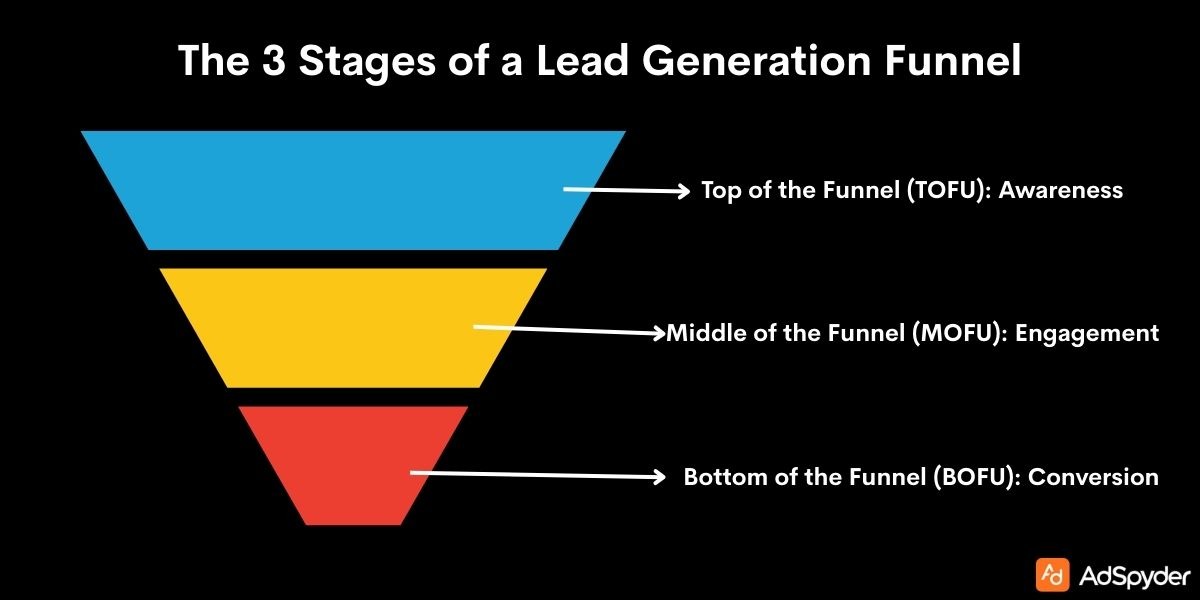
A lead generation funnel is built around three crucial stages: TOFU, MOFU, and BOFU. Each stage has a specific role and requires tailored content and messaging.
Top of the Funnel (TOFU): Awareness
This stage is about capturing attention and introducing your brand. Prospects at this level are problem-aware but not solution-aware—they know the challenge but not the fix.
TOFU Goals
- Generate awareness
- Educate prospects on their problem
- Drive traffic to your website or landing page
Best TOFU Content
- SEO blog posts answering basic questions
- Short educational videos
- Social media carousels
- Infographics
- Paid social campaigns
- Introductory guides
TOFU Actions to Optimize
- Blog reads
- Ad clicks
- Video views
- Lightweight downloads
How AdSpyder Helps at TOFU
- Identify competitor ad angles, messaging, and creative trends
- Analyze top-performing landing pages across your industry
- Discover which hooks generate the most engagement. This is key in social media marketing funnels.
Middle of the Funnel (MOFU): Engagement
This stage nurtures interest and builds trust. Prospects are now researching solutions and evaluating options.
MOFU Goals
- Capture emails
- Build credibility
- Present deeper value
- Move leads toward intent
Best MOFU Content
- Lead magnets (templates, checklists, reports)
- Email sequences
- Case studies
- Webinars and workshops
- Product walkthroughs
MOFU Actions to Optimize
- Email signups
- Lead magnet downloads
- Webinar attendance
- Repeat visits
How AdSpyder Helps at MOFU
- Identify competitor lead magnets and nurture assets
- Study webinar promotion strategies
- Discover which MOFU content types perform best in your niche
Bottom of the Funnel (BOFU): Conversion
This is where prospects make purchase decisions. They already trust you; now they need a final push.
BOFU Goals
- Convert leads into customers
- Present offers clearly
- Overcome objections
- Provide proof
Best BOFU Content
- Product demos
- Free trials
- Consultations or audits
- ROI calculators
- Customer success stories
- Testimonials
BOFU Actions to Optimize
- Demo bookings
- Trial signups
- Proposal requests
- Purchase decisions
How AdSpyder Helps at BOFU
- Reveal how competitors structure demo/trial offers
- Analyze their most effective BOFU landing pages
- Identify social proof patterns and conversion triggers
Anatomy of a High-Converting Lead Generation Funnel
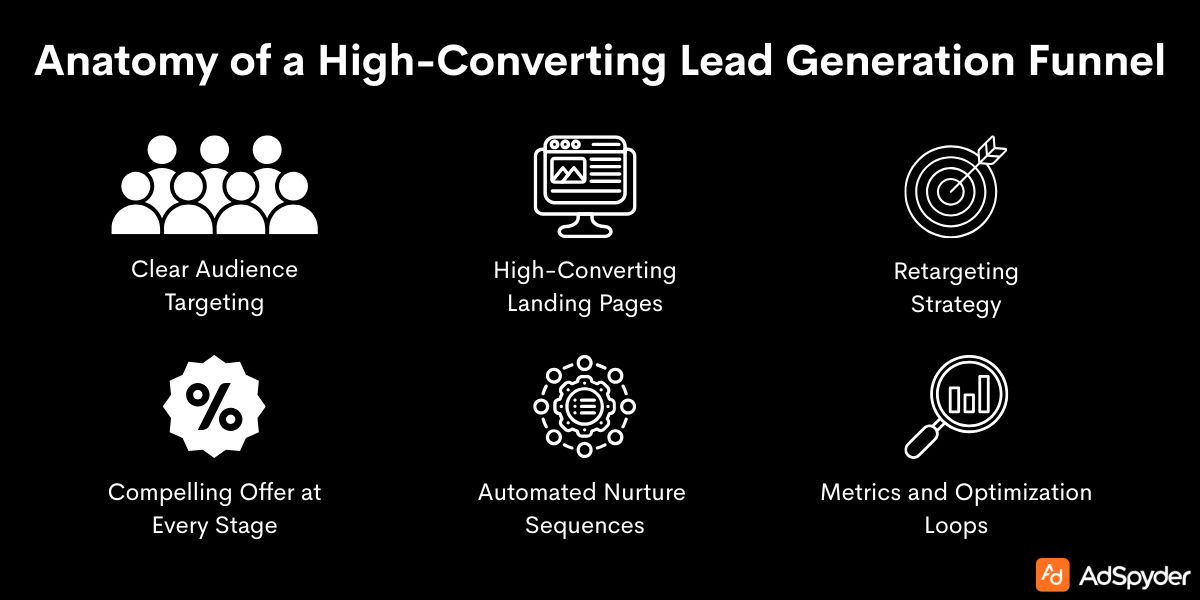
Every high performance marketing funnel includes the following core components:
1. Clear Audience Targeting
Understand whom you’re speaking to and what motivates them. Write content using their language and pain points.
2. Compelling Offer at Every Stage
Each stage must give the prospect something valuable:
- TOFU → education
- MOFU → lead magnet
- BOFU → call/demo/trial
3. High-Converting Landing Pages
A strong page has:
- A clear, benefit-driven headline
- One CTA
- Social proof
- Minimal friction
4. Automated Nurture Sequences
Your emails should guide leads toward meaningful next steps with:
- Step-by-step frameworks
- Case studies
- Personalized insights
- Clear CTAs
5. Retargeting Strategy
Most leads don’t convert immediately—retargeting recaptures lost attention.
6. Metrics and Optimization Loops
Regular testing improves performance dramatically.
How to Build a Lead Generation Funnel in 5 Steps
Step 1: Define Your Ideal Customer & Buyer Journey
Start by understanding:
- Who your customer is
- What their pain points are
- What triggers them to search for solutions
- How they typically make decisions
This clarity ensures your messaging cuts through noise and resonates deeply.
Step 2: Create High-Value TOFU Content & a Strong Lead Magnet
Your TOFU content must attract prospects by speaking to early-stage problems and curiosity.
Great lead magnet formats:
- Checklists
- “Swipe file” templates
- Mini-courses
- Audits
- Industry benchmark reports
The best lead magnets solve a small but urgent problem quickly.
Step 3: Build Optimized Landing Pages for Each Offer
A dedicated landing page is essential for capturing leads effectively.
Key components:
- A headline that states the benefit explicitly
- A clear promise (e.g., “Increase ad conversion rates in 7 days”)
- A short description and bullet-point value list
- Trust indicators like testimonials
- A simple form
Keep your landing pages distraction-free.
Step 4: Nurture Leads via Multi-Step Email Sequences
After capturing leads, nurture them with educational and persuasive emails.
A high-performing sequence includes:
- Email 1: Deliver resource + welcome
- Email 2: Teach a quick win
- Email 3: Share a case study
- Email 4: Introduce your solution softly
- Email 5: Strong CTA — trial/demo/consultation
This process builds authority and naturally nudges prospects to take action.
Step 5: Track, Test & Optimize Your Funnel
Funnel optimization is ongoing.
Things you can test:
- Titles and hooks
- Lead magnet positioning
- Landing page layout
- Email subject lines
- CTA button text
- Retargeting sequences
Your best-performing funnel will come from testing, not guessing.
Lead Generation Funnels Examples
Example 1: SaaS Free-Trial Funnel
This funnel is ideal for software companies wanting rapid user acquisition.
TOFU
- Blog content targeting problem-aware keywords
- LinkedIn ads promoting a “SaaS Growth Checklist”
MOFU
- Lead magnet → email nurturing sequence
- Case studies showcasing ROI and quick wins
BOFU
- Free trial with onboarding emails
- Retargeting ads pushing trial activation
How AdSpyder Helps:
It reveals competitor trial angles, landing page layouts, and messaging that drive conversions.
Example 2: Agency Consultation Funnel
Perfect for marketing, creative, and consulting agencies.
TOFU
- Content highlighting common industry problems
- Social posts demonstrating expertise
MOFU
- Free audit template or “Marketing Scorecard” download
- Webinar teaching a framework
BOFU
- Strategy call landing page
- Testimonials, case studies, ROI breakdowns
How AdSpyder Helps:
It shows which industries competitors target, what offers they promote, and how they frame their positioning.
Example 3: Webinar Funnel for High-Ticket Offers
Ideal for businesses needing deeper education before a purchase.
TOFU
- Ads promoting a free educational webinar
- SEO content around pain points
MOFU
- Webinar showing a 3- or 5-step method
- Strong value-delivery during the session
BOFU
- Pitch for a discovery call or premium offer
- Follow-up emails to non-attendees
How AdSpyder Helps:
It uncovers competitor webinar ads, hooks, and retargeting sequences.
Key Metrics to Track
To diagnose funnel performance, monitor:
Top of Funnel Metrics
- Website sessions
- Click-through rates
- TOFU lead magnet opt-in rate
Middle of Funnel Metrics
- Lead engagement
- Webinar attendance
- Email open rates and click rates
Bottom of Funnel Metrics
- Trial/demo requests
- Lead-to-customer conversion rate
- Cost per acquisition
- Revenue per lead
Tracking each stage independently helps pinpoint bottlenecks.
Check this Out – WhatsApp Marketing Funnel
Common Mistakes to Avoid for Lead Generation Funnels
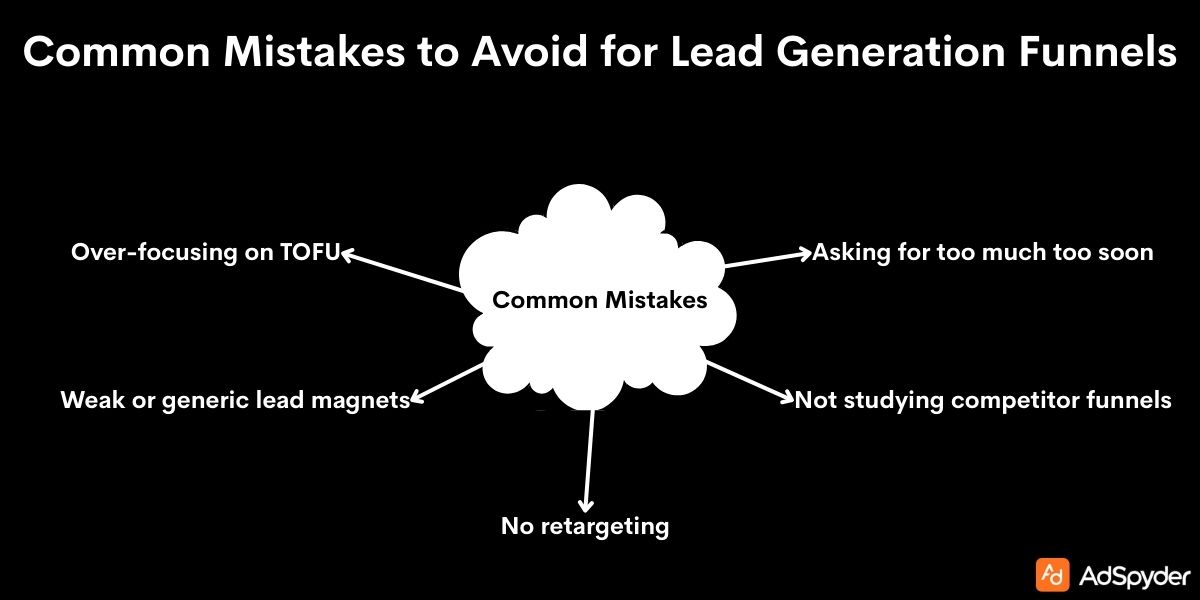
1. Over-focusing on TOFU
Traffic without nurture leads to poor conversion outcomes.
2. Weak or generic lead magnets
People only exchange emails for highly specific, actionable value.
3. No retargeting
Prospects rarely convert on first touch; retargeting recaptures lost prospects.
4. Asking for too much too soon
Jumping straight to “Book a call” scares away cold visitors.
5. Not studying competitor funnels
You waste time reinventing strategies that already work in your industry.
How AdSpyder Supports Each Funnel Stage
AdSpyder enhances funnel building by providing deep insights into competitor strategies.
TOFU
- Discover winning ad creatives
- Analyze messaging patterns
- Understand which hooks drive curiosity
MOFU
- Reveal competitor lead magnets
- Identify webinar strategies
- Compare nurture-focused ad variations
BOFU
- Analyze demo/trial promotions
- Evaluate landing pages for conversion triggers
- Identify guarantees, urgency angles, and proof formats competitors use
This intel helps you build stronger funnels and optimize faster.
FAQs On Lead generation Funnels
What is the main purpose of a lead generation funnel?
To build a consistent, predictable flow of qualified leads that move toward becoming customers.
How long does it take to build a strong funnel?
Basic funnels can be built in days, but optimization may take several weeks to months.
Do I need paid ads for my funnel to work?
No. SEO + content + email nurturing can drive strong results alone. Ads simply accelerate data collection.
Which lead magnet type converts best?
Templates, checklists, audits, calculators, and short frameworks usually outperform long ebooks.
Can funnels work for both B2B and B2C?
Yes—funnels are universal. You simply adjust the offer and nurture strategy based on your customer’s buying cycle.
Conclusion
A strong lead generation funnels transforms unpredictable marketing into a systematized, repeatable growth engine. By combining educational content, compelling offers, automated nurturing, and data-driven optimization, you turn attention into actionable leads—and leads into revenue. Pairing this strategy with intelligent competitor insights from AdSpyder lets you build faster, test smarter, and outperform competitors at every stage.