As the adoption of Agentic AI accelerates, the ecosystem of tools supporting the development and deployment of autonomous systems has grown rapidly. From frameworks and memory stores to execution engines and monitoring platforms, teams now have a rich toolkit to choose from. But with so many emerging options, selecting the right tools for your use case can be daunting. This post offers a comparative review of the top Agentic AI tools for 2026, categorized by their role in the agentic stack.
Agentic AI Stack Overview
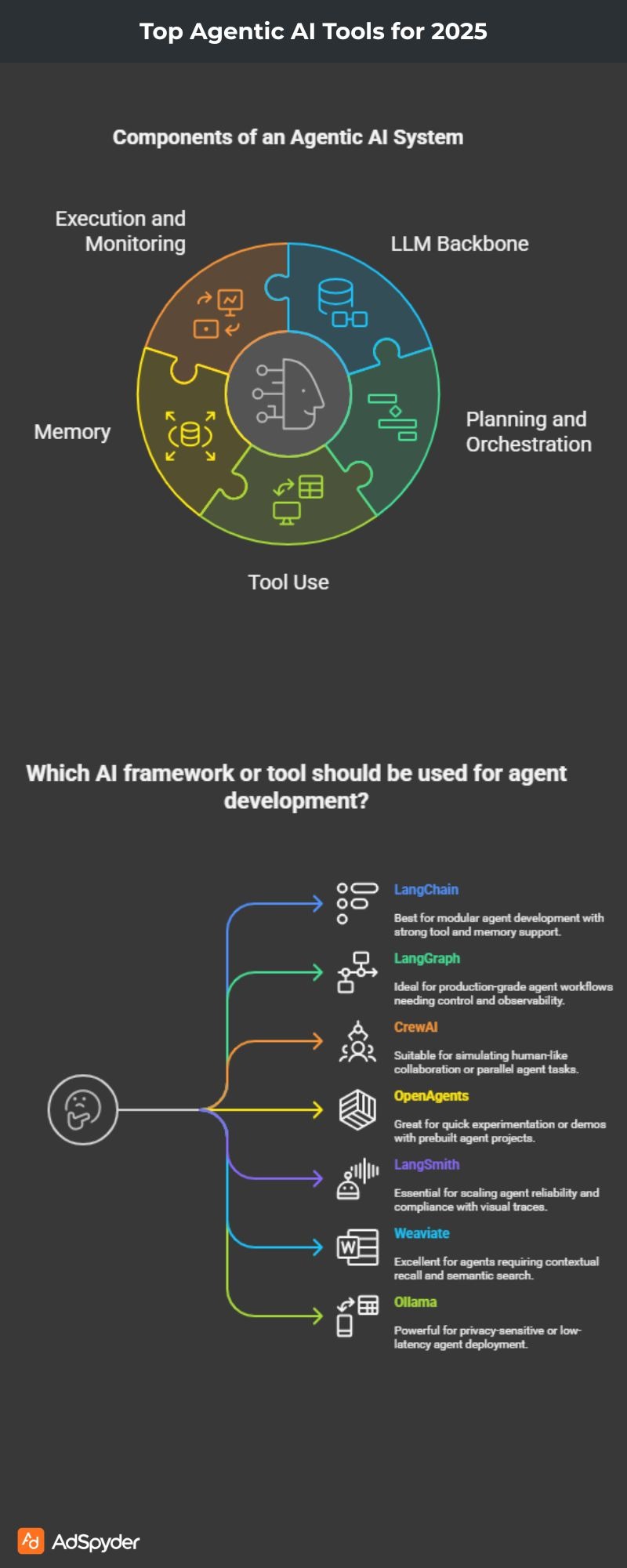
A robust agentic system typically includes the following layers:
- LLM Backbone – Core reasoning engine
- Planning and Orchestration – Structures task flow
- Tool Use – Connects to external systems (APIs, databases)
- Memory – Short- and long-term contextual storage
- Execution and Monitoring – Logging, control, and retries
We’ll evaluate top tools across these categories based on four key criteria:
- Maturity
- Developer Experience
- Ecosystem Compatibility
- Enterprise Readiness
1. LangChain
Category: Planning, Tool Use, Memory
Best For: Modular agent development
Strengths:
- Large community and extensive documentation
- Seamless integration with vector stores and APIs
- Supports tool routing, memory, and multi-turn reasoning
Limitations:
- Can become complex in larger projects
- Requires orchestration layer for full agent workflows
Verdict: Great foundation for building custom agents with strong tool and memory support.
Related – Agentic AI Frameworks for Teams
2. LangGraph
Category: Orchestration
Best For: Multi-step workflows and agentic graphs
Strengths:
- Enables retry logic, loops, branching
- Visual and traceable workflows
- Integrates naturally with LangChain
Limitations:
- Requires deeper architectural thinking
- Still maturing in terms of large-scale deployment examples
Verdict: Best suited for teams building production-grade agent workflows that need control and observability.
3. CrewAI
Category: Multi-agent Collaboration
Best For: Role-based agent design
Strengths:
- Models collaborative agents with distinct roles
- Easy to configure “crews” for parallel or dependent tasks
- Lightweight and composable
Limitations:
- Less mature observability than LangGraph
- Smaller community
Verdict: Ideal for simulating human-like collaboration or parallel agent tasks.
4. OpenAgents
Category: Deployment-ready Agent Templates
Best For: Prebuilt agent projects
Strengths:
- Templates for use cases like file management, browser tasks, email
- GitHub-hosted and open-source
- Fast start for proof-of-concept
Limitations:
- Quality varies by project
- Less customizable than frameworks
Verdict: Great for quick experimentation or team demos with little setup.
Must See – Agentic AI Self Study Roadmap
5. LangSmith
Category: Observability and Debugging
Best For: Tracing agent behavior
Strengths:
- Visual traces of agent runs
- Rich metadata on LLM inputs, outputs, and tool use
- Integrates with LangChain/LangGraph workflows
Limitations:
- Tied closely to LangChain ecosystem
- Requires setup for multi-environment monitoring
Verdict: A must-have for teams scaling agent reliability and compliance.
Must See – Market Map for Agentic AI: Navigating Tools and Vendors
6. Weaviate
Category: Long-Term Memory
Best For: Semantic search and memory persistence
Strengths:
- Fast, scalable vector search
- Supports hybrid search (text + vector)
- Compatible with many frameworks and embeddings
Limitations:
- Requires hosting or cloud deployment
- Query design can be nontrivial
Verdict: Excellent foundation for agents that require contextual recall, search, and knowledge grounding.
7. Ollama
Category: On-device LLM Execution
Best For: Lightweight, private agentic apps
Strengths:
- Runs open-source models locally
- Optimized for low-resource systems
- Great for prototyping without cloud costs
Limitations:
- Limited to smaller models
- No built-in orchestration
Verdict: Powerful for privacy-sensitive or low-latency agent deployment.
Must See – Implementing Agentic AI
Final Thoughts
The Agentic AI landscape in 2026 offers something for every team—from flexible developers to enterprise architects. Rather than searching for a one-size-fits-all platform, smart teams are composing their stacks using:
- LangChain for modularity
- LangGraph for workflow control
- CrewAI for collaboration
- Weaviate and LangSmith for memory and monitoring
By choosing tools based on your architecture, maturity, and team skillset, you can accelerate the transition from prompt-based systems to intelligent autonomy.
FAQs
What are agentic AI tools?
Agentic AI tools enable the creation of intelligent agents that can reason, plan, use tools, and act autonomously. These tools span LLM integration, memory, planning, orchestration, and observability.
Which is the most complete framework for Agentic AI development?
LangChain is the most complete in terms of modularity and integrations, but pairing it with LangGraph for orchestration and LangSmith for observability is often recommended for robust systems.
What’s the difference between LangChain and LangGraph?
LangChain handles modular components like tools and memory, while LangGraph orchestrates agent workflows using a graph-based state machine for control and logic.
Can I use multiple Agentic AI tools together?
Yes. Most teams use a composable stack—e.g., LangChain + LangGraph + Weaviate + LangSmith—to handle different layers of agent development.
Is CrewAI suitable for enterprise use?
Yes, especially for scenarios involving role-based agents or multi-agent workflows. However, it’s newer than LangChain and may require additional observability support.
What is OpenAgents, and when should I use it?
OpenAgents is a collection of open-source agent templates for real-world tasks (e.g., email, file management). It’s great for demos, experimentation, and rapid prototyping.
How important is observability in Agentic AI systems?
Critical. Tools like LangSmith help track agent reasoning, tool calls, and failures—ensuring reliability, compliance, and better debugging in production environments.
Can I build Agentic AI systems without internet access?
Yes, tools like Ollama allow local LLM execution. You can build and run agentic systems on local machines, useful for prototyping or privacy-sensitive applications.
Which memory solution is best for long-term context?
Weaviate is a strong choice due to its fast vector search and scalability. Alternatives like Pinecone, Redis, and Milvus are also widely used based on infrastructure needs.
How do I choose the best tools for my use case?
Base your choice on your team’s maturity, use case complexity, integration needs, and observability requirements. No single tool does everything—modularity is key.