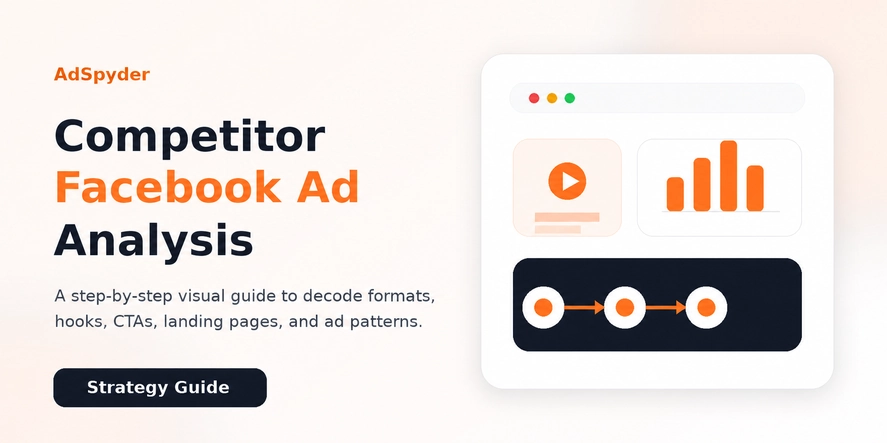
To analyse a competitor’s Facebook ad strategy, study four layers: format mix (image vs video vs carousel), copy structure (hook, proof, offer), CTA choices, and creative patterns over time. Meta’s Ad Library only shows active ads. To properly spy on Facebook ads — including paused campaigns and historical creatives — use AdSpyder’s Facebook Ads Spy, which indexes 55 million+ Meta ads dating back to 2012.
If you analyse competitor Facebook ads only by looking at the design, you will miss the real strategy. The creative is one layer. The stronger signals are the hook, the offer structure, the CTA intent, and how long the same messaging angle keeps running. A competitor repeating the same hook across 15 ads in a row is telling you something that one polished ad never could.
This guide gives you a step-by-step system to run a Facebook competitor ad analysis like a performance team — format audit, copy deconstruction, CTA strategy, creative pattern mapping, and an action list. Every step has a clear output so you end with a brief, not a folder full of screenshots.
The sections on format mix and CTA patterns use AdSpyder’s own Meta archive data — 55 million+ ads, 14 years of history — so the benchmarks here come from real ad behaviour, not general advice.
See every Facebook ad your competitor has ever run
AdSpyder’s Meta archive holds 55 million+ Facebook and Instagram ads going back to 2012. Search by competitor domain, filter by format and CTA, and build your next creative brief from real patterns — not guesswork.
What to Track Before You Open Any Tool
Before you open any Facebook ads research tool, decide what you are trying to learn. Otherwise you will collect screenshots without a campaign decision to show for it. The five signals that matter:
| Signal | What to record | Why it matters |
|---|---|---|
| Format | Image, video, carousel, reel-style, product demo, testimonial | Shows how they stop the scroll — and their creative investment level |
| Hook | Problem, bold claim, question, fear, social proof, comparison, offer | Reveals which audience pain point they have bet real spend on |
| Copy structure | Short punchy copy, long proof copy, benefit list, founder note, discount framing | Reveals their persuasion logic and which objection they pre-empt |
| CTA | Learn More, Shop Now, Sign Up, Send Message, WhatsApp message, Install Now | Shows the conversion intent they are pushing and which funnel stage they target |
| Landing page | Product page, lead form, offer page, quiz, category page, WhatsApp flow | Connects the ad promise to the actual conversion path — the most overlooked signal |
When a competitor repeats the same hook across many creatives, treat it as a stronger signal than one polished ad. Repetition means the angle survived internal testing — it did not just look good, it performed well enough to justify re-running.
What AdSpyder’s Meta Archive Actually Shows
Most guides point you to Meta’s Ad Library. That is a fine starting point — but it only shows currently active ads. The competitive intelligence that actually changes campaign decisions comes from historical data, format trends, and CTA patterns at scale. Here is what AdSpyder’s Meta archive holds:
Source: AdSpyder platform data, May 2026
| Year | Video share in new Meta ads | Image share | Signal |
|---|---|---|---|
| 2024 | 38.6% | 61.4% | Image still dominant |
| 2025 | 47.2% | 52.8% | Video closing fast |
| 2026 | 50.8% | 49.2% | First year video exceeded image in new ads |
If your competitor analysis does not include format trend data, you are working with an incomplete picture. A competitor moving from 30% to 60% video in 12 months has found something that works — and your research should surface that shift, not miss it.

The 9-Step Workflow: From Zero to a Fully-Briefed Campaign
Choose Your Competitors
Start with 5–10 brands selling the same product to the same audience at a similar price point. These are the competitors whose ad decisions are most relevant to yours — same auction, same audience pool, same purchase triggers.
Add one larger aspirational brand only for creative direction — not as a performance benchmark. Their budgets and testing velocity are usually not comparable, so copying their approach wholesale tends to produce expensive failures.
Include 2–3 adjacent brands who target your audience but sell a different product. They often pioneer copy angles and creative formats before those approaches reach your category — catching them early gives you a meaningful head start.
Map Their Ad Footprint
Before you analyse anything, get a complete picture of how many ads a competitor is running, when they started, and how their volume has moved. This context shapes everything else you find.
In AdSpyder’s Facebook Ads Spy, enter the competitor’s domain into the URL search. This pulls every Meta ad ever indexed for that domain — not just what is currently running. You will see total ad count, first and last ad dates, format breakdown, and whether their volume has been trending up or down.
A brand running 200+ active ad variants is split-testing aggressively. One running 8 is working with a single proven creative. These are fundamentally different competitive dynamics — and require different responses from you. A sudden 3× spike in volume almost always signals a new product launch, seasonal push, or budget increase.
Audit the Format Mix
Format preference is a strategic signal. A competitor leaning heavily into video when your category has historically run static images is either ahead of the curve or testing expensively. Compare their last 90 days against their lifetime archive to find out which.
For video, check the first three seconds — that is where the hook lands and where most viewers decide whether to keep watching. For image, check the first visible promise in the frame. Strong image ads make the audience problem or reward obvious before the user reads a word of copy.
| Format | What it signals | Where to look |
|---|---|---|
| Static image | Lower production cost, faster iteration | Headline text overlay, product hero, UGC-style |
| Video | Higher engagement potential, longer storytelling window | First 3-second hook, narrative structure, CTA timing |
| Carousel | Multi-product or multi-benefit consideration stage | Card sequence logic, offer per card, final CTA card |
Group Ads by Angle, Not Design
Most people group competitor ads by format: here are their video ads, here are their image ads. That is the wrong organising principle. Two ads with completely different visuals can be making exactly the same strategic bet on audience psychology.
Group by message angle instead:
Discount / offer
Social proof
Comparison claim
New launch / drop
Urgency / scarcity
Product benefit
Creator-style proof
If 12 of 15 recent competitor ads use a pain-point angle and only 3 use a discount angle, they have data telling them that problem-awareness outperforms price framing for their audience. That is a testable hypothesis for your own campaigns — even with completely different copy and visuals.
Deconstruct the Copy Layer by Layer
Reading a competitor’s copy is not analysis. Breaking it down structurally is. Every Facebook ad follows the same underlying architecture. Once you can identify each layer, you can see exactly where a competitor is strong and where they are leaving a persuasion gap you can exploit.
| Copy layer | What to look for | What it tells you |
|---|---|---|
| Hook (first line) | Pain question, bold claim, number, fear trigger | Which audience pain they are betting their CPM on |
| Body proof | Stats, testimonials, feature list, before/after, founder story | What objection they pre-empt before making the ask |
| Offer frame | Discount %, free trial, bundle, urgency phrase, limited quantity | Whether they close on value or on price — a critical strategic difference |
| Pre-CTA line | The sentence immediately before the button | The micro-commitment they ask for and how much friction they accept |
Pull 15–20 ads per competitor in AdSpyder, sorted by date (most recent first). Use AdSpyder’s Saved Ads feature to bookmark ads into named collections with per-ad notes. Export as a PDF for your creative team — no extra formatting required.
Analyse Their CTA Strategy
The CTA button tells you which funnel stage a competitor is targeting. “Learn more” is awareness. “Shop now” is purchase intent. “Sign up” is lead capture. “Send message” is high-touch assisted selling. When a competitor switches CTA type at scale, they are signalling a funnel strategy shift — not just a creative refresh.
Source: AdSpyder platform data, May 2026. “Learn more” and “Shop now” together appear in roughly 16% of all Meta ads analysed.
A competitor sending “Learn more” clicks to a pricing page is deliberately collapsing their funnel — they have found cold traffic converts without a warming step. Use AdSpyder’s Landing Page Analysis to match each competitor ad to its destination page and judge whether their ad-to-page alignment is strong or weak.
Study Creative Patterns Over Time
Brands that have been running Facebook ads for 12+ months develop creative systems — a handful of visual styles, colour palettes, or copy frameworks they return to repeatedly. These are what survived testing and earned repeat spend.
Three creative pattern signals to look for:
- Recurring visual style — same colour palette, font treatment, or product-on-background composition across 60%+ of recent ads. This is their creative signature — what audiences recognise before reading a word.
- Seasonal templates — ads that appear every year around the same dates with refreshed copy but the same structural format. If they repeat the same template for a third consecutive year, it works. Plan your seasonal push before they flood the auction.
- A/B test clusters — multiple ads launched within a 3–5 day window with near-identical copy but different visuals (or vice versa). This tells you what creative element they are currently testing — and previews what their next proven creative will look like.
Set Up Ongoing Competitor Monitoring
A one-time analysis is a snapshot. The real value is knowing the moment a competitor pivots their messaging, launches new creative, or enters a format they have not used before.
Set up competitors in AdSpyder’s Competitor Intelligence dashboard. You will get a daily delta summary — new ads launched, copy changes detected, and platform mix shifts — in one feed.
| Frequency | What to do | Time needed |
|---|---|---|
| Weekly | Review alerts feed — flag new copies, format changes, CTA shifts | ~15 min |
| Monthly | Fresh domain search on top 3–5 competitors. Flag new angles, seasonal patterns, volume spikes. | ~30 min |
| Event-triggered | Before any new campaign, product launch, or major seasonal push | 1–2 hrs |
Turn Patterns Into Test Hypotheses
Competitor research only matters if it changes what you do. For every pattern you identify, write one specific testable hypothesis. Not “try a pain-point hook” — but “a direct problem-diagnosis hook may outperform our current feature-led hook for cold audiences.” That specificity is what turns research into a brief your team can actually test and learn from.
| What you found | Your test hypothesis |
|---|---|
| Competitor is 70% video, you are 90% static image | Test one video-first variant with their hook structure but your original offer — validate format before scaling |
| 12 of 15 recent ads use a pain-question hook you have not addressed | Pain-hook variant in next sprint — address the same problem with a stronger, more specific answer |
| They use “Send message” where you use “Learn more” | Test conversational close for high-consideration products where the buyer typically needs a nudge |
| Their ad volume doubles every November | Prepare seasonal creative 6 weeks ahead — be in-feed before they flood the auction |
| A copy angle they have not used in 90+ days | Either they tested it and it failed (useful signal) or it is untapped — worth a controlled test either way |

What to Look for by Industry
The same ad signal means different things in different categories. A “Shop Now” CTA in fashion is expected. In B2B SaaS, that level of directness on cold traffic usually backfires. Calibrate your analysis to your vertical:
| Industry | What to analyse | Likely dominant angle | Test idea |
|---|---|---|---|
| Fashion & apparel | Offer, product shot style, model choice, seasonal urgency | New drop or limited-offer framing | Test “new collection” vs “limited offer” with the same product set |
| B2B SaaS | Pain point, product screenshot, demo CTA, comparison claim | Problem diagnosis with a clear workflow benefit | Test “manual work is slowing you down” vs “see exactly how it works” |
| Real estate | Location, project stage, price framing, WhatsApp CTA | Location-led and inventory-led demand creation | Test “book a site visit” against “get the price list” |
| Health & beauty | Before/after framing, ingredient proof, creator demo, discount | Visible result paired with a trust cue | Test creator demo vs product-only image at the same offer level |
| Education & coaching | Outcome promise, batch timing, teacher credibility, parent concern | Result confidence and structured preparation | Test “new batch open” vs “exam-focused preparation plan” |
Based on page category metadata from 55M+ Meta ads: Business (906K+), Product/Service (427K+), Health & Beauty (398K+), Shopping (377K+), Clothing brand (359K+), Real Estate (315K+). Health & beauty and real estate together represent over 700K advertiser pages — both highly competitive verticals where creative differentiation carries the most weight. AdSpyder platform data, May 2026. To extend competitor research beyond Facebook, use AdSpyder’s Ad Library to compare the same competitors across Google, Amazon, LinkedIn, TikTok, YouTube, and 6 other channels in one place.
Stop guessing what competitors are testing on Facebook
Search by competitor domain, filter by format and CTA, group by angle, and build your next creative brief from 55M+ real Meta ads — all in AdSpyder.
Mistakes to Avoid When You Spy on Facebook Ads
Copying layout without understanding the audience angle almost always produces weak results. Extract the persuasion logic — not the design — and rebuild it with your own brand voice.
A strong ad with a weak landing page is not a complete strategy. A competitor’s ad is only half the funnel — always inspect where the click goes and whether the page promise matches the ad promise.
One ad is a hypothesis. Repeated ads, repeated angles, and reused CTA structures are validated signals. Do not build a campaign strategy around a single ad you thought looked good.
A beauty ad, a SaaS ad, a real estate ad, and an education ad cannot be scored with the same rules. Cross-category logic creates confused campaigns.
Stale research means decisions built on a market that no longer exists. Set a weekly review cadence or use AdSpyder’s automated Competitor Intelligence alerts.
Free Meta Ad Library vs AdSpyder: The Honest Comparison
Meta’s Ad Library is free and useful for a quick active-ad scan. But the hard ceiling on what it can tell you becomes obvious fast — no history, no domain search, no format filters, no ongoing alerts.
| Capability | Meta Ad Library | AdSpyder Facebook Ads Spy |
|---|---|---|
| Active ads | ✓ | ✓ |
| Historical and paused ads | ✗ | ✓ back to 2012 |
| Domain-level search (all ads for a URL) | ✗ | ✓ |
| Format filter (image vs video vs carousel) | ✗ | ✓ |
| CTA filter | ✗ | ✓ |
| Save ads to collections with notes | ✗ | ✓ |
| Daily competitor change alerts | ✗ | ✓ via Competitor Tracking |
| Landing page destination analysis | Manual click-through | ✓ via Landing Page Analysis |
Pre-Analysis Checklist: Before You Call It Done
Competitor research without action is just expensive browsing. Every insight should change something — a hook you write differently, a CTA you test, a seasonal push you prepare earlier, a landing page you sharpen. If it does not change your plan, it did not count as research.
Build Your Next Facebook Ad Test From Competitor Proof
55 million+ Meta ads. 14 years of archive history. Format filters, CTA data, domain search, and daily competitor alerts — everything you need to stop guessing and start knowing. Over 23,000 marketers use AdSpyder to turn competitor patterns into campaign decisions.
Frequently Asked Questions
How do I analyse competitor Facebook ads? +
Analyse the format mix, hook type, copy structure (hook/proof/offer/pre-CTA), CTA button, and landing page destination. Use Meta Ad Library for a quick active-ad check, then AdSpyder for historical research, format filters, domain-level search, and angle-level pattern analysis across 15–20 ads per competitor.
Can you spy on Facebook ads your competitors are running? +
Yes. Meta’s free Ad Library shows currently active ads. AdSpyder’s Facebook Ads Spy tool indexes 55M+ historical and live Meta ads — including paused and stopped campaigns — filterable by country, format, date range, CTA, and advertiser domain. Archive history goes back to 2012.
Is it legal to spy on competitor Facebook ads? +
Yes, completely legal. You are accessing publicly available advertising data. The risk starts if you copy protected creative, brand assets, or claims directly. Use competitor ads as research input — not as material to duplicate.
What is the most common CTA in Facebook ads? +
Across AdSpyder’s Meta archive, “Learn more” is the most used CTA with 3.3M+ instances, followed by “Shop now” at 2.6M+. Together they appear in roughly 16% of all Meta ads analysed. “Send WhatsApp message” (632K+) is a strong signal for assisted buying journeys in real estate and high-consideration retail. (AdSpyder platform data, May 2026.)
What should I take from competitor Facebook ads? +
Do not copy the ad — copy the learning. If a competitor repeats a pain-point hook, creator demo format, or specific CTA type across many ads, convert that into a testable hypothesis with original copy and brand-safe visuals. Extract the persuasion logic, not the creative execution.
How often should I check competitor Facebook ads? +
For active paid campaigns, review direct competitors weekly. During sale seasons or product launches, check more often — ideally 6 weeks ahead so you have time to act on what you find. With AdSpyder’s Competitor Intelligence alerts you can monitor daily without manual checking.