Quick Answer
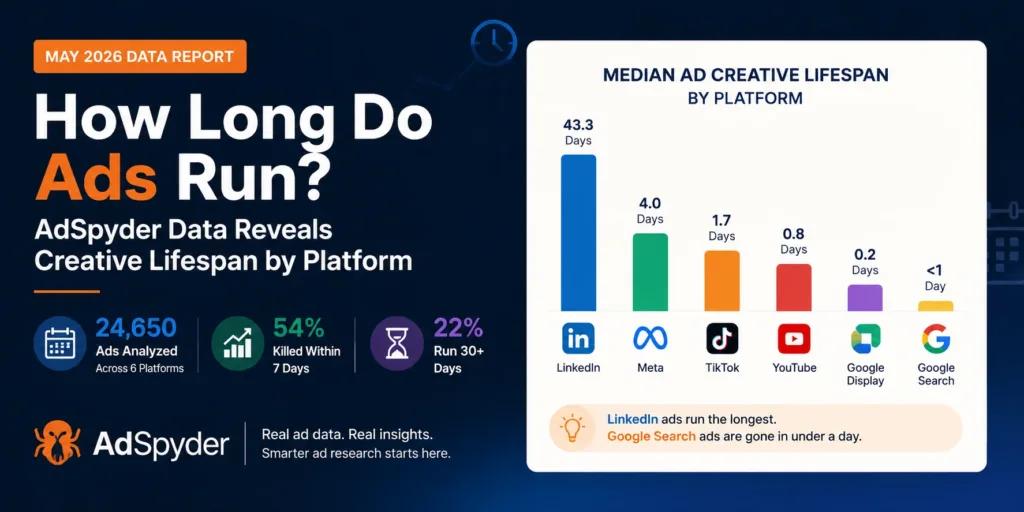
Based on AdSpyder’s analysis of 24,650 ads across Google Search, YouTube, Meta, LinkedIn, Bing, and Display: 54% of ads are killed within 7 days, 22% reach 30+ days, and only 1 in 10 survives past 90 days. LinkedIn is the structural outlier at a 43.3-day median vs. under 5 days on every other platform. You can see exactly how long any competitor’s ad has been running inside the AdSpyder Ad Library, which indexes 400M+ ads with first-seen and last-seen dates on every creative.
Every media buyer has asked this question. You want to know if a competitor’s ad is still live or already dead, how fast you need to rotate your own creatives, and what a “winning” creative actually looks like in terms of run time. The internet gives you plenty of answers about how long it takes a campaign to work — learning phases, algorithm warm-up, 3-month ramp-up timelines. That is a completely different question.
The question no one has data on is: how long does a specific ad creative actually stay live before the advertiser kills it or rotates it out?
AdSpyder tracks first-seen and last-seen dates for every ad in the archive. We sampled 24,650 ads with usable date pairs across six platforms and measured the actual gap. What follows is the only published data set that answers this directly — broken down by platform, with a framework for using it in your own creative strategy. Data is current as of May 2026.
24,650
Ads sampled with date pairs
AdSpyder platform data, May 2026
54%
Killed within 7 days
AdSpyder platform data, May 2026
22%
Surviving 30+ days
AdSpyder platform data, May 2026
9.4%
Surviving past 90 days
AdSpyder platform data, May 2026
400M+ ads. 10 platforms. First-seen and last-seen on every creative.
See exactly how long competitors’ ads have been running — and which ones are still live right now.
In This Article
Why “How Long Do Ads Take to Work?” Is Not the Question You Should Be Asking
Every agency blog that ranks for this topic is answering the wrong question. They tell you Google Ads needs 3 months to mature. Meta’s learning phase takes one to two weeks. These are correct facts about platform algorithm warm-up. They have nothing to do with how long individual ad creatives stay live.
The distinction matters because the questions you actually need answered are about creatives, not campaigns:
- Is this competitor’s ad still running, or did they kill it last week?
- If an ad has been live for 60 days, is that a signal it’s working?
- How quickly should I rotate my own creatives before fatigue sets in?
- Which platform’s ads are worth spending time analysing vs. which rotate too fast to matter?
No public benchmark answers these. The only way to get real numbers is to measure ads directly — which is exactly what the AdSpyder archive allows.
Important data note
AdSpyder records a first-seen date (when the ad was first observed) and a last-seen date (most recent observation). The gap between them is the observable run duration — a floor estimate, not the true final lifespan, since an ad still running today shows last-seen = today. We filtered out date anomalies and durations over 10 years. Platforms without usable date pairs (Google Shopping historical archive, Amazon, TikTok) are excluded. Source: AdSpyder platform data, May 2026.
How Long Ads Actually Run: Platform-by-Platform Data
We sampled 24,650 ads with usable first-seen and last-seen dates across six platforms. The platform you choose determines creative lifespan more than any other factor.
| Platform | Archive Size | Sample (n) | Avg Days | Median Days | <7 Days | 30+ Days | 90+ Days |
|---|---|---|---|---|---|---|---|
| LinkedIn Ads | 857K+ | 4,650 | 75.3 | 43.3 ↑ | 15.0% | 70.7% | 22.3% |
| Meta (Facebook/Instagram) | 11.1M+ | 4,000 | 52.4 | 4.0 | 54.4% | 29.8% | 15.5% |
| YouTube Ads | 2.5M+ | 5,000 | 30.3 | 5.1 | 54.2% | 22.1% | 7.8% |
| Bing/Microsoft Ads | 4.6M+ | 4,500 | 10.8 | 0.0* | 88.4% | 8.1% | 4.4% |
| Google Search Ads | 164M+ | 1,000 | 6.5 | 0.0* | 92.9% | 4.9% | 1.9% |
| Display Ads | 17.5M+ | 500 | <1 | 0.0* | 99.4% | 0.2% | 0.2% |
*Median of 0.0 means most ads were caught in a single observation window (firstSeen = lastSeen). This reflects observation frequency, not necessarily a literal 1-day run.
Source: AdSpyder platform data, May 2026. Google Shopping historical archive, Amazon, and TikTok excluded — no usable date pairs in the random sample.
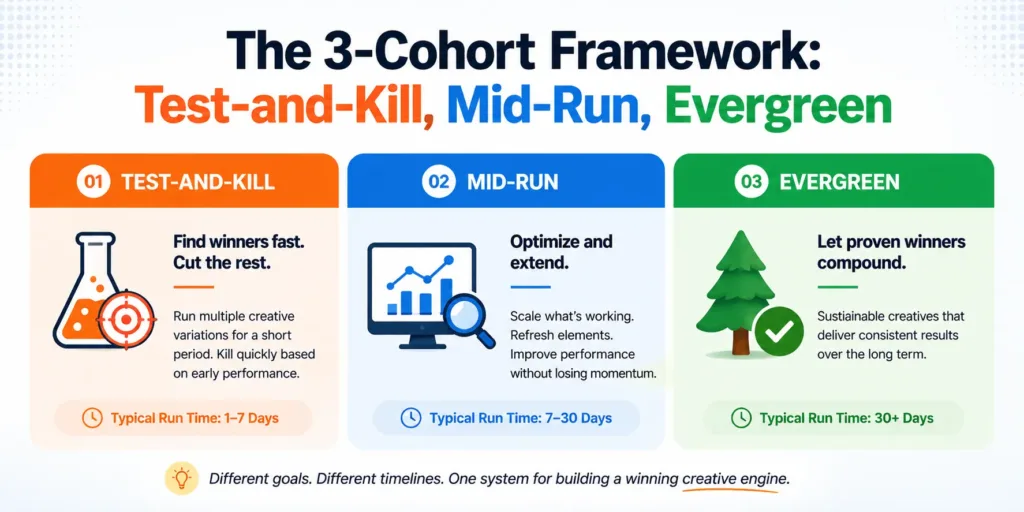
The 3-Cohort Framework: Test-and-Kill, Mid-Run, Evergreen
Averages don’t tell the full story because ad lifespans are not normally distributed. The useful way to think about this data is in three cohorts. Every ad lands in one of these buckets — and which bucket it’s in tells you something different about how to treat it as competitive intelligence.
Test-and-Kill — Under 7 Days (54% of all ads)
These ads were spotted once or over a few days and then disappeared. On Google Search and Bing, over 88–93% of all sampled ads fall here. These are A/B test variants, time-limited promotions, and creatives killed after weak early signals. If you spot a competitor’s ad under a week old, don’t invest heavy analysis time — it may not survive the month.
Mid-Run — 7 to 30 Days (24% of all ads)
These creatives survived the initial cull. On social platforms like Meta and YouTube, this cohort showed enough early signal to keep running but hasn’t crossed into proven territory. A 2–3 week old competitor ad is worth watching — they’re deciding whether to scale it.
Evergreen — 30+ Days (22% of all ads)
Only about 1 in 5 ads makes it past 30 days. These are the proven performers. The 90-day threshold narrows to roughly 1 in 10. If a competitor’s ad has been running 60+ days on Instagram, YouTube, or LinkedIn, treat it as market-validated. Study the angle, offer, and proof structure — not the specific copy.
| Ad Run Length | What It May Signal | Research Priority | What to Analyse |
|---|---|---|---|
| Under 7 days | Test variant, failed creative, or limited-window promo | Low — may not survive | Hook angle, offer type — look for patterns across multiple short-run ads |
| 7–30 days | Moderate validation, early scale decision pending | Medium — worth monitoring | Creative format, copy structure, CTA framing |
| 30+ days | Proven winner or evergreen control creative | High — deep analysis justified | Messaging pattern, offer durability, audience promise, landing page match |
Source: AdSpyder platform data, May 2026.
The LinkedIn Outlier: Why B2B Ads Run an Order of Magnitude Longer
The most important finding in this data set is the LinkedIn vs. everything-else gap. The median LinkedIn ad runs 43.3 days — roughly 10× the Meta median (4 days), 8× YouTube (5.1 days), and orders of magnitude longer than Google Search or Display. 70.7% of LinkedIn ads ran 30+ days. More than 1 in 5 ran past 90 days.
Three structural factors explain this — and understanding them changes how you approach B2B creative research.
Production cost. LinkedIn ads — document ads, lead-gen forms, carousel sequences — take significantly more time and budget to produce than a Facebook image ad. Advertisers do not rotate these weekly because the replacement cost is high.
Slower feedback loop. LinkedIn CPCs are among the highest of any ad platform. Conversion volumes are lower. It takes longer to accumulate statistically meaningful performance data before making a cut decision.
Smaller audience pools. When you are targeting CFOs at companies between 200 and 1,000 employees in a specific country, your audience may be 40,000 people. Ad fatigue arrives much later than on a 5-million-person consumer audience.
Practical implication for B2B advertisers
If you are running LinkedIn competitor research and dismissing ads that are 6–8 weeks old as “stale,” you are discarding the most valuable data in the archive. A 45-day LinkedIn ad is in the middle of its normal run. A 90-day LinkedIn ad is a confirmed winner. The opposite is true on Meta — a 45-day Meta ad is already a long-tail outlier.
The Longest-Running Ads in the Archive
The longest first-seen to last-seen span in our Meta real-time sample was 1,620 days — approximately 4.4 years. LinkedIn had a comparable outlier at 1,546 days. YouTube’s maximum in the sample was 1,035 days, just under three years.
These are not anomalies. They represent a real class of evergreen creative that advertisers simply never turned off — typically broad awareness spend with no tight frequency caps. These ads passed through every budget review, every creative audit, every platform algorithm change over multiple years. Studying a 4-year ad is fundamentally different from studying a 4-day one.
What a multi-year ad tells you
When you find a competitor ad that has been running for 6+ months, you are not looking at neglect — you are looking at a proven asset. Use Facebook Ads Spy or YouTube Ads Spy to filter by first-seen date and find these long-run creatives. Then study the structure — not the copy.
What This Data Means for Your Creative Rotation Strategy
The biggest mistake most media buyers make is applying one rotation cadence across every platform. Platform choice is the single biggest determinant of creative lifespan. Here is what each platform’s numbers imply for how you should operate.
Google Search & Bing. With 88–93% of ads in the test-and-kill cohort and only ~5% surviving past 30 days, search is the most aggressive rotation environment. When doing Google Ads competitive research, focus on headline patterns and keyword coverage consistency rather than individual ad copy. The ~5% of Google Search ads surviving past 30 days are your real signal.
Meta (Facebook & Instagram). The Meta numbers reveal a bimodal distribution: most ads die fast (median 4 days), but the ones that work run for a very long time (average 52 days). The 15.5% surviving 90+ days represent top performers receiving all the budget. When using Facebook Ads Spy or researching Instagram Ads, filter for creatives older than 30 days — those are platform-selection survivors.
YouTube. YouTube sits between Meta and LinkedIn. Video production cost means advertisers give creatives more runway before cutting. Don’t kill a YouTube ad after 7 days of mediocre data. Use the YouTube Ads Spy to check first-seen dates before spending time on what may be test variants.
LinkedIn. If you’re rotating LinkedIn creatives on a Meta or Google cadence, you’re over-rotating. The median is 43 days and 70.7% hit 30+ days. A 6-week-old LinkedIn ad is still in its primary run. Use the LinkedIn Ad Library with this context in mind.
| Platform | “Winner” Threshold | Rotation Signal | What to Prioritise in Competitor Ads |
|---|---|---|---|
| Google Search | Any ad at 30+ days | Rotate by performance, not calendar | Keyword groups, headline patterns across multiple ads |
| Meta / Instagram | 30–60+ days old | Watch frequency; rotate when >3–4× | Hook format, offer structure, CTA on 30+ day creatives |
| YouTube | 30+ days old | Give video at least 2–3 weeks before cutting | First 5-second hook, offer in first 15 seconds |
| 60+ days old | Rotate every 4–8 weeks, not weekly | Proof point structure, lead-gen offer, B2B-specific language | |
| Bing | Any ad at 30+ days (only 8%) | Performance-driven; no fixed cadence | Headline phrasing, extensions, keyword intent alignment |
Mistakes to Avoid When Reading Ad Longevity Data
Equating long run with profitability
A long run is the strongest available public signal, not proof. Brand awareness campaigns can run for years without close ROAS monitoring. Always pair duration data with creative, offer, and landing page analysis.
Applying one timeline across platforms
A 10-day-old ad on LinkedIn is fresh. A 10-day-old ad on Meta has already survived 2.5 median lifespans. Platform context is everything. The benchmarks in this article are per-platform — don’t blend them.
Copying the creative directly
Long-running competitor ads are research inputs, not templates. Study the angle, proof point structure, and offer framing. Build your own version. Direct duplication misses the strategy and creates legal exposure.
Watching only one platform
Winning ideas migrate across channels. Check Twitter Ad Library and Amazon Ad Library too — some categories run aggressive creative on platforms you’d never think to check.

How to Find Long-Running Competitor Ads in AdSpyder
This workflow takes under 20 minutes per competitor and produces a research output backed by real market signals. AdSpyder’s Ad Library records first-seen and last-seen dates on every ad across 10 platforms.
Select your platform and open the Ad Library
Go to adspyder.io/ad-library and pick the platform relevant to your campaign — whether that’s Google, Facebook, TikTok, Amazon, or any of the other supported platforms.
Search by competitor domain or keyword
Enter a competitor domain to see their full ad footprint with date data, or search by keyword to see every advertiser on a term. Use URL/Domain Analysis for a cross-platform view alongside landing page analysis.
Sort oldest-first and filter the 14+ day window
This is the most important step most people skip. Sorting oldest-first surfaces long-running ads — the ones advertisers have kept paying for. Filter to a 14–45 day start-date window. Recent launches (last 3–5 days) are untested hypotheses.
Analyse the hook, offer, and structure
For every long-running ad, document: the hook format (question, stat, pain point, social proof), the offer type (free trial, demo, discount, gated content), and the CTA framing. Use the Text Ad Generation or Image Ad Generation tools to build your own angle variation once you’ve identified the winning pattern.
Set up ongoing competitor tracking
AdSpyder users have set up 8,600+ active competitor tracking projects (AdSpyder platform data, May 2026). Rather than doing one-time audits, track the competitors whose creative longevity you care about. The AI Agent for Google Ads can automate monitoring and surface changes as they happen.
Creative Longevity Research Checklist
✓
Check first-seen and last-seen dates before spending time analysing any competitor ad
✓
Apply the correct platform threshold: 30+ days on Google, 30–60+ on Meta/YouTube, 60+ on LinkedIn
✓
Separate test-and-kill variants (<7 days) from mid-run and evergreen creatives before grouping by theme
✓
For long-run ads: document hook format, offer type, proof point structure, CTA phrasing
✓
Check the landing page behind every long-running ad — creative and destination work together
✓
Check the same competitor across platforms — cross-platform presence is a scaling signal
✓
Use the insight to write your next testing hypothesis, not to duplicate the ad
✓
Set up a competitor tracking project so you catch new long-runners the moment they hit the 30-day mark
AdSpyder Ad Library
Stop guessing when competitor ads are worth studying.
400M+ ads across 10 platforms. First-seen and last-seen dates on every creative. Filter by brand, keyword, platform, or date range — and find the ads that keep running.