
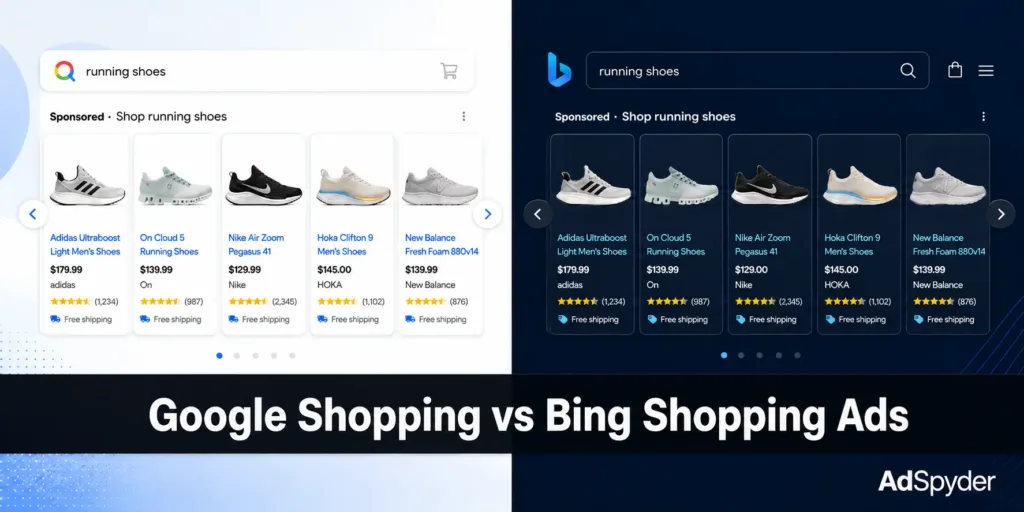
Quick Answer
Google Shopping dominates in scale — AdSpyder’s archive covers 94 million+ Google Shopping ads across 184 countries. Bing Shopping is a leaner, lower-competition channel best used as a supplement, not a replacement. For most e-commerce brands in 2026, the answer is Google first, then Bing once your feed is stable and converting. Use AdSpyder’s Shopping Ads Spy to see what competitors are running on both platforms before committing budget.
Every e-commerce brand eventually asks the same question: is Bing Shopping worth adding to the mix, or is Google Shopping the only game that matters? The honest answer in 2026 is more nuanced than most comparison posts admit.
This post breaks down the real differences — reach, audience, feed requirements, competition levels, and where the data points. It’s built on AdSpyder’s analysis of 94M+ Google Shopping ads and supplemented with early Bing Shopping data, so the platform comparisons are grounded in what advertisers are actually doing.
You won’t find a winner declared for every situation — because there isn’t one. What you will find is a clear framework for making the right call for your specific category, market, and budget.
In This Guide
The Market Reality in 2026
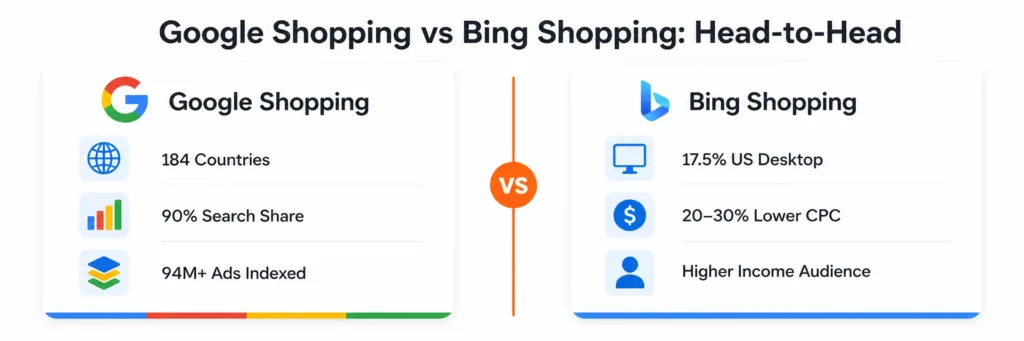
Google controls roughly 90% of global search. Bing sits at about 5% worldwide — but that number buries the more useful stat: Bing commands approximately 17.5% of US desktop search, and desktop is where considered purchases (electronics, appliances, home goods, software) still happen at scale.
Microsoft’s search and advertising revenue grew 21% year-over-year in FY2025, and continued growing in 2026. That’s not a declining platform — it’s a smaller one that consistently punches above its search-share weight in ad revenue, partly because its audience skews older, higher-income, and purchase-ready.
Sources: StatCounter/Backlinko (April 2026); Microsoft FY2025 earnings (SEC); Seoprofy Bing Ads Statistics 2026
Key context: 54% of Bing users visit the platform specifically for product research, and nearly half have household incomes in the top 25% (Microsoft Advertising data). If your products are in the $100–$500 range, you’re likely reaching a more qualified buyer on Bing than the raw search-share numbers suggest.
Google Shopping in 2026: What 94 Million Ads Tell Us
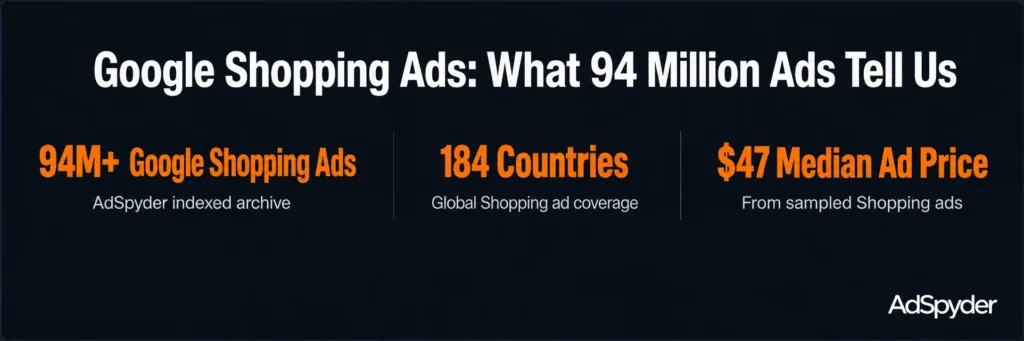
AdSpyder’s Google Shopping archive covers 94 million+ product ads across 184 countries spanning 2018 to 2026. Here’s what stands out for anyone planning campaigns today.
It’s a long-tail advertiser market
In a random 1,000-ad sample from AdSpyder’s archive, 63% of ads came from a distinct retailer domain. Google Shopping isn’t dominated by five or ten brands — it’s a long tail of thousands of retailers competing for carousel slots. For smaller e-commerce brands, that’s genuinely good news: you’re often competing with retailers of comparable size, not just Amazon.
The most frequently seen advertisers in AdSpyder’s sample include Amazon (across 7+ country storefronts), Mercado Libre, SHEIN, Etsy, eBay, AliExpress, Flipkart, Shopee, and Lazada — but they don’t crowd out the thousands of independent retailers also running campaigns.
Source: AdSpyder Google Shopping ads archive, 1,000-doc random sample, May 2026
Geographic reach: deep coverage in your key markets
If your target markets include the US, UK, India, Australia, or Canada, Google Shopping has deep archive coverage. Those five markets alone represent over 50% of AdSpyder’s Shopping index:
| Market | Google Shopping Ads (Archive) | Share |
|---|---|---|
| United States | 21M+ | 22.1% |
| United Kingdom | 10M+ | 10.7% |
| India | 6.1M+ | 6.4% |
| Australia | 4.7M+ | 4.9% |
| Canada | 4.2M+ | 4.4% |
Source: AdSpyder Google Shopping ads archive, May 2026
Price positioning: where most Google Shopping ads cluster
From a 1,000-doc random sample of the archive (773 with parseable prices), here’s the price distribution in USD-equivalent:
Source: AdSpyder Google Shopping archive, 1,000-doc random sample, May 2026
The median advertised price is $47 USD. More than half of all Shopping ads (52%) sit in the $10–$200 range. If your products are in this band, you’re in a crowded price tier where product title quality and image sharpness matter more than bid strategy alone. If you’re above $200, there’s less competition — but also less impulse-buy volume.
See What Competitors Are Running on Google Shopping
94 million+ Shopping ads. Search by domain, keyword, or market.
Bing Shopping in 2026: The Honest Picture
Most comparison posts treat Google and Bing Shopping as if they’re equal-scale channels being weighed side by side. They’re not, and pretending otherwise doesn’t help you make a better decision.
AdSpyder’s Bing Shopping dataset is an early-stage pilot of roughly 21,000 ads from a 2023 crawl, compared to 94 million on Google Shopping. Our larger Bing coverage is on Bing Search text ads (4.6M+ indexed) — a different ad type. The asymmetry in our data reflects the actual market: Google Shopping is the dominant product-ads surface; Bing Shopping is a real but smaller, growing channel.
That’s actually the strategic argument for Bing Shopping in 2026: fewer advertisers have made the move there. Less competition, lower CPCs, and an audience that’s disproportionately high-income and desktop-first.
The Bing Shopping audience profile
The CPC advantage — and where it doesn’t apply
AdSpyder’s Shopping archives don’t carry CPC data for either platform. What industry benchmarks consistently show is that CPCs on Bing ads run 20–30% lower than Google equivalents in most categories (Seoprofy, 2026). The reason is simple: fewer advertisers bidding on the same placements.
Lower CPC is only valuable if conversion rate holds. For higher-intent desktop searches in considered-purchase categories, it often does. For impulse-buy categories driven by mobile — sub-$30 fashion, food, beauty — the volume gap is harder to bridge.
Country coverage matters: Bing Shopping currently operates in fewer markets than Google, with active English-language support primarily in the US, UK, Canada, Australia, France, and Germany. If your primary markets are in India, Latin America, or Southeast Asia, Bing Shopping is not a realistic channel at scale right now.
Google Shopping vs Bing Shopping: Head-to-Head
| Factor | Google Shopping | Bing Shopping |
|---|---|---|
| Country reach | 184+ countries | US, UK, CA, AU, FR, DE — primarily |
| Search volume | Very high — 90%+ of global search | ~5% global, ~17.5% US desktop |
| Competition level | High in most categories | Lower — fewer advertisers running Shopping |
| Typical CPC | Higher on competitive terms | ~20–30% lower (industry benchmarks) |
| Audience | All demographics, mobile-heavy | Desktop-first, higher income, older, professional |
| Mobile traffic | Strong — majority of Google searches are mobile | Very limited (<1% Bing mobile share) |
| Feed complexity | High — 24+ required fields, strict approvals | Lower — 6 required fields, more lenient |
| Import from Google | N/A | Yes — Merchant Center direct import |
| Competitor intel (AdSpyder) | 94M+ ads, full archive | 4.6M+ Bing Search ads; Shopping is early-stage |
Feed Requirements: What Actually Differs
Getting a Google Shopping feed approved and optimized takes real time. Bing’s requirements are much lighter — and you can import your Google feed directly into Bing Merchant Center, making the marginal cost of expanding to Bing low once Google is already working.
| Requirement | Google Shopping | Bing Shopping |
|---|---|---|
| Required fields | 24 | 6 |
| Accepted formats | .txt, .xml | .txt, .xml, .zip, .gz, .gzip, .tar.gz, .tgz |
| Google import | — | Yes — direct Merchant Center import |
| Disapproval strictness | High — frequent automated suspensions | More lenient |
Practical implication: Get your Google Shopping feed fully optimized first. Once it’s stable and converting, the Bing Merchant Center import takes a few hours, not days. You’re doubling your placement coverage for a fraction of the operational effort — if your products are in Bing’s supported markets.
Who Wins Where: Platform Fit by Category and Market
The right answer depends on what you sell, who your buyers are, and where your Shopping program is today. Here’s a practical breakdown:
Don’t launch Bing Shopping yet if: Your Google Shopping feed has unresolved disapprovals, your target markets are outside Bing’s active country list, or your category is mobile-driven. Fix Google first — Bing on a broken foundation amplifies problems, not results.
How to Research Competitors on Both Platforms with AdSpyder
Before you finalize your platform decision or set your bids, you need to know what competitors are actually running — their titles, price points, and which markets they’re targeting. Here’s the workflow using AdSpyder’s Shopping Ads Spy:
Search by competitor domain on Google Shopping
Enter a competitor’s domain in AdSpyder’s Shopping Ads Spy with platform set to Google Shopping. You’ll see every product ad they’ve run, including titles, prices, and which countries they targeted. Pair this with URL & Domain Analysis to see their full ad footprint across platforms.
Analyze their price positioning by market
Look at what price points competitors advertise in each country. The median Google Shopping price in the US is around $45 — if your competitors cluster in the $30–$60 band and your product is $89, you need either a stronger title and image or a visible rationale for the premium in your description. The data tells you where the auction pricing battlefield actually is.
Check whether key competitors are absent from Bing
Run the same competitor domains through AdSpyder’s Bing Ads Spy. If a category leader isn’t running on Bing Shopping, that’s a carousel slot with no major-brand competition. You get the placement without facing the biggest players in the auction.
Build a competitor tracking project
Add your top 3–5 Shopping competitors to an AdSpyder project. You’ll get signals when they change titles, prices, or market targeting — before those shifts show up in your own ROAS data. AdSpyder users currently track 3,687+ competitors across 1,104 active projects (AdSpyder platform data, May 2026).
Run keyword research across both platforms
AdSpyder’s platform indexes 377 million+ keywords with competition metrics. Run your core product keywords through both Google and Bing competitive views. Higher Google search volume doesn’t automatically mean higher ROI — if Bing shows significantly less competition depth for the same keyword, it may be the more efficient channel for your margin target.
Platform Decision Checklist
Run through this before deciding where to invest Shopping budget in 2026:
See What Your Competitors Are Running on Google and Bing Shopping
AdSpyder’s Shopping Ads Spy covers 94M+ Google Shopping ads and Bing ad data — search by domain, keyword, or market to see who’s competing for your placements before you set your bids.
Frequently Asked Questions
Data sources: AdSpyder Google Shopping ads archive (94.99M ads, 2018–2026); AdSpyder Bing Shopping pilot dataset (~21,000 ads, 2023); AdSpyder platform usage telemetry (Aug 2023–Jul 2025). Google and Bing market share: StatCounter / Backlinko (April 2026). Microsoft Ads revenue: Microsoft FY2025 SEC filing. CPC benchmarks: Seoprofy Bing Ads Statistics 2026. Bing audience data: Microsoft Advertising. Feed requirements: Google Merchant Center Help / Bing Merchant Center documentation. All AdSpyder archive figures: AdSpyder platform data, May 2026.