AdSpyder Original
Quick Answer
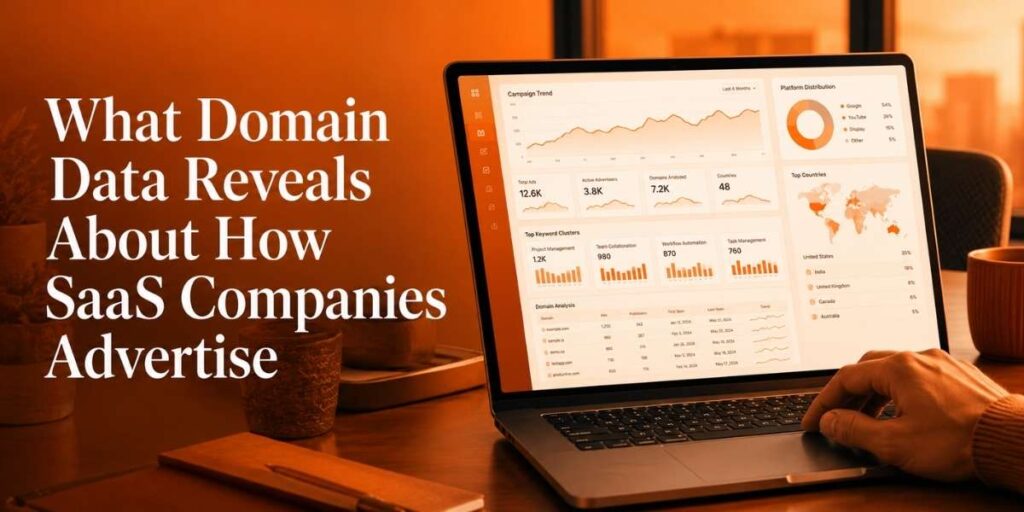
The clearest saas company advertising patterns from AdSpyder’s domain data are simple: SaaS brands concentrate heavily on Google Search, treat LinkedIn as the B2B anchor, and use Meta and YouTube as supporting channels. In AdSpyder’s 30-brand SaaS sample, 100% of brands appeared on Google Search, LinkedIn, and YouTube, while only 23.3% ran across 6+ platforms. Use AdSpyder’s Domain Analysis to check this pattern for any SaaS competitor.
Most SaaS advertising advice starts with channels: run Google Ads, test LinkedIn, build retargeting, launch YouTube, improve landing pages. Useful — but incomplete.
The real question is sharper: how do SaaS companies actually distribute ads across platforms, keywords, CTAs, and competitor domains?
For this AdSpyder Original analysis, we looked at a curated 30-brand SaaS sample across Google Search, LinkedIn, Meta, YouTube, and other platform archives. The finding is clear: SaaS does not advertise like D2C. SaaS goes narrower, deeper, and far more LinkedIn-heavy.
Important data note
AdSpyder does not currently maintain a full SaaS-domain classifier. This analysis uses a manually curated 30-brand SaaS sample plus full-index Google Search keyword theme counts. The dataset shows ad activity, platform presence, keyword themes, and domain patterns — not spend, CPC, CTR, ROAS, bid amounts, or conversion data.
In This Article
AdSpyder Original Data
SaaS Company Advertising Patterns Are Narrower Than D2C — But LinkedIn Changes Everything
The strongest signal from the data is not that SaaS brands use every major ad platform. They do not.
SaaS brands concentrate. Google Search captures active demand. LinkedIn reaches B2B buyers. Meta and YouTube support awareness, education, and remarketing. Amazon, Shopping, Bing, and Twitter/X barely matter for the SaaS sample.
30
SaaS brands sampled
Curated B2B, PLG, creator, edtech, AI, automation, and ecommerce SaaS mix.
100%
Google Search coverage
All 30 sampled SaaS brands appear on Google Search.
100%
LinkedIn coverage
Every sampled SaaS brand shows LinkedIn ad presence.
23.3%
On 6+ platforms
Only 7 of 30 SaaS brands appeared across 6 platforms.
Source: AdSpyder platform data, July 2026.
What this means in practice
If you are benchmarking SaaS competitors, do not begin with every possible platform. Start with Google Search and LinkedIn. For SaaS, those two channels explain most of the competitive signal.
Methodology: How AdSpyder Read SaaS Domain Data
AdSpyder analyzed a curated set of 30 SaaS brands across multiple platform archives. The sample includes B2B enterprise SaaS, PLG collaboration tools, creator/design software, ecommerce SaaS, automation tools, Indian SaaS, edtech, AI SaaS, and support platforms.
| Data point | Used in this report |
|---|---|
| SaaS sample size | 30 manually curated SaaS brands |
| Platform archives checked | Google Search, LinkedIn, Meta historical, Meta realtime, YouTube, Amazon, and other platform archives where available |
| Google Search keyword scope | 167,750,873 Google Search ads scanned for SaaS-native keyword themes |
| LinkedIn archive scope | 857,793 LinkedIn ads across 182 countries |
Important limitation
This is not a full SaaS-market census. AdSpyder does not currently have a complete SaaS classifier across every advertiser domain. The sample is useful for pattern analysis, platform comparison, and competitor benchmarking — not for claiming total SaaS ad spend or exact SaaS market share.
SaaS Platform Distribution: Google Search Leads, LinkedIn Defines the Category
Across the SaaS sample, platform use is highly consistent. Every sampled brand appears on Google Search, LinkedIn, and YouTube. Meta realtime is also common, with 28 of 30 brands active.
The surprise is not that SaaS uses Google. The surprise is how little some other platforms matter for SaaS compared with D2C.
| Platform / footprint | SaaS sample result | What it means |
|---|---|---|
| Google Search | 30 of 30 brands | Main demand-capture channel for SaaS |
| 30 of 30 brands | The clearest B2B SaaS differentiator | |
| YouTube | 30 of 30 brands | Useful for demos, tutorials, and education |
| Meta realtime | 28 of 30 brands | Supporting acquisition, launch, retargeting, and awareness |
| Amazon | 6 of 30 brands | Minor for SaaS, mostly edge cases |
| Twitter/X and Bing | 0 of 30 brands | No meaningful presence in this SaaS sample |
Source: AdSpyder platform data, July 2026.
SaaS platform rule
If your SaaS competitor is strong on Google Search but absent on LinkedIn, that is a strategic gap worth investigating. If they are absent on Amazon or Shopping, that is usually normal for SaaS.
Top SaaS Brands by Ad Volume in the Sample
The highest-volume SaaS brands in this sample are not all classic enterprise SaaS names. Edtech, design, creator tools, and ecommerce SaaS also show heavy Google Search activity.
The bigger pattern: Google Search accounts for 80–99% of ad volume across nearly every sampled SaaS brand. That makes search competitor analysis the best first step for SaaS ad research.
| Brand | Google Search ads | LinkedIn ads | Total ads in sample | Dominant channel |
|---|---|---|---|---|
| Udemy | 477,792 | 924 | 485,703 | Google Search 98% |
| Canva | 245,574 | 175 | 253,538 | Google Search 97% |
| Adobe | 210,017 | 2,553 | 217,020 | Google Search 97% |
| Grammarly | 187,942 | 610 | 190,608 | Google Search 99% |
| Shopify | 168,150 | 784 | 176,911 | Google Search 95% |
| Wix | 124,422 | 61 | 125,608 | Google Search 99% |
| Coursera | 83,785 | 72 | 85,678 | Google Search 98% |
| Miro | 76,713 | 176 | 78,842 | Google Search 97% |
| Salesforce | 38,413 | 3,089 | 41,687 | Highest LinkedIn share |
Source: AdSpyder platform data, July 2026.
What this means in practice
A SaaS brand can be massive on Google Search and still use LinkedIn strategically. Google Search shows demand capture. LinkedIn shows B2B buyer targeting. You need both views before judging a SaaS competitor’s ad strategy.
LinkedIn Is the SaaS Advertising Difference
The clearest line between SaaS and D2C advertising is LinkedIn. In the AdSpyder comparison, all 30 SaaS brands showed LinkedIn ad presence. Zero D2C brands did.
857,793
LinkedIn ads
Total ads in AdSpyder’s LinkedIn archive.
182
Countries
LinkedIn archive country coverage.
33.8%
United States
Top country by LinkedIn ad share.
22.6%
India
India ranks #2 in LinkedIn ad volume.
Source: AdSpyder LinkedIn archive, July 2026.
The top LinkedIn Saas company advertising patterns in the sample are Salesforce, Adobe, Atlassian, Udemy, Shopify, Zendesk, Grammarly, Slack, Freshworks, Asana, and HubSpot.
LinkedIn research rule
Use LinkedIn Ad Library when you want to understand SaaS positioning for decision-makers. Use Google Search when you want to understand active buyer demand.
SaaS Keyword Themes: Free Trial Beats Demo by Volume
SaaS keyword patterns split into two clear families: PLG-style offers and enterprise demo-led offers.
The PLG side is larger. “Free trial” alone appears in 1.33 million Google Search ads in AdSpyder’s archive.
| Keyword / CTA theme | Google Search ads | What it signals |
|---|---|---|
| free trial | 1,334,117 | Signature PLG acquisition signal |
| get started | 941,408 | Low-friction signup CTA |
| pricing | 920,718 | Commercial comparison and evaluation |
| demo | 695,686 | Enterprise demand generation |
| no credit card | 412,395 | Freemium trust signal |
| CRM | 275,856 | Category demand |
| automation | 260,042 | Workflow value proposition |
| book a demo / book demo | 48,235 | High-intent sales CTA |
Source: AdSpyder Google Search Ads archive, 167,750,873 ads scanned, July 2026.
The PLG vs enterprise split
PLG-style themes — free trial, no credit card, try free, start free, and sign up free — appeared in 2.08 million ads. Demo-style themes — demo, book demo, and watch demo — appeared in 758,881 ads. In this dataset, PLG CTAs outnumber demo CTAs by about 2.7x.
Use Google Ads Spy to inspect which CTA family your SaaS competitors use most often for your category keywords.
Domain Analysis
See how any SaaS competitor advertises across platforms.
AdSpyder’s Domain Analysis helps you check competitor ad presence, platform activity, keywords, landing pages, and domain-level advertising patterns from one place.
SaaS vs D2C: Same Performance Goal, Opposite Advertising Structure
D2C and SaaS both rely heavily on paid acquisition. But the platform logic is completely different.
D2C spreads wide because product discovery, shopping feeds, marketplaces, and visual creatives matter. SaaS narrows down because buyer intent, role, use case, and category keywords matter more.
| Metric | D2C pattern | SaaS pattern |
|---|---|---|
| Brands running on 6+ platforms | 50% | 23.3% |
| LinkedIn presence | 0% | 100% |
| Amazon presence | About 50% | 20% |
| Google Search share of total brand ad volume | 20–40% typical | 80–99% typical |
| Shopping fit | Universal in D2C sample | Rarely relevant for SaaS |
Source: AdSpyder platform data, July 2026.
The real takeaway
A D2C competitor audit should check Shopping, Meta, YouTube, Amazon, and product feeds. A SaaS competitor audit should start with Google Search intent, LinkedIn positioning, demo/free-trial CTAs, and landing page paths.
SaaS Category Patterns: Not Every SaaS Brand Advertises the Same Way
The core stack is similar across SaaS, but the channel role changes by category.
| SaaS category | Brands in sample | Typical advertising pattern |
|---|---|---|
| Enterprise B2B | Salesforce, HubSpot, Atlassian, Zendesk, Freshworks, Zoho | Google Search + LinkedIn heavy, smaller Meta presence |
| Collaboration / PLG | Slack, Notion, Airtable, Asana, Monday.com, ClickUp, Miro, Zoom | Google Search dominant, Meta realtime for acquisition, LinkedIn for enterprise deals |
| Design / creator SaaS | Canva, Adobe, Figma, Webflow, Squarespace, Wix, Grammarly, Loom | Very heavy Google Search, YouTube for tutorials and demos |
| EdTech SaaS | Udemy, Coursera | Massive Google Search activity, moderate Meta realtime |
| Marketing / SEO SaaS | Mailchimp, Semrush | Google Search dominant, LinkedIn moderate, Meta realtime for lead generation |
| AI SaaS | ChatGPT | Meta realtime dominant in this sample, unlike most legacy SaaS brands |
Source: AdSpyder platform data, July 2026.
This is why “best SaaS ad strategy” is too broad. A CRM brand, an AI app, a design tool, and an edtech platform can all be SaaS — but their platform mix should not be identical.
How to Research SaaS Competitor Advertising Using AdSpyder
Instead of copying generic SaaS ad examples, use competitor domain data to understand which channels, messages, and landing pages are actually active in your market.
Start with competitor domains
Open URL & Domain Analysis and search 3–5 direct SaaS competitors. A direct domain view is cleaner than starting with broad industry keywords.
Check Google Search and LinkedIn first
For SaaS, Google Search reveals active buyer intent. LinkedIn reveals B2B positioning. If you skip either one, your competitor analysis is incomplete.
Group ads by CTA family
Separate free trial, no credit card, get started, pricing, demo, book a demo, and watch demo messages. This shows whether competitors are pushing PLG signup or sales-led pipeline.
Compare ad copy with landing pages
Use Landing Page Analysis to check whether ads send traffic to pricing pages, demo pages, feature pages, comparison pages, integration pages, or free-trial pages.
Build controlled tests from the patterns
Do not copy ads directly. Turn the patterns into tests: one CTA family, one keyword theme, one landing page type, and one channel at a time.
Manual SaaS Ad Research vs AdSpyder
Manual research can show a few live ads. It usually cannot show domain-level platform patterns, historical coverage, keyword themes, or cross-platform competitor movement.
| Task | Manual research | With AdSpyder |
|---|---|---|
| Find SaaS competitor ads | Platform-by-platform checks | Search by domain, keyword, platform, country, and date |
| Compare Google and LinkedIn | Separate workflows, inconsistent visibility | Use Google Ads Spy and LinkedIn Ad Library together |
| Track CTA themes | Manual screenshots and notes | Review free trial, pricing, demo, and competitor keyword patterns at scale |
| Connect ads to landing pages | Click and record page paths manually | Use domain and landing page analysis to review destination patterns faster |
SaaS Competitor Ad Research Checklist
✓ Have you checked at least 3–5 direct SaaS competitor domains?
✓ Have you reviewed Google Search ads before judging the full strategy?
✓ Have you checked LinkedIn ad presence and B2B positioning?
✓ Have you separated PLG CTAs from demo-led enterprise CTAs?
✓ Have you grouped keyword themes like free trial, pricing, demo, CRM, automation, AI, analytics, and project management?
✓ Have you checked whether ad traffic goes to demo, pricing, feature, comparison, integration, or free-trial pages?
✓ Have you avoided using D2C platform logic for SaaS?
✓ Have you turned competitor patterns into controlled campaign tests?
Stop guessing how SaaS competitors advertise.
AdSpyder’s Domain Analysis shows competitor ad activity across Google Search, LinkedIn, Meta, YouTube, and more — so your SaaS ad strategy is based on real domain-level signals, not generic advice.
Try AdSpyder Domain Analysis Free
Also covers: Google Ads · LinkedIn · Facebook · YouTube · Display and more
FAQ: SaaS Company Advertising Patterns
What are the main SaaS company advertising patterns?
The main SaaS advertising pattern is narrow, deep platform focus. In AdSpyder’s 30-brand sample, all brands appeared on Google Search, LinkedIn, and YouTube, while Google Search accounted for most ad volume across nearly every brand.
Which platform matters most for Saas company advertising patterns?
Google Search dominates SaaS ad volume, but LinkedIn is the strongest B2B differentiator. Google captures high-intent searches, while LinkedIn helps SaaS brands reach buyers by role, seniority, company type, and business context.
How are SaaS ads different from D2C ads?
D2C brands spread wider across Shopping, Amazon, Meta, YouTube, and product-discovery channels. SaaS brands concentrate more heavily on Google Search and LinkedIn because software buyers search by problem, category, feature, pricing, and role.
What SaaS CTA appears most often in Google Search ads?
“Free trial” is the largest SaaS-native CTA theme in AdSpyder’s Google Search archive, appearing in 1.33 million ads. The broader PLG CTA cluster outnumbers the demo CTA cluster by about 2.7x.
Does AdSpyder have a full SaaS-domain classifier?
No. This report uses a manually curated 30-brand SaaS sample plus full-index Google Search keyword theme counts. A complete SaaS-domain classifier would require a separate structured category layer.
Why is LinkedIn so important for SaaS advertising?
LinkedIn matches the SaaS buying process better than most consumer channels. SaaS buying often depends on job role, team size, industry, seniority, department, and company type — all signals that matter more in B2B than in D2C.
How can I check my SaaS competitors’ ad strategy?
Use AdSpyder’s URL & Domain Analysis to enter a competitor domain, check platform presence, inspect Google Search and LinkedIn ads, review keyword themes, and compare ad copy with landing pages.
Sources and Methodology
- AdSpyder platform data, July 2026.
- 30-brand curated SaaS sample across B2B enterprise, PLG/collaboration, creator/design, ecommerce SaaS, automation, Indian SaaS, edtech, AI SaaS, and support software.
- AdSpyder Google Search Ads archive: 167,750,873 ads scanned for SaaS-native keyword themes.
- AdSpyder LinkedIn archive: 857,793 ads across 182 countries.
- This analysis does not include spend, CPC, CTR, ROAS, conversions, impression share, or bid amounts.