Cost · Speed · Control · Attribution
Quick Answer
- Paid ads win on speed: campaigns can generate measurable traffic soon after launch.
- AI search wins on compounding visibility: useful pages can influence discovery without paying for every visit.
- Paid ads provide stronger control over targeting, budgets, offers, and landing pages.
- AI search attribution is less predictable because citations and referrals do not always create trackable visits.
- The strongest strategy uses both. See AdSpyder’s AI search advertising guide for current sponsored AI-search formats.
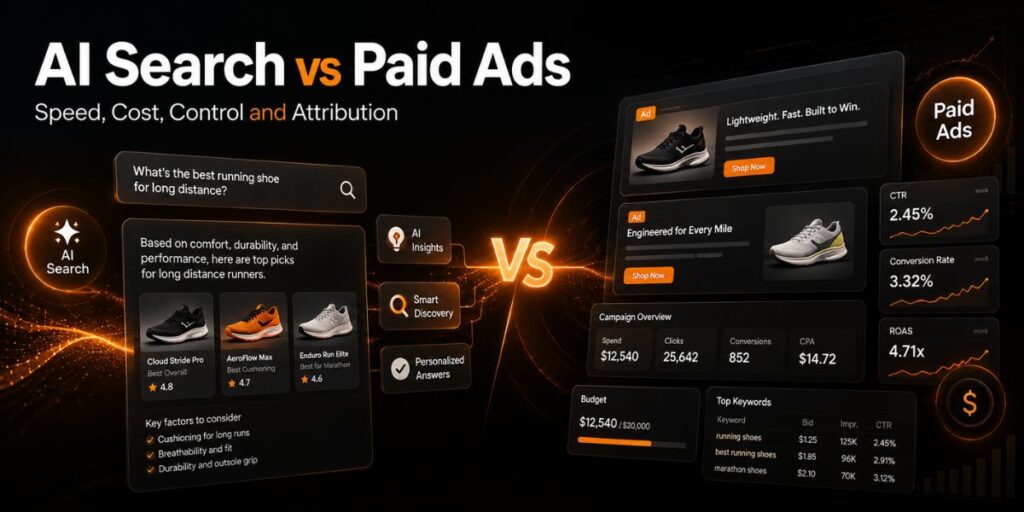
AI search vs paid ads is not an either-or decision. AI search helps brands become discoverable when people ask ChatGPT, Gemini, Perplexity or AI-powered Google questions, while paid advertising buys immediate access to selected audiences and commercial intent. The right mix depends on how quickly you need results, how much control you need and how accurately you must attribute revenue.
AI Search vs Paid Ads: Quick Comparison
| Factor | AI Search | Paid Ads | Winner |
|---|---|---|---|
| Speed | Usually builds gradually | Traffic can begin after campaign approval | Paid Ads |
| Media cost | No direct charge for an organic citation | Requires CPC, CPM or other paid budget | AI Search |
| Control | No guaranteed citation or position | Strong budget, creative and targeting controls | Paid Ads |
| Attribution | Referral and assisted attribution can be incomplete | Click IDs, UTMs and conversion tracking are stronger | Paid Ads |
| Long-term value | Useful content can keep earning discovery | Delivery normally falls when spend stops | AI Search |
| Best role | Research, education and discovery | Demand capture, offers and conversion | Use Both |
What Do AI Search and Paid Ads Actually Mean?
AI Search
Organic discovery inside ChatGPT, Gemini, Perplexity, Google AI Overviews, AI Mode and similar answer-led experiences.
Brands improve visibility through useful content, clear entities, credible sources, product information and pages that directly answer buyer questions.
Paid Ads
Sponsored placements purchased through platforms such as Google, Meta, Microsoft, LinkedIn, TikTok and emerging AI ad platforms.
AI now supports targeting, bidding and creative production inside paid advertising. AdSpyder’s 2026 AI advertising guide explains this broader shift.
Important distinction: AI search itself is not always organic anymore. Google can place ads inside or around AI Overviews, and ChatGPT is piloting clearly labelled sponsored placements. Organic AI visibility and AI search advertising should therefore be measured separately.
What Changed in AI Search Advertising in 2026?
Platform information verified in August 2026.
200+
AI Overview markets
Ads can appear above or below AI Overviews
12
Countries
Google currently supports ads inside AI Overviews in English in selected markets
CPC
ChatGPT buying added
OpenAI introduced CPC bidding during its 2026 ads pilot
Beta
Self-serve Ads Manager
OpenAI is expanding how advertisers can buy ChatGPT placements
For marketers preparing for conversational placements, AdSpyder’s ChatGPT Ads readiness checklist covers proof, landing pages, tracking and creative preparation.
Cost, Speed, Control and Attribution
1. Cost: AI search is not free
Organic AI visibility has no CPC, but content research, expert input, technical improvements, digital PR, authority building and measurement still cost money. Paid advertising makes the media cost visible immediately because every campaign has a defined budget.
2. Speed: paid ads create the faster test
A paid campaign can test an offer, keyword or landing page quickly. AI search visibility is less predictable because the brand must first become a useful source or recommendation for relevant questions.
3. Control: paid media offers more levers
Advertisers can set budgets, locations, audiences, creative, exclusions and conversion goals. Organic AI systems decide whether a source is useful enough to mention or cite. There is no bid that guarantees an organic recommendation.
4. Attribution: paid campaigns are easier to connect to revenue
Paid platforms provide mature conversion-tracking infrastructure. AI referrals can appear from ChatGPT, Gemini or Perplexity, but some visits lose referral information or convert through later branded searches. Keep AI referral, assisted conversion and CRM source data separate.
When Should You Use Each Channel?
| Situation | Best Starting Point | Why |
|---|---|---|
| Launching a new offer | Paid Ads | Test demand and messaging quickly. |
| Building category authority | AI Search | Create useful resources around recurring buyer questions. |
| High-intent lead generation | Paid Ads | Control the offer, destination and conversion goal. |
| Comparison research | AI Search | Buyers increasingly use AI for recommendations and evaluation. |
| Sustainable full-funnel growth | Both | Organic discovery creates demand while paid media captures and retargets it. |
Why AI Search and Paid Ads Work Better Together
1 · DISCOVER
Map buyer questions
2 · PUBLISH
Build useful pages
3 · TEST
Validate with paid ads
4 · LEARN
Find converting messages
5 · SCALE
Reinvest in winners
Paid campaigns can reveal which offers, comparisons and customer problems create commercial action. Those findings can improve future AI-search content. Meanwhile, AI search can expose new questions and comparison themes worth testing through paid campaigns. This creates a shared learning loop rather than two disconnected marketing plans.
Simple Decision Framework
Start with paid ads when:
- You need leads or sales this month.
- You already have a validated offer and conversion page.
- You need precise geographic or audience control.
- You need reliable campaign-level attribution.
Invest aggressively in AI search when:
- Buyers research extensively before contacting you.
- Your category contains comparison and educational questions.
- Your team can publish expert, evidence-backed resources.
- You want visibility that can continue without paying for every visit.
For most established businesses: use paid ads for immediate demand capture while building AI-search visibility as a compounding acquisition layer.
How AdSpyder Supports the Combined Strategy
AdSpyder is most useful on the paid and competitive-intelligence side of this workflow. It does not replace your AI-search optimization or analytics stack; it helps answer what competitors advertise, which offers they repeat and where they send commercial traffic.
Ad Analytics
Compare competitor platforms, keywords, campaign activity and funnel positioning.
Ad Library
Study real creative, offers and CTAs across established paid channels.
ChatGPT Ad Research
Prepare for conversational paid placements as AI-search advertising expands.
Start with AdSpyder Ad Analytics to identify paid-market activity, then use the cross-platform Ad Library to compare creative and landing-page patterns.
For emerging conversational advertising, the AdSpyder ChatGPT Ad Library is currently marked Coming Soon. Use the page for early-access updates rather than treating it as a fully launched archive today.
Use AI search for discovery and paid intelligence for faster testing
Study competitor ads, offers and landing pages before deciding which messages deserve paid budget.
FAQs for AI Search vs Paid Ads
Neither wins universally. AI search is stronger for compounding discovery, while paid ads provide faster traffic, more control and stronger attribution.
Organic AI citations do not charge per click, but producing credible content, research, technical improvements and authority requires investment.
There is no guaranteed timeline. Visibility depends on the topic, authority, content quality and how AI systems select sources.
Yes. Google supports ads around and, in selected markets, within AI Overviews. ChatGPT is also running a sponsored-ad pilot.
Paid advertising generally has stronger campaign attribution through click IDs, UTMs, conversion tags and CRM imports.
Yes, when budget allows. Use paid campaigns to validate offers quickly and build AI-search content around questions that matter throughout the buying journey.