Research · Creative · Landing Pages · Campaign Planning
Quick Answer
- Use a ChatGPT ad library to find observable competitor ads by brand, keyword, niche or market.
- Do not analyze only the headline. Record the offer, benefit, creative, CTA, landing page and audience problem each ad appears to address.
- Shortlist recurring patterns rather than copying one competitor creative.
- Inspect the landing page behind the ad to understand whether the message continues consistently after the click.
- Turn repeated competitor patterns into a gap your own campaign can fill.
- Use AdSpyder’s ChatGPT Ad Library to research ads, creatives and destination pages before building an original ChatGPT campaign.
Competitor research for ChatGPT Ads requires a different mindset from traditional search advertising. On Google, marketers often begin with keywords. In ChatGPT, the advertising opportunity is more conversational: people are comparing options, explaining constraints and working toward decisions.
That means the useful question is not simply “Which keyword is my competitor buying?” It is “What problem is this ad responding to, what value does it promise, and where does the click take the user next?”
Why This Matters Now
ChatGPT Ads expanded rapidly in 2026. The format now gives advertisers a new place to appear while users explore options, compare alternatives and make decisions. That creates a new competitive-research layer alongside Google, Meta, LinkedIn and other established ad channels.
First, Understand What a ChatGPT Ad Contains
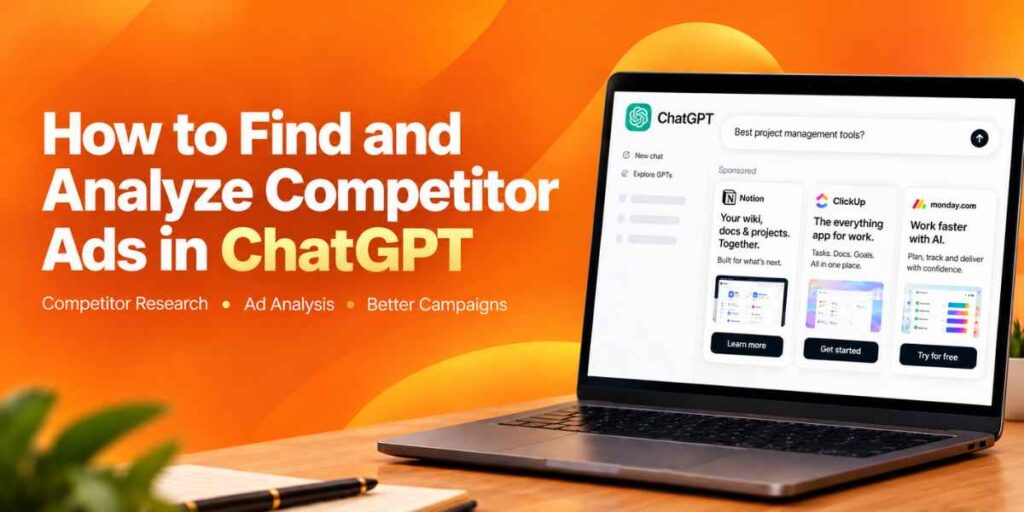
OpenAI’s current ad format can include an advertiser name, favicon, headline, description, landing page and image creative. Ads appear separately from ChatGPT’s answer and are clearly identified as advertising.
Message
Headline, supporting copy, benefit and reason to click.
Creative
Image and visual framing supporting the offer.
Destination
The landing page where the advertiser continues the conversation.
This is why AdSpyder’s broader multi-platform Ad Library is useful when you want to compare the same brand’s ChatGPT approach with Google, Meta, LinkedIn or other channels.
Set the Research Goal Before Opening the Library
Do not begin by scrolling through hundreds of ads. Decide what you need to learn.
- Which competitors are already appearing in ChatGPT?
- Which customer problems do they lead with?
- Are they promoting products, trials, consultations or educational content?
- Which benefits repeatedly appear in their copy?
- What creative style do they use?
- What page does each ad send traffic to?
- Where does the market look repetitive?
A focused question turns ad browsing into competitive intelligence.
Step 1: Find Relevant Competitors in AdSpyder
Open AdSpyder’s ChatGPT Ad Library and begin with one of three search approaches:
| Search Type | Example | Use It For |
|---|---|---|
| Brand | Known competitor | Direct competitor research |
| Keyword | CRM software | Discover brands around a problem/category |
| Niche | B2B accounting | Broader market-pattern research |
Start with 3–5 direct competitors. If the dataset is small, expand into adjacent category leaders rather than immediately widening the search to unrelated businesses.
Step 2: Filter and Shortlist the Ads Worth Studying
The goal is not to save every ad. You want a research sample that represents different strategies.
Useful filters may include brand, category, creative type, date, market, CTA, landing page or other available AdSpyder fields. Data availability can differ depending on the ad and market.
Build a Balanced Shortlist
Save 2–3 ads with similar positioning, 2–3 with different offers and at least one outlier. The outlier often reveals the most interesting differentiation opportunity.
Step 3: Break Down the Message Instead of Judging the Ad Visually
A competitor ad can look attractive and still teach you very little unless you deconstruct it.
| Element | Question to Ask |
|---|---|
| Problem | What user problem is the ad responding to? |
| Promise | What outcome is promised? |
| Proof | Does it use pricing, ratings, proof points or specificity? |
| Offer | Trial, discount, demo, quote, guide or direct purchase? |
| CTA | What action does the advertiser want now? |
OpenAI’s own current creative guidance emphasizes clear, specific and benefit-focused ad copy rather than generic slogans. That makes competitor benefit framing particularly valuable to benchmark.
Step 4: Analyze the Creative as an Information Device
Instead of asking “Do I like this design?”, ask what the image contributes.
- Does it show the product or an abstract lifestyle image?
- Does it visualize the result promised in the headline?
- Is proof visible immediately?
- Does the visual make sense without reading every word?
- Does the competitor rely on product UI, people, objects or typography?
- Which visual patterns appear repeatedly across several advertisers?
Repeated visual patterns are useful as category signals—but they are also opportunities to look different.
Step 5: Inspect the Landing Page Behind Every Important Ad
The ad gives you the promise. The landing page tells you how the competitor tries to convert that promise into action.
Record:
- Hero headline
- Primary CTA
- Offer continuity
- Price or trial terms
- Proof and testimonials
- Form length
- Product screenshots
- FAQ / objection handling
For deeper post-click research, combine the library with AdSpyder’s Landing Page Analysis rather than studying the ad in isolation.
Look for Ad-to-Landing-Page Message Match
This is one of the easiest competitive advantages to miss.
Example
Ad: “Launch a professional online store this weekend.”
Landing page: Generic homepage saying “Build your business.”
Gap: The specific promise disappeared after the click.
If competitors consistently create this mismatch, your own campaign can gain clarity simply by continuing the same promise from ad to landing page.
Step 6: Save Patterns—Not Ads to Copy
Create a small research sheet with one row per ad:
| Brand | Problem | Offer | Proof | CTA |
|---|---|---|---|---|
| Competitor A | Too much admin | Free trial | Time saved | Start free |
| Competitor B | High cost | Discount | Pricing | Compare plans |
| Competitor C | Complex setup | Demo | Implementation | Book demo |
When the same promise appears repeatedly, ask whether the category has validated an important customer need—or whether everyone is now saying the same thing.
Step 7: Turn Competitor Research Into an Original Campaign
The goal of competitive intelligence is not imitation. It is reducing blind spots before you create something distinct.
Keep
The customer problem that repeatedly appears across credible competitors.
Challenge
The generic promise everyone uses without enough proof.
Add
Your own evidence, offer, positioning or product advantage.
Simple Differentiation Formula
Shared customer problem + underused proof + distinct offer + message-matched landing page.
What Competitor ChatGPT Ad Research Cannot Tell You
Do not turn observable advertising into claims about private data or confirmed performance.
- You cannot see competitors’ private ChatGPT conversations.
- You cannot see users’ personal information.
- You should not assume one visible ad is the advertiser’s highest-performing creative.
- Ad visibility does not reveal exact profitability unless trustworthy performance data is provided.
- You cannot infer a competitor’s complete targeting strategy from one ad.
- Third-party “prompt” or intent labels should not be treated as access to private user conversations.
OpenAI states that advertisers receive aggregate ad-performance information rather than access to people’s private chats. Competitive research should stay focused on observable ads and public destination pages.
Common ChatGPT Ad Research Mistakes
- Copying one competitor ad. Study several advertisers before deciding what is a genuine pattern.
- Ignoring the landing page. The post-click experience often reveals more strategy than the ad.
- Looking only at visuals. Deconstruct problem, promise, proof, offer and CTA.
- Assuming keyword logic works exactly like search ads. ChatGPT ad relevance is built around richer conversational context.
- Treating ad duration as guaranteed proof of success. It can be a directional signal, not confirmed ROAS.
- Recreating competitor wording too closely. Use patterns for strategy, not plagiarism.
AdSpyder ChatGPT Ad Research Checklist
☐ Define the competitive-research question
☐ Select 3–5 direct competitors
☐ Search brand, keyword and niche variations
☐ Filter the results to a useful sample
☐ Save different messaging approaches
☐ Record the problem each ad addresses
☐ Record the main benefit / promise
☐ Record proof and offer
☐ Analyze creative structure
☐ Open the destination page
☐ Check ad-to-page message match
☐ Group repeated competitor patterns
☐ Find overused claims
☐ Identify an underused angle
☐ Build an original creative brief
☐ Track your own campaign results after launch
See how competitors are approaching ChatGPT Ads
Research observable competitor messaging, creative and landing pages, then turn recurring patterns into a campaign that is clearly your own.
Frequently Asked Questions
Is there a ChatGPT ad library?
AdSpyder currently provides a ChatGPT-focused ad intelligence library for researching observable ads, creative approaches and landing pages.
Can I find competitor ads running in ChatGPT?
Competitor-ad intelligence tools can surface observable ChatGPT advertising data where available. Coverage can vary by advertiser, geography and the data available to the platform.
What should I analyze in a competitor ChatGPT ad?
Study the customer problem, benefit, proof, offer, CTA, creative style and landing page. Patterns across several ads are more useful than one isolated example.
Are ChatGPT ads based only on keywords?
No. OpenAI describes ChatGPT Ads as using conversational intent and other permitted relevance signals, making them different from traditional keyword-only advertising.
Can advertisers see ChatGPT conversations?
No. OpenAI states that advertisers do not receive access to people’s private conversations, chat history or personal details.
How should I use competitor ads without copying them?
Extract strategic patterns—customer problem, proof, offer and CTA—then combine them with your own product strengths, evidence and positioning to create an original campaign.