Ads · Landing Pages · CRM · Follow-Up · Sales
Quick Answer
- AI lead nurturing uses lead data, behavior and engagement signals to decide what follow-up should happen, when it should happen and when a human salesperson should take over.
- The nurture sequence should continue the same promise that generated the ad click instead of resetting the conversation after form submission.
- Use AI to prioritize, summarize and personalize—but keep transparent scoring rules and human review for high-value leads.
- Differentiate high-intent actions such as pricing views and demo requests from low-intent actions such as reading one blog post.
- Measure qualified conversations, opportunities and revenue—not email opens alone.
- Use AdSpyder Landing Page Analysis to study how competitors connect ad promises, offers, CTAs and post-click pages before building your own nurture flow.
A person clicks an ad promising “Cut reporting time by 50%,” fills out a form—and receives a generic email saying, “Thanks for your interest in our company.” The lead may technically be captured, but the conversation has already lost momentum.
AI lead nurturing works best when it preserves context. The ad creates an expectation. The landing page develops it. The CRM stores what the prospect did. AI helps determine the next useful action. Sales enters when the lead is ready for a real conversation.
What Is AI Lead Nurturing?
AI lead nurturing is the use of artificial intelligence and automation to prioritize leads, interpret engagement signals, personalize follow-up and route prospects toward the most appropriate next step.
The Nurturing Chain
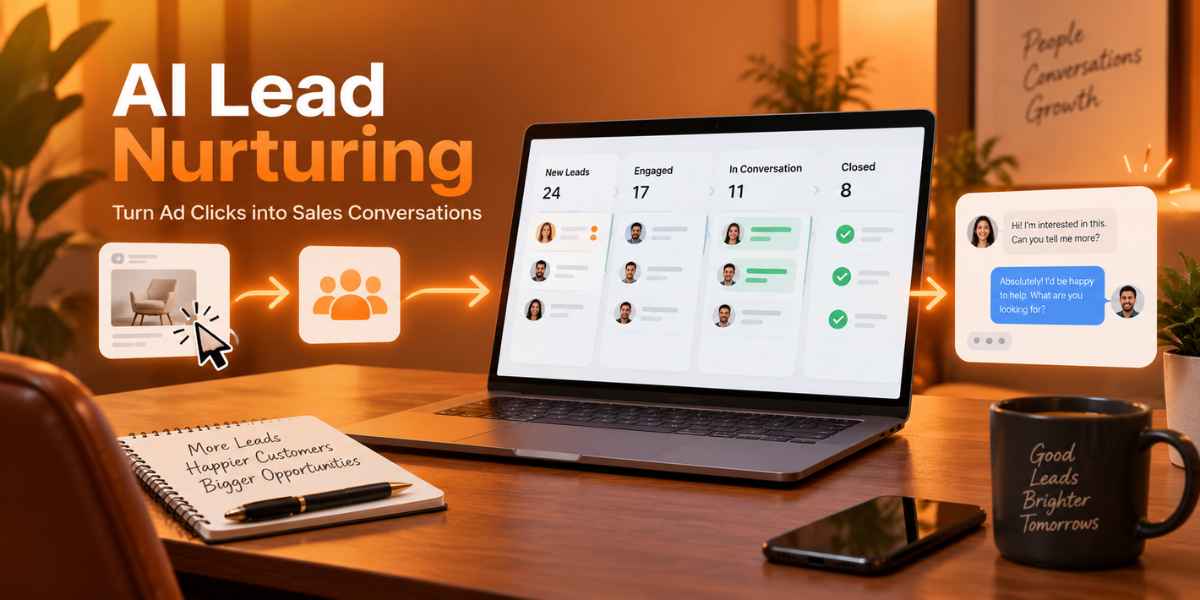
Ad Promise → Landing Page → Lead Capture → Intent Signals → AI Nurture → Sales Conversation → Opportunity
The AI layer should improve timing and relevance. It should not turn every new contact into a ten-email sequence regardless of what they actually did.
The 6-Step AI Lead Nurturing Framework
1. Preserve the Original Campaign Promise
The nurture journey begins before the lead exists. Record the ad, offer, landing page, campaign and CTA that created the conversion.
If the ad says “See how agencies cut reporting time”, the first follow-up should continue that subject—not suddenly introduce every feature your product offers.
Context to Store
Ad campaign · creative/offer · landing page · source · keyword/audience where available · form submitted · first important action.
2. Separate Fit From Intent
A large company can fit your ideal customer profile but have no current buying intent. A smaller company may urgently need your solution today.
| Signal Type | Examples |
|---|---|
| Fit | Company size, industry, role, region, use case |
| Intent | Pricing view, demo request, return visit, comparison page, trial start |
3. Let AI Prioritize Signals—Not Invent Them
AI can summarize activity and help rank leads, but the underlying score should be based on observable behavior and CRM data.
High Intent
Demo requested · pricing revisited · trial started · sales reply
Medium Intent
Case study viewed · webinar attended · multiple return visits
Low Intent
Single article view · generic newsletter signup
4. Personalize the Next Step, Not Just the First Name
“Hi Sarah” is not meaningful personalization. Useful personalization changes the content based on why the lead converted.
| Lead Action | Better Follow-Up |
|---|---|
| Downloaded PPC guide | Related audit template + campaign example |
| Viewed pricing twice | Plan comparison + sales availability |
| Started trial | Activation help around the feature they explored |
| Requested demo | Human follow-up with captured campaign context |
5. Define the Human Handoff Before Automating
One of the most important design decisions is deciding when automation should stop.
Current AI lead-nurturing guidance increasingly emphasizes clean CRM data, transparent scoring and clear boundaries between AI and human sales interactions. High-intent prospects should not be trapped inside an automated sequence when a salesperson should be talking to them.
Possible Human-Handoff Triggers
Demo request · pricing interaction + good fit · reply with buying question · high-intent return visit · trial activation milestone · explicit request for a call.
6. Use Remarketing as Part of the Nurture System
Not every follow-up needs to arrive by email. Leads who are still researching may respond better to supporting ads that continue the same topic.
A pricing-page visitor might see a comparison or proof-focused ad. A lead who downloaded educational content might see a case study rather than an immediate “Book Demo” message. The objective is continuity—not following the prospect everywhere with the same creative.
Example: From Ad Click to Sales Conversation
Ad: “See how ecommerce teams reduce abandoned carts.”
Landing page: Cart-recovery case study + calculator.
Lead: Downloads calculator.
AI nurture: Sends cart-recovery benchmark and related customer example.
Intent signal: Lead visits pricing and integration pages.
Handoff: Sales receives context and starts a conversation around cart recovery—not a generic product pitch.
AI Lead Nurturing Use Cases
B2B SaaS
Score demo intent, summarize website activity and route high-fit leads to sales.
Agencies
Nurture audit requests with relevant case studies before consultation calls.
High-Ticket Services
Educate longer-cycle prospects while escalating direct buying signals.
Product-Led Growth
Use product actions to trigger onboarding help and sales assistance when needed.
Metrics That Show Whether AI Nurturing Is Working
Do not judge nurture performance only through opens and clicks. Measure progression.
| Metric | What It Reveals |
|---|---|
| Lead response time | How quickly meaningful follow-up begins |
| Lead → qualified rate | Whether nurturing improves lead quality progression |
| Qualified → meeting rate | Whether sales conversations actually happen |
| Time to opportunity | Whether qualified prospects progress faster |
| Revenue by nurture path | Which sequences generate real commercial value |
Response-Time Benchmark
For high-intent inbound leads, many revenue teams target rapid follow-up rather than waiting hours or days. HubSpot’s current guidance specifically recommends reducing lead response time to under 30 minutes where the sales model supports it. Treat that as an operational benchmark—not a universal rule.
What Does AI Lead Nurturing Actually Cost?
There is no useful universal “cost per nurtured lead” benchmark because the cost depends on your CRM, automation platform, AI usage, sales model and lead volume.
A better calculation is:
Nurturing Cost ÷ Qualified Opportunities Created
If automation saves administrative time but produces more unqualified meetings, it has not made the funnel more efficient.
How AdSpyder Improves the Nurturing Workflow
AdSpyder does not replace your CRM or send nurture sequences. Its role comes earlier: helping you understand the advertising promises and post-click experiences buyers are already seeing.
AdSpyder’s Landing Page Analysis links ads with post-click destinations, screenshots, messaging, CTAs and historical page versions. That helps you study how competitors continue—or break—the promise made before the click.
Competitor-to-Nurture Workflow
1. Find competitor ads around your target audience.
2. Record the promise, problem, offer and CTA.
3. Open the competitor landing page.
4. Compare message match, proof, form friction and objections.
5. Identify gaps or overused messaging.
6. Build your own ad → page → nurture narrative around a clearer value proposition.
The recent competitor landing-page workflow is useful here because nurture quality begins with message match before a lead ever reaches your CRM.
For wider funnel research, use AdSpyder’s AI lead generation workflow to map competitor ads, offers, forms and visible funnel gaps before planning your own nurturing logic.
Common AI Lead Nurturing Mistakes
- Using the same sequence for every lead. A demo request should not receive the same path as a newsletter signup.
- Breaking message continuity. Follow-up ignores the offer that originally generated interest.
- Scoring engagement without fit. Heavy browsing from the wrong customer profile can waste sales time.
- Scoring fit without intent. A perfect account that shows no buying behavior may not need immediate sales outreach.
- Automating the human moment. High-intent leads stay trapped inside email sequences.
- Optimizing for opens and clicks. Engagement is useful only when it moves leads toward qualified conversations.
- Using messy CRM data. AI cannot reliably personalize or prioritize when industries, roles, sources and lifecycle stages are inconsistent.
AI Lead Nurturing Checklist
☐ Ad promise stored with the lead
☐ Landing-page source captured
☐ Fit criteria documented
☐ Intent signals documented
☐ High / medium / low intent separated
☐ AI scoring logic is explainable
☐ Nurture paths vary by lead behavior
☐ Follow-up continues the original campaign promise
☐ Human-handoff rules defined
☐ High-intent lead response time measured
☐ Remarketing supports the nurture journey
☐ CRM lifecycle stages are clean
☐ Qualified-lead rate tracked
☐ Meetings and opportunities tracked
☐ Revenue tied back to nurture path
Build the nurture journey before automating it
Research competitor ads and landing pages, identify message gaps, then create a clearer ad-to-page-to-sales journey around your own offer.
Frequently Asked Questions
What is AI lead nurturing?
AI lead nurturing uses behavioral, CRM and engagement data to prioritize leads, personalize follow-up and decide when prospects should move into a human sales conversation.
How is AI lead nurturing different from lead generation?
Lead generation creates or captures demand. Lead nurturing develops that interest after the lead enters your funnel and helps move qualified prospects toward a buying conversation.
What data should AI use to nurture leads?
Useful inputs include campaign source, offer, landing page, firmographic fit, website behavior, form responses, CRM history and prior sales engagement.
Should AI automatically contact every lead?
No. Automation should reflect lead intent and lifecycle stage. High-intent prospects may require immediate human follow-up instead of another automated message.
What are the best metrics for AI lead nurturing?
Track response time, lead-to-qualified rate, qualified-to-meeting rate, opportunity creation, time to opportunity and revenue by nurture path.
How does AdSpyder help with AI lead nurturing?
AdSpyder strengthens the research layer by showing observable competitor ads, offers and landing pages. Your CRM and automation platform still handle your first-party nurturing, lead scoring and sales handoff.