Lead Quality · CPL · Tracking · Conversion
Quick Answer
- Lead form ads usually win when speed, low friction, and lead volume matter most.
- Landing pages usually win when buyers need proof, comparison, qualification, or more information before submitting.
- Low-ticket and simple offers can perform well with in-platform forms.
- High-value B2B, demos, quotes, and longer sales cycles usually benefit from a stronger landing-page experience.
- Judge performance by qualified opportunities, meetings, and revenue rather than cost per lead alone.
- Use AdSpyder Landing Page Analysis to study how competitors connect ads, offers, CTAs, and landing pages before choosing your own flow.
A campaign can generate a cheap lead and still lose money.
- That happens when marketers optimize for the easiest number to see — form submissions — instead of the lead quality that comes after them.
- The real lead form ads vs landing page decision is therefore not “Which converts more?” It is “Which path creates enough intent, qualification, and tracking for this specific offer?”
The Better Comparison
Compare the cost of creating a sales-qualified opportunity, not only the cost of collecting a form submission.
A ₹400 lead that books a meeting can be better than a ₹100 lead that never responds.
Lead Form Ads vs Landing Pages – Quick Decision Matrix
Use the buyer journey and sales economics to choose the format.
| Decision Factor | Lead Form Ads | Landing Pages | Likely Winner |
|---|---|---|---|
| Low-Friction Mobile Capture | Excellent | Depends on page speed and UX | Lead Forms |
| Offer Explanation | Limited | Full control | Landing Page |
| Lead Volume | Usually easier to maximize | More friction | Lead Forms |
| Qualification Depth | Moderate | High | Landing Page |
| Tracking Control | Platform dependent | Much deeper | Landing Page |
| Fast Campaign Launch | Fast | Needs design and development | Lead Forms |
| High-Value Sales Cycle | Can work with strong filtering | More room for proof and education | Landing Page |
Lead Generation Comparison Map
What Are Lead Form Ads and Landing Pages?
Lead Form Ads
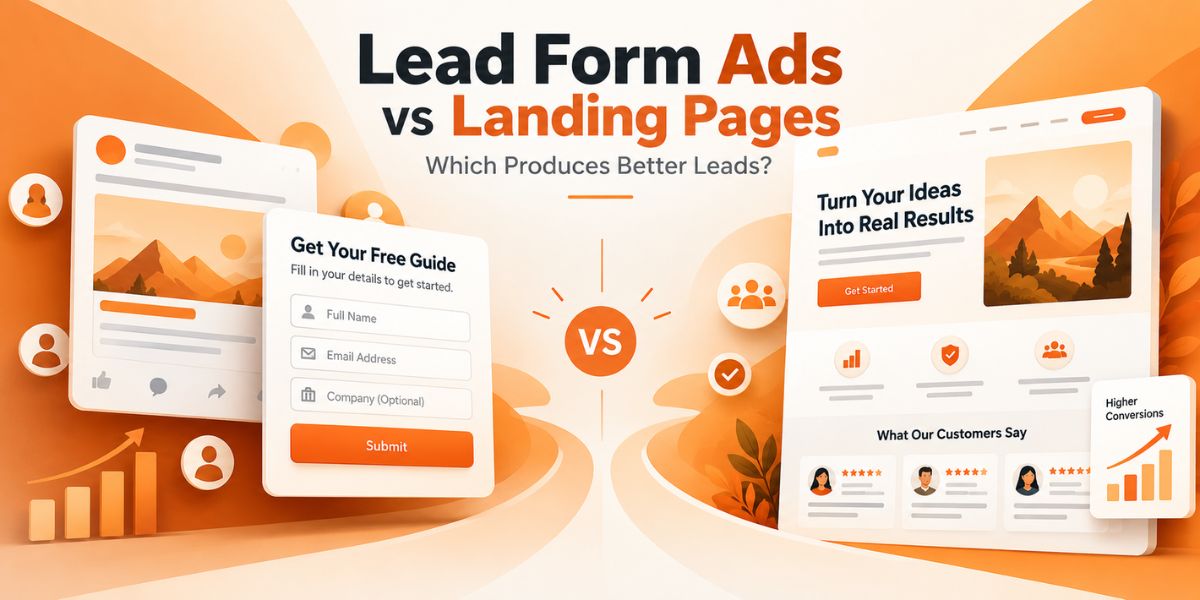
Lead form ads collect information inside the advertising platform instead of sending the visitor to another website.
- Meta Instant Forms can collect leads inside Facebook and Instagram. Google supports lead form assets in eligible campaign types. LinkedIn Lead Gen Forms can prefill information from a member’s profile.
- The main advantage is reduced friction. A user can move from ad click to submission with fewer steps.
Landing Pages
A landing page sends the user from the ad to a dedicated webpage where you control the message, proof, form, design, tracking and next step.
That additional page adds friction, but it also creates room to answer objections before asking for contact details.
What Are the Biggest Differences?
Friction
Lead Forms Remove Steps
The user often stays inside the same platform and some details can already be populated.
Context
Landing Pages Explain More
You can show case studies, pricing guidance, testimonials, specifications and objection-handling content.
Qualification
Both Can Filter Leads
Platform forms now support custom questions and qualification options, but landing pages give you greater flexibility.
Ownership
Landing Pages Give More Control
You control page experience, analytics setup, testing, content and future changes.
How Do Cost, Speed and Control Compare?
| Factor | Lead Form Ads | Landing Pages |
|---|---|---|
| Launch Speed | Faster | Design, copy and development needed |
| Setup Cost | Lower | Higher initial cost |
| Design Control | Limited by platform | Full |
| Testing Flexibility | Moderate | High |
| Page Maintenance | Minimal | Ongoing |
This is why lead forms are attractive for fast campaign validation. You can test an offer before investing heavily in a landing page.
Do Landing Pages Always Produce Better Leads?
No.
Lead quality comes from the combination of targeting, creative, offer, qualification and follow-up. The form destination alone does not determine quality.
- Meta currently supports different Instant Form approaches, including a Higher Intent option with an additional review step. Meta also recommends CRM integration and conversion-lead optimization when advertisers want the algorithm to learn from better downstream outcomes.
- LinkedIn recommends limiting Lead Gen Forms to around three or four fields where possible because fewer fields can improve submission rates. It also supports custom questions and hidden fields when you need more qualification or attribution context.
Better rule: add only enough friction to remove bad-fit leads without blocking genuinely interested buyers.
Which Option Gives You Better Tracking?
Landing pages usually provide more control because the full post-click journey happens on infrastructure you manage.
You can measure
- landing-page views
- scroll depth
- CTA clicks
- form starts
- form completions
- calendar bookings
- custom conversion events
That does not mean platform forms are disconnected from your CRM.
- Google currently supports lead delivery through CSV export, email notifications, webhooks and API-based integrations. LinkedIn can sync Lead Gen Forms with supported CRM and marketing-automation systems and supports hidden attribution fields.
- The difference is flexibility. Your own landing page gives you more freedom to design the tracking model around your funnel.
Why Conversion Rate Alone Can Mislead You
Landing-page benchmarks are useful for context, but they are not a direct prediction of your lead quality.
Unbounce’s large benchmark study across 41,000 landing pages reported a median landing-page conversion rate of around 6.6% across industries.
But a 12% form conversion rate can still be worse than a 5% rate if the higher-converting page produces buyers who never qualify.
The Better Metric Chain
Click → Lead → Qualified Lead → Meeting → Opportunity → Revenue
When Should You Use Lead Form Ads?
Simple Offer
Newsletter or Download
The visitor understands the value without needing a long explanation.
Fast Validation
New Campaign Test
Test audience and offer response before building a more complex funnel.
Mobile-Heavy Traffic
Fast Contact Capture
Prefilled information can make the process much easier on mobile.
When Should You Use a Landing Page?
High Deal Value
Enterprise or B2B Services
Buyers need capabilities, proof, trust signals and more context before talking to sales.
Complex Product
Demo or Consultation
Visitors need education before the form feels like the logical next step.
Strong Qualification Need
Quote or Application
The sales team needs budget, use case, geography, company size or technical requirements.
Use This Decision Framework Before Launching
| Factor | Choose Lead Form Ads When | Choose Landing Pages When |
|---|---|---|
| Buyer Intent | Interest can be captured quickly | Buyer needs evaluation before inquiry |
| Deal Value | Lower or moderate | High |
| Sales Cycle | Short | Long or consultative |
| Proof Required | Minimal | Case studies, specifications or trust proof needed |
| Tracking Needs | Basic platform and CRM attribution | Detailed on-page and cross-channel measurement |
| Launch Urgency | Need campaign live quickly | Can invest in a stronger conversion experience |
Why a Hybrid Strategy Often Wins
You do not always have to choose one format forever.
A practical campaign can use both.
Start With Lead Forms for Fast Demand Testing
Learn which audiences, creatives and offers create initial interest.
Build a Landing Page Around the Winning Angle
Use proven messaging and add the proof buyers need before committing.
Judge Both by Downstream Quality
Compare qualification rate, contact rate, meetings, opportunities and revenue rather than submission volume alone.
How AdSpyder Supports the Winning Workflow
Choosing the destination is only half the job. You also need to understand what users are seeing before and after the click.
AdSpyder Landing Page Analysis lets marketers study competitor landing-page screenshots, messaging, CTAs, layouts and historical page changes.
It can also connect observed ads with their destination pages, which helps answer questions such as:
- Does the ad promise the same thing as the landing-page headline?
- Does the competitor ask for a demo, quote, trial or consultation?
- What proof appears before the form?
- How much information is requested?
- Has the CTA or offer changed over time?
- Are several competitors using similar post-click structures?
Use Competitive Research Correctly
AdSpyder can show observable ads, landing-page layouts and historical changes. It cannot see a competitor’s private conversion rate, CPA or revenue. Use the patterns as research inputs, not proof that a specific page is profitable.
This makes AdSpyder most useful before you build your own landing page or when you want to understand whether competitors are using a short-form, proof-heavy or direct-response workflow.
What Can You Learn From Current Lead Generation Workflows?
Current lead-generation services increasingly treat form submission as only one part of the funnel.
- For example, Gushwork’s current Paid Boost workflow combines paid campaigns with landing pages, qualification and rapid follow-up rather than optimizing only for raw submission count.
- That is the more useful lesson for advertisers. The winning destination is the one that fits the complete process from ad impression to sales conversation.
Final Recommendation – Which Produces Better Leads?
Choose Lead Form Ads
When Friction Is the Main Problem
Best for simple offers, fast testing, mobile-heavy audiences and campaigns where sales can qualify leads quickly.
Choose Landing Pages
When Trust Is the Main Problem
Best for high-value offers, longer sales cycles, technical services and situations where buyers need more proof before contacting sales.
Use Both
When Scale and Quality Both Matter
Run both paths and optimize toward qualified pipeline rather than declaring a winner from CPL alone.
See What Competitors Put After the Click
Analyze competitor landing pages, CTAs, messaging and historical changes before building your next lead-generation flow.
Lead Generation Decision Checklist
☐ Deal value reviewed
☐ Buyer intent understood
☐ Sales cycle considered
☐ Required proof identified
☐ Qualification questions defined
☐ CRM integration tested
☐ Follow-up speed measured
☐ Qualified lead rate tracked
☐ Competitor pages reviewed
☐ Revenue tracked back to source
Do Not Optimize for the Cheapest Lead
Study competitor ad-to-page journeys with AdSpyder and build the lead path that creates better opportunities for your sales team.
FAQs for Lead Form Ads vs Landing Page
Are Lead Form Ads Better Than Landing Pages?
They are better when low friction and fast lead capture matter most. Landing pages are usually stronger when the buyer needs more information, proof or qualification.
Why Are Lead Form Ads Often Cheaper?
The user can submit without navigating through an external page, and some platforms can prefill information. Fewer steps can increase submission volume.
Do Lead Forms Produce Lower-Quality Leads?
Not automatically. Quality depends on targeting, questions, form type, offer and follow-up. Platform features such as higher-intent forms and qualification questions can increase friction deliberately.
Which Is Better for B2B Lead Generation?
Landing pages are usually more useful for high-value B2B offers because they provide room for case studies, capabilities, trust signals and qualification. Lead forms can still work for simpler offers or early testing.
Can Lead Form Ads Send Leads Directly to a CRM?
Yes. Major platforms provide CRM or lead-delivery options. The exact integration method depends on the ad platform and your CRM.
Should I Test Both Lead Forms and Landing Pages?
Yes, when traffic volume and budget allow it. Compare qualified leads and downstream sales outcomes rather than choosing the winner only from cost per lead.
What Should I Measure After the Form Submission?
Track contact rate, qualification rate, meeting rate, opportunity rate, sales-cycle progression and revenue. These metrics show whether a cheap lead is actually valuable.
How Can AdSpyder Help With This Decision?
AdSpyder can show competitor ads, destination URLs, landing-page screenshots and historical page changes so you can study how competitors structure the journey from ad to conversion.