If your targeting still starts and ends with age, gender, and location, you’re leaving performance on the table. Modern audiences don’t buy because they’re “25–34 in Mumbai.” They buy because of their motivations: status, security, self-improvement, convenience, belonging, sustainability, curiosity, and a hundred other drivers. That’s where psychographic segmentation changes the game.
It helps you group people by beliefs, values, lifestyle, interests, and attitudes—then write creative that feels like it was made for them. In this guide, you’ll get practical psychographic segmentation examples, learn how it differs from demographics, and walk away with a step-by-step process you can apply across paid social, search, and eCommerce.
What Is Psychographic Segmentation?
Psychographic segmentation is a way to divide your audience into groups based on psychological attributes—like beliefs, values, lifestyle, activities, interests, opinions, and attitudes. It focuses on why people buy, not just who they are.
- Demographics tell you: “32-year-old marketer in a metro city.”
- Psychographics tell you: “Ambitious, growth-focused, wants credibility, hates wasting budget, and prefers proof over promises.”
Most brands already do a form of psychographic targeting without realizing it: they use “premium,” “eco-friendly,” “time-saving,” “performance,” or “community” as positioning. The difference is making it systematic—so every segment gets the right hook, proof, and offer.
Demographics vs Psychographics (Why Both Matter)
The best targeting isn’t “demographics vs psychographics”—it’s combining them. Demographics can tell you who is likely to afford or access your product. Psychographics help you decide what to say to make them care.
| Category | What it tells you | Examples | Best use |
|---|---|---|---|
| Demographic | Who someone is | Age, income, job title, education | Budget fit + eligibility |
| Geographic | Where someone is | Country, city, radius | Availability + localization |
| Behavioral | What someone does | Visited pricing page, abandoned cart | Retargeting + intent |
| Psychographic | Why someone decides | Values, lifestyle, motivations, attitudes | Messaging, creatives, offers |
A simple way to combine them: pick the right segment (demographic/geographic), confirm intent (behavioral), then win attention with the right motivation (psychographic).
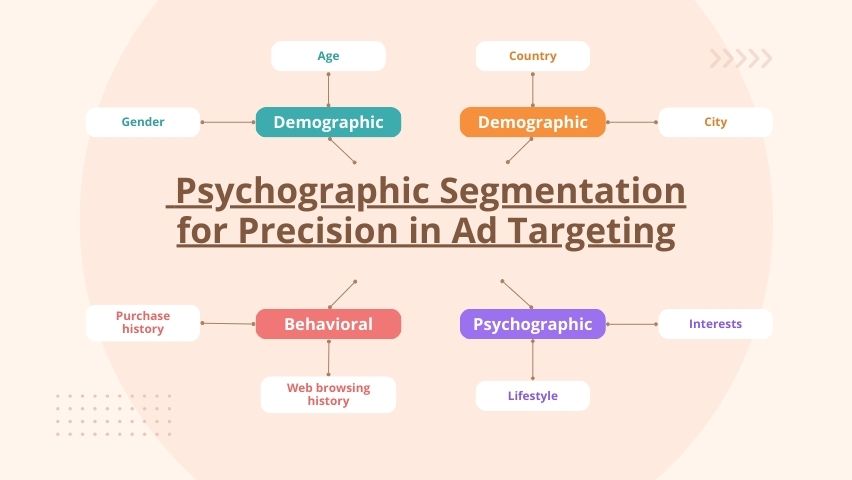
Demographic, Geographic, Behavioral, and Psychographic Segmentation

You’ll often see “demographic psychographic behavioral and geographic segmentation” grouped as the four core segmentation models. Each one answers a different question:
- Demographic: Who are they (age, role, income)?
- Geographic: Where are they (region, language, proximity)?
- Behavioral: What do they do (clicks, visits, purchases, engagement)?
- Psychographic: Why do they do it (values, motivations, attitudes)?
The biggest mistake is trying to make psychographics replace everything. Psychographics amplify your strategy—especially when your products look similar to competitors and “features” stop being persuasive.
Psychographic Segmentation Examples You Can Copy
Below are practical psychographic segmentation examples you can adapt. Notice how each segment includes a motivation, a fear, and a message angle—so creative teams can actually build ads from it.
1: Fitness subscription
- Segment: “Identity-driven achievers” (discipline, tracking, progress)
- Hook: “Your next 30 days—planned, tracked, and measurable.”
- Proof: Before/after routines, streaks, performance metrics
2: Sustainable D2C brand
- Segment: “Eco-mindset shoppers” (values + responsibility)
- Hook: “Less waste. Better materials. No guilt.”
- Offer: Refill packs, recycling program, transparent sourcing
3: B2B SaaS
In B2B, psychographics often show up as risk tolerance, career incentives, and trust preferences.
- Segment: “Career-safe buyers” (avoid mistakes, want credibility)
- Hook: “Prove ROI in 14 days—without changing your stack.”
- Proof: Case studies, peer logos, compliance/security pages
Example 4: Premium category (status + taste)
- Segment: “Taste curators” (craft, uniqueness, design)
- Hook: “Designed to be noticed—built to last.”
- Creative: Close-up product details, editorial visuals, creator collabs
How to Find Psychographic Data (Without Guessing)
Psychographics come from signals—language people use, content they consume, what they complain about, and what they celebrate. Here are reliable places to uncover them:
- Customer interviews: Ask why they chose you, what nearly stopped them, and what “success” looks like.
- On-site behavior: What pages do they binge? Pricing? Case studies? FAQ? That’s motivation in disguise.
- Reviews & support tickets: Objections, fears, and desired outcomes—written in customer language.
- Social listening: Communities reveal identity, norms, and what “good” looks like.
- Surveys (AIO): Activities, Interests, Opinions—fast way to cluster mindsets.
If you already run paid campaigns, your ad accounts are a goldmine too: interest clusters, engagement patterns, and lookalike quality often reveal what your buyers value. This overlaps heavily with audience interests—but psychographics go deeper into motivations and decision style.
How to Use Psychographic Segmentation in Marketing

Once you have segments, your job is to convert them into repeatable ad decisions: hook, offer, proof, landing page, and channel choice. Here’s a system that works across industries.
| Segment type | Motivation | What to say | Proof that works | Best channels |
|---|---|---|---|---|
| Risk-averse | Avoid mistakes | “Predictable outcomes, no surprises” | Case studies, guarantees, security | Search, retargeting, email |
| Status-seeking | Identity + prestige | “Join the top tier” | Influencers, exclusivity, design | Instagram, YouTube, premium display |
| Value-driven | Ethics + sustainability | “Better choices, less waste” | Transparency, sourcing, impact | Content, community, creators |
| Efficiency-first | Save time + simplify | “Done in minutes” | Demos, “before/after,” automation | Search, short video, remarketing |
Here’s the key: a psychographic segment becomes real only when it changes what you do. If Segment A and Segment B see the same creative, the same landing page, and the same offer, you don’t have segmentation—you have labels.
Where psychographics show up in paid media (real examples)
- Amazon-first shoppers: respond to proof, value, and convenience. This is why many Amazon ads winners lean on reviews, bundles, and benefit clarity.
- B2B credibility seekers: want authority signals and peer validation—this is why LinkedIn advertising campaigns often spotlight thought leadership, product POVs, and career-safe outcomes.
- Scale-focused performance teams: love automation and precision—common in programmatic advertising where targeting and efficiency are core value props.
And if you want to speed this up: AdSpyder helps you map psychographic angles by showing what competitors repeatedly test (hooks, visuals, positioning). Repetition across multiple winning ads is usually a signal that a segment-based message is working.
Ethics, Privacy, and Trust (Don’t Cross the Line)
Psychographic targeting is powerful—which is why it can feel creepy when done wrong. The goal is relevance, not manipulation. A few practical rules:
- Use aggregated insights (patterns), not invasive personal data.
- Avoid sensitive targeting and exploitative framing.
- Be transparent with offers, terms, and partnerships—especially in regulated categories.
- Keep compliance content visible and clear when required (not hidden in tiny footers).
If your campaigns involve affiliates, regulated offers, or sponsorships, strong ad disclosure and transparency protects both customers and brand trust.
Key Statistics That Explain Why Psychographics Work
A 7-Step Playbook to Implement Psychographic Segmentation
If you want a simple process your team can repeat every quarter, use this:
- Collect language: reviews, tickets, sales calls, community threads.
- Find motivations: cluster into 4–8 “why” buckets (status, safety, convenience, values, mastery, belonging).
- Name segments: give each a memorable label (“Efficiency-first”, “Eco-mindset”, “Career-safe”).
- Map objections: what stops each segment from buying?
- Build a message matrix: hook + offer + proof for each segment.
- Launch creatives by segment: isolate tests so you can attribute results.
- Scale winners: promote the best segment messages into broader campaigns, then refresh creative monthly.
Competitive research can accelerate steps 5–7—because you can see which segment angles competitors keep repeating (a strong sign the message resonates).
FAQs: Psychographic Segmentation
What is psychographic segmentation in marketing?
How is psychographic different from demographic segmentation?
What are common psychographic segmentation variables?
How do I collect psychographic data?
Can psychographic segmentation improve ad performance?
What are simple psychographic segmentation examples?
How do I avoid creepy targeting with psychographics?
Conclusion
Psychographic market segmentation helps you compete on relevance—by matching what you say to what people care about. Combine demographics for fit, behavioral data for intent, and psychographics for persuasion. When you operationalize it with a message matrix and clean testing, you stop “hoping” a creative works—and start scaling messages that are designed to resonate.