Ad Intelligence · Leads · CRM · Creative · Reporting
Quick Answer
- Agencies need different tools for ad intelligence, prospecting, CRM, automation, creative production and reporting.
- AdSpyder fits the competitor-ad and paid-media intelligence layer—not the B2B contact-database category.
- Seamless.AI is designed mainly for finding B2B contacts, emails and phone numbers.
- Do not compare tools only because they both use AI; compare the business job each product solves.
- Agencies researching paid campaigns can start with AdSpyder’s advertising agency workflow.
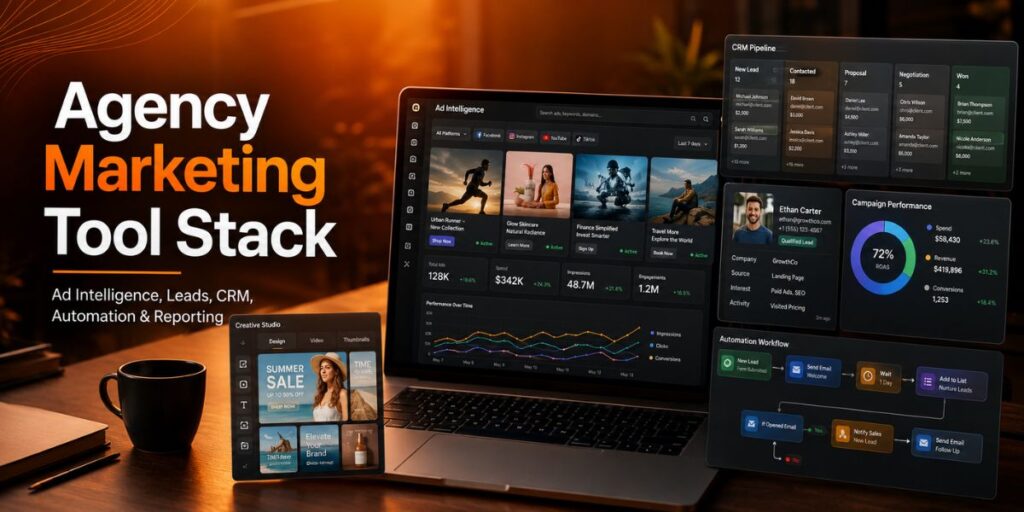
The best digital marketing agency tools do not all compete with one another. A B2B contact database, competitor-ad intelligence platform, CRM, automation system and creative tool solve different stages of agency work.
That distinction matters when evaluating products such as Seamless.AI and AdSpyder. Seamless.AI helps teams identify business prospects and contact information. AdSpyder helps agencies understand competitor advertising, creatives, keywords, domains and landing-page activity. An agency may use both—but for completely different jobs.
The Modern Agency Tool Stack at a Glance
| Agency Job | Example Tool | Main Output | Best KPI |
|---|---|---|---|
| Competitor Ad Intelligence | AdSpyder | Ads, creatives, keywords, domains and campaign patterns | Better campaign hypotheses |
| B2B Prospecting | Seamless.AI | Business contacts, emails and phone numbers | Valid prospects / meetings |
| CRM | HubSpot | Pipeline, contacts and follow-up | SQLs / opportunities |
| Workflow Automation | Zapier / Make | Connected processes | Hours saved / error rate |
| Creative Production | Canva | Campaign assets and variations | Production time |
| Reporting | Looker Studio | Client dashboards and reports | Reporting efficiency |
Where Seamless.AI Fits: B2B Prospecting and Contact Data
Seamless.AI is primarily a B2B sales-intelligence and contact-discovery platform. Its use case is finding potential buyers, business emails, phone numbers and account information that sales teams can use for prospecting.
That makes searches such as “Seamless AI pricing,” “Seamless AI login” and “Seamless AI free trial” strongly navigational and sales-prospecting focused. Someone making those searches is usually not looking for competitor-ad intelligence.
Important: this is why agencies should not compare Seamless.AI and AdSpyder as direct alternatives. Seamless.AI answers “Who can we contact?” AdSpyder answers “What are competitors advertising, and what can we learn from it?”
Where AdSpyder Fits: Paid Campaign Intelligence
AdSpyder is useful earlier in the advertising decision process. Agencies can research competitors, identify visible campaign patterns, study creatives, compare advertising platforms and inspect where competitors send traffic.
For agencies deciding which advertising platforms and tools belong in their paid-media stack, AdSpyder’s AI advertising platforms guide separates competitor research, ad generation and campaign optimization rather than treating every AI product as the same category.
This difference becomes especially useful when a client enters a crowded market. Instead of relying only on a creative brief, agencies can review competing offers, messages and campaign activity before deciding what deserves testing.
How the Two Categories Can Work Together
1. Define the client market
Identify the client’s product, ideal customer profile, competitors, geography and commercial objective before choosing tools.
2. Research competitor advertising
Use advertising intelligence to understand the offers, platforms and creative patterns already visible in the market.
3. Find target business contacts
If the client also needs B2B outbound prospecting, use a separate sales-data product such as Seamless.AI to find relevant contacts.
4. Move qualified prospects into the CRM
Use HubSpot, Salesforce or another CRM to manage ownership, follow-up and pipeline rather than leaving lead data scattered across prospecting tools.
5. Launch controlled paid-media tests
Translate market research into original campaign hypotheses and measure them using your own ad-account and CRM data.
Competitor Research Should Happen Before Creative Production
Agencies often lose time by beginning with visual production before agreeing on the actual market hypothesis. A better order is:
Market → Competitor → Offer → Message → Creative → Landing Page → Launch → Measurement
This sequence keeps creative execution connected to an actual advertising question.
AdSpyder’s competitor ad audit framework gives agencies a structured way to review competitor platforms, creative formats, messaging, keyword signals and destinations before building a new campaign.
Creative Tools Solve a Different Agency Bottleneck
Once the campaign angle is clear, tools such as Canva and Adobe can help agencies produce more creative variations faster. Their job is production—not deciding which competitor signal deserves attention.
AdSpyder’s winning creative research workflow helps bridge that gap by showing how observable ad longevity, creative variation and repeated themes can be used as research signals before designers start producing original assets.
CRM Software Should Own the Lead After Acquisition
Agencies should avoid turning prospecting or ad-intelligence software into an unofficial CRM. Once a prospect responds or a paid campaign produces a lead, there needs to be one reliable system for status, ownership, qualification and follow-up.
For agencies measuring campaign quality beyond cost per lead, AdSpyder’s lead generation KPI framework explains why CPQL, cost per SQL, opportunity rate and CAC are more useful than lead volume alone.
Automation Connects the Stack
A mature agency stack rarely works as six disconnected dashboards. Automation tools can pass information between forms, CRMs, project-management systems, spreadsheets and reporting tools.
Useful examples include sending qualified leads to the correct salesperson, creating client tasks after campaign approval or notifying the account team when conversion quality changes.
When automation begins making advertising decisions rather than simply moving data, use AdSpyder’s AI agent vs human PPC framework to define which actions can be automated and which should remain under accountable human review.
Reporting Tools Turn Activity Into Client Decisions
Clients do not need a screenshot from every tool in the agency stack. They need a small number of metrics connected to commercial outcomes.
| Layer | Useful Client Metric |
|---|---|
| Ad research | New campaign opportunities identified |
| Paid media | Spend, conversions, CPA/ROAS |
| Lead quality | Qualified leads and SQLs |
| CRM | Opportunities and pipeline value |
| Business outcome | Customers, CAC and revenue |
For agencies building a more complete research-to-optimization workflow, AdSpyder’s ad optimization tools guide helps separate research, execution, analytics and optimization software by function.
How Agencies Should Decide Which Tool to Add Next
| Problem | Tool Category | Do Not Solve It With |
|---|---|---|
| “We do not know what competitors are advertising.” | Ad intelligence | A contact database |
| “We cannot find decision-maker contacts.” | B2B prospect data | An ad library |
| “Leads are not being followed up.” | CRM / sales automation | A design platform |
| “Creative production is too slow.” | Creative production software | A contact database |
| “Reporting takes half a day.” | Reporting + automation | Another CRM |
Agency Tool Stack Checklist
☐ Each tool owns one clear business job
☐ Ad research happens before creative production
☐ Prospect data is verified where possible
☐ CRM remains the system of record
☐ Repetitive handoffs are automated
☐ Client reporting uses business KPIs
☐ Duplicate subscriptions are removed
☐ Data access and permissions are reviewed
☐ AI-generated work receives review
☐ New tools are piloted before rollout
Final Verdict: Seamless.AI and AdSpyder Solve Different Agency Problems
If an agency needs business contacts for outbound prospecting, Seamless.AI belongs on the shortlist. If the agency needs to understand competitor advertising, campaign patterns, creatives and paid-market activity, AdSpyder belongs in a different part of the stack.
The mistake is asking which one is “better.” The useful question is which business problem you are trying to solve.
Strong agencies build their stack around workflow ownership: research the market, find prospects where required, manage leads in a CRM, produce original campaigns, automate repetitive work and report commercial results.
Need competitor intelligence for your agency’s paid campaigns?
Use AdSpyder to research competitor advertising, campaign patterns and creative activity before your team decides what to test next.
FAQs for Agency Marketing Tool Stack
Is Seamless.AI an ad intelligence tool?
No. Seamless.AI is primarily a B2B prospecting and sales-intelligence platform focused on finding business contacts and contact information.
Is AdSpyder a Seamless.AI alternative?
Not as a direct replacement. AdSpyder focuses on advertising intelligence, while Seamless.AI focuses on sales-contact data. Agencies may use the two products for different workflows.
What is the best tool for competitor ad research?
Choose a dedicated ad-intelligence platform when the goal is to research observable competitor ads, creatives, domains, keywords and landing-page patterns across advertising channels.
What tools does a digital marketing agency need?
Most agencies need some combination of ad intelligence, analytics, CRM, automation, creative production, SEO tools, reporting and—when they do outbound sales—B2B prospect data.
Should agencies use a separate CRM?
Usually yes. Prospecting and advertising tools should feed relevant information into a CRM that owns lead status, follow-up, qualification, pipeline and revenue tracking.
Where does AdSpyder fit in an agency stack?
AdSpyder belongs in the paid-media research and competitive-intelligence layer, helping agencies research observable competitor advertising before building and optimizing their own campaigns.