Quick Answer
- An AI lead generator helps identify, prioritize or create potential opportunities using data, signals and AI-assisted workflows.
- A lead database primarily gives you searchable company and contact data. Think: who could we contact?
- An AI SDR goes further by automating parts of prospect research, personalization, outreach and follow-up. Think: who should we contact, what should we say, and when should we follow up?
- These categories increasingly overlap, so choose based on the workflow you need—not the label on the homepage.
- If you already know your ICP but lack contact data, start with a database. If outreach execution is the bottleneck, consider an AI SDR. If targeting and campaign strategy are unclear, fix the intelligence layer first.
- AdSpyder’s Ad Library fits before outreach when you need to understand competitor ads, offers, keywords and landing pages shaping demand in your market.
The lead-generation software market has a naming problem.
A product calls itself an AI lead generator. Another calls itself an AI SDR. A third describes itself as a sales-intelligence database—but also scores leads, writes emails and launches sequences.
From the buyer’s side, the categories can look almost identical. The easiest way to separate them is to stop comparing labels and ask one question: which part of the pipeline does this tool actually own?
Table of contents
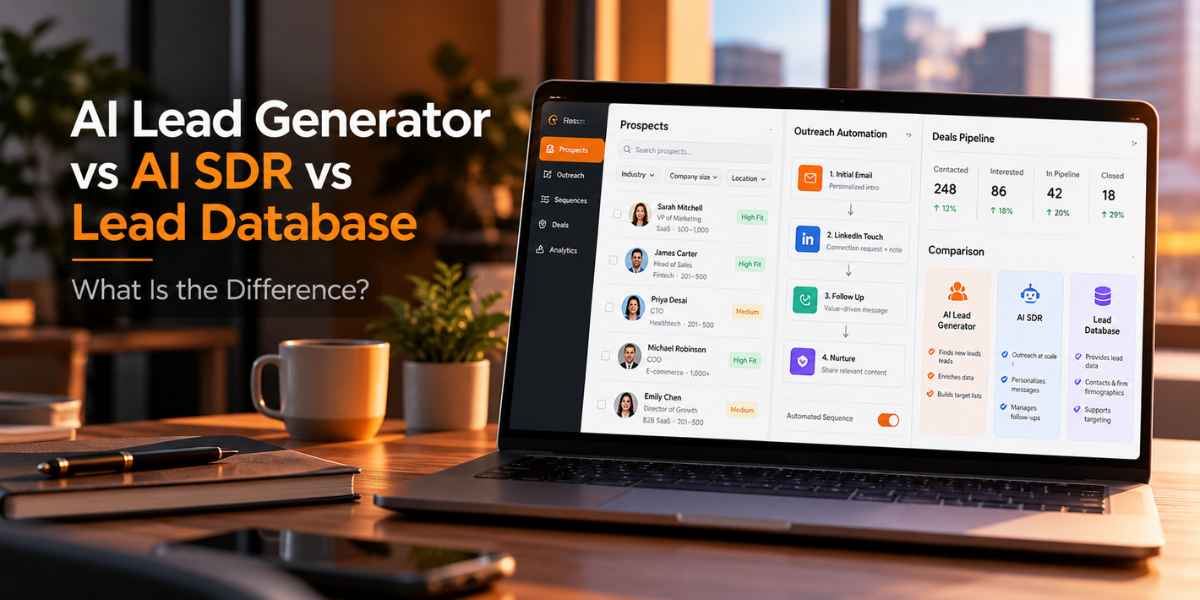
AI Lead Generator vs AI SDR vs Lead Database: Quick Comparison
| Category | Main Job | Typical Output | Human Control | Best For |
|---|---|---|---|---|
| AI Lead Generator | Identify and prioritize potential leads | Lead lists, scores, signals or opportunities | Medium | Teams needing faster prospect discovery |
| AI SDR | Research and execute outbound workflows | Personalized outreach, follow-ups, meetings | Lower if highly automated | Teams constrained by SDR capacity |
| Lead Database | Supply searchable prospect data | Names, roles, companies, emails, phones, firmographics | High | Teams that already know whom they want |
The complication: modern platforms increasingly combine all three. A lead database may now include AI scoring and sequences. An AI SDR may include contact data. An AI lead generator may handle enrichment and outreach. Evaluate the actual workflow rather than trusting the category name.
What Is an AI Lead Generator?
An AI lead generator uses data and automated analysis to help identify prospects more likely to match a target customer profile or buying situation.
Depending on the platform, that can mean:
- Finding companies matching an ICP.
- Finding contacts inside those companies.
- Prioritizing prospects with AI lead scores.
- Using intent or behavioral signals.
- Enriching missing account information.
- Automatically sending qualified prospects into an outreach workflow.
This broad definition is why category confusion happens. Apollo, for example, describes its own lead-generation workflow as a combination of a contact database, AI scoring, sequences and CRM synchronization. A modern “lead generator” may already contain pieces of the other two categories.
What Is an AI SDR?
An AI SDR attempts to automate work traditionally handled by a sales development representative.
That can include prospect research, account qualification, personalized email creation, sequencing, follow-up and—in some systems—meeting booking or reply handling.
Important distinction: an AI SDR is not just a writing assistant. If a platform only drafts outreach copy but does not handle prospect selection, sequencing, execution or follow-up, it is closer to an AI sales assistant than an autonomous SDR.
What Is a Lead Database?
A lead database is fundamentally a data product.
You search companies and people using filters such as title, industry, company size, geography, technology or seniority, then use those records for prospecting and enrichment.
Modern databases may also include verified emails, phone numbers, buying intent, personas, enrichment and sequencing. The core value, however, remains the same: give your team better data about who exists and how to reach them.
The 6 Differences That Actually Matter
| Question | Lead Generator | AI SDR | Lead Database |
|---|---|---|---|
| Who finds prospects? | AI + filters/signals | Often automated | User searches database |
| Who writes outreach? | Sometimes AI | AI by design | Usually user or separate tool |
| Who sends messages? | Depends on product | Usually automated | Not core database function |
| Primary asset | Qualified prospect opportunity | Automated sales activity | Contact and company data |
| Main risk | Bad scoring or weak signals | Poor automation damages brand | Outdated or irrelevant data |
| Best KPI | Qualified leads / opportunities | Positive replies / meetings / pipeline | Data coverage / accuracy / usable contacts |
Costs, Speed, Control and Limitations
Lead databases: usually the easiest place to start
Database pricing is commonly seat- and credit-based. As one current benchmark, Apollo offers a free tier and paid plans beginning at $49 per seat per month when billed annually, with larger credit allowances and more automation on higher tiers.
Best advantage: high control. Your team chooses the filters, list and outreach strategy.
AI SDRs: higher automation, wider pricing range
AI SDR pricing varies far more because products automate different amounts of work. Current published market examples range from a few hundred dollars per month for lighter agents to several thousand dollars per month for more autonomous outbound platforms.
Best advantage: speed and capacity. Biggest risk: automating the wrong message at scale.
AI lead generators: pricing depends on what “generate” means
Some are effectively databases with AI scoring. Others combine enrichment, intent signals and workflow automation. Some use credits; others charge by seat, volume, data enrichment or successful outcomes.
Buying rule: compare the cost of producing one usable sales opportunity—not the headline subscription price. A cheap database is expensive if half the contacts are unusable. An expensive AI SDR can still make sense if it consistently creates qualified pipeline.
Which Option Is Best for Your Team?
Choose a lead database if…
You already understand your ICP, have people available to prospect, and mainly need accurate contact and company information. This is often the cleanest starting point for founders, SDR teams and agencies building targeted lists.
Choose an AI lead generator if…
The real bottleneck is deciding which accounts and contacts deserve attention. AI scoring, signals, enrichment and automated prospect discovery can reduce the manual research burden before outreach starts.
Choose an AI SDR if…
You know whom to target but cannot research, personalize and follow up with enough prospects manually. AI SDRs make the most sense when outbound execution—not market clarity—is the constraint.
The Wrong Order: Automating Outreach Before You Understand the Market
This is where many AI lead-generation stacks fail.
A team buys a database, adds an AI SDR, generates thousands of personalized emails—and only afterward realizes its offer sounds identical to every competitor.
More automation cannot fix weak positioning.
The AI lead generation workflow takes a different approach: research the visible competitor funnel first—ad, landing page, offer and form—then decide which prospecting and outreach tools should execute the strategy.
A Simple Decision Framework
Question 1: Do we know exactly which companies and roles we want?
If no, work on ICP, market intelligence and lead-generation criteria first.
Question 2: Do we have accurate ways to reach those people?
If no, a lead database or enrichment platform is the immediate need.
Question 3: Can our team research and prioritize prospects efficiently?
If no, add AI lead generation or scoring.
Question 4: Can our SDR team execute enough quality outreach?
If no, evaluate AI SDR automation.
Question 5: Does our message actually differentiate us?
If no, stop scaling outbound and research the market before adding volume.
Question 6: Can we measure qualified pipeline back to source?
If no, fix CRM attribution before judging any lead-generation tool.
Where AdSpyder Fits in the Winning Workflow
AdSpyder is not a B2B contact database and it is not an AI SDR.
It belongs one step earlier: the market and campaign intelligence layer.
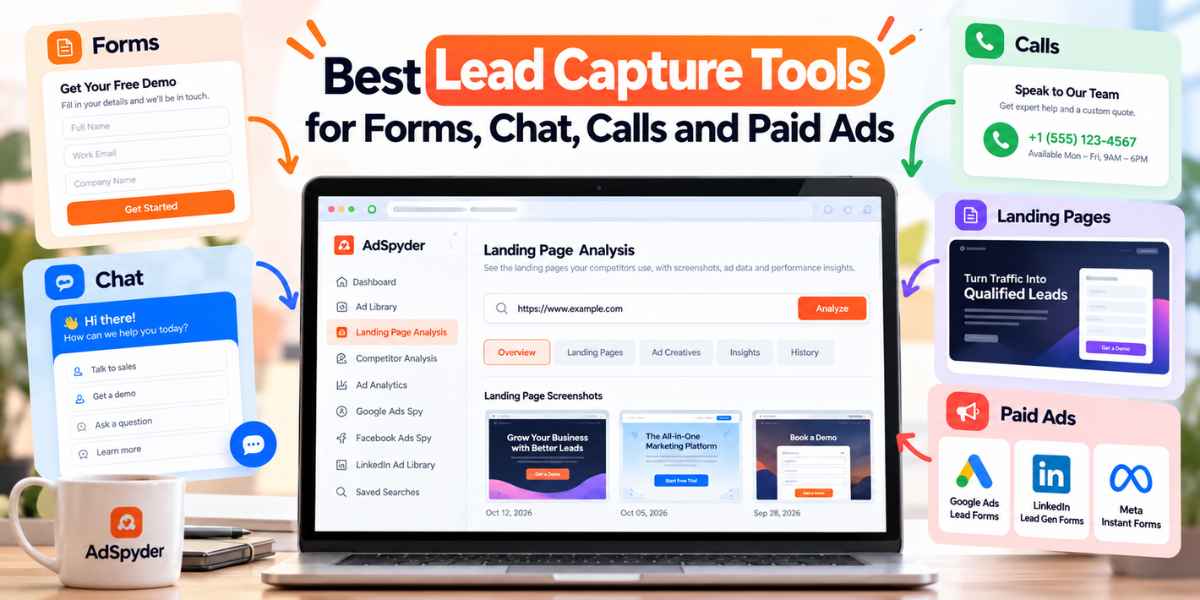
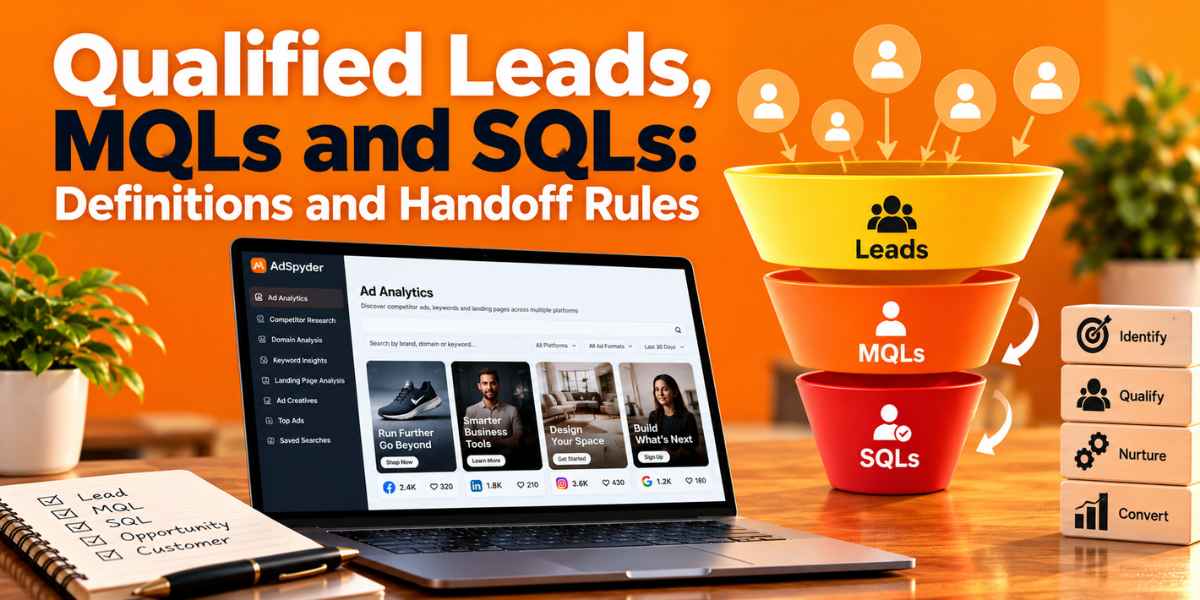
Use Ad Analytics to understand competitor domains, keywords and campaign activity before deciding what your outbound or demand-generation message should emphasize.
Map competitor demand generation
Use Domain Analysis to see which platforms, keywords and advertising themes competitors are using.
Study the offers
Compare demo, trial, audit, report, pricing and other offer structures instead of asking AI to invent a CTA without market context.
Inspect the post-click funnel
Use Landing Page Analysis to connect competitor ads with headlines, proof, CTAs and form friction.
Build the lead and outreach brief
Define audience, pain point, differentiated angle, proof and offer before handing the strategy to a database, AI generator or AI SDR.
Generate from evidence, not a blank prompt
The competitor-data + AI generation workflow shows how real market patterns can become inputs for original messaging rather than copied creative.
What the Full Stack Can Look Like
| Stage | Tool Category | Question Answered |
|---|---|---|
| Market research | Ad intelligence | What messages and offers are buyers already seeing? |
| Prospect discovery | Lead database | Who matches our ICP? |
| Prioritization | AI lead generator / scoring | Who deserves attention now? |
| Outbound | AI SDR | How do we research, contact and follow up at scale? |
| Learning | CRM + campaign intelligence | Which sources, messages and offers create pipeline? |
This is why the “best” category depends on what your team already has. Buying an AI SDR when you do not have a clear ICP simply automates uncertainty.
Buying Checklist
☐ Do we need data, prioritization or outreach execution?
☐ How fresh and verifiable is the contact data?
☐ What signals does the AI use to prioritize a lead?
☐ Can we explain why a prospect was selected?
☐ Does the system personalize from real account context?
☐ Who approves outbound messages before sending?
☐ How does pricing scale: seats, credits, contacts, emails or outcomes?
☐ Can it sync campaign/source data into our CRM?
☐ Can we pause or override automation immediately?
☐ Will we measure meetings only—or qualified opportunities and revenue?
FAQs About AI Lead Generators, AI SDRs and Lead Databases
What is an AI lead generator?
An AI lead generator uses data, filters, enrichment, scoring or intent signals to help identify and prioritize potential prospects. Some platforms also include outreach and CRM automation.
What is the difference between an AI SDR and a lead generator?
A lead generator primarily helps find or prioritize prospects. An AI SDR is designed to execute more of the outbound sales-development workflow, including research, personalization, sequencing and follow-up.
Do I still need a lead database if I use an AI SDR?
Often yes, unless the AI SDR includes its own contact-data source or enrichment layer. Check where the AI SDR gets its prospect data and how that data is verified.
Which option is best for a small B2B team?
If you already know your target customer, a quality database plus controlled manual or semi-automated outreach is often the simplest starting point. Add more AI automation after the team understands which prospects and messages actually create opportunities.
How much does an AI SDR cost?
Pricing varies widely. Current market examples range from a few hundred dollars per month for lighter automation to several thousand dollars per month for more autonomous outbound systems. Compare scope and outcomes, not only subscription price.
Where does AdSpyder fit in AI lead generation?
AdSpyder fits before prospecting and outreach. It helps teams research competitor ads, keywords, offers and landing pages so lead-generation and SDR workflows begin with stronger market context rather than generic AI messaging.
Before you automate outreach, understand the market
Research competitor ads, keywords, offers and landing pages first. Then give your lead database, AI generator or AI SDR a strategy worth scaling.