Quick Answer
- AI lead scoring ranks leads according to how likely they are to become a meaningful sales outcome.
- A strong score combines fit, behavior, acquisition context and recency rather than relying on one activity such as a form fill.
- If you have limited historical conversion data, start with transparent rules before moving to a predictive model.
- High-intent behaviors such as pricing-page visits, demo requests and repeated product exploration should normally outweigh lightweight engagement.
- Source context matters: the keyword, ad message, landing page and campaign that produced the lead can reveal purchase intent before sales speaks to them.
- AdSpyder can improve this upstream context through competitor ad, keyword and landing-page intelligence, while your CRM or scoring system should own the individual lead score.
Two people download the same guide. One is a decision-maker at a target company who reached the page after searching a high-intent commercial keyword. The other is a student who arrived from an informational social post.
Both completed the same form, but they should not automatically receive the same priority. That is the problem AI lead scoring is designed to solve: turn scattered signals into a useful estimate of which leads deserve attention first.
What Is AI Lead Scoring?
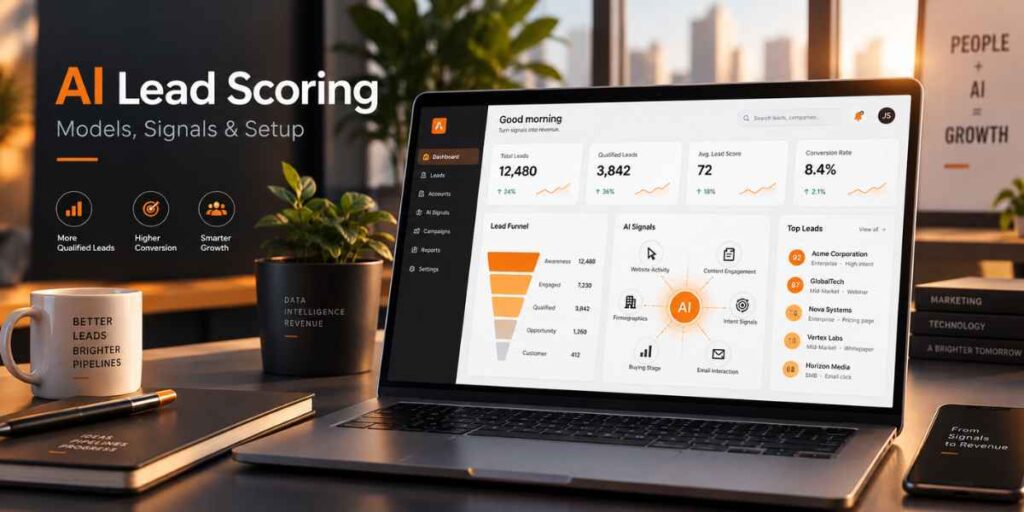
AI lead scoring uses historical customer data, lead attributes and behavioral signals to rank prospects according to their likelihood of reaching a defined outcome—such as becoming qualified, booking a meeting, creating an opportunity or becoming a customer.
Traditional lead scoring usually works like this:
Job title = +10 → Pricing page = +15 → Demo request = +30 → Total score = 55
Predictive scoring goes further. Instead of assuming those weights manually, a machine-learning model looks at patterns among previous converted and non-converted leads and estimates which combinations correlate with the chosen business outcome.
For a wider acquisition context, see AdSpyder’s recent guide on using AI to reverse-engineer competitor lead-generation funnels.
Rule-Based vs Predictive vs Hybrid Lead Scoring
| Model | How It Works | Best For |
|---|---|---|
| Rule-Based | Marketing/sales assigns points to known signals. | Newer companies or limited conversion history. |
| Predictive / AI | Machine learning learns patterns from historical converted and lost leads. | Businesses with enough clean historical CRM data. |
| Hybrid | Predictive output is combined with explicit business rules. | Teams that want AI prioritisation with business control. |
For many teams, a hybrid system is the practical starting point. Use rules for things you know are structurally important—such as geography or account type—while allowing historical data to improve the weighting of engagement and conversion patterns over time.
The 4 Signal Groups a Useful Lead Score Should Include
1. Fit Signals: Is This the Right Person or Company?
Fit tells you whether the lead resembles the type of customer you are actually equipped to serve.
- Industry
- Company size
- Revenue or employee band
- Country or sales territory
- Job title or seniority
- Technology stack
- Existing customer profile similarity
2. Intent Signals: What Is the Lead Actually Doing?
Behavior should differentiate curiosity from buying intent.
| Behavior | Typical Intent Level |
|---|---|
| Blog visit | Low / exploratory |
| Guide download | Low–medium |
| Repeated product-page visits | Medium–high |
| Pricing-page visit | High |
| Demo request / contact sales | Very high |
3. Acquisition Context: Why Did This Person Arrive?
This is one of the most underused scoring layers.
Capture:
- Advertising platform
- Campaign
- Keyword or search term where available
- Creative/ad ID
- Offer shown in the ad
- Landing page
- UTM parameters and referring source
A lead arriving through “enterprise CRM migration software pricing” usually carries different commercial context from someone arriving through “what is CRM?” even if both eventually submit the same form.
4. Recency: How Fresh Is the Intent?
A pricing-page visit yesterday normally matters more than the same visit six months ago. Good scoring systems therefore decay engagement value over time instead of allowing old activity to permanently inflate the lead’s priority.
A Practical 100-Point AI Lead Scoring Framework
If you are building the first version manually, a structure like this is easier to manage than assigning random points to dozens of actions.
| Score Group | Suggested Weight | Examples |
|---|---|---|
| Fit | 35 points | Industry, company size, title, country |
| Behavior / Intent | 30 points | Pricing, demo, product depth, repeat visits |
| Acquisition Context | 20 points | Keyword, ad message, landing page, campaign |
| Recency | 15 points | Recent vs stale high-intent activity |
Important
These weights are an illustrative starting framework—not a universal benchmark. Your converted-lead data should eventually determine which signals deserve more or less weight.
Do Not Forget Negative Lead Scoring
A scoring model should be able to remove points as well as add them.
Useful negative signals can include:
- Unsupported geography
- Student, recruiter or job-seeker intent
- Competitor or internal employee
- Invalid contact information
- Repeated visits to support rather than buying pages
- Unsubscribe or strong disengagement
- Long periods without meaningful activity
Otherwise, leads can accumulate points forever and appear “hot” long after their commercial intent has disappeared.
Example: Scoring a B2B SaaS Lead
| Signal | Points |
|---|---|
| Company is inside target employee range | +15 |
| Director-level marketing title | +10 |
| Visited pricing twice | +15 |
| Requested competitor comparison page | +10 |
| Arrived from high-intent paid-search keyword | +15 |
| Activity occurred in last 48 hours | +10 |
| Total | 75 |
If historical data shows leads above 70 convert at a materially higher rate, that threshold can trigger faster sales routing. If not, the threshold needs adjustment.
How to Set Up AI Lead Scoring Step by Step
Decide whether you are predicting MQL, SQL, opportunity creation, purchase or another outcome. Do not build one score to represent everything.
Remove obvious duplicates, invalid contacts and inconsistent lifecycle labels before training or calibrating the model.
A highly engaged bad-fit lead and a perfect-fit inactive lead should not look identical.
Store campaign, keyword, creative, landing page and UTM information before it disappears during CRM handoff.
Recent buying signals should carry more weight than equivalent activity from months ago.
For example: 0–39 nurture, 40–69 marketing-qualified, 70+ priority sales review. Your real conversion data should determine the final thresholds.
A model trained on last year’s audience, pricing or acquisition strategy can drift as the business changes.
How Much Data Do You Need Before Using Predictive Scoring?
There is no universal minimum across every AI model, but predictive systems need enough historical positive and negative outcomes to discover useful patterns.
If you have only 70 total leads and six customers, a complicated machine-learning model may create false confidence. A transparent rules-based framework is often easier to inspect and improve.
As a useful reference point, some enterprise scoring systems require hundreds or thousands of historical lead records before creating an organization-specific predictive model. The practical lesson is simple: use AI when the data supports it, not because the label sounds more advanced.
How to Measure Whether Your Lead Score Is Actually Working
Do not judge a scoring system because the numbers “look right.” Test whether higher-scored leads actually produce better outcomes.
| Metric | What It Tells You |
|---|---|
| Conversion rate by score band | Do high-score leads convert more often? |
| Lift in top 10–20% | How much better are your highest-ranked leads than average? |
| Sales acceptance rate | Does sales agree that scored leads are useful? |
| Opportunity rate | Do high-score leads progress to pipeline? |
| Revenue by score band | Does priority translate into commercial value? |
| Time to first response | Are high-intent leads being contacted quickly enough? |
A scoring model that predicts form fills but not pipeline can look statistically impressive while being commercially unhelpful. Align evaluation with the business outcome sales actually cares about.
How AdSpyder Improves the Lead Scoring Workflow
AdSpyder should not replace your CRM’s lead scoring engine. Its value sits earlier in the process: understanding the acquisition context that creates the lead.
1. Understand commercial keyword context
AdSpyder’s Ad Analytics connects domain activity with keyword and campaign intelligence. That can help marketing teams distinguish commercial search themes from broad informational traffic when designing acquisition-context scoring.
2. Understand which messages competitors use for high-intent demand
Search competing brands in the AdSpyder Ad Library and study their offers, calls to action, formats and keyword-linked ads. Repeated commercial messaging can help you identify the language associated with deeper funnel intent.
3. Add landing-page context
A click to a pricing page, comparison page or demo-focused landing page can represent different intent from a click to a generic homepage. AdSpyder’s Landing Page Analysis helps teams study how competitors align ads, offers, CTAs and post-click pages.
4. Build better source categories
Use URL & Domain Analysis to map competitor paid-search activity, landing destinations and keyword strategy. Those external patterns can inform the source and intent categories you later capture in your own CRM.
An AdSpyder-to-CRM Lead Scoring Workflow
Competitor research → identify commercial ads, keywords and landing-page patterns →
campaign setup → preserve UTM, keyword, creative and page data →
CRM → combine acquisition context with fit and engagement →
AI/rules model → generate score →
sales → prioritize and feed outcomes back into the model
The feedback loop is the important part. External intelligence can suggest which acquisition signals look commercially meaningful, but your own closed-won and closed-lost outcomes should decide whether those signals truly deserve weight.
8 Common AI Lead Scoring Mistakes
A highly engaged person can still be completely outside the target customer profile.
A newsletter signup and demo request should not automatically carry the same intent.
When acquisition context disappears during CRM handoff, useful intent information disappears with it.
A lead should not remain priority forever because of an action completed nine months ago.
If “converted,” “qualified” and “lost” are inconsistently recorded, the model learns inconsistent outcomes.
Hundreds of weak features can make a model harder to explain without meaningfully improving prioritisation.
A model can get very good at predicting the wrong business outcome.
New pricing, markets, products and acquisition channels can make old weights obsolete.
AI Lead Scoring Setup Checklist
Frequently Asked Questions
What is AI lead scoring?
AI lead scoring uses historical lead and conversion data to estimate which current prospects are most likely to reach a defined outcome, helping sales and marketing prioritize attention.
What data should be used for lead scoring?
Useful inputs include company and contact fit, website behavior, high-intent actions, campaign source, keyword, landing page, recency, sales interactions and negative/disqualification signals.
Is AI lead scoring better than manual lead scoring?
Predictive scoring can discover patterns that manual rules miss when enough clean historical data exists. Rules remain valuable when data is limited or when the business needs explicit qualification criteria.
How many leads do I need for AI lead scoring?
There is no universal minimum because model requirements differ. Predictive scoring needs enough converted and non-converted examples to identify stable patterns. Teams with sparse data should start simpler and add predictive modelling as reliable history grows.
Should keyword and ad-source data affect lead scores?
They can. A commercial keyword, product-comparison ad or pricing-focused landing page may indicate stronger intent than a broad informational source. Validate the effect against your own conversion data before assigning permanent weight.
How often should a lead score be updated?
Individual scores should update as meaningful new data arrives. The scoring model or rules should also be reviewed periodically when conversion patterns, products, acquisition channels or customer profiles change.
Does AdSpyder provide CRM lead scores?
AdSpyder is an ad and competitor-intelligence platform, not a replacement for your CRM lead-scoring engine. It can improve the acquisition-context layer by revealing competitor keywords, ads, offers, domains and landing-page patterns that help teams design better source and intent classifications.
A lead score is only as useful as the signals behind it.
Use AdSpyder to understand competitor keywords, ad messages, offers and landing pages—then bring that acquisition context into a scoring framework grounded in your own pipeline and conversion data.