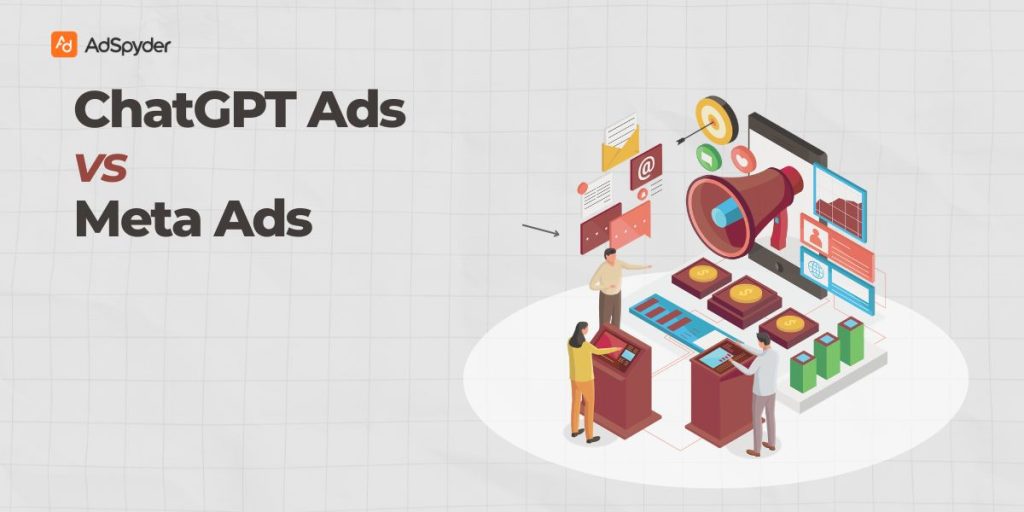
The ChatGPT ads vs Meta ads decision comes down to intent type, creative capabilities, and measurement maturity. Meta Ads (Facebook, Instagram, Messenger, Audience Network) offers 20+ years of social targeting with visual-first creatives. ChatGPT ads (currently testing) use conversational context and recommendation cards. This guide delivers a platform comparison framework, chatgpt ads vs meta ads cost benchmarks, targeting mechanics, creative requirements, and an AdSpyder workflow to analyze both platforms with competitive data.
Platform Overview: ChatGPT Ads vs Meta Ads
Before comparing costs, understand each platform’s core mechanics. Meta Ads is a mature social advertising ecosystem with 3 billion+ users across Facebook, Instagram, Messenger, and Audience Network. ChatGPT ads are testing conversational-context targeting. Both require fundamentally different creative strategies.
ChatGPT Ads: What you need to know
Currently testing with U.S. logged-in adults. Ads appear as clearly labeled recommendation cards at the bottom of ChatGPT responses. Targeting is based on conversational context, not social behavior or demographics. Users can dismiss ads and provide feedback. Early reports suggest premium CPM pricing around $60 per 1,000 views.
Unlike Meta’s visual-first approach with feed placements, ChatGPT uses text-based recommendation cards in conversational moments. This fundamental difference mirrors the contrast between ChatGPT Ads and Google Ads, where keyword targeting meets conversational context instead of social behavior signals.
Meta Ads: The social advertising leader
Offers placements across Facebook Feed, Instagram Stories/Reels, Messenger, and Audience Network. Targeting uses demographics, interests, behaviors, custom audiences, and lookalikes. Pricing is auction-based with both CPC and CPM models. Average costs: $0.50-2 CPC, $5-15 CPM depending on audience and placement. Supports image, video, carousel, collection, and interactive formats.
- ChatGPT ads require proof-led messaging that fits conversational discovery moments.
- Meta Ads needs visual-first creative optimized for social feeds and short attention spans.
- Meta offers advanced retargeting and lookalike scaling; ChatGPT has limited audience options currently.
Key Statistics: ChatGPT Ads vs Meta Ads Cost Benchmarks
The 5 Comparison Pillars: ChatGPT Ads vs Meta Ads
Use these five pillars to evaluate platform fit for your goals, creative capacity, and budget. Each reveals trade-offs between ChatGPT’s conversational targeting and Meta’s social behavior data.
Head-to-Head: ChatGPT Ads vs Meta Ads Feature Comparison
This table breaks down every decision factor before budget allocation. ChatGPT excels at conversational discovery; Meta wins on visual storytelling, audience depth, and retargeting infrastructure.
| Feature | ChatGPT Ads | Meta Ads |
|---|---|---|
| Cost model | CPM (~$60 reported) | CPC ($0.50-2) or CPM ($5-15) |
| Minimum budget | Unknown (likely premium) | $1/day minimum (recommended $10-20/day) |
| Targeting options | Conversational context | Demographics, interests, behaviors, custom audiences, lookalikes |
| Ad formats | Recommendation cards (text + proof) | Image, video, carousel, Stories, Reels, collection, instant experience |
| Placement control | Limited (bottom of responses) | Granular (Facebook, Instagram, Messenger, Audience Network) |
| Measurement depth | Limited (early testing phase) | Advanced (Pixel, Conversion API, attribution, funnel reports) |
| Creative requirements | Proof-led, recommendation-style | Visual-first, mobile-optimized, platform-native |
| Best for | Conversational intent, early adopters | Visual brands, social awareness, retargeting, lookalike scaling |
| Setup complexity | Unknown (likely simpler) | Moderate (Business Manager, Pixel setup, creative specs) |
| Optimization speed | Slower (limited data) | Fast (algorithm learns from billions of signals) |
When to Use ChatGPT Ads vs Meta Ads (Decision Framework)

Platform selection depends on intent type, creative strengths, and funnel stage. Many brands use both: ChatGPT for conversational discovery, Meta for social awareness and retargeting.
Budget allocation determines platform viability. Meta campaigns scale from $300/month, while OpenAI ChatGPT advertising plans start at $2,000+ monthly minimums. Plan tier selection impacts feature access, support levels, and billing options beyond just spend requirements.
Use ChatGPT Ads when:
- Your audience asks ChatGPT questions about your category or problem space
- You have strong proof assets (verifiable case studies, stats, testimonials)
- You want early-mover positioning before platform saturation
- Your budget supports premium CPM ($2,000+ per month recommended)
- You can produce recommendation-style creative (not visual ads)
Meta Ads when:
- You need visual storytelling (product demos, lifestyle content, UGC)
- You want retargeting and lookalike audience scaling
- Your product fits social discovery behavior (scrolling, exploring)
- You have flexible budgets ($300+ per month works for testing)
- You need format diversity (Stories, Reels, Feed, carousel)
Use both platforms when:
- You’re testing full-funnel strategies (awareness, consideration, conversion)
- You have budget for multi-channel testing ($5,000+ per month)
- Your audience spans conversational and social behavior patterns
- You can maintain separate creative libraries (text vs visual)
Skip both platforms when:
- You lack proof assets (ChatGPT) or visual creative (Meta)
- Your landing pages aren’t conversion-optimized
- You can’t afford $300+ per month for meaningful testing
- You have no tracking infrastructure (Pixel, UTMs, analytics)
Platform Selection Checklist: ChatGPT Ads vs Meta Ads
Run this checklist before budget allocation. It covers cost readiness, creative capacity, audience alignment, measurement needs, and testing velocity. Update weekly as platforms evolve.
1) Budget assessment
- Monthly ad budget: ChatGPT: $2,000+ recommended. Meta: $300+ works for testing.
- Cost tolerance: Can you afford $60 CPM (ChatGPT) vs $5-15 CPM (Meta)?
- Testing runway: How many weeks before you need positive ROI?
- Creative budget: ChatGPT needs proof; Meta needs visual production.
2) Audience behavior mapping
- Conversational behavior: Does your audience use ChatGPT for category research?
- Social behavior: Are they active on Facebook/Instagram daily?
- Discovery mode: ChatGPT = question-driven. Meta = scroll-driven exploration.
- Intent depth: Which platform captures them earlier in the journey?
3) Creative production capacity
- Case studies with metrics
- Testimonials (role + context)
- Verifiable stats/claims
- Recommendation-style copy
- Product photography/videography
- UGC or lifestyle content
- Mobile-optimized visuals (9:16, 1:1)
- Platform-native formats (Stories, Reels)
4) Measurement infrastructure
- UTM standards: Platform-specific tagging (channel=chatgpt vs channel=meta)
- Pixel setup: Meta needs Pixel + Conversion API; ChatGPT has limited options
- Attribution needs: Meta supports multi-touch; ChatGPT requires manual analysis
- Reporting cadence: Can you synthesize cross-platform narratives weekly?
5) Testing velocity & iteration speed
- Creative production speed: Meta needs continuous visual refresh; ChatGPT needs proof updates
- Optimization cadence: Meta’s algorithm learns fast with volume; ChatGPT needs patience
- Learning budget: Can you afford 4-8 weeks before scaling decisions?
- Team bandwidth: Running both requires separate workflows and skill sets
14-Day Dual-Platform Test Plan: ChatGPT Ads + Meta Ads
Performance monitoring reveals which platform delivers better ROI for your category. Systematic ChatGPT ad optimization requires tracking proof element density, conversational targeting precision, and landing page intent match—metrics that differ completely from Meta’s engagement signals.
Use this plan to test both platforms simultaneously with separate creative strategies. Allocate budgets proportionally to cost differences (70% Meta, 30% ChatGPT or adjust based on your goals).
- Define budget split (70/30 or custom)
- Map audience behavior per platform
- Set up Meta Pixel + Conversion API
- Build UTM naming conventions
- ChatGPT: 6 proof-led recommendation cards
- Meta: 10-15 visual variants (image, video, carousel)
- Platform-specific landing pages
- QA creative against platform requirements
- Set up ChatGPT ads account (if accessible)
- Build Meta campaigns (awareness, conversion objectives)
- Test Pixel firing + event tracking
- Create cross-platform reporting dashboard
- Launch both platforms simultaneously
- Monitor daily: CPM, CTR, CPC, conversions
- Compare quality metrics (time on site, bounce rate)
- Write week-1 narrative: cost vs quality trade-offs
Common Mistakes When Comparing ChatGPT Ads vs Meta Ads

These mistakes waste budget and produce misleading results. Avoid them by understanding each platform’s core mechanics before launching campaigns.
How AdSpyder Helps Compare ChatGPT Ads vs Meta Ads (with Competitive Intelligence)
Platform comparison improves when grounded in market reality. AdSpyder scans both ChatGPT ads (when available) and Meta Ads to reveal what creative formats, offers, and targeting strategies work across platforms.
- Scan: identify 40+ competitor ads across ChatGPT (if accessible) and Meta placements
- Tag: creative format, hook, offer, proof elements, CTA, landing page structure
- Compare: how do visual strategies differ between social feeds and conversational contexts?
- Extract: top 5 creative patterns per platform (format, length, proof density)
- Build: platform-specific creative libraries and testing hypotheses
What AdSpyder reveals about each platform
By analyzing competitor activity, you can infer creative requirements and budget allocation before spending your own money. Here’s what to look for:
- How much proof do winning ads show?
- What recommendation formats work best?
- Which landing pages convert?
- How often do ads refresh?
- Which formats get most engagement (video, carousel, image)?
- What placements do competitors use (Feed, Stories, Reels)?
- How do creative angles vary by product?
- What’s the average creative lifespan before refresh?
This competitive intelligence converts platform selection into a data-driven decision. You’ll know where competitors invest and which creative patterns win before committing your budget.
FAQs
Which is cheaper: ChatGPT ads or Meta ads?
Can I run ChatGPT ads and Meta ads simultaneously?
What’s the minimum budget for testing each platform?
Which platform has better targeting: ChatGPT or Meta?
How do I track ROI across both platforms?
Should beginners start with ChatGPT ads or Meta ads?
Conclusion
The ChatGPT ads vs Meta ads decision depends on intent type, creative strengths, and budget capacity. ChatGPT offers conversational targeting with premium pricing and early-stage limitations. Meta provides visual storytelling, massive scale, retargeting infrastructure, and proven ROI paths at accessible budgets.
Run the selection checklist weekly as both platforms evolve. Use AdSpyder to ground your decisions in competitive data, not assumptions. And remember: most successful strategies use both platforms with divergent creative approaches optimized for each context.