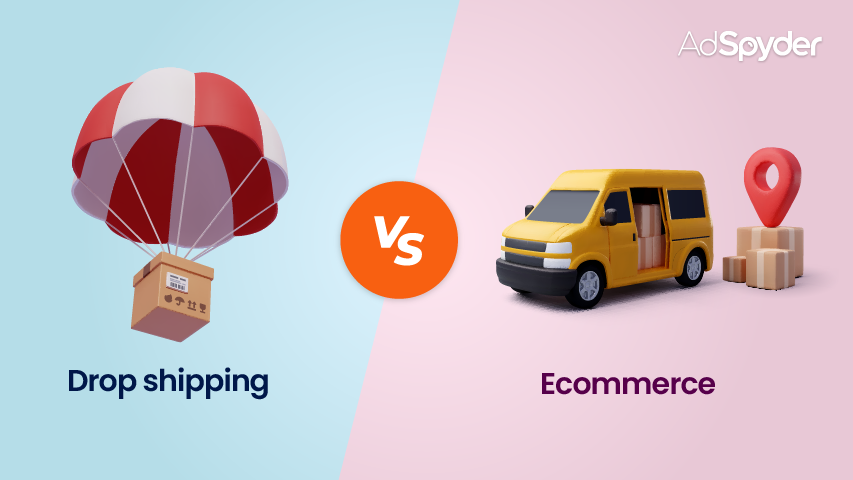
“E-commerce vs dropshipping” is one of the most searched decisions in online business—because both models can work, but they win for different reasons. An ecommerce business gives you more control and higher margins when you manage inventory and fulfillment. A dropshipping business reduces upfront risk by letting suppliers ship orders directly to customers—so you focus on traffic, conversion, and retention.
This guide breaks down what each model is, the real dropshipping pros and cons, when a hybrid approach makes sense, and a practical “drop shipping how to start” path you can follow—whether you want to start a dropshipping business from scratch or scale a branded store with inventory.
What’s an E-commerce Business?
An ecommerce business sells products online through a website, marketplace, or social shop. You can sell your own products, private-label items, or wholesale inventory. You typically manage product quality, pricing, branding, and the customer experience end-to-end.
- Higher margin potential through bulk purchasing or manufacturing
- Full control over packaging, unboxing, and brand perception
- Faster shipping with local fulfillment or owned inventory
- A defensible brand (repeat buyers + retention)
If you’re building trust at scale, content matters. For example, internal storytelling and culture-led content can influence how people perceive your business— which is why many teams invest in employee engagement videos alongside customer-facing creatives.
What Is Dropshipping?
A dropshipping business is a fulfillment method where you sell products you don’t physically stock. When a customer orders, the supplier ships directly to the customer. That’s why dropshipping is often recommended for beginners—you can validate demand without buying inventory upfront for high-value items, such as luxury engagement rings or designer accessories like a Swarovski necklace.
The phrase “e commerce dropshipping” usually refers to a store that looks like a standard ecommerce site, but uses suppliers behind the scenes for fulfillment—often through app integrations and catalog sync.
E-commerce vs Dropshipping: The Practical Comparison
Use this table to decide fast. If you’re still unsure after reading it, jump to the decision checklist below.
| Feature | E-commerce | Dropshipping |
|---|---|---|
| Upfront investment | Higher (inventory, storage, packaging) | Lower (no inventory required) |
| Brand control | High (packaging, inserts, custom experience) | Medium/Low (depends on supplier) |
| Shipping speed | Faster when stocked locally | Variable (supplier location + SLA) |
| Margins | Often higher (bulk pricing + repeat buyers) | Often lower (supplier markup + fees) |
| Operational complexity | Higher (inventory + fulfillment + forecasting) | Lower (focus on marketing + customer support) |
| Best for | Brand builders who want long-term defensibility | Testing demand quickly with lower upfront risk |
- Choose ecommerce if you need predictable shipping, premium branding, and repeat purchases.
- Choose dropshipping if you want to validate demand fast and keep startup costs minimal.
- Choose hybrid if you want to test with dropshipping first, then stock winners later.
E-commerce vs Dropshipping Costs & Margins: What You Actually Pay For

The biggest misconception is thinking dropshipping is “free.” You can start dropshipping for free only in the sense that you can begin without inventory— but you still pay for store software, creative production, customer support time, and (most importantly) paid traffic tests.
E-commerce cost structure
- Inventory purchase (largest cash requirement)
- Warehousing / storage (or 3PL fees)
- Packaging, inserts, returns, and QA
- Ads, email/SMS, and content production
Dropshipping cost structure
- Supplier product cost (higher than bulk inventory for products like for a Swarovski necklace)
- Supplier shipping fees (often per order)
- Refunds/chargebacks risk if shipping is slow or quality misses
- Ads + creative testing (your main scaling lever)
Marketing & Growth: Where Most Stores Win (or Lose)
The difference between “a store” and “a business” is repeatable acquisition. Whether you run ecommerce or dropshipping, your engine is the same: offer → creative → targeting → landing page → checkout → retention.
1) Go multi-channel on purpose
Most profitable brands don’t rely on one platform forever. They run short test loops across channels and double down on what converts. If you want ideas on building cohesive messaging across placements, use video in multichannel marketing as a framework—one core story, adapted into multiple creatives.
2) Use lookalikes once you have signals
Broad targeting can work early, but scaling usually needs cleaner audience expansion. When you have enough purchases, leads, or high-intent events, build lookalike audiences to reach people similar to your best customers—without guessing interests one by one.
3) Collab-led creatives can beat “product-only” ads
If you’re competing in a crowded niche, “good product photos” aren’t enough. A faster advantage is creator-led proof: real demos, unboxings, comparisons, objections, and outcomes. That’s why teams build pipelines for video marketing for influencer collaboration and turn those assets into conversion-focused ad variations.
Drop Shipping: How to Start (Without Wasting Months)

If your goal is to start a dropshipping business, the fastest path is “validation-first.” Don’t build a giant catalog. Start small, test quickly, and scale only when unit economics look real.
- Pick a niche where buyers have urgency, repeat needs, or clear “before/after” outcomes.
- Choose 3–8 products maximum for your first test cycle (avoid a 100-product store at launch).
- Vet suppliers (shipping times, quality, return policy, tracking reliability, communication).
- Build a tight offer (bundles, guarantees, bonuses, urgency, or value-add content).
- Launch small paid tests with 3–5 creatives per product and a clear learning goal.
- Scale winners by improving creatives, upsells, and retention—not by adding random products.
What about “start dropshipping for free”?
You can reduce cost by using trials, free themes, and organic content—but the moment you need predictable sales, you’ll invest in ads, creators, or distribution. A smarter goal is “start lean,” not “start free.”
Amazon drop shipping business: a quick note
An Amazon drop shipping business can work, but it’s less forgiving. Marketplace policies, delivery SLAs, and customer expectations are strict. If you do it, ensure your supplier can meet delivery targets, provide tracking reliably, and handle returns cleanly—otherwise account health becomes your biggest risk.
Best Drop Shipping Companies & Dropshipping Platforms: What to Look For
People search “best drop shipping companies” expecting a universal list. In reality, the best supplier depends on your niche, geography, delivery promise, and return expectations.
- Real shipping time ranges by destination (not “estimated” marketing claims)
- Tracking quality and exception handling (lost packages, failed delivery)
- Return address, refund timelines, and who pays return shipping
- Product quality consistency (batch variance is the silent killer)
- Support response time (hours, not days)
For a platform breakdown and how people choose tools, explore dropshipping platforms and compare integrations, supplier access, and automation.
A simple way to reduce dropshipping risk
Use a “test-to-stock” rule: once a product proves consistent demand and acceptable refund rates, consider holding small inventory for faster shipping and better margins. This hybrid approach often produces the best balance of speed and profitability in ecommerce vs dropshipping decisions.
Key Statistics: E-commerce vs Dropshipping (Quick Snapshot)
How AdSpyder Helps You Scale E-commerce vs Dropshipping
Whether you run a branded ecommerce store or a lean dropshipping operation, growth comes down to “what works right now” in your market. AdSpyder helps you avoid blind testing by showing patterns in competitor offers, creatives, hooks, and landing page structure.
- Discover proven angles and creatives competitors are scaling
- Spot new product positioning ideas before you spend heavily
- Build faster testing loops (more variations, less guessing)
- Improve messaging consistency across channels and placements
FAQs: E-commerce vs Dropshipping
What is the main difference between ecommerce and dropshipping?
Is dropshipping good for beginners?
Can I start dropshipping for free?
Which model is more profitable: ecommerce or dropshipping?
How do I find the best drop shipping companies?
What are the biggest dropshipping cons?
Can I combine ecommerce and dropshipping?
Conclusion: E-commerce vs Dropshipping
The best choice in E-commerce vs Dropshipping depends on what you’re optimizing for. If you want control, premium branding, and margin expansion, ecommerce is the stronger long-term play. If you want to validate demand fast with lower upfront cost, dropshipping can be a smart entry—especially when you treat supplier quality and customer experience as non-negotiable. Whichever model you choose, consistent growth comes from strong offers, better creatives, and faster learning loops.