Quick Answer
- Capture email or SMS only when the shopper receives a clear benefit.
- Use product quizzes when customers need help choosing between several products.
- Segment retargeting by product view, quiz result, cart value and purchase intent.
- Match every ad to a relevant collection, quiz, offer or product page.
- Measure subscriber-to-purchase rate and revenue—not email sign-ups alone.
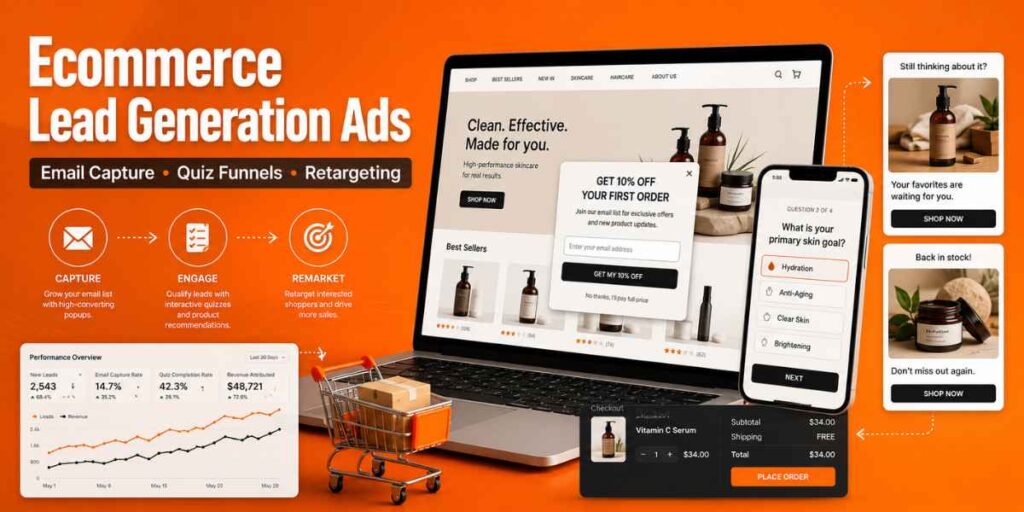
Strong ecommerce lead generation turns anonymous visitors into identifiable shoppers before they are ready to buy. Email capture, product quizzes and retargeting work best as one connected system: capture a useful preference, recommend the right product and follow up with a message that reflects what the shopper actually viewed or selected.
Ecommerce Lead Generation Playbook
Why Ecommerce Lead Generation Often Produces Low-Value Subscribers
Many stores treat every email address as an equally valuable lead. That creates a large list with limited buying intent and weak personalization data.
Generic discount popups
The store captures an email but learns nothing about category interest, product need or purchase timing.
Too many product choices
Shoppers leave because the catalog does not help them compare products or choose confidently.
One retargeting audience
A casual homepage visitor sees the same ad as a shopper who abandoned a high-value cart.
Disconnected follow-up
The welcome email promotes unrelated products instead of continuing the shopper’s original journey.
The solution is a connected journey: acquire the visitor through the correct channel, capture useful first-party preferences, recommend relevant products and trigger follow-up based on behavior.
Ecommerce Capture and Conversion Benchmarks
Recent ecommerce research published or updated in 2025–2026.
70.19%
Cart Abandonment
Global ecommerce average
69%
Quiz Completion
Shoppers who start and finish
5.5%
Quiz-to-Purchase
Completed quiz to order
30%
Email Revenue
Generated by 2% of sends
Sources: Baymard 2025 checkout research, RevenueHunt 2026 quiz benchmark and Omnisend 2026 ecommerce marketing report.
Target Audiences and High-Intent Ecommerce Moments
| Shopper Segment | Intent Signal | Best Lead Journey |
|---|---|---|
| First-time browser | Views several categories but no product repeatedly | Preference quiz or category guide |
| Problem-aware shopper | Searches for the best product for a specific need | Product finder with educational result |
| Product comparer | Revisits two or more product pages | Comparison email and product-specific retargeting |
| Cart abandoner | Adds a product but leaves checkout | Cart email, dynamic ad and objection handling |
| Past customer | Approaches replenishment or complementary-product timing | Replenishment, cross-sell or loyalty sequence |
A lead becomes more valuable when the store knows what the shopper needs, which category they prefer and how close they are to buying.
Best Ecommerce Ad Channels and Campaign Structure
Mature D2C campaigns rarely depend on one channel. AdSpyder’s recent D2C cross-platform advertising analysis found that successful platform planning requires separating discovery, demand capture and retargeting roles.
| Channel | Primary Role | Best Destination |
|---|---|---|
| Meta | Discovery, UGC, offers and quiz acquisition | Quiz, collection or campaign landing page |
| Google Search | Capture category and problem-aware intent | Relevant collection, comparison or quiz |
| Google Shopping | Capture SKU-level purchase demand | Fast, complete product page |
| YouTube and creator ads | Education, demonstration and trust | Product guide or demonstrated product |
| Retargeting | Recover warm visitors and cart abandoners | Exact product, cart or personalized result |
Ecommerce Keywords, Lead Offers and Creative Angles
High-intent keyword patterns
- best [product] for [need]
- [product] finder
- [product A] vs [product B]
- which [product] should I buy
- [category] gift guide
- [product] for beginners
Lead-capture offers
- Personalized product recommendation
- First-order incentive
- Early access to a product launch
- Back-in-stock notification
- Buying guide or comparison chart
- Bundle builder or routine planner
Creative angles
- Creator demonstration
- Problem-to-product transformation
- Customer review montage
- Find-your-match quiz
- Comparison or myth-busting
- Bundle value explanation
For Shopping campaigns, analyze product titles, images, pricing and listing longevity—not only promotional copy. AdSpyder’s Shopping Ads Spy guide explains how ecommerce teams can compare product listings across markets.
How to Build a Product Quiz Funnel That Generates Useful Leads
Start with a real buying decision
Build the quiz around product fit, routine, size, style, skin type, use case or gift recipient—not entertainment alone.
Ask only questions that change the result
Each answer should influence the recommendation, segmentation or follow-up sequence. Remove questions that collect interesting but unusable information.
Explain why the recommendation fits
Show two or three suitable products and connect each recommendation to the shopper’s answers.
Use email capture with clear value
Offer to email the result, routine, comparison or personalized recommendations. Explain what messages the shopper will receive.
Retarget by quiz result
A shopper matched to a sensitive-skin routine should not receive the same creative as a shopper looking for maximum-strength results.
See how D2C competitors acquire, educate and retarget shoppers
Use AdSpyder to compare competitor platforms, creative angles, calls to action, keywords and post-click experiences before building your own lead funnel.
Ecommerce Retargeting Segments and Message Examples
| Audience | Message | Destination |
|---|---|---|
| Quiz starter, no completion | Finish finding your best match | Saved quiz step or quiz start |
| Quiz completer, no purchase | Your recommended routine is ready | Personalized result page |
| Product viewer | Show the benefit, proof or comparison they missed | Exact product page |
| Cart abandoner | Resolve shipping, returns, trust or price concerns | Cart or checkout recovery page |
| Previous buyer | Replenish, upgrade or complete the routine | Relevant reorder or cross-sell page |
Retargeting should move the shopper forward rather than repeatedly showing the same acquisition ad. Review AdSpyder’s guide to building retargeting ads for additional audience and messaging ideas.
Ecommerce Landing Page and Lead-Quality Checklist
Before Sending Paid Traffic
The page continues the exact ad promise and product angle.
Shipping, returns, delivery timing and payment details are easy to find.
Reviews, demonstrations and product-use details answer buyer objections.
Email or SMS consent language clearly explains future communication.
Mobile speed, image quality, variant selection and checkout flow are tested.
When evaluating competitors, compare the promise in the ad with the offer, headline, proof and CTA on the destination page. Use the workflow in AdSpyder’s competitor landing-page teardown guide.
How to Teardown Ecommerce Competitor Ads with AdSpyder
Start with the competitor domain
Search the brand domain to map its platform presence before focusing on one creative or campaign.
Group Meta ads by persuasion angle
Sort ads into product demo, creator proof, discount, problem-solution, comparison, quiz and launch angles. AdSpyder’s guide to analyzing competitor Facebook ads provides a structured format, hook, proof and CTA framework.
Check the lead mechanism
Record whether the ad sends shoppers to a product page, collection, quiz, instant form, email gate or promotional landing page.
Compare Search, Shopping and Meta roles
A competitor may test creative on Meta while capturing purchase demand through Shopping and Search. Do not judge the complete funnel from one platform.
Turn patterns into original tests
Create a test hypothesis such as: “Competitors lead with discounts, but few help shoppers select the right product. We will test a quiz-led acquisition ad against our standard collection ad.”
Important Limitation
Competitor ad data reveals visible activity, messaging and destinations. It does not reveal private ROAS, revenue, conversion rate or profitability. Use patterns to choose experiments, then use your own attribution and customer data to choose winners.
30-Day Ecommerce Lead Generation Action Plan
| Days | Main Task | Output |
|---|---|---|
| Days 1–5 | Map products, buyer problems, lead sources and existing email performance. | Funnel baseline |
| Days 6–10 | Audit five direct competitors across Meta, Search, Shopping and landing pages with AdSpyder. | Competitor pattern file |
| Days 11–15 | Build one email-capture offer or product recommendation quiz. | Lead-capture experience |
| Days 16–20 | Launch two acquisition creatives and separate retargeting audiences. | Campaigns live |
| Days 21–25 | Activate welcome, quiz-result, browse and cart-abandonment automations. | Lifecycle follow-up |
| Days 26–30 | Compare lead quality, quiz completion, subscriber purchase rate and revenue by source. | Month-two test plan |
Build your ecommerce lead funnel from competitor evidence
Use AdSpyder to compare D2C creative, platform presence, product ads, CTAs and landing pages before deciding which email capture, quiz or retargeting angle to test.
Frequently Asked Questions
What is ecommerce lead generation?+
Ecommerce lead generation is the process of converting anonymous visitors into identifiable prospects through email, SMS, quizzes, alerts or other opt-ins before or alongside a product purchase.
What is the best ecommerce lead magnet?+
The best lead magnet solves a buying problem. Product recommendations, back-in-stock alerts, personalized routines, comparison guides and first-order offers usually provide clearer value than a generic newsletter invitation.
Do ecommerce quizzes generate sales?+
They can when the questions improve product selection. RevenueHunt’s 2026 benchmark reported a 69% completion rate and a 5.5% purchase rate among shoppers who finished a product recommendation quiz.
How should ecommerce stores retarget quiz users?+
Segment users by quiz completion and recommendation result. Continue incomplete quizzes, remind completers of recommended products and use the answers to personalize email, SMS and advertising creative.
Which email automations should ecommerce stores launch first?+
Start with welcome, abandoned-cart and browse-abandonment sequences. Add quiz-result, back-in-stock, post-purchase and replenishment flows after the core journeys are working.
What ecommerce lead generation metrics matter most?+
Track capture rate, quiz completion, subscriber-to-purchase rate, cost per purchasing subscriber, revenue per lead, average order value, unsubscribe rate and revenue by acquisition source.
Can AdSpyder show whether a competitor’s quiz or ad is profitable?+
No public competitive-intelligence tool can confirm private revenue, ROAS or profit. AdSpyder helps identify visible ads, keywords, platform activity, CTAs and landing pages so ecommerce teams can create better-informed experiments.