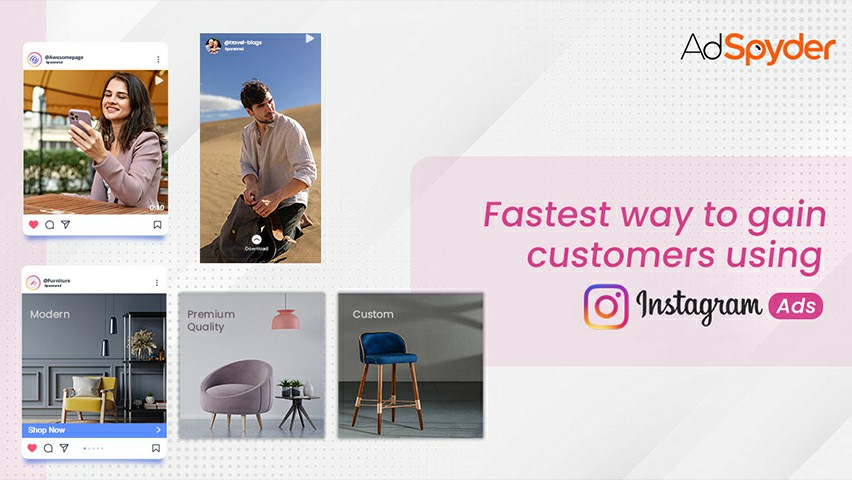
Instagram is no longer “just a social app”—it’s a full-funnel growth channel where people discover brands, compare options, and buy. With modern Instagram advertising, you can target by intent signals (behavior, interests, lookalikes), choose high-performing placements (Feed, Stories, Reels, Explore), and measure outcomes down to conversions.
This guide explains how to run ads on instagram using Instagram Ads Manager (Meta Ads Manager), how targeting works, which ad formats to choose, what Instagram ads cost typically looks like, and the fastest ways for small businesses to
get consistent leads and sales.
Why Instagram Advertising Works for Customer Growth
Instagram is visual-first, mobile-first, and discovery-driven—meaning people are already in “scroll to find something interesting” mode. When your ad looks native, your offer is clear, and your landing page matches the promise, Instagram sponsored ads can drive new customers faster than many organic channels.
- Attention: Scroll-stopping creative (short video, carousel, bold hook)
- Trust: Reviews, UGC, and social proof in marketing
- Action: A single clear CTA (Shop now, Book, Get quote, Start trial)
- Retention: Retarget viewers, engagers, and site visitors with the next offer
so interested people can ask questions and move to checkout/booking faster.
The biggest mistake is treating Instagram like a billboard. The winning approach: match what people want to see—helpful, entertaining, or aspirational content—and then deliver the offer in a clean, frictionless way.
Instagram Ads Manager: How to Set Up Campaigns Correctly
Most “real” Instagram advertising is built in Instagram Ads Manager (Meta Ads Manager). You can still boost posts from the app, but Ads Manager gives you better control over objectives, placements, targeting, and measurement.
- Connect your Instagram account to a Meta Business portfolio
- Confirm pixel + conversion events (or app events) are firing correctly
- Choose an objective that matches your goal (Sales/Leads/Traffic/Awareness)
- Set a realistic daily budget for learning (don’t starve the algorithm)
- Pick placements intentionally (or start with automatic placements + review performance)
- Launch with 2–4 creatives and 2–3 audiences (enough variety, not chaos)
| Option | Best for | Limitations |
|---|---|---|
| Boost Post (in-app) | Quick reach, simple engagement, lightweight traffic tests | Less control over targeting structure, optimization, and reporting depth |
| Instagram Ads Manager (Meta Ads Manager) | Full-funnel campaigns (sales, leads), structured testing, scaling | More setup steps (pixel, events, creatives, tracking) |
If you’re asking how to advertise on instagram “the right way,” Ads Manager is almost always the answer— especially for lead gen, purchases, and retargeting.
Instagram Ad Formats: What to Use (and When)

The best format depends on your goal. If you want fast intent capture, Stories/Reels can work well. If you need product depth, carousels often win.
For trust-building, short videos with testimonials or demos are hard to beat.
| Format | Where it shows | Use it for | Creative tip |
|---|---|---|---|
| Image ads | Feed, Explore | Simple offers, retargeting, product highlights | 1 message, 1 CTA, strong contrast |
| Instagram story ads | Stories | High-intent clicks, limited-time promos | Vertical-first, big headline, fast hook |
| Reels ads | Reels | Awareness + performance when creative is native | Use captions, show product in first 2 seconds |
| Instagram carousel ads | Feed, Stories (carousel stories), Explore | Explainers, comparisons, bundles, catalogs | Slide 1 = hook, slides 2–5 = proof, last = CTA |
| Collection / shop ads | Feed, Explore | Ecommerce discovery + easier browsing | Use clear categories + “best sellers” |
Video ads often win here because you can demonstrate value quickly using
storytelling in video marketing.
Instagram Ads Targeting: How to Find Buyers (Not Just Viewers)
Strong instagram ads targeting is a balance: narrow enough to be relevant, broad enough to let the algorithm learn.
If you’re too broad, you pay for unqualified impressions. If you’re too narrow, delivery becomes expensive and inconsistent.
| Targeting type | What it is | When it works best | Example |
|---|---|---|---|
| Core (interests/demos) | Interests, behaviors, demographics, locations | New customer prospecting | “Fitness” + “nutrition” + 18–34 + metro cities |
| Custom audiences | Website visitors, engagers, video viewers, customer lists | Retargeting + warm conversions | Viewed product page in last 14 days |
| Lookalike | People similar to your buyers/leads | Scaling beyond your warm pool | 1–3% lookalike of purchasers |
| Placement-focused | Optimizing for Stories/Reels vs Feed behaviors | Creative that is truly native to the placement | Reels-only for UGC style videos |
- Prospecting: 1–2 broad core audiences + 1 lookalike (if you have data)
- Warm retargeting: engagers (7–30 days), video viewers (25–95%), site visitors (7–14 days)
- Hot retargeting: cart/checkout viewers (3–7 days) + offer reinforcement
If your ads “get views but not results,” it’s usually one of these: wrong audience intent, weak creative hook, or the landing page doesn’t match the promise.
Instagram Advertising Cost: What You Pay and Why It Varies
Instagram advertising cost depends on auction dynamics: your bid strategy, audience size, creative quality, expected action rate, and how competitive your niche is. This is why you’ll see different instagram advertising rates across accounts.
Don’t obsess over a single benchmark. Instead, track your unit economics: cost per lead, cost per purchase, and your break-even ROAS.
| Cost metric | What it means | How to improve it |
|---|---|---|
| CPM (cost per 1,000 impressions) | How expensive it is to get seen | Broaden audience, refresh creatives, improve relevance |
| CPC (cost per click) | How expensive it is to drive traffic | Stronger hook, clearer CTA, better offer alignment |
| CPL (cost per lead) | What you pay to capture a lead | Simplify form, improve trust, retarget warm users |
| CPA (cost per purchase/action) | What you pay to get the result you want | Optimize landing page, improve checkout, add proof, test creatives |
to a higher-funnel event (view content → add to cart → purchase) and build a retargeting layer for purchases.
If you’re researching advertising in instagram cost, remember: “cheap clicks” don’t matter if they don’t convert.
Optimize for outcomes, not vanity metrics.
How to Promote Instagram Post (Boosting) Without Wasting Money
If you’re asking how to promote instagram post, the best practice is to boost content that already performs well organically. Boosting a weak post just amplifies a weak message.
- Boost posts that already have saves, shares, or strong watch time
- Use a single goal: profile visits, website clicks, or DMs
- Target: start broad + add a tight geo (if needed)
- Run 3–5 days, then decide: scale, refresh creative, or stop
If you need predictable sales/leads, move from boosting to Ads Manager so you can run conversion-optimized campaigns and structured retargeting.
Instagram Ads for Small Business: A Simple 3-Campaign System

Instagram ads for small business work best when you keep the system simple: one campaign to find buyers, one to warm them up, and one to convert. This structure also helps you understand what’s actually working (creative, targeting, or offer).
- Prospecting (new people): Reels/Story videos + 1–2 broad audiences
- Engagement warming: Best-performing post as a view/engagement driver
- Retargeting (close the sale): Offer + proof (UGC/reviews) to site visitors/engagers
If your product needs explanation, use a carousel to “teach” (problem → solution → proof → CTA). If it’s impulse-friendly, short videos win.
Key Instagram Advertising Statistics (Quick Snapshot)
How AdSpyder Helps You Win Instagram Ads Faster
The fastest way to improve results is to stop guessing. Winning accounts don’t “invent” ads from scratch—they learn patterns from what already works, then create better variations. That’s where AdSpyder comes in.
- Spot competitor offers, angles, and creative patterns that keep repeating (usually a sign they convert)
- Build faster tests for Reels, Stories, and Carousel formats (without copying)
- Reverse-engineer landing pages so your post-click experience matches the ad promise
- Improve iteration speed—more tests, faster learning, better ROAS
FAQs: Instagram Advertising
How to run ads on Instagram for a beginner?
How much do Instagram ads cost?
What is Instagram Ads Manager?
Which Instagram ad format works best?
How to advertise on Instagram for small business?
Do hashtags help Instagram ads?
How can I improve targeting and reduce wasted spend?
Conclusion
Instagram advertising works when you combine the right objective, smart instagram ads targeting, and creative that feels native.
Use Ads Manager for structured campaigns, pick formats based on intent (Stories/Reels for attention, carousel for education, video for trust), and measure success by leads and purchases—not just impressions. Add proof, simplify post-click experience, and iterate faster with competitor insights using AdSpyder.