
Healthcare digital advertising has entered a new era—one where performance and compliance must work hand in hand. As platforms like Google Ads and Meta tighten healthcare policies and regulators increase scrutiny, marketers can no longer rely on generic messaging or aggressive claims. In 2026, success depends on creating compliant healthcare ads that build trust, respect patient privacy, and still drive measurable growth.
This guide explores how healthcare brands can master advertising compliance while improving patient acquisition strategies—using real competitor insights, platform intelligence, and AI-powered creative generation.
Why Healthcare Advertising Compliance Matters More Than Ever
Healthcare decisions are high-stakes. Patients expect transparency, accuracy, and ethical communication. Regulators and ad platforms enforce this expectation with strict guidelines covering:
- Medical claims and outcomes
- Targeting restrictions
- Sensitive health data and privacy
- Misleading imagery or exaggerated benefits
According to industry reports, 19% of all ads facing rejection or limited delivery due to policy violations are from healthcare. This leads to wasted spend and delayed campaigns. This makes healthcare advertising compliance not just a legal requirement—but a performance imperative.
Healthcare Advertising Compliance Challenge in Medical Ad Campaigns
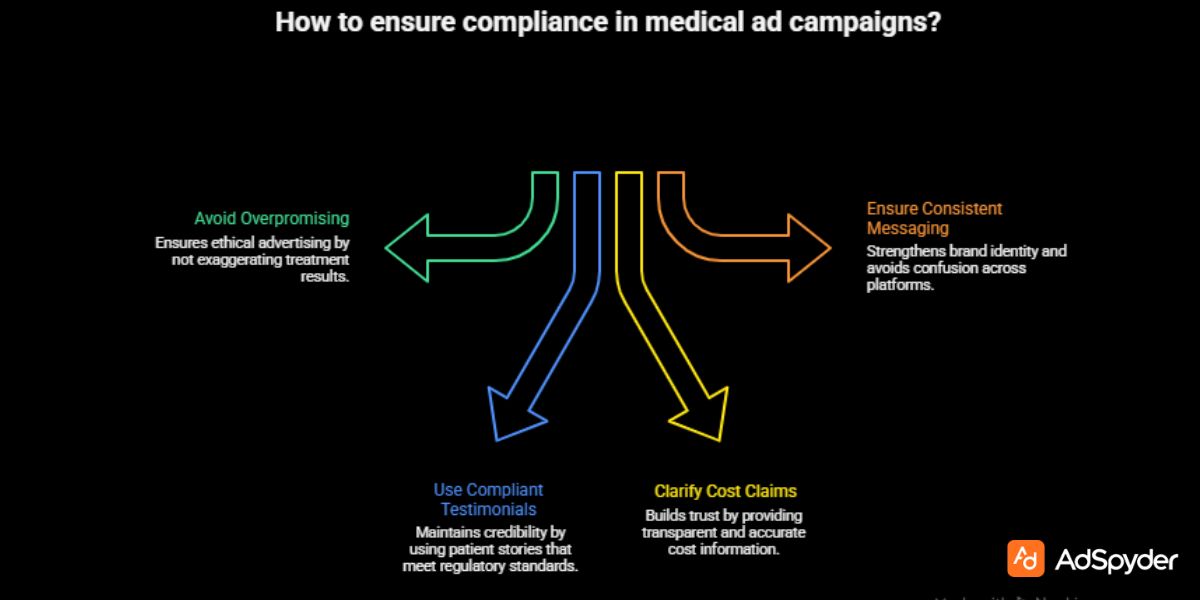
Healthcare marketers face unique hurdles compared to other industries. Compliance issues are rarely black and white, and platform rules often change without warning.
Before exploring solutions, it’s important to understand where most campaigns fail:
- Overpromising treatment results
- Using non-compliant patient testimonials
- Vague or misleading cost claims
- Inconsistent messaging across platforms
Without visibility into what’s already approved and performing, teams are left guessing—slowing down growth and increasing risk.
Learning from Approved, High-Performing Competitor Ads
One of the most effective ways to ensure compliance is to analyze what’s already working in the market.
By studying approved medical advertising campaigns from competitors, healthcare marketers can uncover:
- Language patterns that pass platform reviews
- Trust-building messaging frameworks
- Safe ways to highlight expertise, access, and outcomes
Using a competitive ad intelligence hub like AdSpyder for Smarter Healthcare Services Advertising, teams can filter ads by platform, region, and service type—revealing exactly how leading brands balance compliance with performance.
This approach replaces guesswork with data-backed confidence.
Creating Compliant Healthcare Ads Without Sacrificing Performance
Compliance doesn’t mean boring or ineffective ads. The key is aligning creative strategy with patient expectations and platform rules.
Successful compliant healthcare ads typically focus on four proven angles:
- Trust and authority (credentials, safety standards)
- Access and convenience (telehealth, fast appointments)
- Cost transparency (insurance clarity, pricing ranges)
- Specialization and expertise (specific conditions or treatments)
Before listing these angles, marketers must evaluate them through real-world examples. Competitive analysis allows teams to see which angles are actively approved and driving engagement—reducing trial-and-error.
This insight also feeds directly into AI-powered ad generation, enabling fast creation of compliant variations without legal risk.
Compliance Varies by Platform, Location, and Service
Healthcare advertising compliance isn’t universal. What’s allowed for a women’s health clinic on Google Search may be restricted for a telehealth service on Meta.
That’s why granular analysis is critical. Advanced filtering helps marketers isolate ads by:
- Platform (Google Ads, Facebook Ads, YouTube Ads, LinkedIn Ads)
- Geography (local clinics vs national services)
- Specialty (mental health, urgent care, family health center)
This level of specificity ensures that local ads for clinics are tailored correctly—especially for high-intent searches like medical centre near me or community health center.
Reducing Healthcare Advertising Compliance Risk with Pre-Launch Creative Analysis
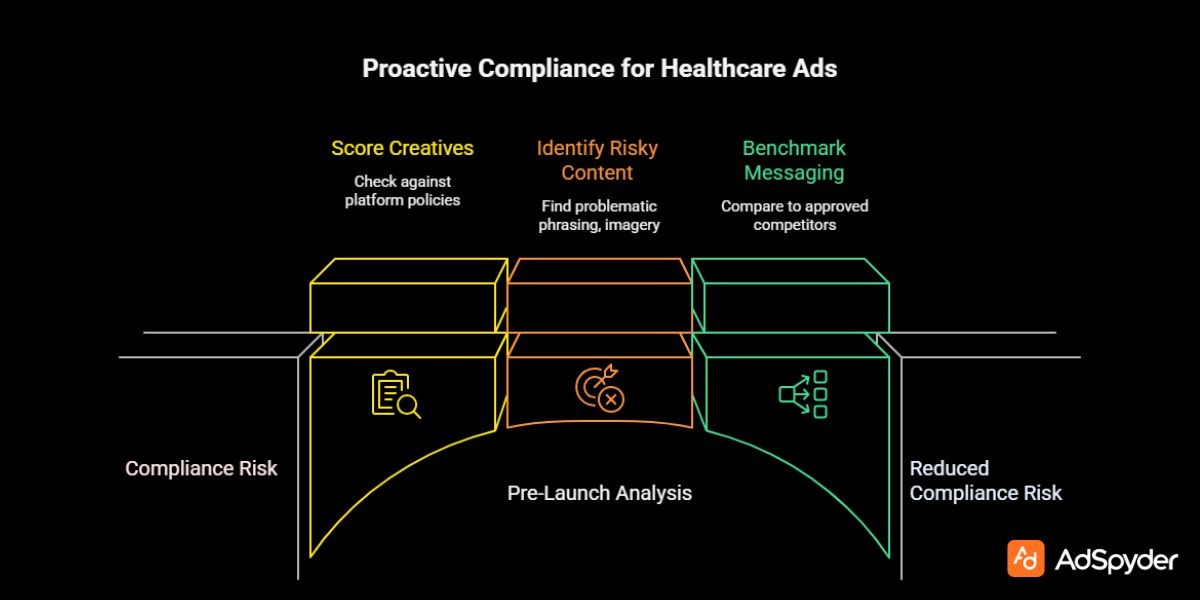
One of the biggest compliance mistakes happens before ads even go live. Without scoring or validation, teams risk rejections that delay launches and hurt momentum.
Modern healthcare marketers now rely on ad content analysis tools to:
- Score creatives against platform policies
- Identify risky phrasing or imagery
- Compare messaging to approved competitor benchmarks
By validating creatives before launch, brands can shorten review cycles and protect their ad accounts—while still scaling patient acquisition strategies.
This proactive approach supports both compliance and efficiency.
Healthcare Advertising Compliance as a Competitive Advantage in 2026
Healthcare brands that prioritize compliance don’t just avoid penalties—they win patient trust.
Research shows that trust-focused healthcare ads generate up to 30% higher engagement than promotional or hype-driven messaging. Patients respond better to transparency, clarity, and credibility—especially in sensitive categories like mental health, women’s health, and telehealth.
When compliance is integrated into strategy—not treated as a constraint—it becomes a growth lever.
This foundation also supports advanced tactics like patient acquisition funnel optimization, healthcare PPC, and healthcare SEM, which we explore further in related guides.
How Healthcare Advertising Compliance Connects to the Full Patient Journey
Compliance doesn’t stop at the ad. The promise made in the creative must align with the landing page, inquiry flow, and follow-up experience.
Analyzing competitor ad-to-landing-page journeys reveals how top brands:
- Reinforce trust post-click
- Match ad claims with on-page content
- Reduce friction in appointment booking
This alignment lowers bounce rates, improves Quality Score, and strengthens long-term patient relationships—especially for regulated services like telehealth marketing ads.
FAQs: Healthcare Advertising Compliance
What makes a healthcare ad compliant?
A compliant healthcare ad follows platform rules, avoids misleading claims, protects patient privacy, and uses accurate, transparent messaging.
Why are healthcare ads rejected so often?
Most rejections stem from exaggerated claims, restricted targeting, or unclear medical outcomes.
Can compliant healthcare ads still perform well?
Yes. Trust-based messaging often outperforms aggressive sales tactics in healthcare digital advertising.
Does compliance differ by platform?
Absolutely. Google, Meta, and LinkedIn each apply healthcare policies differently.
How can clinics ensure local ads remain compliant?
By analyzing approved local competitor ads and filtering by region and service type.
Is AI safe to use for healthcare ad creation?
Yes—when guided by real, approved competitor data and compliance scoring.
How does compliance affect patient acquisition strategies?
Compliance builds trust, which directly improves engagement, lead quality, and conversion rates.
Conclusion: Building Healthcare Advertising Compliance That Scales
In 2026, healthcare advertising compliance is no longer a barrier to growth—it is a strategic advantage. Brands that ground their healthcare digital advertising in transparency, trust, and real competitor intelligence consistently outperform those relying on hype or generic messaging. By studying approved healthcare PPC strategies, healthcare marketers can confidently create compliant healthcare ads that resonate with patients and meet evolving platform standards.
When compliance is embedded into creative research, AI-driven generation, and campaign optimization, it strengthens every stage of patient acquisition strategies. With the right insights, healthcare teams can scale telehealth marketing ads, improve lead quality, and protect long-term brand credibility—turning compliance into a sustainable engine for patient growth.