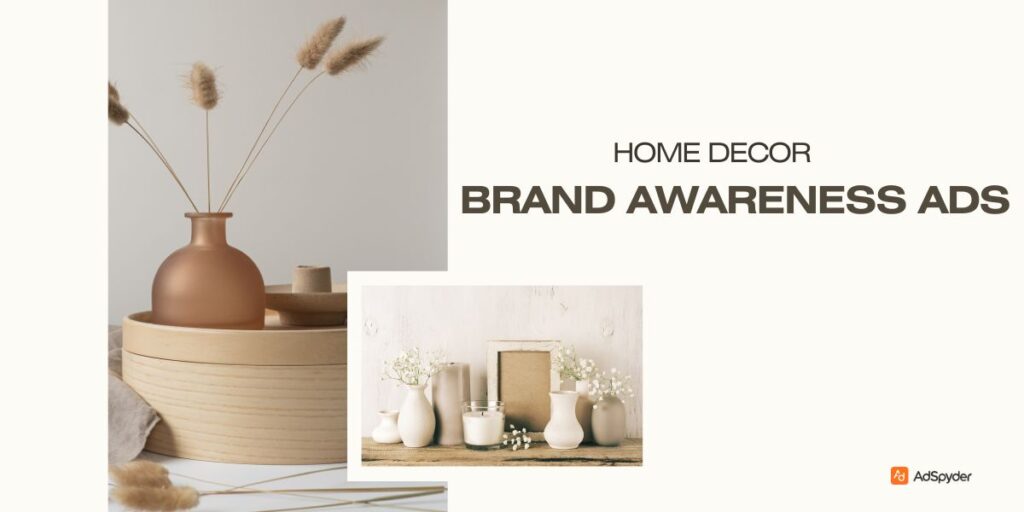
Home decor isn’t an impulse category—it’s a taste category. People save, compare, screenshot, mood-board, ask friends, revisit, then buy. That’s why home decor brand awareness ads outperform “hard sell” messaging over time: your goal is to become the brand that shows up in the buyer’s head when they finally decide to refresh a room.
This guide breaks down home decor brand awareness advertising for 2026—what to run, where to run it, and how to measure lift. You’ll also see home decor awareness campaign examples (from Pinterest-first creatives to influencer-led room transformations), plus a repeatable framework you can apply whether you sell furniture, lighting, textiles, wall art, or decor bundles.
What Are Home Decor Brand Awareness Ads?
Brand awareness ads for home decor brands are campaigns designed to build memory and preference before the customer is ready to buy.
Instead of pushing “Shop now” immediately, awareness creative focuses on making your brand feel like the obvious choice when the buyer eventually purchases:
a recognizable style, a signature color palette, a distinct room mood, and a clear reason to trust quality.
- Awareness ads build taste + trust: “This brand matches my style and feels premium/reliable.”
- Consideration ads reduce uncertainty: reviews, materials, delivery, sizing, room-fit visuals.
- Conversion ads close the loop: bundles, financing, limited drops, free shipping thresholds, retargeting.
The mistake many decor brands make is skipping straight to bottom-funnel. But shoppers often take weeks (or months) from first inspiration to checkout.
Your best-performing awareness work is what lowers CPA later—because people click your brand name, not a generic product.
Key Home Decor Brand Awareness Ads Stats (Why This Category Rewards Branding)
The Home Decor Brand Awareness Advertising Framework (Style → Proof → Distribution → Momentum)

Most decor ads fail because they act like product ads in a category that sells identity. Your awareness engine should be built like a system:
establish a recognizable aesthetic, prove quality, distribute through the right channels, then keep momentum with repeatable story formats.
| Layer | What you build | Example creative | Goal metric |
|---|---|---|---|
| Style | A clear “room mood” + signature palette | Before/after room transformation | Reach, video views, saves |
| Proof | Quality cues + trust assets | Material closeups + reviews overlay | Engaged visits, CTR to PDP |
| Distribution | Channel mix + creator engine | UGC + influencer “room day” | Frequency, brand search lift |
| Momentum | Repeatable series + seasonal drops | “One room, one budget” series | Return visits, assisted conversions |
| Conversion bridge | Retargeting + bundles + local | “Complete the look” carousel | CVR, CPA, ROAS |
Notice what’s missing: screaming discounts as your main message. In decor, a price-led brand can win, but awareness still requires taste cues and trust. Your conversion engine becomes easier once people believe your aesthetic fits them.
Home Decor Brand Awareness Advertising Examples (What to Copy in 2026)
You don’t need to copy exact visuals—copy the structure. The best awareness ads in home decor tend to fall into a few repeatable campaign “types.”
Here are examples you can use as a blueprint for your own creative.
1) The “Room Transformation” narrative (before → after)
The simplest awareness concept in decor: show an ordinary room becoming aspirational. The key is clarity—a single style direction, a clear hero product,
and a satisfying reveal. This format works especially well in short video (Reels/TikTok/Pins) and can be scaled into a series:
“One wall,” “One corner,” “One weekend makeover.”
2) Pinterest inspiration-to-purchase campaigns (save-first behavior)
Pinterest is uniquely strong for decor because the platform is designed for visual discovery and planning. In a Pinterest success story for Life Interiors,
a campaign reported an 82% month-to-month increase in conversions—a reminder that inspiration platforms can still drive measurable outcomes.
The best Pinterest awareness creative doesn’t look like an ad; it looks like a beautiful idea: styling tips, room palettes, “how to build the look,” and product tags.
- Style boards: “Warm minimal,” “Modern rustic,” “Coastal calm.”
- Shopping Pins: combine inspiration + product availability.
- Timing: don’t stop after holidays—Pinterest highlights “Q5” (Dec 26–31) as an active shopping window.
3) Influencer-led “lived-in” proof (real homes, real constraints)
Home decor is full of skepticism: “Will it look like the photos?” The easiest awareness win is letting creators show the product in real lighting,
real room sizes, and real everyday life. The best creator campaigns aren’t just unboxings—they’re use cases: styling, cleaning, durability, and “how it holds up.”
Many home and decor roundups emphasize creators because they deliver trust at scale (and they generate reusable ad assets).
4) AR / “visualize in my space” campaigns (confidence marketing)
If your products benefit from spatial confidence (rugs, sofas, lighting, wall art), awareness should reduce the biggest fear: “Will it fit?”
AR previews, sizing overlays, and “fit guides” (doorway check, assembly time, couch depth comparisons) make people feel safer—
and safer customers buy faster later.
5) The “signature style” brand film (taste ownership)
Some brands win by being unmistakable. Their awareness ads feel like a mini magazine spread: consistent color grading, repeated motifs, a particular type of space,
and products staged as a lifestyle. This approach works best when you have a clear point of view (not “something for everyone”).
If your product catalog is broad, build awareness around collections—not SKUs.
Channel Playbook for Home Decor Brand Awareness Advertising
Awareness isn’t “one channel.” It’s a coordinated set of touchpoints that builds recognition and then captures intent when it appears.
Here’s a practical mix that works well for decor brands.
1) Pinterest: discovery + saves that compound
Pinterest is ideal for top-of-funnel home decor because “saving” is a strong intent signal. Your creative should be a visual idea first:
a room palette, a styling formula, a “complete the look” board. Keep the copy minimal; let the image do the work.
Then retarget engagers with product carousels and collection pages.
2) Meta (Instagram + Facebook): video-first awareness, then proof
On Meta, awareness performs best when you sequence creative: (a) room transformation hook, (b) proof clip (materials, durability, reviews),
(c) “shop the room” carousel. If you also sell locally or have showrooms, Meta is strong for geographic targeting and store-visit behaviors.
For tactical performance layering, keep a swipe file of formats from Facebook ads for furniture retailers and adapt the structure to decor bundles and seasonal refresh campaigns.
3) Google (Search + Shopping): capture demand you created
Awareness should increase branded search volume over time. That’s when Search and Shopping become your demand-capture machine.
For Shopping specifically, benchmarks for Home & Furniture are often modest (for example, one 2025 benchmark source lists ~0.90% CTR and ~1.3% CVR),
which means creative quality and feed hygiene matter a lot: crisp images, clear titles, rich attributes, and reviews.
If you operate in adjacent categories (fixtures, renovation supplies), the targeting and structure ideas from Google ads for home improvement stores can translate nicely to decor “project” buyers.
4) Local awareness: win the radius around your store
If you have physical locations (or even pop-ups), local awareness can outperform national spend because decor is tactile—people want to see texture and color.
Use a simple local loop: geo-targeted video + showroom highlights + “book a styling consult” CTA. For concrete tactics on local targeting, offers, and creative ideas, use local advertising for home stores as the operational blueprint.
5) Retargeting: the conversion bridge (without feeling pushy)
The fastest way to prove awareness is working is to watch retargeting efficiency improve over time. For decor, retargeting works best when it’s intent-based:
separate visitors by behavior (collection viewers vs. PDP viewers vs. cart abandoners), then match the message to the stage.
If you want a clean segmentation model and creative sequencing, adapt the structure from retargeting ads for furniture buyers and apply it to “shop the room” bundles.
Measurement & Reporting in Home Decor Brand Awareness Ads: How to Prove Awareness Is Paying Off

Awareness doesn’t mean “unmeasurable.” It means you measure differently. In home decor, the strongest signals show up as a mix of platform metrics and business metrics:
more branded search, higher direct traffic, better retargeting efficiency, and higher assisted conversion rates.
- Reach + frequency by audience and region (are you showing up enough?)
- Video completion rate (are people actually watching your transformations?)
- Saves / adds-to-boards (Pinterest) and shares (Meta) as “taste signals”
- Branded search lift (Google Search Console + Ads brand campaign trends)
- Retargeting CPA trend (should improve as awareness grows)
- Assisted conversions and time-to-purchase (GA4) for decor categories
A practical measurement tactic: run always-on branded search campaigns and monitor impression share, CPC, and conversion rate as awareness spend scales.
If your awareness is working, you’ll typically see (a) more brand queries, (b) cheaper branded clicks relative to non-brand, and (c) improved conversion rates from returning visitors.
Also track the “content engine” side: which room styles are saved most, which creators drive engaged visits, which hooks create longer watch time.
Those are early signals you can use to decide what to scale without waiting weeks for purchase data.
FAQs: Home Decor Brand Awareness Ads
What are home decor brand awareness ads?
What creative works best for home decor awareness?
Is Pinterest good for brand awareness in home decor?
How long should I run awareness ads before expecting results?
What metrics prove awareness is working?
Should local home decor stores run awareness ads?
What’s the simplest awareness campaign to launch this month?
Conclusion
The fastest-growing decor brands don’t treat awareness as “extra.” They treat it as the engine that makes conversion cheaper. Build a recognizable style, prove quality in real spaces, distribute across inspiration platforms and social video, and keep momentum with repeatable room-story formats. Then connect it to demand capture through Search, Shopping, and segmented retargeting. When done right, home decor brand awareness advertising doesn’t just increase reach—it increases preference, which is the only sustainable advantage in a category built on taste.