Quick Findings
- Learn More was the most-used Meta CTA, appearing in 30.3% of historical records and 28.6% of real-time records.
- Send Message and Send WhatsApp Message together increased from 11.5% historically to 12.6% in the real-time dataset.
- Sign Up declined from 4.1% to 3.5%, while Book Now declined from 3.3% to 2.6%.
- In Google Search SaaS ads, product-led CTA language appeared in 2,078,027 ads, compared with 758,881 ads in the demo-related cluster.
- CTA frequency is a market signal—not proof of conversion performance, lead quality or ROAS.
The most popular call to action is not automatically the best call to action for your campaign.
A low-commitment CTA such as “Learn More” may suit an audience discovering a problem. A high-intent CTA such as “Book a Demo” may suit a prospect already comparing providers.
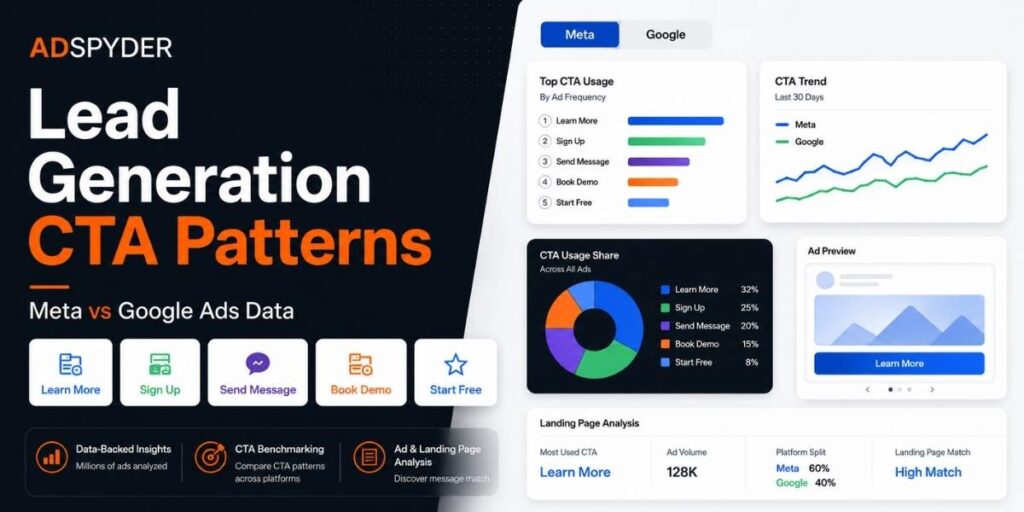
This AdSpyder Original study examines how advertisers use CTA buttons on Meta and CTA language in Google Search ads, then translates those patterns into practical choices for lead generation campaigns.
Marketers can use the AdSpyder Ad Library to find live and historical competitor ads before comparing their CTA wording, creative context and destination pages.
Table of Contents
Methodology and Dataset
This study uses two separate datasets because Meta and Google Search expose CTA information differently.
Meta Dataset
CTA records across cleaned historical and real-time Meta datasets.
Google Dataset
Google Search ads available for phrase-level analysis in the archive snapshot.
| Dataset | What Was Measured | Snapshot Date |
|---|---|---|
| Meta Historical | Normalized values from 14,373,097 records with a populated structured CTA field. | May 2026 |
| Meta Real-Time | Structured CTA values from 11,092,610 real-time ad records. | May 2026 |
| Google Search | Exact and related CTA phrases appearing inside SaaS-relevant ad copy. | July 2026 |
Why the Datasets Remain Separate: Meta provides a constrained CTA-button field. The Google analysis measures words and phrases inside ad copy. Their percentages and counts should not be combined into one platform ranking.
The Most-Used CTA Buttons in Meta Ads
Learn More and Shop Now dominate Meta’s structured CTA menu. Together, they represent 56.5% of populated historical CTA records and 53.5% of real-time records.
For campaign-level research, the Facebook Ads Spy lets marketers examine competitor Meta creatives, CTA elements, date ranges and campaign pages instead of evaluating button wording in isolation.
| CTA Button | Historical Share | Real-Time Share | Primary Intent |
|---|---|---|---|
| Learn More | 30.3% | 28.6% | Exploration |
| Shop Now | 26.2% | 24.9% | Purchase |
| Send Message | 6.1% | 6.6% | Conversation |
| Send WhatsApp Message | 5.4% | 6.0% | Conversation |
| Sign Up | 4.1% | 3.5% | Registration |
| Book Now | 3.3% | 2.6% | Scheduling |
| Install Now | 3.0% | 2.8% | App Acquisition |
| Order Now | 2.6% | 2.7% | Purchase |
| Apply Now | 2.5% | 2.1% | Application |
Historical vs Real-Time CTA Share
30.3% Historical · 28.6% Real-Time
6.1% Historical · 6.6% Real-Time
5.4% Historical · 6.0% Real-Time
4.1% Historical · 3.5% Real-Time
Which Meta CTAs Are Relevant to Lead Generation?
Not every popular Meta CTA is a lead generation CTA. Shop Now and Order Now usually support transactions, while Install Now is primarily an app-acquisition action.
Learn More
Useful for educational pages, reports, complex services and audiences that need more context before converting.
Send Message
Useful when buyers need a fast answer, a custom quote or reassurance before taking the next step.
Send WhatsApp Message
Useful for mobile-first markets, local services and businesses that already manage leads through WhatsApp.
Sign Up
Useful for webinars, newsletters, communities, accounts and offers where registration is the expected action.
Book Now
Useful for appointments, consultations, clinics, property visits and other schedule-based conversions.
Apply Now
Useful when access is selective, eligibility matters or the advertiser wants prospects to self-qualify.
Do Not Choose a CTA by Frequency Alone: Learn More is common partly because it is flexible and low commitment. That does not mean it will outperform a specific CTA such as Book a Demo or Get a Quote for a high-intent audience.
Free Trial vs Book a Demo in Google Search Ads
Google Search ads do not use the same structured CTA-button field as Meta in this dataset. The analysis therefore measures CTA-related phrases inside SaaS ad copy.
The Google Ads Spy can be used to review competitor headlines, descriptions, displayed landing pages, countries and date ranges when studying how CTA language fits the complete search ad.
Product-Led CTA Cluster
Ads containing phrases such as Free Trial, No Credit Card, Try Free, Start Free or Sign Up Free.
Best Match: Self-Serve and PLG SaaS
Demo-Related CTA Cluster
Ads containing Demo, Book a Demo, Book Demo, Watch Demo or closely related phrases.
Best Match: Sales-Assisted and Enterprise SaaS
Headline Finding: Product-led CTA language appeared approximately 2.74 times as often as demo-related language in the analysed Google Search SaaS ad clusters.
The difference reflects two distinct buying motions.
- Product-Led Growth: The advertiser removes sales friction and asks the prospect to experience the product.
- Sales-Assisted Growth: The advertiser asks the prospect to schedule a conversation before gaining access.
- Hybrid Growth: The advertiser may use Start Free for smaller accounts and Book a Demo for enterprise prospects.
The CTA Commitment Ladder
A useful lead generation CTA asks for the next reasonable commitment—not the largest commitment the business wants.
Explore
Examples: Learn More, See How It Works and Explore Solutions. Use when the audience still needs context.
Engage
Examples: Send Message, Chat on WhatsApp and Ask a Question. Use when conversation removes buying uncertainty.
Capture
Examples: Sign Up, Register, Download and Get the Guide. Use when the visitor receives a defined resource or access.
Experience
Examples: Start Free, Try Free and Create Account. Use when prospects can evaluate the product without sales assistance.
Schedule
Examples: Book a Demo, Book Consultation and Schedule a Call. Use when a human conversation is part of delivery.
Commit
Examples: Apply Now, Request Proposal, Get Started and Subscribe. Use when the audience understands the offer and is ready for a substantial next step.
Which CTA Should You Use by Offer Type?
| Offer | Recommended CTA Family | Why It Fits |
|---|---|---|
| Research Report or Guide | Download · Get the Report | Makes the value exchange specific. |
| Webinar or Event | Register · Save My Seat | Clearly describes the registration action. |
| Self-Serve SaaS | Start Free · Try Free | Lets prospects experience the product directly. |
| Enterprise SaaS | Book a Demo · Talk to Sales | Supports qualification and complex buying decisions. |
| Marketing Agency | Book Consultation · Request Proposal | Matches a customised service and sales process. |
| Local Service | Get a Quote · Send Message | Lets prospects ask about availability, location or price. |
| Selective High-Ticket Service | Apply Now · Check Eligibility | Signals that not every enquiry will be accepted. |
Patterns and Anomalies in the Data
Low-Commitment CTAs Dominate
Learn More remains the largest CTA because it can support awareness, consideration and lead-generation pages.
Messaging CTAs Are Growing
Send Message and WhatsApp gained share in the real-time dataset, suggesting continued demand for conversation-led journeys.
Product-Led SaaS Uses Lower Friction
Free-trial and related language substantially outnumbered demo language in the Google Search SaaS clusters.
Platform Menus Shape Behaviour
Meta advertisers choose from a predefined button menu, while Google advertisers can place more varied CTA language directly in their copy.
How to Research Competitor CTAs With AdSpyder
AdSpyder should be used to find observable CTA patterns—not to estimate a competitor’s private conversion rate.
1. Start With the Competitor Domain
Use URL Domain Analysis to examine a competitor’s platform presence, active campaigns, keyword use and associated landing pages before comparing individual CTAs.
2. Separate Ads by Funnel Stage
Group ads into awareness, consideration, lead capture, product trial, sales conversation or purchase stages.
3. Record the Button and Copy CTA
The button may say Learn More while the copy says Download the Report. Record both because they can communicate different levels of specificity.
4. Inspect the Post-Click Experience
Use Landing Page Analysis to compare the CTA promise with the page headline, form, offer, trust signals and final conversion action.
5. Compare Repeated CTA-Offer Combinations
Look for combinations repeated across several ads, such as Learn More plus a case study, Start Free plus no-credit-card copy, or Book a Demo plus enterprise proof.
6. Turn the Finding Into Original Ad Copy
After identifying the appropriate commitment level, use Text Ad Generation to create original CTA and copy variations based on your own offer, audience and brand positioning.
What Marketers Should Do Next
- Match Commitment to Awareness: Do not ask a cold audience to book a sales call before they understand the offer.
- Make the Outcome Specific: “Get the Benchmark Report” is clearer than “Submit.”
- Keep Message Match: The landing page should fulfil the exact action promised by the ad.
- Test One Variable at a Time: Do not change the CTA, offer, creative and form simultaneously.
- Measure Lead Quality: A CTA that generates more clicks may still produce fewer sales opportunities.
Teams running Google campaigns can use the AI Agent for Google Ads to create campaign variations, monitor results and optimize connected campaigns after the CTA hypothesis has been tested with real account data.
Limitations and Methodology Notes
- Frequency Is Not Effectiveness: This study does not measure CTR, conversion rate, CPL, lead quality or ROAS.
- The Platform Datasets Differ: Meta data uses structured buttons; Google data uses phrases in ad copy.
- CTA Menus Are Constrained: Advertisers cannot choose any possible phrase as a Meta button.
- Intent Is Inferred: The same CTA may support awareness, lead capture, ecommerce or another campaign objective.
- Archive Observations Are Not Private Results: AdSpyder cannot see a competitor’s CRM, conversion or revenue data.
FAQs for Lead Generation CTA Patterns
What are the Best Lead Generation CTA Patterns Ads?
There is no universal winner. Use a CTA that matches the audience’s awareness, the value of the offer and the commitment required by your sales process.
What Is the Most Common CTA in Meta Ads?
Learn More was the largest populated CTA in both datasets: 30.3% historically and 28.6% in the real-time data.
Is Learn More a Good Lead Generation CTA?
It can suit low-awareness audiences and complex offers. Use a more specific CTA when the next action is clear, such as Download the Report or Book a Consultation.
Should SaaS Ads Use Start Free or Book a Demo?
Start Free fits self-serve products. Book a Demo fits complex, expensive or enterprise products that require qualification and human assistance.
Does a Frequently Used CTA Convert Better?
Not necessarily. Popularity may reflect flexibility, platform availability or category convention rather than superior performance.
Can AdSpyder Show Competitor CTA Conversion Rates?
No. AdSpyder can show observable ad and landing-page patterns, but competitor conversion rates, lead quality and revenue remain private.
Data Sources
- AdSpyder Meta Ads Archive: Cleaned historical CTA records and real-time CTA records, snapshot analysed May 2026.
- AdSpyder Google Search Archive: SaaS CTA phrase analysis, snapshot analysed July 2026.
Turn Competitor CTA Patterns Into Better Tests
Review competitor campaigns, identify repeated CTA and offer combinations, inspect their landing pages and build an original experiment for your audience.