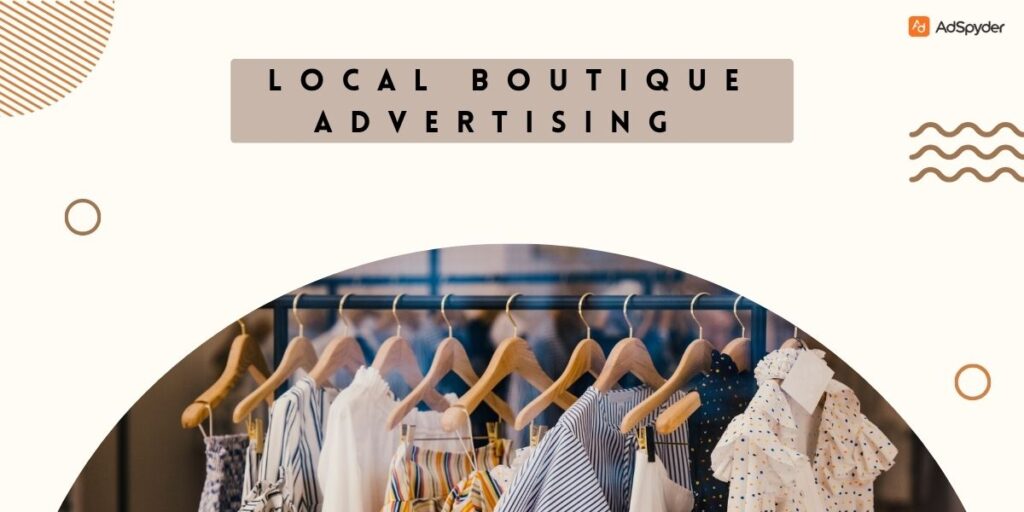
Local boutiques don’t lose to big brands because their products are worse. They lose when their local boutique advertising doesn’t make the boutique feel easy to discover, worth visiting, and obviously “the right choice” for a specific neighborhood audience. The good news: local marketing rewards focus. When your message matches your community—and your ads match how people shop—you can win share of mind without competing on massive budgets.
This guide breaks down practical boutique advertising strategies that drive footfall and repeat customers: Google + Maps visibility, social proof, local creator partnerships, seasonal drops, retargeting, and simple offer design. You’ll also get a plug-and-play framework for local marketing for boutiques, plus a set of FAQs you can use to train staff, align messaging, and stay consistent.
What is Local Boutique Advertising?
Local boutique advertising is the system you use to turn nearby shoppers into:
(1) store visits, (2) first purchases, and (3) repeat buyers. It blends location-based discovery (Google/Maps), trust signals (reviews, UGC),
and “neighborhood relevance” (local style, local events, local creators).
- Boutiques win on specificity: a tight niche (style + price + vibe) beats “something for everyone.”
- Boutiques sell the experience: styling help, curation, new drops, and community moments.
- Boutiques rely on proximity: the offer must justify a visit (or quick delivery/pickup).
Your goal isn’t to run “more ads.” Your goal is to build a repeatable system that helps local customers discover you, trust you, and choose you—especially during seasonal peaks
(festivals, weddings, vacations, and end-of-season sales).
Key Statistics for Local Boutique Advertising (Quick Snapshot)
The Local Boutique Advertising Framework (Discover → Trust → Visit → Repeat)

Most boutique owners post content, run an ad for a week, and hope footfall spikes. A better approach is building a simple loop that compounds results.
Use this four-step framework to structure every campaign.
| Stage | What shoppers need | What you run |
|---|---|---|
| Discover | Find you quickly (near me + style) | Google Business Profile, local SEO pages, Maps ads, Reels reach |
| Trust | Proof you’re worth the visit | Reviews, UGC, creator try-ons, “what’s new” carousels |
| Visit | A reason to come now | Drop calendar, limited-time bundle, appointment styling, click-to-call |
| Repeat | A habit + relationship | Retargeting, WhatsApp/SMS, loyalty perks, VIP previews |
The biggest unlock: treat “visit” like a conversion event. Your ads, content, and offers should make the next action obvious—call, directions, DM, reserve, or walk in.
12 Local Boutique Advertising Strategies That Work for Local Customers
Use this as a weekly playbook. You don’t need to do everything at once—pick 4–6 tactics, run them consistently for 30 days, and improve what the data tells you.
1) Make your Google Business Profile your “storefront ad”
Many local boutiques spend on Instagram before they’ve fixed Maps. Prioritize: correct hours, categories, a sharp description (style + neighborhood), weekly posts, a product/photo gallery, and a review response routine. If someone searches “boutique near me,” you want the click to become directions.
2) Use “style + occasion” targeting, not generic fashion targeting
Generic ads (“new collection”) blend in. Specific ads get remembered: “Workwear capsule under ₹X,” “Wedding guest edit,” “Airport-to-dinner sets,” “Plus-size partywear,” “Saree blouse studio.”
This is the same principle behind strong fashion brand awareness ads—one clear identity, repeated consistently.
3) Turn your best-selling rack into a recurring content series
People don’t want “all options.” They want curation. Weekly series ideas: “3 outfits under ₹X,” “New arrivals in 30 seconds,” “One kurti, three looks,” “Best sellers back in stock,” “Stylist picks for this weekend.”
Keep the filming simple: daylight, mirror shots, and clear text overlays.
4) Use click-to-call, directions, and WhatsApp as primary CTAs
For boutique ads for local customers, the CTA shouldn’t be “Shop now” by default.
Your highest-intent actions are: call for availability, DM for sizing, WhatsApp to reserve, and directions to visit.
Make the next step frictionless.
5) Run local creator “try-on days” (micro-influencers > celebrities)
Collaborate with creators who already post in your neighborhood or city. Invite them for a try-on session and capture: Reels, a carousel of favorite picks, and a short “what I’d wear to…” clip. Then run those clips as paid ads to similar local audiences.
The creator becomes social proof—and your boutique becomes the place people “already know.”
6) Use Meta ads for nearby reach + fast testing
Meta is ideal for testing hooks quickly. Start with 3 creatives: (a) a try-on reel, (b) a carousel with prices, (c) a “new drop” announcement.
If you need a channel-specific playbook, align your approach with Facebook ads for clothing brands—especially when you’re optimizing for local discovery rather than pure ecommerce checkout.
7) Retarget everyone who showed intent (but didn’t visit)
Retargeting is how boutiques stop wasting attention. Build audiences like: video viewers, Instagram engagers, profile visitors, “get directions” clickers, and WhatsApp clickers.
Then show them one of three messages: “back in stock,” “new drop,” or “limited weekend offer.”
A structured approach like retargeting ads for fashion shoppers helps you stay consistent instead of posting random reminders.
8) Build a “drop calendar” that creates urgency without discounts
Discounts work—but they train customers to wait. A better strategy is predictable drops:
“New arrivals every Friday,” “Festive edit launching 7 PM,” “Workwear capsule this Monday.”
People visit when they believe they might miss something.
9) Make your offer about value, not price
Value-focused shoppers don’t only want “cheap.” They want a reason the purchase is smart.
Offer examples: free alterations, styling consultation, bundle value (top + bottom), or a free accessory on threshold spend.
In markets like India, value shifts are real—private label preference is rising—so your job is to communicate quality and price-value clearly.
10) Use local partnerships to borrow trust
Partner with adjacent businesses: salons, cafés, yoga studios, photographers, bridal makeup artists. Create shared perks: “Show your café receipt for a small freebie,” or “Bridal trial booking gets a styling appointment.”
This is “community distribution”—you’re buying trust with relationships, not ad spend.
11) Borrow non-fashion ad patterns when they’re better
The best local ad patterns aren’t limited to boutiques. High-intent local campaigns often use: clear location, fast CTA, and immediate value. Some principles overlap with industries like delivery and services—for example, the structure of Google ads for meal delivery (tight targeting + intent keywords + simple conversion action) can inspire how you build “near me” boutique campaigns.
12) Track the right metrics (so you don’t optimize the wrong thing)
For boutiques, “success” isn’t only website purchases. Track:
(a) calls, (b) directions clicks, (c) WhatsApp starts, (d) profile visits, (e) repeat customer rate,
and (f) average order value in-store. If your ads increase these, your advertising is working—even if checkout is offline.
- 1 day: shoot 6–10 try-on clips + 1 carousel (prices visible).
- 3 days: post organically + boost best performers locally.
- Every day: respond to DMs/WhatsApp fast (speed is conversion).
- Weekly: rotate “drop calendar” and refresh retargeting creatives.
4 Campaign Examples You Can Run for Local Boutique Advertising

These aren’t “theoretical.” Each example is designed to work even if your store has a small team and limited time.
Pick one, run it for 2–3 weeks, then keep what performs.
Campaign 1: The “Weekend Outfit Edit” (Footfall-first)
Creative: 3 outfits + price range + “available in-store today.”
Targeting: 5–10 km radius + interests aligned to your niche.
CTA: Get Directions / WhatsApp to reserve your size.
Why it works: It turns browsing into a plan: “I can go there this weekend and know what I’ll get.”
Campaign 2: The “New Drop Countdown” (Urgency without discounts)
Creative: teaser Reel (7–10 seconds) + carousel (top 8 items).
Offer: “First 25 visitors get free styling / small gift.”
Why it works: A predictable drop habit reduces dependence on sales events.
Campaign 3: The “Creator Try-On + Paid Amplification” (Trust engine)
Creative: creator try-on reel + “Top 5 picks” caption + store location pinned.
Paid: run the creator content as an ad to local lookalike audiences + city targeting.
Why it works: People trust people. The boutique becomes a validated recommendation, not a cold ad.
Campaign 4: The “Second Chance” Retargeting Loop (Conversion recovery)
Audience: video viewers + profile visitors + WhatsApp clickers (last 14–30 days).
Creative: “Back in stock” + “best sellers” + short social proof (“Loved by 200+ local shoppers”).
CTA: DM your size to reserve today.
Why it works: Most boutique sales happen after a second touch.
FAQs: Local Boutique Advertising
What is the fastest way to get boutique footfall from ads?
How much should a local boutique spend on ads?
Are Instagram ads enough for local marketing for boutiques?
What creative performs best for boutique ads for local customers?
How do I measure conversions if most sales happen in-store?
Do boutique advertising strategies work without discounts?
What’s the best retargeting window for boutiques?
Conclusion: Local Boutique Advertising
Winning local boutique advertising isn’t about competing with big brands on spend.
It’s about competing on relevance: tighter positioning, clearer “why visit now,” stronger proof, and faster follow-up. Build your loop—Discover → Trust → Visit → Repeat—and your boutique becomes the obvious local choice.
Start today with two moves: optimize Maps visibility, and publish one weekly try-on series with prices. Then layer in retargeting and drop calendars. When your neighborhood sees you consistently, buying becomes easy.