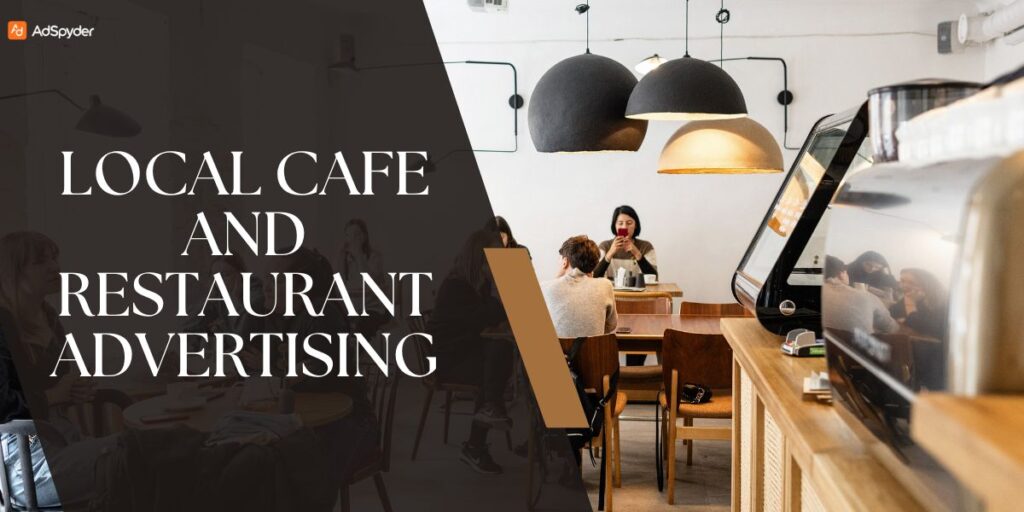
Local food marketing in 2026 is less about “posting more” and more about getting discovered at the exact moment someone is hungry, curious, or deciding where to go. The winning playbook is simple: show up in search and maps, tell a clear story in short-form video, make ordering effortless, and follow up with repeat-visit offers that don’t feel spammy. That’s the core of local cafe and restaurant advertising that actually moves revenue.
This guide breaks down local restaurant advertising and coffee shop promotion ideas into a system you can run weekly: capture intent (search + map demand) → convert (menus, offers, ordering) → retain (retargeting + loyalty) → compound (reviews + UGC + seasonal launches). You’ll also get practical cafe promotion ideas, proven creative angles, and a metrics checklist to keep your spend profitable.
What This Guide Covers (Cafes + Restaurants, One Local Growth System)
Whether it’s a neighborhood cafe, a quick-service brand, or a sit-down restaurant, the growth mechanics are the same. People don’t “want ads”—they want answers:
What’s good here? Is it close? How long will it take? Is it worth the money? Your marketing works when it reduces decision friction.
- Discovery: Search + Maps + social reach so locals can find you fast
- Conversion: menus, ordering, reservations, calls—make “yes” easy
- Retention: retargeting + loyalty + offers that drive repeat visits
- Reputation: reviews + UGC that improve click-through and trust
Some tactics carry over from other local categories. For example, the intent-driven structure used in Google ads for gyms and supplements translates well to food: separate campaigns by intent (near me, menu, delivery, deals) and match the landing page to the search.
And if the business has multiple locations or cross-sells, patterns from local ads for wellness can help—especially when building localized creatives by neighborhood and audience need.
Key Statistics (Why Local Visibility Matters More Than Ever)
The Local Cafe and Restaurant Advertising Framework (Intent → Proof → Convenience → Repeat)
When local food business advertising underperforms, it’s rarely “bad ads.” It’s usually a mismatch between what the customer wants and what the experience delivers. The durable framework is:
| Layer | What to build | What it improves |
|---|---|---|
| Intent capture | Search + Maps + delivery intent campaigns | High-quality traffic |
| Proof | Reviews, UGC, “best-sellers,” press, hygiene cues | CTR + trust |
| Convenience | Fast menu, pricing clarity, hours, parking, ordering UX | CVR + AOV |
| Follow-up | Retargeting + loyalty + “next visit” offers | Lower CPA over time |
| Iteration | Weekly offer + creative tests (2–3 angles) | Compounding gains |
Think of this as “local DTC.” A cafe is a product; a restaurant is an experience. The goal is to make the decision obvious:
this looks great, it’s close, it’s easy, I can order now.
Capture Demand: Search + Maps (The Highest-Intent Channel for Local Cafe and Restaurant Advertising)
For local restaurant advertising, “near me” searches and menu intent are the closest thing to a guaranteed buyer signal. The job is to show up with the right promise and send people to the right next step:
call, directions, reserve, or order.
1) Build campaigns by intent (don’t mix them)
- Near-me discovery: cafe near me, best restaurant in [area], breakfast near [landmark]
- Menu intent: [dish] near me, vegan cafe [area], pizza delivery [area], brunch menu [neighborhood]
- Deal intent: lunch offers, happy hour deals, coffee combo, family meal deals
- Brand intent: [your brand] menu, [your brand] reservations, [your brand] delivery
2) Make Maps work harder than your feed
Most local purchases start with a location decision. Ensure your business profile is built for conversion: accurate hours, updated categories, “order” and “reserve” links, price range, and fresh photos of top sellers (not just interiors).
3) Landing pages: menu-first, friction-last
The fastest way to waste local clicks is sending traffic to a slow homepage. Use a dedicated page that loads fast and answers:
what to order, how much, how long, how to get it.
If delivery is a key revenue stream, patterns from Google ads for meal delivery services can help—especially when aligning ad groups to cuisine and delivery radius.
Creative Angles That Win for Local Cafe and Restaurant Advertising (What Actually Stops the Scroll)

The best coffee shop advertising ideas and restaurant ads don’t “announce.” They show. Food is a sensory category—use short video, tight close-ups, and real customer context. Below are angles that repeatedly perform across formats (Reels, Stories, Shorts, static).
1) The “best-seller proof” angle
Lead with one hero item and a simple reason to believe: “Most ordered,” “Chef’s signature,” “Back by popular demand,” “Sold out last weekend.” Pair it with a 6–10 second clip of the item being made or plated.
2) The “time & convenience” angle
Local customers don’t only buy taste—they buy timing. Creative that shows “ready in 10 minutes,” “grab-and-go,” “no waiting before 12 pm,” or “late-night delivery” reduces uncertainty and increases conversion.
3) The “menu exploration” angle
A carousel-style reel (or quick cuts) that answers “What should we order?” works extremely well—especially for new visitors. Show 4–6 items with on-screen labels and prices. This doubles as a coffee shop advertisement example format that is easy to recreate weekly.
4) The “people + vibe” angle
For cafes, atmosphere sells: laptop-friendly corners, quiet mornings, date-night lighting, live music. For restaurants, show “group table moments” and staff energy. Keep it real—UGC-style performs because it feels local.
Offers That Drive Visits in Local Cafe and Restaurant Advertising (Without Discounting Your Brand)
Discounts work—but they can train customers to wait. Strong coffee shop promotion ideas and restaurant promos usually add value instead of cutting price. The key is to align offers to time-of-day and intent.
High-performing promo formats
- Bundles: “Coffee + croissant combo,” “Family meal for 4,” “Starter + main + dessert.”
- Time-based value: happy hour, weekday lunch set, late-night delivery perk.
- New item launches: “limited drop” or “seasonal special” with a simple story.
- First-order incentives: not a deep discount—free add-on or free delivery threshold.
- Loyalty nudges: “buy 6 coffees, get 1 free” or stamp-card equivalents.
When offers are the main growth lever, make sure follow-up is built in. A customer who tried you once is your cheapest future sale—especially when paired with retargeting ads for food businesses that remind them of what they viewed or ordered.
Reviews & UGC in Local Cafe and Restaurant Advertising (The Trust Layer That Improves Every Campaign)
Local food decisions are heavily influenced by social proof. Reviews don’t just “help reputation”—they improve ad performance by increasing confidence after the click. Treat review collection as a weekly process, not an occasional push.
How to collect reviews without being awkward
- Ask at the right moment: after payment, after delivery confirmation, or after a compliment.
- Keep the prompt specific: “Could you mention the dish you ordered?” is better than “Leave a review.”
- Use signage + QR codes: at the counter, on receipts, and inside delivery packaging.
- Turn UGC into ads: compile 5–10 short clips or photos into weekly “what people are ordering” creatives.
Retargeting & Repeat Visits with Local Cafe and Restaurant Advertising (Where Local CAC Gets Cheaper)
Most customers don’t convert on the first exposure—especially for new restaurants or higher-ticket experiences. Retargeting closes that gap by reminding people what they viewed, what’s popular, and how easy it is to order.
Retargeting also works across adjacent categories. The same sequencing logic behind
retargeting ads for health products applies to food: segment by intent, show proof, reduce friction, then present a value-forward offer.
3 retargeting sequences that consistently work
- Menu viewer → best-sellers → order: show top 3 items + delivery/pickup CTA.
- Location page viewer → vibe → directions: show ambience + quick map CTA.
- Cart abandoner → reassurance → checkout: show ETA, delivery fee clarity, and a small value add.
Measurement Checklist for Local Cafe and Restaurant Advertising (What to Track Weekly)

Local campaigns get profitable faster when measurement is tight. The goal is to track real outcomes—calls, directions, reservations, and orders—not vanity metrics.
Core metrics for local cafes & restaurants
- Intent capture: CTR by campaign (near-me vs menu vs deals)
- Conversion: orders/reservations, call clicks, direction clicks
- Efficiency: cost per order, cost per reservation, ROAS (if ecommerce)
- Retention: repeat purchase rate, returning customer share, offer redemption
- Reputation: review velocity (new reviews/week) + rating stability
A simple weekly routine works: pause obvious losers, duplicate winners into new variations, update the “proof library,” and refresh one offer per week. Consistency beats occasional big bursts.
FAQs: Local Cafe and Restaurant Advertising
What are the best local restaurant advertising channels in 2026?
What are easy coffee shop promotion ideas that don’t require discounts?
What makes a good coffee shop advertisement example?
How should cafes structure Google Ads campaigns?
How can local food businesses reduce cart abandonment for ordering?
How important are reviews for local cafe and restaurant advertising?
What’s the fastest way to improve local food business advertising results?
Conclusion
The winning approach to local cafe and restaurant advertising is not “more posts” or “more budget”—it’s a tighter system: capture high-intent demand in Search and Maps, lead with proof and a clear hero item, remove ordering friction, and convert delayed decisions with retargeting. Layer in consistent offers and review collection, and the results compound—week after week.