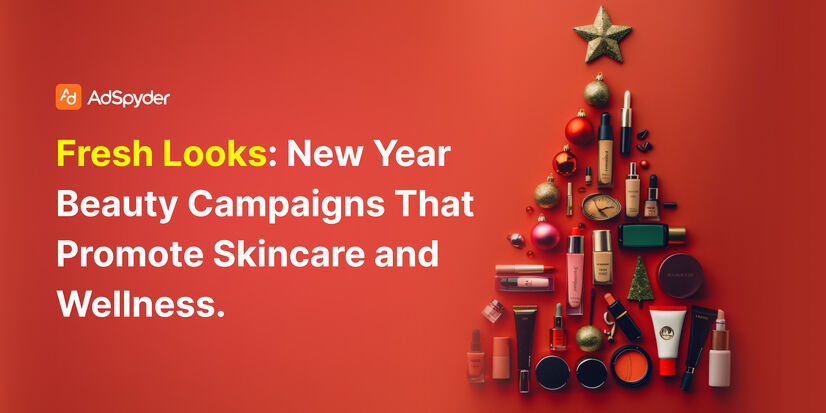
New Year is one of the few moments when people actively want to change: routines, confidence, skincare discipline, makeup looks, and the “version of me” they’re projecting. That’s why New Year beauty ads can outperform “always-on” campaigns—if your creative and offer match the mindset.
In this guide, we’ll break down a practical playbook for New Year beauty advertising campaigns—including Lunar New Year angles, creative frameworks, landing page structure, channel mixes, and how to measure what’s actually working. You’ll also get copy-ready hooks for New Year beauty brand ads and New Year cosmetics ads, plus 7 short FAQs you can drop straight into your blog.
What are New Year Beauty Ads?
New Year beauty ads are seasonal campaigns from skincare, makeup, fragrance, haircare, and wellness-adjacent brands designed around the New Year “reset” mindset. They typically focus on:
- Transformation: glow-up, confidence, “new routine,” “new look.”
- Rituals: habit-building (skincare steps, nightly routine, weekly mask).
- Occasions: parties, weddings, travel, work re-entry, reunions.
- Gifting + limited editions: sets, bundles, holiday leftovers reframed as “fresh start.”
Why New Year works for beauty (the psychology behind the clicks)
New Year is not just a date—it’s a permission slip. People are unusually receptive to messages like “start fresh,” “commit to a routine,” and “treat yourself.” That matters because beauty purchases are often fueled by identity, confidence, and social context—not only “need.”
- New identity moment: “the person who takes care of their skin” (habit framing).
- Social calendar: parties, travel, and events re-starting (occasion framing).
- Gift-to-self logic: it feels justified after holiday spending (value framing).
If you’re planning seasonal sequences across Q4 → Q1, you can keep continuity by bridging from Christmas gift ads into “fresh start” bundles, while keeping creative consistent across the handoff.
Key stats for New Year beauty advertising campaigns (market + paid benchmarks)
Campaign Types that Win in New Year Beauty Ads
Most New Year beauty advertising campaigns fall into 5 “winner archetypes.” Pick the one that matches your product category and your customer’s friction.
1) The “Reset Routine” campaign (best for skincare + haircare)
This campaign sells a routine, not a product. It frames the purchase as the first step of a habit: cleanse → treat → moisturize → protect. It performs especially well when you show a clear timeline (“Day 1,” “Week 2,” “30 days”).
- Angle: “start fresh” with a simple 3-step plan
- Proof: routine demo, dermatologist guidance, ingredient explanation
- CTA: “Build my routine” / “Take the routine quiz”
2) The “Event Ready” campaign (best for makeup + fragrance)
New Year comes with parties, weddings, reunions, travel, and “back-to-work” social settings. This campaign uses the occasion as the reason to buy. If your audience is traveling in late December and early January, pairing it with seasonal intent content like Christmas travel ads makes the transition feel natural: “packable beauty,” “carry-on friendly,” “all-day wear.”
3) The “Limited Edition / Lucky Drop” campaign (best for Lunar New Year)
Lunar New Year creative often leans into symbolism—luck, renewal, prosperity, family—and limited-edition packaging. If you have strong brand identity, this is a high-shareability play: collectors, gift buyers, and loyal customers fuel distribution.
4) The “New Habit Buddy” campaign (best for subscription + replenishment)
This is the retention-forward approach. Instead of discounts, you sell consistency: reminders, refills, routine tracking, and a “30-day glow plan.” It’s ideal if you have a subscription model or recurring purchase behavior.
5) The “Resolution Stack” campaign (beauty + wellness crossover)
In Q1, consumers don’t separate beauty and wellness. A strong cross-sell angle is “feel good + look good.” For inspiration on how brands package the transformation narrative, studying how fitness advertisers frame goals can help—especially in New Year fitness ads.
Creative Frameworks + Hooks for New Year Beauty Ads
Great New Year creatives are built around one job: reduce uncertainty while making the “fresh start” feel achievable. Here are 6 frameworks you can reuse across Reels, Stories, TikTok-style UGC, YouTube Shorts, static, and carousels.
Framework 1: “3-step glow plan” (clarity beats complexity)
- “If you’re overwhelmed by skincare, start with this 3-step reset.”
- “New year, new routine: cleanse → treat → protect.”
- “Your glow plan doesn’t need 12 products.”
Framework 2: “Before/after + timeline” (results without hype)
When you show a timeline, people can picture themselves succeeding. Make it honest: “2 weeks,” “4 weeks,” “8 weeks,” and explain what changed.
Framework 3: “Objection flip” (turn doubt into the angle)
- “I don’t have time.” → “60-second night routine.”
- “My skin is sensitive.” → “Barrier-first routine.”
- “I’ve tried everything.” → “Here’s what’s different (proof + ingredient logic).”
Framework 4: “Routine POV” (UGC-friendly, high trust)
Simple creator-style “get ready with me” content works because it feels real. Use close-ups, texture shots, and quick on-screen captions: “Step 1,” “Step 2,” “Results.” If you can’t access creators at scale, build an internal UGC system: staff, micro-creators, customers, and community clips.
Framework 5: “New Year kit” (bundle story makes the price feel fair)
Bundles sell because they remove decision fatigue. A kit should have a clear outcome (“hydration reset,” “acne calm kit,” “party-ready set”), and each item should earn its place.
Framework 6: “Culture + community” (Lunar New Year done right)
Lunar New Year campaigns work best when they feel like celebration—not appropriation. Use authentic storytelling (family, home, tradition), highlight artists/creators, and make gifting frictionless.
Offers, Bundles, and Gifting in New Year Beauty Ads (how to win without discounting everything)

The best New Year promotions feel like help, not desperation. Instead of “20% off everything,” build an offer ladder that gives people a reason to act now.
| Offer type | Best for | Example |
|---|---|---|
| Bundle value | Skincare routines, haircare systems | “Reset Kit: save 18% vs. single items” |
| Gift with purchase | Makeup/fragrance, premium brands | “Free mini serum on orders above $X” |
| Trial / discovery | New customer acquisition | “Try 3 minis before committing” |
| Limited edition | Lunar New Year, collectors | “Lucky Drop: limited packaging, limited run” |
Also consider “New Year host” moments: parties, dinners, get-togethers. Beauty pairs well with food-and-celebration contexts, so seasonal merchandising themes from New Year food ads can inspire bundling language like “party-ready,” “hosting glow,” or “camera-ready skin.”
Channels + Targeting Notes for New Year Beauty Ads
Your channel mix depends on whether you’re selling immediate purchases (makeup/fragrance) or routine outcomes (skincare/haircare). Here’s the simplest way to plan without overcomplicating.
- Reels/Shorts/TikTok-style video: routine demos, texture shots, “GRWM” UGC.
- Meta feed + stories: broad reach + retargeting + bundle offers.
- Search: capture intent (“best serum for…”, “hydrating moisturizer,” “party makeup”).
- Creator + affiliate traffic: warm audiences you can retarget.
Landing Pages that Convert New Year Beauty Ads Clicks into Sales
New Year shoppers want a plan. Your landing page should feel like a guided decision, not a product dump. A high-converting New Year page answers: What’s the outcome? How fast? Why trust you? What do I do next?
- Hero promise: “Reset your routine in 3 steps” + 1 clear CTA.
- Proof block: results timeline, reviews, before/after, clinical notes (if applicable).
- What’s inside: the kit, how to use, when to apply, who it’s for.
- Friction removal: FAQs, shipping/returns, ingredient details, sensitive skin notes.
- Offer clarity: bundle savings, gifts, limited edition terms.
If you run lead-gen for samples, “routine quizzes,” or waitlists, benchmark your economics realistically: WordStream’s 2025 Meta benchmarks list Beauty & Personal Care average leads CPL at $51.42, so make sure your lead value and follow-up flow justify it.
Measurement + Iteration in New Year Beauty Ads (the weekly loop that compounds)
New Year is short. You don’t have time for “wait and see.” Use a weekly loop that tells you what to fix: message, proof, targeting, or post-click experience.
- Low CTR: your hook/promise isn’t matching New Year intent → rewrite the first 2 seconds.
- High CTR, low CVR: landing page doesn’t deliver on the promise → add proof + simplify the kit.
- Good CVR, poor MER/ROAS: audience mismatch or weak retention → tighten retargeting + increase AOV with bundles.
Launch Checklist for New Year Beauty Ads

Use this checklist to get from “ideas” to a clean campaign structure in one working session.
- Pick a winner archetype: Routine Reset / Event Ready / Lucky Drop / Habit Buddy / Resolution Stack.
- Write one message spine: 1 promise + 3 proof points + 1 CTA (same meaning across channels).
- Create 6 assets: 2 UGC routine videos, 2 testimonial clips, 1 before/after timeline, 1 bundle/value carousel.
- Build 2 landing pages: one for the kit, one for a hero product (each with proof + friction removal).
- Set retargeting segments: kit viewers, cart abandoners, video viewers (high intent).
- Plan Lunar New Year: packaging visuals + gifting story + limited run terms (if relevant).
When you map your seasonal calendar, treat New Year as a continuation—not a restart. Q4 gifting learns (what sets sold, what angles clicked) can roll into New Year routines and habit framing.
FAQs: New Year Beauty Ads
What makes New Year beauty ads different from regular beauty ads?
When should I launch New Year cosmetics ads?
What creative formats work best for New Year beauty brand ads?
Should I discount heavily for New Year?
How do I position skincare for New Year?
What’s a good CPL benchmark for beauty lead-gen?
How do I make Lunar New Year beauty campaigns feel authentic?
Conclusion
The best New Year beauty ads don’t shout “sale.” They offer a believable reset: a clear plan, strong proof, and a landing page that guides the decision. Build campaigns around one winner archetype, ship weekly creative variants, and use an offer ladder (bundles, gifts, limited editions) to create urgency without wrecking margins. If Lunar New Year is relevant to your audience, treat it as a second peak with authentic storytelling—and you’ll turn seasonal attention into compounding demand.