Quick Answer
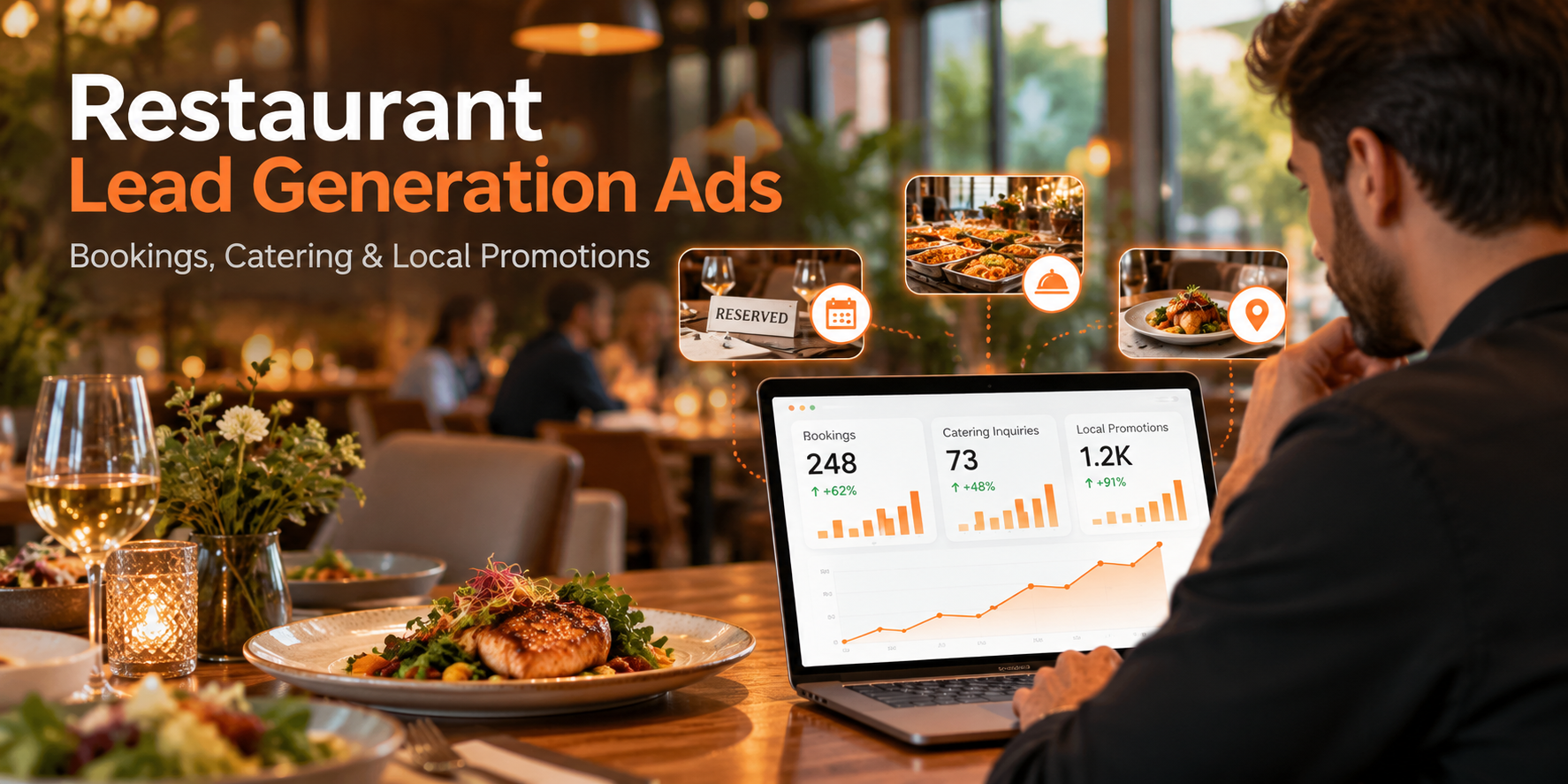
- Do not run one generic restaurant campaign. Separate reservations, catering, private events and local promotions.
- Use Google Search for people already looking for a restaurant, caterer or event venue, and use Meta for visual discovery, local offers and retargeting.
- Match every ad to one specific action: reserve a table, check an event date, request a catering quote or claim a local offer.
- For catering leads, collect event date, guest count, location and event type before treating an enquiry as qualified.
- Measure booked tables and booked events—not clicks or form fills alone.
- Use AdSpyder for Restaurants to study competitor ads, keywords, offers and landing pages before building the campaign.
A restaurant does not really have one lead-generation funnel.
Someone searching for dinner tonight behaves very differently from an office manager planning lunch for 80 people next month. A couple looking for a private dining room is different again. If all three land on the same homepage and see the same “Order Now” button, good intent gets wasted.
Table of contents
The Restaurant Lead-Generation Problem: Not Every Conversion Is Equal
Restaurants often optimize around traffic because traffic is easy to see. But 500 menu visits are not automatically more valuable than five serious private-event enquiries.
Split the funnel by the revenue action you actually want.
| Campaign | Customer Intent | Primary Conversion |
|---|---|---|
| Reservations | “I want somewhere to eat.” | Completed booking |
| Catering | “I need food for a group or event.” | Qualified catering enquiry |
| Private Events | “I need a venue plus food.” | Date check / event consultation |
| Local Promotion | “Give me a reason to visit soon.” | Reservation, redemption or store action |
That separation matters because the ad, page and follow-up for a Saturday dinner reservation should be much lighter than the process for a wedding catering enquiry.
Target Audiences and Their High-Intent Moments
1. Diners ready to book
These customers usually care about location, cuisine, availability, price range, reviews and whether they can book immediately. Keep the route short.
Good CTA: Reserve a Table
2. Corporate catering buyers
Office managers, admins, HR teams and event organizers care about reliability, headcount, delivery radius, dietary options, invoicing and repeat ordering.
Good CTA: View Corporate Catering Menu or Request a Quote
3. Wedding and celebration planners
These leads normally need more reassurance. Photos, capacity, testimonials, menu flexibility, tasting information and date availability matter more than a quick discount.
Good CTA: Check Your Date
4. Nearby diners responding to an occasion
Think weekday lunch, happy hour, Valentine’s Day, game night, family meal, brunch or a new-menu launch. Here the offer and timing often matter more than a long explanation.
Best Ad Channels and Campaign Structure
Google Search: capture existing intent
Search works best when somebody has already decided what they need. Separate ad groups by intent instead of putting every restaurant-related keyword into one campaign.
Use AdSpyder Google Ads Spy to research how local competitors phrase their headlines, offers and destination pages before writing your own.
Campaign A: restaurant reservations
Campaign B: catering
Campaign C: private dining / events
Campaign D: seasonal or local promotion
Meta: create appetite and retarget interest
Facebook and Instagram are stronger when the creative itself can create demand: food preparation, a busy dining room, a private-event setup or a limited-time menu.
Use AdSpyder Facebook Ads Spy to compare competitor video, image and carousel patterns instead of assuming that polished food photography is always the best format.
Retarget people who viewed menus, catering pages or event pages but did not complete the relevant action. Do not send all retargeting visitors back to the homepage.
Local/store campaigns: optimize for physical intent
Restaurants with physical locations should also think beyond lead forms. Google’s current store-goal campaigns can optimize toward local actions and reach people across local surfaces such as Search and Maps. That is more appropriate for some nearby-diner campaigns than forcing every visitor through a form.
Restaurant Keywords, Offers and Creative Examples
The best keyword is not necessarily the one with the biggest search volume. For restaurants, a smaller query can carry much stronger booking intent.
| Goal | Keyword Ideas | Offer / CTA |
|---|---|---|
| Reservations | Italian restaurant near me, book restaurant [area], dinner reservation [city] | Reserve Your Table |
| Corporate Catering | office catering [city], corporate lunch catering, business event catering | View Corporate Menu |
| Events | private dining [city], birthday party restaurant, restaurant event venue | Check Your Date |
| Local Offers | happy hour [area], brunch [area], lunch special near me | See This Week’s Offer |
Use the Keyword Analysis AI Agent to see which platforms, advertisers and creative patterns appear around the terms you want to test.
Example restaurant ad angles
Reservation
Friday tables are filling up. Reserve dinner in [Area] online.
Corporate Catering
Planning lunch for 25–100 people? View our corporate catering menu.
Private Dining
Hosting a birthday or team dinner? Check availability for our private dining space.
Local Promotion
Tuesday dinner plans solved: limited weekly menu available from 6 PM.
The point is specificity. “Come visit our restaurant” gives the user no reason to act now and tells the ad platform very little about the intended conversion.
Landing Page and Lead-Quality Checklist
Do not send catering traffic to the normal online-order page. A customer ordering dinner and an event planner feeding 80 people are trying to complete different jobs.
Reservation page
☐ Location and opening hours are obvious.
☐ Booking action appears immediately.
☐ Menu and price expectations are easy to find.
☐ Mobile booking works cleanly.
☐ Reviews, photos or relevant trust proof support the decision.
Catering / event page
☐ Event types and service area are clear.
☐ Menu or package guidance is available.
☐ Capacity or minimum-order expectations are explained.
☐ Relevant event photographs show scale.
☐ CTA asks for a quote or date check.
☐ Form collects enough information to qualify the enquiry.
Use AdSpyder Landing Page Analysis to compare competitor destinations, CTAs and page structures with the ads sending traffic to them.
What should a catering lead form ask?
| Field | Why It Matters |
|---|---|
| Event date | Availability |
| Event type | Wedding, office, birthday and other needs differ |
| Guest count | Checks capacity and order size |
| Event location | Confirms service radius |
| Service requirement | Delivery, buffet, staffed service, pickup |
| Contact details | Allows quick follow-up |
Do not turn the first form into a 20-question event contract. Collect enough information to decide whether the enquiry deserves fast human follow-up.
How to Judge Restaurant Lead Quality
Raw lead count is especially misleading for restaurants because a low-value coupon signup and a 150-person catering enquiry can both appear as “one conversion.”
For reservations: track completed reservations and, where possible, actual dining outcomes.
For catering: track qualified enquiries, quotes, booked events and booked revenue.
For private events: track date checks, consultations and confirmed bookings.
For promotions: track reservation, redemption, order or store action—not reach alone.
Once you know which campaigns generate actual restaurant revenue, optimize toward those outcomes instead of whichever campaign produces the cheapest form fill.
Competitor Ad Teardown: What to Look for in AdSpyder
Do not open an ad library and simply save the nicest food photo.
Use AdSpyder’s Ad Library to research the campaign as a system.
1. Search the local intent.
Try competitor domains plus terms such as “private dining,” “corporate catering,” “Italian dinner deals” or your cuisine + location.
2. Separate campaigns by offer.
Do competitors promote reservations, delivery, catering, seasonal menus or event spaces?
3. Record the hook.
Is the ad leading with cuisine, occasion, scarcity, location, price, social proof or convenience?
4. Check the CTA.
Reserve, order, get quote, view menu and check availability imply very different funnel goals.
5. Follow the landing page.
Does a catering ad actually land on a catering page? Does a booking ad open a booking flow?
6. Compare patterns over time.
Repeated offers and long-running creative are useful research signals, but they are not proof of profitability.
For deeper competitor analysis, AdSpyder Ad Analytics connects domain activity, keyword research and campaign intelligence so you can compare more than the creative alone.
Important: competitor ad visibility does not tell you their private ROAS, booking rate or revenue. Treat longevity, repetition, offers and landing-page changes as signals to investigate—not proof that an ad is profitable.
A Simple Restaurant Ad Testing Matrix
| Variable | Test A | Test B |
|---|---|---|
| Hook | Occasion-led | Food-led |
| Creative | Dish close-up | People / dining experience |
| Offer | Menu download | Quote / date check |
| CTA | View Menu | Check Availability |
Change one meaningful variable at a time. If the headline, offer, image and landing page all change together, you learn very little about why performance moved.
30-Day Restaurant Lead Generation Ads Action Plan
Define revenue goals, tracking, service areas and lead qualification rules. Research competitors.
Build separate reservation, catering and event pages. Write campaign-specific ads.
Launch focused Search and Meta tests. Add retargeting once enough visitors accumulate.
Review booked outcomes, search terms, lead quality and landing-page friction. Cut waste and expand winners.
FAQs About Restaurant Lead Generation Ads
What is restaurant lead generation?
Restaurant lead generation is the process of attracting people who are likely to complete a valuable action such as booking a table, requesting catering, checking private-event availability or responding to a local offer.
Are Google Ads good for restaurants?
They can be especially useful for high-intent searches such as restaurant reservations, catering and private dining because the user is already looking for a solution. Campaign structure and conversion tracking matter more than simply bidding on broad restaurant terms.
What information should a catering lead form collect?
At minimum, collect contact details, event date, event type, guest count and location. Add service-style or dietary questions when they materially affect whether the restaurant can serve the event.
Should catering ads go to the restaurant homepage?
Usually not. A dedicated catering page can answer questions about menus, capacity, delivery or service area, event types and the enquiry process much more clearly than a general homepage.
What should restaurants measure besides cost per lead?
Track lead quality, reservation completions, booked events, lead-to-booking rate, cost per booked event and revenue where attribution allows it. A cheap lead is not valuable if it never becomes a customer.
How can AdSpyder help restaurant marketers?
AdSpyder can help restaurants and agencies research competitor ads, keywords, creative formats, offers and landing pages across multiple ad platforms. Use those observable patterns to build original tests rather than copying competitor campaigns.
See what restaurants in your market are advertising before you spend
Research competitor ads, keywords, offers and landing pages, then turn those patterns into original reservation, catering and local campaigns.