On Instagram, people scroll past polished brand ads all day. What makes them stop? A real person, with a real story. That’s why testimonial ads on Instagram are so powerful. When someone in your audience can relate to says “this worked for me,” your claims stop sounding like marketing and start sounding like truth.
Instagram now even has a built-in Testimonials feature for partnership ads, letting creators publicly endorse brands directly on paid posts. Combine that with classic social proof—UGC, reviews, before-and-after stories—and you get a format that can lift your click-through rates, lower your CPAs, and build trust faster than almost any other creative angle.
This guide walks you through everything you need to know to build and scale testimonial ads on Instagram:
- What testimonial ads are (and what they’re not)
- How Instagram’s new Testimonials in partnership ads work
- Types of testimonial ads and when to use each
- How to collect and script authentic testimonials
- Design and copy frameworks you can plug into your campaigns
- How to use AdSpyder to steal what’s working in your niche
- Exactly how to measure and optimise performance over time
What Are Testimonial Ads on Instagram?
A testimonial ad is any ad where the core message is a recommendation from someone other than your brand.
Instead of the brand saying:
“Our skincare cream reduces redness in 7 days.”
You see something like:
“I tried this for 7 days and my redness is almost gone.” – Real customer
On Instagram, testimonial ads can appear in:
- Feed (single image, video, carousel)
- Reels
- Stories
- Explore / placements managed via Ads Manager
- Partnership ads with creators (where Testimonials feature comes in)
The focus is always:
- A person (customer, creator, expert)
- A result (transformation, relief, success)
- Proof (specific details, visuals, numbers)
The ad creative and caption are built around that story.
Related – Creating Interactive Ads on Instagram
How Instagram Testimonials in Partnership Ads Work
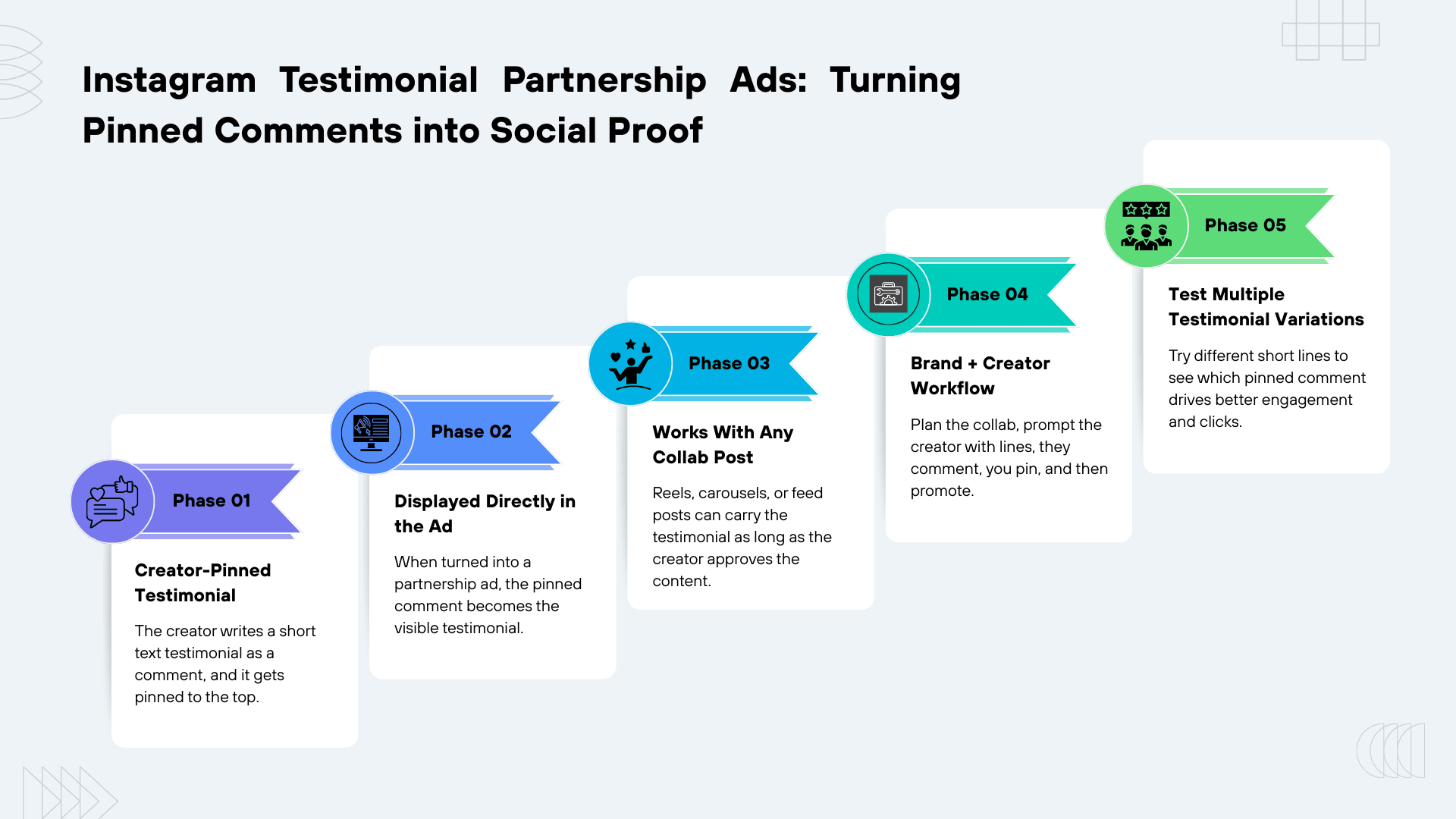
Instagram’s newer Testimonials feature brings testimonials directly into the ad product for partnership ads.
Here’s what that means in practice:
- A brand runs a partnership ad with a creator (collab ad).
- The creator posts or approves a piece of content featuring your product.
- The creator leaves a short written testimonial as a comment on that partnership content.
- The brand (or creator) pins this comment to the top of the comments section.
- When the post is turned into an ad, that pinned comment acts as a visible testimonial attached to the ad.
Key points:
- It’s a text-only testimonial, so every word counts.
- It appears as a pinned comment, not as on-image text, so creative and testimonial work together.
- Users can tap into the comments and immediately see the endorsement.
- Disclosure (paid partnership tag) still needs to be handled correctly.
Step-by-step: Adding a testimonial to a partnership ad
Plan the collab
- Choose a creator who reflects your target audience.
- Align on the product, message, and deliverables.
Create the content
- Reel, carousel, or feed post featuring your product.
- Make sure the visual itself is strong enough as an ad.
Give testimonial prompts
Provide 2–3 short lines the creator can adapt, such as:
- “I’ve been using [Brand] for [time] and it genuinely [result].”
- “This is the only [product type] that actually [benefit].”
Creator posts a comment, and you pin it
- After the content goes live (or is approved for partnership), the creator posts the testimonial as a comment.
- You pinned that comment so it appears first.
Promote as a partnership ad
- Turn the collab post into an ad via Meta Ads Manager.
- The pinned testimonial now rides along with the ad.
Test variations
- Try different testimonial lines across multiple ads.
- Note which phrasing drives more saves, shares, and clicks.
This feature doesn’t replace other testimonial formats—but it adds extra social proof right where users expect conversation: the comments.
Why Testimonial Ads Work So Well (The Psychology)
Before we go tactical, it helps to understand why testimonial ads work so consistently.
- Social proof
People copy people. Especially if they see “people like them” getting a result they want. - Risk reversal
Trying something new feels risky: money, time, reputation. A testimonial tells your brain, “Someone else took this risk and it worked out.” - Specificity and credibility
Real stories tend to include specific details—numbers, timeframes, quirky phrases—that generic ad copy rarely hits. - Pattern break
A talking-head UGC video or screenshot of a review breaks the pattern of polished brand imagery. It feels more like a recommendation and less like a banner.
When you combine those factors with Instagram’s visual, social environment, testimonial ads become one of the highest-leverage creatives in your paid arsenal.
Check Out – Leveraging Video Ads for Instagram Success
Where Testimonial Ads Fit in Your Instagram Funnel
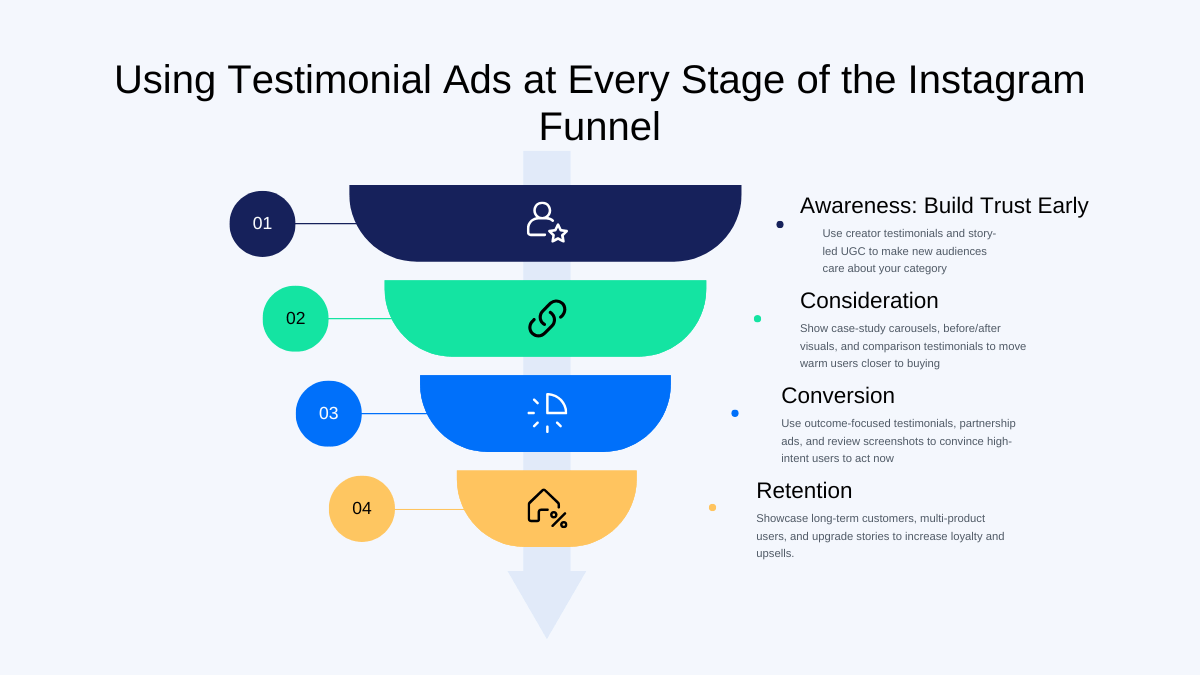
Testimonial ads aren’t just for retargeting. You can use them at every stage of your Instagram funnel.
Awareness (cold audiences)
- Goal: Make strangers believe your category and brand are worth caring about.
- Use:
- Creator testimonials (“I switched from X to Y and here’s why”)
- Light, story-led UGC Reels
- Creator testimonials (“I switched from X to Y and here’s why”)
- Angle: Emotional stories, relatability, “people like you use this.”
Consideration (warm audiences)
- Goal: Push people who already know you closer to the decision.
- Use:
- Detailed case-study style carousels
- Before-and-after visuals
- Side-by-side comparisons with testimonial quotes
- Detailed case-study style carousels
- Angle: Depth, proof, “this solved specific pains you have right now.”
Conversion (hot audiences)
- Goal: Turn high-intent users into paying customers.
- Use:
- Testimonial ads emphasising ROI, time savings, or concrete outcomes
- Partnership ads with strong creator endorsements
- Review screenshot carousels with clear CTAs
- Testimonial ads emphasising ROI, time savings, or concrete outcomes
- Angle: “This works. Here’s the result. You’re next.”
Retention & upsell
- Goal: Increase repeat purchases, upgrades, and referrals.
- Use:
- Testimonial ads highlighting long-term use and repeat buyers
- Customer stories about using multiple products or higher tiers
- Testimonial ads highlighting long-term use and repeat buyers
- Angle: “People don’t just buy once—they stay, upgrade, and use more.”
Mapping your testimonial strategy to funnel stages keeps your messages focused, rather than generic.
Types of Testimonial Ads on Instagram
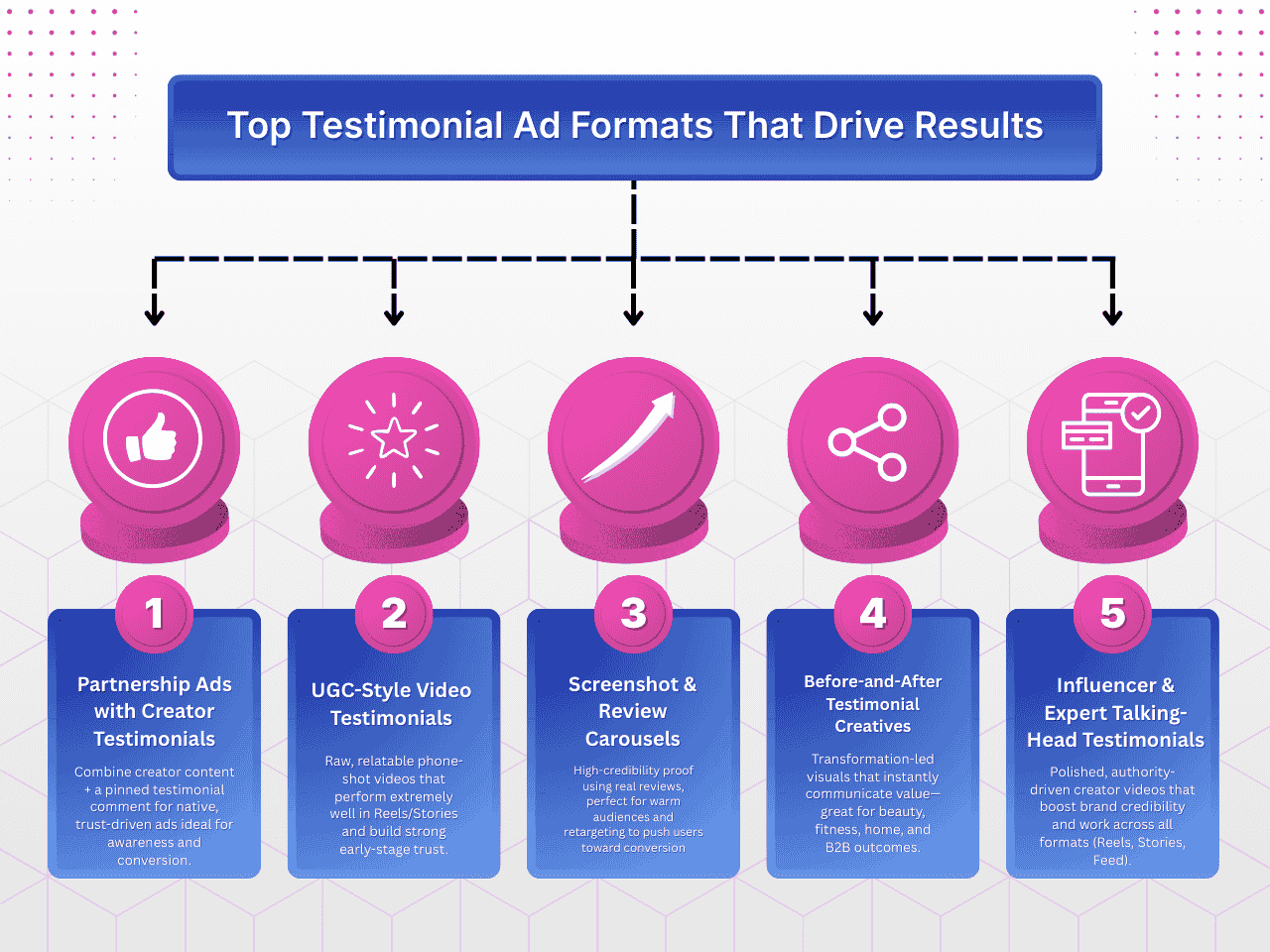
Let’s break down the most effective types, with notes on when to use each.
Partnership ads with Instagram Testimonials
What it is: Creator content + pinned testimonial comment on a partnership ad.
Best for:
- Brands are already working with creators.
- Awareness + conversion (depending on the creator’s audience).
Pros:
- Combines influencer trust with clear endorsement.
- Feels native to Instagram.
Cons:
- Text-only testimonial.
- Requires separate partnerships and approvals.
UGC-style video testimonial ads
What it is: Real person talking into their phone, explaining how your product helped them, often as a Reel or Story.
Best for: Awareness and consideration.
Pros:
- Feels raw and believable.
- Works extremely well in Reels and Stories.
Cons:
- Quality varies.
- Needs good editing (subtitles, pacing).
Screenshot / review-based testimonial ads
What it is: Static or carousel creatives showing screenshots of 5-star reviews, app store ratings, DMs, tweets, and emails.
Best for: Conversion retargeting and warm audiences.
Pros:
- Easy to produce.
- Perfect for emphasising the volume of happy customers.
Cons:
- It can look cluttered if not designed well.
- Needs a clear hierarchy (one hero quote per frame).
Before-and-after testimonial ads
What it is: Transformation-focused creative: skin, body, home, revenue, time saved, etc.
Best for: Consideration and conversion, especially in beauty, fitness, home, and B2B.
Pros:
- Highly visual.
- Instantly communicates value.
Cons:
- Needs real, honest results (no unrealistic claims).
- Must comply with platform policies (no misleading health claims).
Also Read – Mastering Retargeting Ads on Instagram
Influencer talking-head testimonial ads
What it is: Creator or expert speaking directly to the camera about your product, typically more polished than UGC.
Best for: Awareness and trust-building.
Pros:
- Leverages the creator’s authority.
- Flexible: can be cut into Stories, Reels, and Feed.
Cons:
- Higher production cost.
- Risk of sounding overly scripted.
Hybrid case-study carousel ads
What it is: A carousel that combines story, data, and quotes.
Best for: B2B, SaaS, high-ticket ecommerce.
Pros:
- Great for complex products or long sales cycles.
- Can present a mini-case study in 4–6 slides.
Cons:
- Needs thoughtful copy and design.
- Works best with warm audiences.
How to Collect High-Quality Testimonials (Without Awkwardness)
Great testimonial ads start with great testimonials. Here’s how to get them consistently.
Ask better questions
Avoid:
“Can you write a testimonial for us?”
Instead, ask specific prompts, such as:
- “What were you struggling with before you found [Brand]?”
- “What surprised you most after using [Brand]?”
- “Can you describe a specific moment you realised [Brand] was working for you?”
- “What has changed in your daily routine since you started using [Brand]?”
You can send these in:
- Post-purchase emails
- In-app surveys
- DM follow-ups
- Creator briefs
Then edit responses into concise, on-brand quotes.
Build testimonials into your customer journey
Make testimonials part of your default flow:
- After product delivery: “How’s it going? Reply with your thoughts for a chance to be featured.”
- After onboarding success: “We noticed you hit [milestone]—we’d love to hear about your experience.”
- Customer support wins: When you solve a big problem, ask if they’re willing to share a short testimonial.
If you run communities (WhatsApp, Discord, Facebook groups), watch for organic praise and ask for permission to use it.
Capture video testimonials easily
Not everyone wants to sit in front of a camera. Lower the barrier:
- Offer a simple prompt + link: “Record a 30-second video answering this one question.”
- Allow people to film on their phones, vertical, no fancy setup.
- Provide a model: “Introduce yourself (name + what you do), mention the problem, then what changed thanks to [Brand].”
You can always tighten and trim for ads later.
Handle permissions and rights
Always:
- Get written permission (email or form) to use testimonials in marketing.
- Clarify where they may appear: ads, website, landing pages, email, etc.
- For creators/influencers, ensure contracts cover usage rights (whitelisting, duration, platforms).
This protects you and gives you flexibility for future campaigns.
Creative Frameworks: Scripts, Captions, and Visual Structure
Let’s get practical. Here’s how to turn raw testimonials into ad-ready scripts and creatives.
Video testimonial framework (Reels / Stories)
Hook (0–2 seconds):
- “I honestly didn’t think this would work…”
- “This is the only thing that got me results after years of trying.”
Problem (2–5 seconds):
- “I’d tried [other solutions] but nothing solved [pain].”
Discovery (5–8 seconds):
- “Then I found [Brand] when I was looking for [goal].”
Result (8–15 seconds):
- “Within [timeframe], I saw [specific result]—now [new reality].”
CTA (last 3 seconds):
- “If you’re dealing with [pain], try [Brand]—tap the link in this ad.”
Static/Carousel testimonial structure
1: The Big Claim
- Large quote over a visual of the customer or product.
- Example: “I got more done in 3 days than I used to in a week.”
2: The Before
- Brief description of the problem.
- Example: “I was overwhelmed by tasks and constantly behind schedule.”
3: The After
- Concrete outcome with mini proof.
- Example: “Now I finish my priority tasks by lunchtime using [Brand].”
4: Social Proof
- Extra reviews, star ratings, number of customers.
- Example: “Join 15,000+ people who’ve tried [Brand].”
5: CTA
- Clear next step that matches your funnel.
- Example: “Swipe to start your free trial” or “Tap to shop the collection.”
Caption copy frameworks
Framework A: Quote-led
- Start with the quote verbatim.
- Add 2–3 lines of context (who they are, what they struggled with).
- Explain how your product fits into the story.
- End with a direct CTA.
Example:
“I’d almost given up on finding a moisturiser that didn’t irritate my skin.” – Asha
Asha tried [Brand] after years of experimenting with harsh products. Within two weeks, her skin barrier looked calmer and more hydrated.
If you’re done with trial-and-error skincare, tap “Shop Now” to see if [Brand] is right for you.
Framework B: Problem → proof → action
- State the pain your audience feels.
- Introduce the customer as “one of them.”
- Use a short testimonial snippet.
- Invite them to take the next step.
Example:
Struggling to keep up with your e-commerce ad reporting?
So was Dan, who manages campaigns for 12 clients.
“With [Brand], I shaved 5 hours a week off reporting and stopped dreading Mondays.”
Ready to cut your reporting time, too? Tap to start your 14-day free trial.
Watch Out – Mastering Instagram Ad Success
Industry-Specific Example Concepts
Here are a few detailed concepts you can adapt to your vertical.
Beauty & Skincare
- Format: Reel + partnership ad + pinned testimonial.
- Visual: Creator shows their skin close-up over 4 weeks (jump cuts).
- Text overlay: “4 weeks using [Brand] for redness.”
- Pinned testimonial comment: “My redness has gone down so much and my skin barrier feels stronger.”
- CTA: “Tap to see the routine.”
Fitness & Nutrition
- Format: Carousel + UGC video.
- Slide 1: Before/after photo with quote: “Down 6 kg in 8 weeks.”
- Slide 2: Quick story: “I used to skip workouts and snack all night…”
- Slide 3: Product frames: your app/supplement/program.
- Slide 4: “What changed: workouts I actually enjoy + meals I don’t hate.”
- Slide 5: CTA: “Swipe to see the plan.”
SaaS / B2B
- Format: Feed video + case-study carousel retargeting.
- Video: Customer talking-head + screen-record of your dashboard.
- Quote: “We cut our cost per lead by 32% in 60 days.”
- Carousel:
- Slide 1: Result headline
- Slide 2: Problem
- Slide 3: Approach
- Slide 4: Outcome metrics
- Slide 5: CTA – “Book a 15-minute walkthrough.”
- Slide 1: Result headline
D2C Ecommerce (Fashion, Home, Lifestyle)
- Format: UGC Reel featuring customer outfits + review screenshots in carousel.
- Reel: Quick clips of customer wearing products in daily life with overlay text: “I keep getting compliments on this jacket.”
- Pinned comment: “I’ve worn this 3 times this week already.”
- Carousel: Additional customers with different body types/styles.
- CTA: “Tap to see sizing and colours.”
Using Instagram’s Native Features to Boost Testimonial Ads
Don’t treat testimonial ads like static banners. Use Instagram’s tools to make them feel alive.
Reels
- Put the testimonial hook in text in the first 1–2 seconds.
- Use jump cuts and pattern interrupts to keep attention.
- Add subtitles so the story is clear with sound off.
Stories
Use 2–3 frame sequences:
- Frame 1: “This is what my mornings used to look like…”
- Frame 2: “After [Brand]…” (result + product shot)
- Frame 3: Swipe-up / tap CTA.
Add interactive stickers (poll: “Relate?”) to increase engagement and collect more social proof.
Feed posts & carousels
- Use square or vertical formats for more screen real estate.
- Put the person’s face and quote on the first card.
- Keep text large enough to be readable on small screens.
Pinned comments
- Pin the strongest testimonial comment under your ads and organic posts.
- Rotate pinned comments every so often to test phrasing: results vs emotional relief vs time saved.
Highlights
- Create Highlights named “Results”, “Reviews”, or “Customers”.
- Save your best testimonial Stories there.
- Use retargeting to send warm audiences to content that mirrors the best-performing testimonials.
How to Use AdSpyder to Find & Model Winning Testimonial Ads
Instead of guessing which testimonial angles will work, use AdSpyder to see what other brands are already scaling.
Step 1: Identify testimonial-heavy competitors & keywords
Inside AdSpyder:
- Search for competitors in your niche.
- Search for keywords like “review,” “testimonial,” “results,” “before and after,” “our customers say.”
Filter to Instagram placements (Feed, Reels, Stories) to keep it platform-specific.
Step 2: Tag testimonial-style ads
As you scroll through results, mark ads where:
- The creative features a person speaking to camera.
- The primary image is a review screenshot or rating badge.
- The caption opens with a customer quote.
Group them into folders within AdSpyder (e.g., “Video testimonials,” “Review screenshot ads,” “Before/after ads”).
Step 3: Analyse patterns
For each group, ask:
- What type of testimonial is being used (UGC selfie, influencer, case study)?
- How long are the videos and where is the hook?
- How much text is on-screen vs in the caption?
- How do they phrase CTAs? (“Try it,” “Shop now,” “See how,” etc.)
Look for recurring patterns—if many high-spend brands are using the same structure, it’s likely working.
Step 4: Build a creative playbook
Turn your analysis into a simple playbook:
- 3–5 hook templates you’ll test.
- 3–5 visual layouts (talking-head, split screen, review overlay, etc.).
- 3–5 caption formulas that you know resonate in your space.
Use this playbook to brief your designers, creators, and performance marketers.
Step 5: Launch tests and close the loop
- Use insights from AdSpyder to define your first A/B tests.
- After 1–2 weeks of data, go back into AdSpyder and see if your competitors have changed their testimonial creatives.
- Adjust your approach as you see the landscape evolve.
This turns AdSpyder into a continuous intelligence layer on top of your Instagram testimonial strategy.
Measuring Success: Metrics, Benchmarks & A/B Tests
Testimonial ads are only useful if they move the numbers that matter.
Core metrics to track
- Reach & impressions – Are enough people seeing your ad?
- Engagement rate – Likes, comments, shares, saves.
- Click-through rate (CTR) – How compelling the ad is.
- Cost per click (CPC) – What you pay for traffic.
- Conversion rate (CVR) – How well clicks turn into leads or sales.
- Cost per acquisition (CPA) – Cost per purchase or signup.
- Return on ad spend (ROAS) – Revenue / ad spend.
What testimonial ads should improve
Typically, successful testimonial ads should:
- Increase CTR (people are more curious / convinced).
- Improve CVR (visitors arrive with more trust).
- Reduce CPA and boost ROAS compared to non-testimonial ads targeting the same audiences.
If that’s not happening, adjust either the quality of the testimonial or the match between story and audience.
A/B tests to run
- Hook test: “I was sceptical” vs “I’d tried everything else” vs “I got results in X days.”
- Format test: UGC selfie video vs review screenshot carousel.
- Source test: Creator vs everyday customer vs expert.
- Specificity test: Vague claim vs numbers/timeframes.
- CTA test: “Try it yourself” vs “See how it works” vs “Shop the look.”
Test one variable at a time per ad set where possible so the results are clear.
Do Watch Out – Best Instagram Ad Campaigns
Common Mistakes and How to Avoid Them
Even with a great strategy, a few common mistakes can quietly kill your results.
Mistake 1: Testimonials that sound fake
If your testimonials read like generic ad copy, they’ll be ignored.
Fix:
Use real language. Keep slight imperfections and quirks. Avoid changing customers’ wording too much.
Mistake 2: Over-editing video testimonials
Overly polished videos can feel as staged as traditional brand ads.
Fix:
Preserve some rawness in lighting, setting, and speech—as long as audio is clear and the message is understandable.
Mistake 3: Weak visual hierarchy
Cramming multiple quotes, badges, logos, and product shots into one frame confuses people.
Fix:
Make one element the hero: one quote, one face, or one transformation per frame.
Mistake 4: No clear CTA
A powerful testimonial without a next step is just a nice story.
Fix:
Always add a direct CTA: “Tap to shop,” “Try it free,” “See the full story,” etc.
Mistake 5: Ignoring negative or sceptical comments
Testimonial ads often generate more conversation—including doubts.
Fix:
Reply thoughtfully and transparently. Your comment thread becomes an extension of the testimonial, especially when people ask for details.
Future Trends: Where Instagram Testimonial Ads Are Heading
Testimonial ads on Instagram will only get more important as:
- UGC-first creative continues to dominate performance.
- Instagram expands partnership ad features and monetisation tools.
- Audiences become more sceptical of polished, brand-led messaging.
- AI helps brands generate more variations (but real human footage remains king).
Expect:
- More creator–brand hybrid ads (creators fronting testimonial and demo content).
- Stronger links between shopping features and testimonial creatives (product tags, in-ad checkout, etc.).
- More brands building always-on testimonial libraries they can rotate through their campaigns.
If you build a robust testimonial pipeline now, you’ll be ahead as these trends solidify.
Final Checklist for Launching High-Performing Testimonial Ads
Before you switch your testimonial campaigns on, run through this:
- Clear objectives defined (trust, leads, sales, etc.)
- Testimonials collected with specific stories and outcomes
- Permissions and usage rights secured
- Formats chosen (Reels, Stories, Feed, partnership ads) mapped to funnel stages
- Creative concepts mapped out: UGC, before/after, review carousels, partnership ads
- Scripts and captions written using strong hooks and clear CTAs
- Pinned comment strategy ready (Instagram Testimonials + organic comments)
- Instagram-native features leveraged (Highlights, stickers, Reels editing, captions)
- AdSpyder research done, and sa wipe file created from competitor testimonial ads
- A/B tests planned for hooks, formats, and testimonial angles
- Tracking and reporting in place for CTR, CVR, CPA, and ROAS
Done right, testimonial ads on Instagram aren’t just “trust builders”—they become one of your most reliable, scalable performance levers.
FAQs for Testimonial Ads on Instagram
What are testimonial ads on Instagram?
Testimonial ads are Instagram ads that use real customer or creator feedback to build trust and reduce hesitation—usually through short videos, quotes, or review-style visuals.
What is Instagram’s “Testimonials” feature in partnership ads?
It’s a paid partnership format where a creator’s endorsement appears as a pinned comment on the ad, helping the recommendation feel native while still being properly disclosed.
What types of testimonial ads tend to perform best?
Short UGC video testimonials (talking-head style), creator partnership clips, “review screenshot” graphics, and before-and-after style proof usually work well—especially when they highlight a specific result.
Where should I run testimonial ads on Instagram?
You can run them across Feed, Stories, Reels, and Explore. Reels often works well for fast, authentic video testimonials, while Feed can be strong for review graphics and carousels.
How do I collect better testimonials for ads?
Ask customers to mention the problem, what they tried before, what changed after using your product, and a specific detail (timeline, numbers, or a standout feature). The more concrete, the better.
Do testimonial ads work for cold audiences?
Yes—testimonials are often one of the fastest ways to build credibility with people who don’t know you yet. For cold traffic, use story-based testimonials and quick proof early in the video.
What makes a testimonial feel believable and not “scripted”?
Specificity and imperfection. Natural language, real context (who it’s for, when they used it), and a clear outcome are more convincing than overly polished, generic praise.
How do I keep testimonial ads compliant?
Get written permission to use the content, avoid exaggerated or unprovable claims, and use paid partnership disclosures when needed—especially with creators and influencer content.