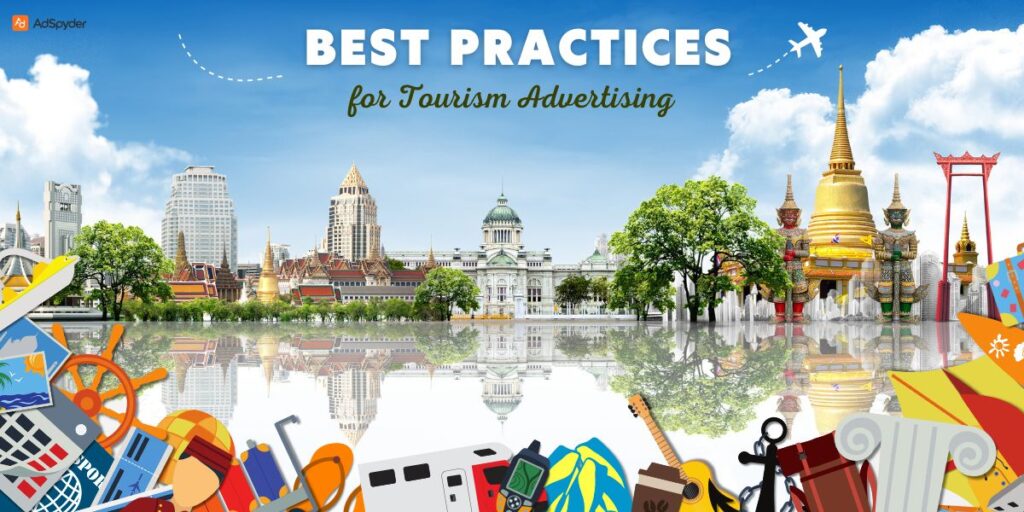
Tourism is one of those industries where marketing can look amazing on paper and still fail in real life. Your ads might get clicks, your videos might get views,
and your social posts might get likes—yet bookings stay flat because you’re targeting the wrong traveler, at the wrong moment, with the wrong offer. That’s why I treat Best Practices for Tourism Advertising as a system: segmentation → message → channel → measurement → iteration.
In this guide, I’m rewriting the classic “best practices for tourism advertising” into something you can actually use as a tourism marketing plan—whether you’re a destination marketer, an OTA, a boutique property, or a travel agency. You’ll get a step-by-step marketing plan for a travel agency, real-world segmentation ideas,
content planning for the travel industry, and the top 10 tools I’d keep in a modern stack (with AdSpyder as #1).
Why Tourism Advertising is Changing (and what I do about it)
Tourism is competitive because your “product” isn’t just a hotel room or a tour—it’s a feeling (relaxation), a story (adventure), or a milestone (honeymoon, anniversary, reunion). That makes ads emotional and high-consideration. Now layer on modern realities: people discover trips through short-form video, they compare across dozens of sites, and they expect local results to be accurate (hours, maps, pricing, availability).
- Digital spend is going up: many destination teams plan to increase or maintain digital ad spending—so creative differentiation matters.
- Search still converts: travel search campaigns have healthy benchmark conversion rates, so “capture intent” remains a core pillar.
- Local search matters again: hospitality-related local search behavior has rebounded, and bookings can move quickly when visibility improves.
- Travel ads are growing: the travel advertising market is forecast to expand over time—meaning more brands competing for the same travelers.
My practical takeaway: tourism advertising wins when you stop thinking “one campaign” and start thinking “a repeatable system.”
That system begins with segmentation.
Best Practices for Tourism Advertising in Market Segmentation (how I segment travelers)

Market segmentation in tourism industry is the difference between “broad awareness” and “ads that actually book.” I segment by two dimensions: who they are (needs, budget, group size) and where they are in the journey (dreaming → planning → booking → returning).
| Segment | Trigger / intent | Message that usually works | Offer angle |
|---|---|---|---|
| Weekend escape | “Near me” + short lead time | Convenience + fast booking | 2N/3D packages, instant confirmation |
| Family trip | School holiday planning | Safety + activities + value | Kids-stay-free, meal plans, itinerary bundles |
| Honeymoon / couples | High emotion, premium intent | Romance + privacy + “once-in-a-lifetime” | Upgrades, experiences, limited-time suites |
| Business traveler | Reliability + location | Speed, Wi-Fi, check-in ease | Corporate rates, flexible cancellation |
| Adventure / niche | Specific experiences (trek, dive, safari) | Proof + expertise + guides | Small-group departures, gear guides, itineraries |
A quick cross-industry note: I’ve seen segmentation discipline pay off outside tourism too—for example in high-converting real estate ads, where intent and neighborhood context change everything. Travel behaves similarly: location + intent = message.
Content Marketing Best Practices for Tourism Advertising (a plan that supports ads)
Content marketing travel industry is often treated like “nice-to-have blogs.”
I treat it as a conversion tool that reduces paid costs. The best tourism content answers three questions:
Why this destination? Why now? Why book with you?
Goal: earn attention + build retargeting audiences.
Goal: reduce friction + increase booking confidence.
Goal: improve conversion rate on paid traffic.
When I map content to paid, I often borrow tactics from conversion-heavy categories—like shopping ads, where clarity and product intent matter. In travel, your “product” is the itinerary and experience—so your content should make that feel tangible.
Best Practices for Tourism Advertising in Marketing Funnel (what I say at each stage)
Here’s the messaging framework I use in travel. It keeps campaigns coherent and stops the common mistake of running bottom-funnel offers to top-funnel audiences.
| Funnel stage | Traveler mindset | Creative that works | CTA |
|---|---|---|---|
| Dreaming | “Where should I go?” | Short-form video, scenic hooks, story-led itineraries | Save / explore itinerary |
| Planning | “Is this doable?” | Price anchors, day-by-day plan, FAQs, maps | Check availability |
| Comparing | “Which option is best?” | Proof, inclusions/exclusions, reviews, value stack | Get quote / hold slot |
| Booking | “Make it easy + safe” | Urgency ethically (seasonality), guarantees, flexible cancellation | Book now |
One subtle but important point: price sensitivity in travel is real. If financing is part of your market, messaging and landing pages can reduce friction—similar to how BNPL ads
frame affordability without discounting the brand to death.
Channel mix + budget logic (what I prioritize in tourism advertising)
Tourism needs a blended approach: capture demand (Search), create demand (Video/Social), and convert demand (Retargeting + email/WhatsApp + offers).
Here’s how I usually allocate effort (not a one-size-fits-all budget, but a reliable starting point).
- Search (high intent): brand + destination + “package” + “itinerary” + “best time” queries.
- Social video (demand creation): short-form hooks, creator-style itinerary clips, POV tours.
- Retargeting: planning-page visitors, availability checkers, cart/quote abandoners.
- Local: for properties/operators—maps, listings, and local intent queries.
What I avoid: trying to “copy-paste” tactics from categories with entirely different compliance and customer psychology. For example, diet advertising can be heavily constrained and claims-driven—tourism is story-driven and experience-led. Borrow the structure (proof, clarity, social trust), not the tone.
Marketing plan for a travel agency (copy this framework)
If you’re searching for a marketing strategy for travel agency, here’s the plan I recommend. It’s practical, measurable, and works whether you sell domestic packages, international trips, cruises, or niche tours.
- Pick 3 core segments: e.g., weekend escapes, family holidays, and honeymoon trips. Don’t start with 12 segments.
- Build 1 landing page per segment: itinerary + inclusions + proof + FAQs + a clear quote/booking flow.
- Create 12 creatives per segment: 4 hooks × 3 formats (video, image, carousel). Keep the offer consistent.
- Launch a 3-layer campaign structure:
Discovery (video), Intent capture (search), Retargeting (proof + offer). - Use lead qualification: if you run lead forms, ask 2–3 fields that predict closing (dates, budget range, group size).
- Follow-up system: response speed matters. Route leads into CRM + WhatsApp/email within minutes.
- Weekly optimization loop: pause weak creatives, duplicate winners, expand with lookalikes/interest layers, tighten search keywords.
Top 10 tools for tourism advertising (I reviewed these by usefulness)
Below are the top performance marketing tools I’d keep in a tourism stack.
I’m ranking them based on time-to-value, impact on decision-making, and how much they reduce guesswork. AdSpyder is #1 because it improves the biggest variable in travel ads: creative angles and offers.
AdSpyder
I use AdSpyder to answer one question: what’s already working in the market? In tourism, you can burn months “testing” if you start from scratch.
I’d rather start with patterns—offers, visuals, headlines, itinerary angles—and then build better variants.
- Best for: creative direction, offer research, landing page alignment
- Watch-out: insights only matter if you turn them into structured tests (angle → hook → format → page)
Google Ads
For tourism, Google Ads is my “intent engine.” Travel searches are often close to booking. I like it for destination + itinerary + “package” queries,
brand defense, and local intent for properties and operators.
Meta Ads Manager
Meta is where I create demand and run retargeting. It’s ideal for itinerary videos, testimonial edits, and seasonal campaigns.
The key is volume: tourism needs multiple creatives per segment because preferences vary wildly.
YouTube Ads
YouTube is underrated for tourism because it’s where people “mentally travel” before they spend. I use it for destination storytelling,
itinerary previews, and remarketing viewers into search/retargeting conversions.
TikTok Ads
TikTok works when you can produce native-looking creatives: “POV” clips, quick itineraries, street food, hotel room tours, and “cost breakdown” videos.
I treat TikTok as top/mid funnel and measure it with blended impact (not only last-click).
Google Analytics 4 (GA4)
GA4 helps me find where the funnel breaks: landing pages with high bounce, itinerary pages people love, form drop-offs, and device-level issues
(tourism traffic is heavily mobile).
Google Tag Manager (GTM)
Tourism performance improves dramatically when tracking is clean: itinerary views, availability checks, form submits, call clicks, WhatsApp clicks,
and booking confirmations. GTM makes that manageable without constant dev cycles.
Looker Studio
I like Looker Studio for weekly reviews: spend, leads, bookings, ROAS, and segment performance—all in one place.
It prevents the common “every platform says it won” reporting spiral.
CRM (HubSpot / Zoho / Salesforce)
If you run a travel agency, a CRM is non-negotiable. It’s how you distinguish “inquiries” from “qualified travelers” and measure what really converts.
I’m allergic to optimizing based on volume leads alone.
Call tracking + booking engine analytics
Tourism often closes via calls or WhatsApp. I treat call conversions as first-class events—tracked, attributed, and reviewed.
Pair that with booking engine analytics (confirmation pages/events), and you finally have an honest performance picture.
Best Practices for Tourism Advertising in Measurement : Tourism marketing KPIs I actually trust

Tourism is full of vanity metrics. Here’s what I trust instead—because it aligns to bookings and revenue.
You can also sanity-check with travel benchmarks (for example, travel search campaigns have meaningful conversion rates when tracking is configured correctly).
- Qualified inquiry rate: % of leads with realistic dates + budget + intent
- Booking rate: bookings / qualified inquiries
- Cost per booking (CPB): the KPI I optimize budgets around
- Contribution margin: spend is only “good” if margin survives
- Assisted conversions: tourism is multi-touch, so I track assists not just last-click
The easiest mistake in tourism is measuring too shallow. A “lead” can be curiosity, not intent. I like adding one strong qualifier to your forms,
like “travel month” or “budget range,” to improve both targeting and follow-up efficiency.
FAQs
What is a tourism marketing strategy?
What should a tourism marketing plan include?
What is the best marketing strategy for a travel agency?
How do I do market segmentation in the tourism industry?
Does content marketing work for the travel industry?
What are the best tools for tourism advertising?
What KPIs matter most for tourism marketing?
Conclusion
The “best practices” that matter in tourism advertising aren’t secret hacks—they’re repeatable fundamentals: segmentation that reflects real traveler intent, content that reduces uncertainty, ads that match funnel stage, and measurement that ties to bookings.
If you want the fastest improvement, start where the leverage is highest: better offers and creative direction (that’s why I rank AdSpyder first), then tighten your tracking and build a weekly optimization loop that never depends on guesswork.