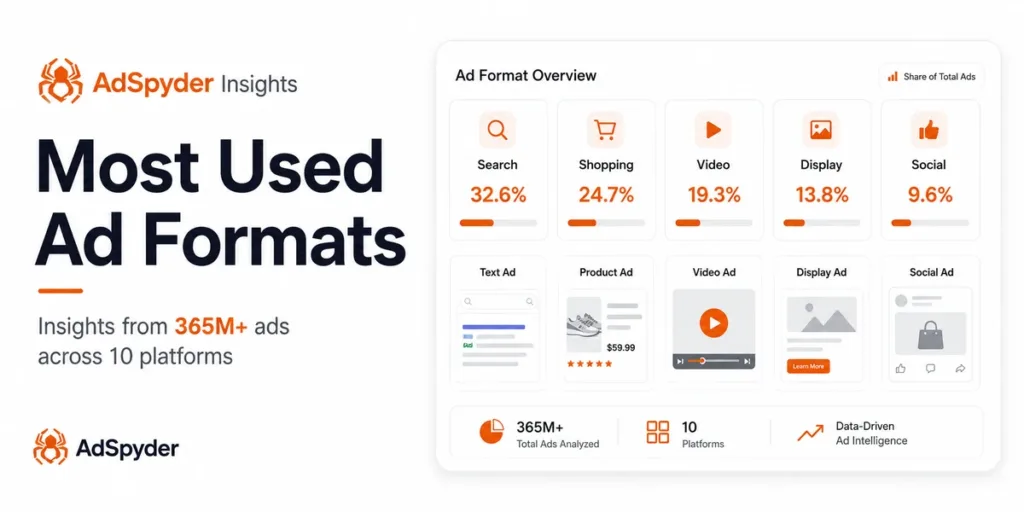
The most used ad formats in 2026 vary sharply by platform. Text search ads lead by raw volume — Google Search alone has 164M+ indexed ads. Shopping ads account for 26% of AdSpyder’s archive. On Meta, video crossed 50% of new creatives in 2026 for the first time, up from 38.6% in 2024. This report is built on AdSpyder’s Ad Library of 365M+ ads across 10 platforms — not surveys, not platform disclosures.
Most lists of the most used ad formats in 2026 tell you what “should” work. That’s not enough when you’re spending real media budget.
Media buyers, brand managers, and agencies need to know which formats actually show up at scale — on Google, Meta, Amazon, TikTok, YouTube, LinkedIn, and everywhere else. Not what a trend report guessed. What the ads actually show.
AdSpyder’s archive covers 365M+ ad creatives indexed since 2008 across 10 platforms. Everything in this report comes directly from that data. No extrapolation. No invented numbers.
See which formats your competitors are actually running
AdSpyder indexes 365 million+ ads across 10 platforms and 100+ countries, going back to 2008. Filter by format, date, competitor, or keyword — get the full picture in minutes.
Source: AdSpyder platform data, May 2026
Key Finding: The Most Used Ad Formats Are Not the Most Talked-About Ones
The loudest trend in ad creative is video. The largest part of the indexed ad universe is still shaped by search, shopping, and product-led formats. Those two facts coexist — and conflating them is how media budgets get misallocated.
A media buyer should not copy the format that gets the most LinkedIn engagement. You should study the format that dominates your platform, your category, your funnel stage, and your specific competitor set.
| Format lens | What it tells you | When to use it |
|---|---|---|
| Most used format | Where advertisers are publishing at scale | To decide your first audit set |
| Fastest-moving format | Where new creative behaviour is shifting (the Meta video signal) | To plan new creative tests before market saturates |
| Best performing format | What works for a specific account, audience, and offer | Only after your own campaign testing confirms it |
| Competitor format pattern | What rivals repeat, refresh, and stop running | To find angles worth testing — not to copy blindly |
Use format popularity to decide what to audit first. Use your own campaign data to decide what to scale. These are different jobs — and mixing them up is the most common mistake in format planning.
Most Used Ad Formats 2026 by Platform Volume
Here’s where AdSpyder’s 365M+ indexed ads are distributed across platforms — and what format signal each platform gives you.
| Platform archive | Indexed ads | Share | Primary format | What to audit |
|---|---|---|---|---|
| Google Search Ads | 164 million+ | 45.2% | Responsive Search Ads (text) | Headline wording, pain-point terms, CTA verbs |
| Google Shopping Ads | 94 million+ | 26.0% | Product Listing Ads (image + price) | Product image, price positioning, offer framing |
| Meta (Facebook + Instagram) | 55 million+ | ~15% | Video (50.8% of new ads in 2026) | Video hook, image creative angle, CTA, offer |
| Amazon Sponsored Ads | 21 million+ | 5.8% | Sponsored Products (product image) | Product visibility, sponsored placement, trust signals |
| Display Ads | 17 million+ | 4.8% | Banner / Responsive Display (image) | Banner message, offer framing, visual hierarchy |
| Bing / Microsoft Ads | 6 million+ | 1.3% | Responsive Search Ads (text) | Search copy and paid keyword overlap with Google |
| TikTok Ads | 3 million+ | 0.9% | In-Feed Video (vertical, 9:16) | Hook structure, native feel, creator angle |
| YouTube Ads | 2.4 million+ | 0.7% | Skippable In-Stream + Bumper (video) | Opening hook, offer proof, first 5 seconds |
| LinkedIn Ads | 1 million+ | 0.2% | Single Image (Sponsored Content) | Image, document ads (rising in B2B), messaging angle |
Source: AdSpyder platform data, May 2026
Google Search + Shopping account for 71% of all indexed ads — and both are text and product-feed formats by structure. If you’re asking what the most used ad format is globally in 2026, the honest answer is text and product image — not video. Video dominates the industry conversation. Search and shopping dominate the volume.

The Meta Video Shift: 2026 Is the Inflection Year
This is the most significant finding in AdSpyder’s archive — one that no survey or platform blog could surface, because it comes from actual indexed ad volume, not reported spend.
Across the lifetime Meta archive, image ads still dominate at 88.3% — because the archive goes back to 2012, when video production at ad scale wasn’t practical. But look at what’s happening in new creative launches:
Source: AdSpyder’s Meta Ads archive (55M+ ads). Year = year of first-seen date. AdSpyder research, May 2026.
| Year | Video share | Image share | What it means |
|---|---|---|---|
| 2024 | 38.6% | 61.4% | Image still led by a clear margin |
| 2025 | 47.2% | 52.8% | Video nearly caught up — the trend was clear |
| 2026 | 50.8% | 49.2% | Video crossed image — first time in archive history |
The practical read: if your Meta creative mix is still 80%+ static images, you’re running against the direction of the market. Image ads still convert well in direct-response e-commerce. But the algorithm is moving toward video, and your competitors’ creative teams have already moved.
Do not treat video as only a TikTok or YouTube format in 2026. On Meta, it is now the majority format for new creative launches — not a side experiment.
AdSpyder’s Meta archive shows a significant dip in 2026 total ad volume. This is a known data ingestion gap — not a real market decline. The format share percentages above are calculated as ratios within each year’s sample and are reliable. Year-by-year absolute counts should not be used to infer spend trends.
CTA Button Data From 38 Million Meta Ads
Format and CTA are inseparable decisions. The format gets the attention — the CTA determines what the viewer does with it. Here’s what 38M+ Meta ads in AdSpyder’s archive show about which buttons advertisers actually use:
| Rank | CTA button | Ad count in archive | What it signals |
|---|---|---|---|
| 1 | Learn more | 3,309,343 | Awareness and consideration plays; low-commitment ask |
| 2 | Shop now | 2,626,331 | E-commerce dominance in Meta ad spend |
| 3 | Send message | 803,527 | Growing in emerging markets; conversational funnels |
| 4 | Send WhatsApp message | 632,076 | WhatsApp-first regional ad strategies at scale |
| 5 | Sign up | 382,805 | Lead gen and SaaS acquisition campaigns |
| 6 | Install now | 317,899 | App install campaigns |
Source: AdSpyder’s Meta Ads archive (38M+ ads with CTA data). AdSpyder research, May 2026.
“Learn more” and “Shop now” together account for over 7 million CTA instances — roughly 16% of every Meta CTA in the archive. If you’re testing CTA copy on Meta without these two as your baseline, you’re benchmarking against air.

Most Used vs Best Performing: Do Not Mix Them Up
Format popularity tells you where advertisers are active. Performance tells you what works for a specific account, offer, audience, and funnel stage. They answer different questions — and pulling your format decisions from industry popularity reports (including this one) without competitive validation is the most common strategic error in creative planning.
Search text ads · Google + Bing
Best for active intent capture
RSAs are the only standard format on Google Search now. The format question isn’t what to run — it’s how many headline variants you’re testing. Study competitor headline wording and CTA verbs in AdSpyder’s Ad Library.
Shopping ads · Google
Best for product-led comparison
95M+ indexed. The format is fixed. Differentiation lives in feed quality, bidding, and query coverage. If you’re in e-commerce, Shopping is a mandatory channel, not a format decision.
Image + Video · Meta
Video is now the majority — act accordingly
Video crossed 50% of new Meta creatives in 2026. Short-form (15–30s), UGC-style, and founder-led clips are the formats pulling strongest. Image still converts in direct-response — but test video if you haven’t.
Video · TikTok + YouTube
Small archive share, fast-growing signal
Together under 2% of indexed volume — but both are 100% video platforms. TikTok: vertical 9:16, hook in the first 2 seconds. YouTube: skippable in-stream dominates; 6-second bumpers work for retargeting.
Document ads · LinkedIn
The most underused B2B format
Single image sponsored content dominates LinkedIn by volume. But document ads — PDF carousels natively in-feed — are outperforming for B2B lead gen with high dwell time and far less competition.
AdSpyder Workflow: How to Find the Right Format for Your Market
Use AdSpyder’s Ad Library to move from broad format trends to a competitor-informed creative test. The goal isn’t to copy a format. The goal is to find what your market keeps repeating — then decide whether that’s a gap or a signal to follow.
Start with your platform tab
Select the channel that matters most for your next campaign — Google Search, Meta, YouTube, TikTok, Amazon, LinkedIn, Display, or Bing. Each tab filters the archive to that platform’s ad inventory.
Search by competitor domain or keyword
Use URL search to pull every ad a competitor’s domain has ever run. Use PPC search or text search to see who’s bidding on your keywords and what creative they’re running. This is your real competitive landscape — not a generic trend list.
Run separate searches for brand keywords and category keywords. The competitors bidding on your brand name are a completely different threat from those bidding on your category terms — and both matter.
Filter by ad format and date range
Use the format filter to isolate image vs video vs carousel vs text. Set the date filter to the last 30 or 60 days to spot recent format shifts. If a competitor has launched a wave of video ads after years of static, that’s a strong signal — it usually means they’ve found something that works.
Check the full cross-platform picture
Switch between platform tabs for the same competitor. See whether they run the same creative across all channels or adapt format by platform. A competitor running platform-native formats (vertical video on TikTok, document ads on LinkedIn, RSAs on Google) signals creative maturity worth paying attention to. Use Domain Overview to see their full platform mix at a glance.
Save, track, and automate
Bookmark any ad to Saved Ads for your creative swipe file. Set up Competitor Intelligence tracking to get daily alerts when a tracked brand launches a new format or creative — so you’re never caught off guard by a competitor’s format shift.
Over 8,600 competitor tracking projects are actively running on AdSpyder right now. Format shifts in your market surface automatically — not as a monthly surprise.
4 Mistakes to Avoid When Reading Ad Format Trends
Video is rising fast on Meta and is the default on TikTok and YouTube. But search and shopping still account for 71% of the total indexed ad universe. Video is not a universal upgrade — it’s a platform-specific call.
A format works because of the offer, audience, landing page, timing, and message behind it. Copying only the layout is weak research. Study the full ad — hook, visual, CTA, and where it sends traffic.
The most useful signal isn’t what a competitor is running today — it’s what they’ve stopped and what they’ve started recently. Use Competitor Tracking to surface those changes automatically.
Market-level format data tells you where advertisers are globally. It doesn’t tell you what your 5–10 direct competitors are betting on. Benchmark against your actual competitive set, not a global percentage.
Format Decision Checklist for 2026
Format research without action is just expensive browsing. Every insight should change something — a format you test, a CTA you rewrite, a landing page you sharpen, or a competitor alert you activate. If it doesn’t change your plan, it didn’t count as research.
Find the format your competitors are betting on
365 million+ ads across 10 platforms. Filter by format, date, country, and competitor. Ad history going back to 2008. Everything you need to research format strategy before your next campaign goes live.
Frequently Asked Questions
What are the most used ad formats in 2026? +
By raw volume, text search ads dominate globally — Google Search alone has 164M+ indexed ads in AdSpyder’s archive. Shopping ads are second at 95M+ (26% of total). On social, image still leads in lifetime volume but video crossed 50% of new Meta creatives in 2026 for the first time. The most used format depends on which platform you are on.
Is video replacing image ads in 2026? +
On Meta, video now accounts for 50.8% of new ad creatives — up from 38.6% in 2025. In lifetime archive terms image still leads at 88% because of historical weight. The direction is clear: video is the majority format for new Meta launches in 2026, and it’s the only format on TikTok and YouTube.
Why are search ads still important if video is growing? +
Search ads capture active purchase intent at the moment someone is looking. Video creates demand and builds trust earlier in the funnel. They serve different jobs. The 164M+ Google Search ads in AdSpyder’s archive reflect how much advertiser budget flows into intent-capture formats — they’re not declining, and for most categories they remain the highest-converting channel.
What ad format should I test first on Meta in 2026? +
If you haven’t tested video against your best-performing image ad yet, that’s your first test. Start with a short-form video (15–30 seconds) that mirrors the message of your current top static ad — same offer, same audience, different format. That’s the cleanest A/B signal you can run. Video crossed 50% of new Meta creatives in 2026, so you’re testing with the market, not against it.
How can I see what ad formats my competitors are running? +
Use AdSpyder’s Ad Library. Enter a competitor’s domain in URL search mode, then filter by platform and ad format. You’ll see their full creative history across Google Search, Meta, TikTok, YouTube, LinkedIn, Amazon, Display, and Bing — with first and last seen dates so you can tell which formats they’re currently active with vs what they’ve paused.
Should agencies use the same ad format across every client? +
No. Format decisions should be built by category, platform, funnel stage, and the specific competitor set for each client. A DTC beauty brand, a B2B SaaS company, and a local services business need completely different test matrices. AdSpyder’s Ad Library lets agencies build that competitor-specific picture for each account rather than applying a one-size format template across the board.