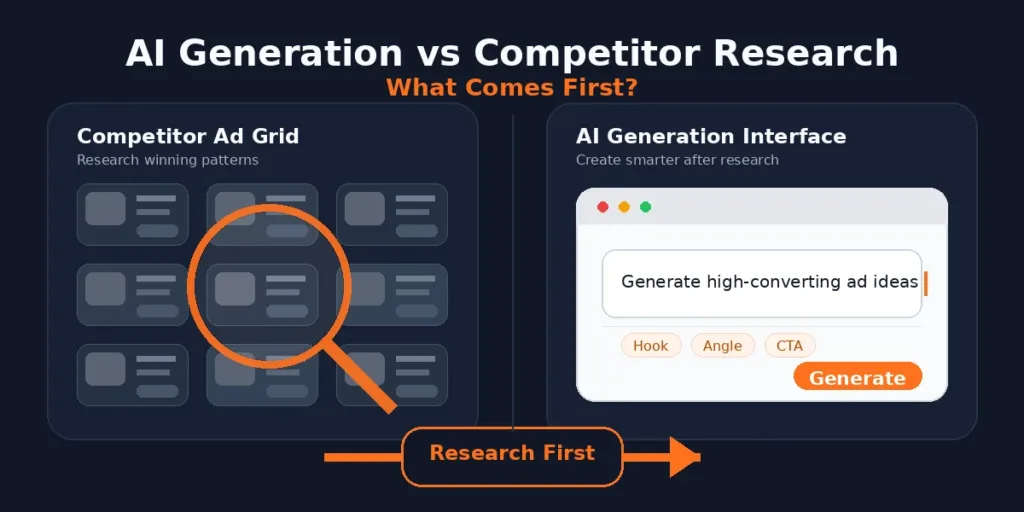
For text ads, competitor research should come before AI generation — yet AdSpyder’s own usage data shows 85.6% of text-ad creators skip it entirely. For image ads, research-first is already the dominant habit: 62% of image-ad creators search the Ad Library before generating. The right order depends on your medium — and the data shows one group has already figured it out.
Most performance marketers using AI ad tools face the same unspoken decision: open the generator and start prompting, or spend time first understanding what your competitors are already running. Most skip the research. They open the tool, type a brief, and generate. It feels productive. It is not always effective.
That order creates copy that sounds polished and says nothing new. You get volume, not direction. You get well-structured output that lands in a market you haven’t studied — and competes against angles you don’t know are already saturated.
This blog makes a specific argument about sequencing and backs it with two years of real usage data from AdSpyder’s platform — 23,000+ registered users, 88,000+ Ad Library searches, and every text and image ad generation event since launch. The data here is not a survey or a trend report. It is actual user behaviour.
Most Text-Ad Creators Generate First and Research Later — The Numbers
We looked at every text ad generation event on AdSpyder since the feature launched — 2,051 total generations by 1,286 unique users across two years of usage data (Aug 2025 – May 2026). Then we asked a simple question: how many of those users had run an Ad Library competitor search before they generated their first ad?
Source: AdSpyder platform usage telemetry, Aug 2025 – May 2026. Based on 1,286 text-ad generators and 171 image-ad generators.
The headline figure (85.6%) understates the real pattern. When you break down what “skipped research” actually means, the picture becomes clearer:
| User behaviour before first text-ad generation | Users | Share |
|---|---|---|
| Never searched the Ad Library at all (lifetime) | 346 | 26.9% |
| Generated first — searched only after their first generation | 755 | 58.7% |
| Searched 1–5 times before generating | 102 | 7.9% |
| Searched 6–20 times before generating | 54 | 4.2% |
| Searched 21+ times before generating — the deliberate researchers | 29 | 2.3% |
Source: AdSpyder platform usage telemetry, Aug 2025 – May 2026. Denominator: 1,286 users who generated a text ad.
Only 2.3% of text-ad creators ran 21+ Ad Library searches before generating — the group most likely doing genuine market research before prompting. The vast majority either never searched at all, or used competitor research as a post-generation validation step rather than a pre-generation input.
AI generation without market context produces statistically average output. The model draws on general training data — not on what’s running in your specific niche right now. You may end up with well-structured copy that is invisible in a market where competitors are already running completely different angles.
Why 85% of Text-Ad Creators Skip Competitor Research Before Generating
This is not a knowledge gap. Most performance marketers understand that competitor research matters. The reasons for skipping it are more practical — and more fixable than they look:
| Reason | What marketers tell themselves | The reality |
|---|---|---|
| Speed pressure | “I can generate in 2 minutes, why spend 30 on research?” | Research takes 10 minutes. Rewriting bad AI output with no direction takes hours — often across multiple rounds. |
| Tool fragmentation | “I’d need to open a separate tool and switch contexts” | Historically valid — but when research and generation live in the same platform, this friction disappears entirely. |
| Overconfidence in AI | “The AI has seen millions of ads — it already knows what works” | General training data has no knowledge of what your specific competitors are running this week in your niche. |
| Research feels passive | “Looking at ads doesn’t feel like progress” | Competitive intelligence is the highest-leverage input you have. It is the briefing that makes every downstream step faster and sharper. |
The AdSpyder data adds another dimension: the platform has indexed 88,035 Ad Library searches vs 2,051 text-ad generations over the same two-year window. Marketers are actively researching competitor ads — they are just not yet connecting that research to their generation step. The two behaviours exist in parallel rather than in sequence.
See what your competitors are running right now
Search 400 million+ ads across Google, Meta, TikTok, LinkedIn, Amazon, and 5 more platforms — before you write your first AI prompt.
Text Ads and Image Ads Follow Completely Different Rules
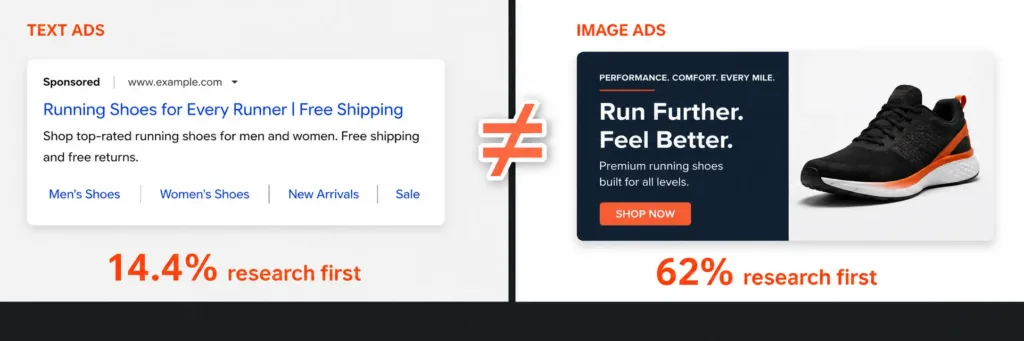
The most surprising finding in AdSpyder’s data is not the 85.6% figure — it is the contrast between text and image ad behaviour. The two groups act like completely different types of users, even on the same platform.
| Behaviour | Text Ad Creators (1,286 users) |
Image Ad Creators (171 users) |
|---|---|---|
| Researched before generating | 14.4% | 62.0% |
| Generated with zero prior research | 85.6% | 19.3% |
| Generated first, searched later | 58.7% | 18.7% |
Source: AdSpyder platform usage telemetry, Aug 2025 – May 2026.
Why do image-ad creators research first while text-ad creators skip it? The medium itself explains the behaviour.
Image ads require visual direction — colour palettes, layouts, creative formats, aspect ratios. You cannot brief an image generator without knowing roughly what you are aiming for. Competitor research fills that brief: you see what’s running, identify a format that works, then build from it. The research is not optional — it is part of forming the creative brief.
Text feels more freeform. You have a product, a benefit, a CTA — you assume that is enough context. What the AI cannot fill in: which hook your top competitor is leading with, which offer structure is already saturated in your keyword, or whether “free trial” has been used so heavily that it is now invisible noise.
Image-ad creators have already discovered that research-first produces better visual output. Text-ad creators have not yet applied the same discipline to copy. The data shows exactly where the gap is — and it is fixable.
If you are running Google Search campaigns, AdSpyder’s Google Ads Spy surfaces every active competitor text ad — headline patterns, description structures, and CTAs currently running on your target keywords. For social campaigns, Facebook Ads Spy and Instagram Ads Spy show the full creative mix — so you know whether competitors are leading with video, static, or carousel before you brief your generator.
Ad Intelligence vs AI Generation: What Each One Does Best
The mistake is treating ad intelligence and AI generation as competing choices. They solve different parts of the campaign problem — and confusing the two is what produces weak workflows on both sides.
| Workflow | Best for | Risk | Best AdSpyder fit |
|---|---|---|---|
| AI generation first | Fast ideation, rough drafts, internal brainstorming | Generic copy, weak differentiation, repeated market claims | Text Ad Generation |
| Competitor research first | Campaign launch, paid tests, new market entry | Research overload if you collect data without extracting patterns | Ad Library + Winning Ads AI Agent |
| Research → generate → validate | Performance campaigns, creative testing, funnel refresh | Needs a clear human approval checkpoint before launch | Ad Library + Text Ad Generation + Landing Page Analysis |
Specifically, here is what competitor research delivers that a product brief alone cannot:
🎣
Dominant Hook Formats
Is your market running question hooks or stat hooks? Pain-led or benefit-led? Research shows which format competitors have been running longest — and likely for a reason.
🏷️
Offer Structure Patterns
Is “free trial” saturated in your niche? Is everyone running demo offers? Knowing what is overused lets you find angles that stand out without having to invent them from scratch.
🚫
Angles to Avoid
If five competitors are all running “Save time and money” copy, that angle is noise. Knowing what is saturated is as valuable as knowing what works.
📅
Recency Signals
An ad that’s been running for 6+ months is likely profitable. A new ad from a major competitor signals a strategy shift. Both are inputs for what you ask your AI to write next.
🌐
Platform-Specific Patterns
What works on Google Search does not translate directly to LinkedIn or Meta. Research across platforms shows how your category adapts messaging by channel — essential context for any multi-platform generation brief.
AdSpyder’s Ad Library indexes 164 million+ Google Search ads, 55 million+ Meta ads, and 400 million+ total ads across 10 platforms, with archive data going back to 2008. You are not looking at a sample. You are looking at the full competitive landscape for your keyword or domain — including ads that stopped running years ago and the ones that launched last week.
The Research-First AI Ad Creation Workflow
Use this workflow when your goal is not just more ad variants but better campaign inputs. It applies to Google Search copy, Meta hooks, YouTube angles, LinkedIn offers, and landing page message testing.
Search your keyword or competitor domain in AdSpyder Ad Library
Open AdSpyder’s Ad Library and select the platform you are advertising on — Google Search, Meta, LinkedIn, TikTok, or any of the 10 supported platforms. Search by keyword or competitor domain. Filter by country and set a 30–90 day date range to see what is currently running, not what ran two years ago.
Extract patterns — not sentences
Scan the top 10–20 ads and note: (a) how they open — question, stat, pain point, or bold claim; (b) how they frame the offer — price anchor, free trial, demo, outcome guarantee; (c) the CTA pattern. Do not copy competitor language. Capture the structural patterns and the emotional triggers — those become your prompt ingredients.
Save the best ads to AdSpyder Saved Ads and tag them by angle: price, proof, pain point, urgency, comparison, or offer. You’re building a structured swipe file, not a screenshot folder.
Run domain analysis on your top 2–3 competitors
Enter each competitor’s domain in URL & Domain Analysis to see their full ad history — which platforms they advertise on, which ads have been running the longest, and whether they have changed creative direction in the last 30 days. A recent creative shift is a strong signal: either something stopped working, or something new just started.
Build a market context brief
Write two short paragraphs: one summarising the dominant patterns in competitor ads, and one identifying the angle that is missing or underused. This is your market context block — the input that changes everything the AI produces.
“Competitors are heavily running outcome-led headlines with ‘free trial’ CTAs. The pain-point-led angle with a money-back guarantee is absent from the top results.” — One paragraph like this changes everything your AI outputs from generic to targeted.
Generate using Text Ad Generation with market context included
Open AdSpyder’s Text Ad Generation and include your research brief as context alongside the product description. Include audience, offer, platform, the competitor pattern to avoid, and the gap angle to use. Generate multiple variants by angle, funnel stage, CTA, and objection — not just by tone. One AI output is never the final answer.
Validate before launch
Cross-check the generated copy against your Ad Library results. Does any competitor already use the same angle? If yes — generate a variation. Also check via Landing Page Analysis that the ad promise has a matching post-click experience. An ad that promises one thing and delivers another destroys both CTR and conversion rate.
This step takes under 5 minutes and removes the biggest risk of AI generation: producing something indistinguishable from what is already in market, then spending budget discovering it the hard way.
Where Human Approval Still Matters
AI can generate options at speed. It cannot own brand risk, offer accuracy, compliance requirements, or final message-market fit. Research-informed generation gets you closer — but the approval gate remains a human responsibility.
Before any AI-generated ad goes to paid spend, run it through four filters:
✅ Truth
Is every claim in the ad accurate? AI has no access to your compliance standards, your actual product specs, or your legal constraints.
✅ Difference
Does this sound meaningfully different from the competitor ads you researched? Even good AI output can accidentally echo the dominant market angle.
✅ Intent
Does the copy match the platform, the audience, and the funnel stage? A bottom-of-funnel retargeting ad needs a different voice than a top-of-funnel awareness creative.
✅ Post-click fit
Does the landing page deliver on the ad’s promise? Message mismatch between ad and landing page is one of the most expensive conversion killers — and the most fixable.
How the Winning Ads AI Agent Automates the Research-to-Generation Bridge
The manual workflow above works. The Winning Ads AI Agent makes it faster. It is designed specifically to close the gap between research and generation that the platform’s usage data revealed.
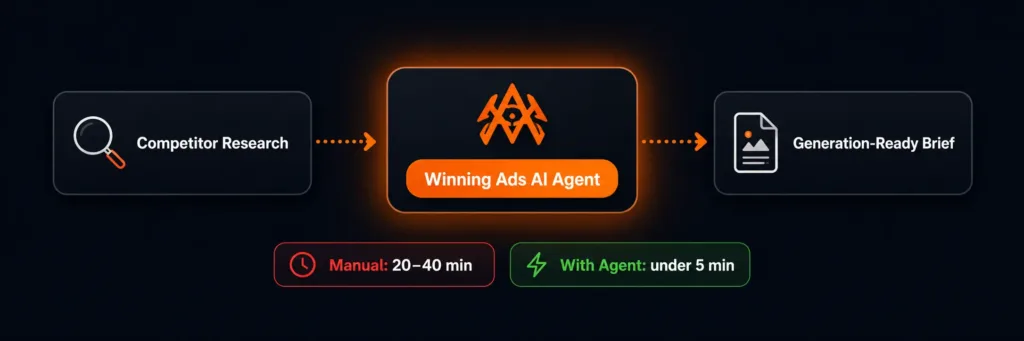
Instead of manually scanning competitor ads, extracting patterns, and writing a brief, the agent does the pattern-recognition step for you. You give it a keyword or category; it identifies the highest-performing ads in that space, surfaces the structural and messaging patterns those ads share, and translates that into an actionable brief ready to feed into generation.
Without the Agent
Manual scan of 10–20 competitor ads → extract patterns → write brief → generate. 20–40 minutes per campaign.
With the Winning Ads Agent
Agent surfaces winning patterns automatically → brief ready → generate with full market context. Research step collapses to under 5 minutes.
The broader point: the research-first vs generation-first debate is increasingly a false choice when both steps live in the same platform. The insight from AdSpyder’s usage data is that this connection is not happening for most text-ad creators today. The Winning Ads AI Agent is a direct answer to that gap.
AdSpyder’s Image Ad Generation connects to the same Ad Library research — and given that 62% of image-ad creators already research first, you are likely already on the right track for visual campaigns. The opportunity is applying the same discipline to your text and copy workflow.
The Verdict: What Should Actually Come First
Here is the honest position based on AdSpyder’s data and workflow logic. The right order depends on what you are making and why:
| Scenario | Recommended Order | Why |
|---|---|---|
| Entering a new niche or market | Research first, always | You have no intuition about what works. Research is the briefing. |
| Refreshing existing campaigns | Research first | Market patterns shift. What worked 6 months ago may be saturated now. Check before generating. |
| Image / visual ad creation | Research first, always | 62% of experienced image-ad creators already do this. Visual direction requires market context. |
| Competitive displacement campaigns | Research first, always | You need to know exactly what you’re positioning against, not approximate it. |
| Quick copy variant testing | Generate first, research to validate | Speed matters more than novelty for small iterations. Validate before spending budget. |
| Internal brainstorming or rough drafts | Generate first | AI as a blank-page starter is valid when output is only a draft. Research before final launch. |
The generate-first pattern is not always wrong — it is a valid workflow for practitioners who already have deep market intuition from previous research. For everyone else, and for any new campaign in a category you have not recently studied, competitor research is the first step. The fact that 85.6% of text-ad creators skip this step is a description of a widespread habit — not an endorsement of it.
Mistakes to Avoid in the AI Ad Generation Process
Asking AI to “write a Facebook ad for my product” without market context produces output that sounds correct and changes nothing. The model needs to know what’s already in market to help you stand apart from it.
Research should reveal patterns and gaps — not create duplicate messaging. Capture structure and angle, not sentences. If your ad reads like a paraphrase of your competitor, research failed its purpose.
Generate variants by angle, funnel stage, CTA, objection, and audience pain point. The first output is a starting point, not a finished asset. AI generation’s advantage is speed of iteration — use it.
A strong ad promise that lands on a weak or mismatched landing page wastes every click. Research and generation without a landing page alignment check is an incomplete workflow.
AdSpyder
Research winning ads. Then generate what’s different.
AdSpyder indexes 400 million+ ads across Google, Meta, TikTok, LinkedIn, Amazon, YouTube, and 4 more platforms. Search by keyword or domain, surface competitor patterns, then generate text and image ads with real market context — all in one platform.
Frequently Asked Questions
Should you research competitors before AI ad generation? +
Yes, if the ads will run in a real campaign. Only 14.4% of text-ad creators on AdSpyder research before generating — but for image ads, 62% already do. The research-first habit that image creators have established for visual work should be applied to text and copy creation as well. Competitor research gives your AI stronger inputs, sharper positioning, and gap angles that make the output genuinely different rather than just well-written.
When should AI ad generation come first? +
AI generation can come first for quick ideation, rough drafts, or internal brainstorming. It also works for small variant tests in campaigns where you already have deep market knowledge built from previous research. Before any paid spend, validate the output against competitor ads in AdSpyder’s Ad Library to confirm differentiation.
What is the best AI ad creation workflow? +
Research, generate, validate, refine. Search competitor ads in AdSpyder’s Ad Library first, extract the dominant patterns and the gap angles those competitors are missing, include that context in your AI generation prompt alongside the product description, generate multiple variants, then cross-check the output for differentiation and landing page alignment before launch.
How does AdSpyder improve AI ad generation? +
AdSpyder gives you real competitor ad data — headlines, CTAs, offer structures, ad formats, platform mix, landing page paths, and keyword intent — from 400 million+ ads across 10 platforms going back to 2008. Those inputs make AI prompts specific and grounded in actual market signals rather than generic best practices. The Winning Ads AI Agent automates the pattern-extraction step so research-to-generation takes under 5 minutes instead of 30.
Is ad intelligence better than AI generation? +
They solve different problems. Ad intelligence gives you market context, competitive positioning, and strategic direction. AI generation produces variations at speed. The strongest workflow uses both together — research defines the brief, AI executes the output. Treating them as alternatives is the mistake; they are sequential inputs into the same process.
What is the Winning Ads AI Agent in AdSpyder? +
The Winning Ads AI Agent is an autonomous AI workflow that identifies top-performing ads in a keyword category, surfaces the messaging and structural patterns those ads share, and translates that analysis into a generation-ready brief. It is designed to automate the pattern-recognition step that currently sits between competitor research and AI generation — the step AdSpyder’s usage data shows most text-ad creators skip entirely.