Quick Answer
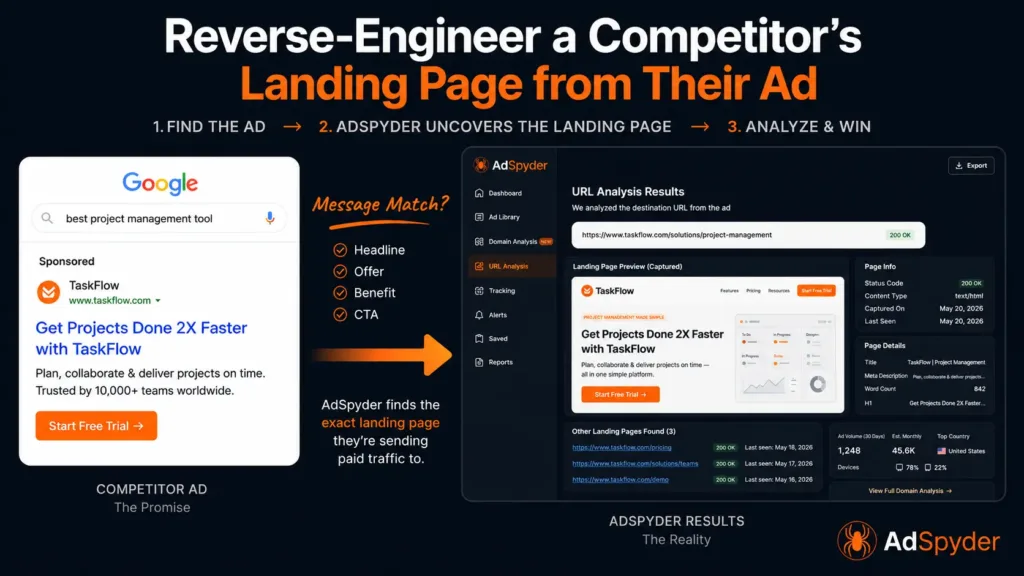
To reverse-engineer a competitor’s landing page from their ad, find the ad, extract the destination URL, and run a domain analysis to pull their full post-click page set, ad volume, CPC data, and competing keywords. Compare the ad’s headline and offer against the page to find message match gaps. AdSpyder’s URL and Domain Analysis lets you do this across 2,554 unique competitor domains already analysed by users — without clicking a single live ad.
Your competitor’s ad is only half the story. The headline, the CTA, the offer — those are the promise. The landing page is where the promise either gets kept or quietly broken. If you only study the ad and ignore where it sends people, you’re missing the conversion layer that actually decides whether their campaign makes money.
This guide gives you a concrete workflow for reading a competitor’s full ad-to-page strategy — what they’re promising in the creative, how they’re fulfilling it post-click, where they’re leaving conversion on the table, and how you build something that beats them on message match before spending a dollar on media.
What most guides miss: they tell you to “visit the competitor’s landing page.” This one shows you how to surface their entire post-click URL set — including pages they run for campaigns you haven’t targeted yet — using domain-level ad intelligence from AdSpyder’s data on 429 distinct competitor domains.
3,953
domain analyses run
by AdSpyder users researching competitor sites
2,554
unique domains analysed
across consumer tech, ecommerce, SaaS, and enterprise verticals
429
domains with landing URLs captured
466 unique URLs, 781 total observations including repeat captures
400M+
ads indexed
across 10 platforms — the intelligence layer behind every domain analysis
Source: AdSpyder URL & Domain Intelligence, May 2026.
See every landing page your competitor is running right now
AdSpyder’s URL and Domain Analysis surfaces competitor post-click pages, ad volumes, CPC data, and competing keywords — across 400 million+ indexed ads on 10 platforms.
In This Guide
The Specific Problem: Your Ad and Your Landing Page Are Telling Two Different Stories
Message match is the alignment between what your ad promises and what your landing page delivers. When they match — same headline language, same offer framing, same CTA energy — conversion rates go up and bounce rates go down. When they don’t, you’re paying for clicks that arrive expecting one thing and land on something that feels like a different brand.
The gap is usually invisible to the team running the account. Your ad manager wrote the ad. Your designer built the landing page. Nobody sat down and read the two together as a single conversation the prospect is having with your brand in 10 seconds flat.
Studying a competitor’s ad-to-page flow forces you to see this from the outside. You’ll notice the disconnect immediately when it’s someone else’s funnel — and that trains your eye to spot the same break in your own.
What a message match break looks like in practice
Strong match: Ad headline “Free 14-day trial — No credit card required” → Page H1 “Start your free trial today”
Message break: Ad headline “Free 14-day trial — No credit card required” → Page H1 “The all-in-one marketing platform”. The prospect clicked on “free trial” and landed on a page that doesn’t immediately confirm what they clicked on.
What Reverse-Engineering a Competitor’s Landing Page Actually Gets You
This is not about copying. The goal is to understand the conversion logic your competitor has bet their ad budget on — then find the gaps in it. When you work backward from an ad to its landing page, you get four things no keyword report can give you:
Their offer framing
Trial vs demo vs discount vs gated content — what conversion mechanism are they betting on?
Their proof stack
Which trust signals are they leaning on — review counts, logos, case studies, or nothing at all?
Their page bets
Long-form vs short? One CTA vs multiple? Dedicated page vs homepage? These are deliberate choices you can benchmark against.
The gaps they leave
Objections they don’t address. Audiences they don’t speak to. Proof they’re missing. These are your entry points.
The fourth one is where you win. A competitor’s landing page shows you the conversion argument they’ve committed to. If they’re not addressing price objections, that’s your opening. If they have no social proof in the hero, that’s your opening. If their ad promises “instant setup” but their page leads with a feature list, that message break is your opening.
You’re not building the same page. You’re building the page that wins the comparison a prospect makes when they’ve already seen theirs.
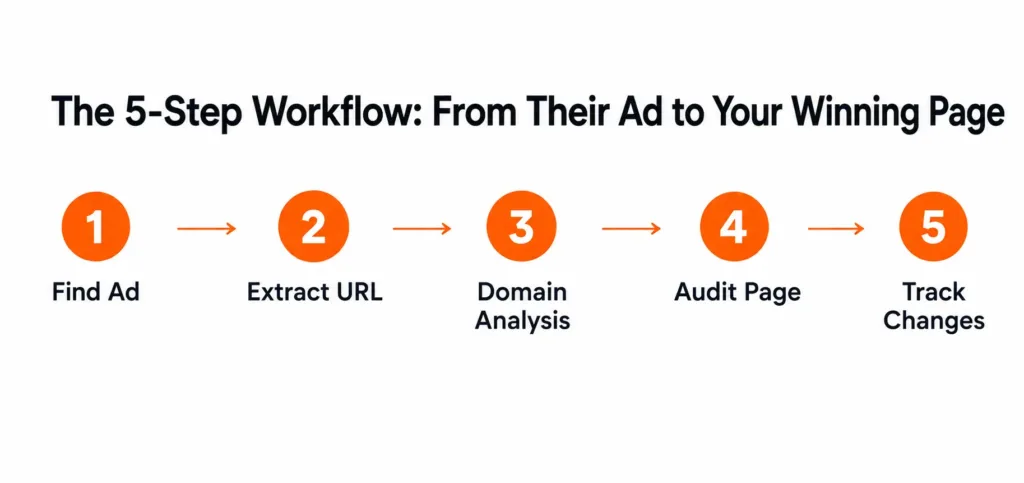
The 5-Step Workflow: From Their Ad to Your Winning Page
Find the ad and capture the destination URL
Start with the ad itself. You need the actual destination URL — not the display URL, which is often different. A Google Search ad can show brand.com while sending clicks to brand.com/trial/google-exact-match-q1. Those two pages will look nothing alike.
Use AdSpyder’s Google Ads Spy to pull your competitor’s active and historical search ads. Each ad record includes the destination URL — you don’t need to click through a live ad to get it. For Meta campaigns, the same is available via AdSpyder’s Facebook Ads Spy.
Record at this step:
Full destination URL including path · Ad headline · Primary CTA text · Offer stated in the ad (trial, demo, discount, content)
Run a Domain Overview — get their full landing page set
One ad points to one URL. But you want every URL this competitor has used across all their campaigns. That’s where AdSpyder’s URL and Domain Analysis becomes the core tool.
Enter the competitor’s root domain. You’ll see their full tracked URL set, estimated ad volume, average CPC, and the keywords they’re competing on. AdSpyder users have run over 3,953 domain analyses covering 2,554 unique domains this way — across consumer tech (Apple, YouTube), ecommerce (Amazon India, Flipkart), SaaS (Stripe), and enterprise (Capgemini) (AdSpyder platform data, May 2026).
This step surfaces every active post-click destination — not just the URL you found in Step 1. A competitor segmenting pages by product line, audience, or keyword will show you those URL variants here.
Audit message match — read the ad and the page together
Open the destination URL and read it against the ad you captured in Step 1. You’re looking for continuity — or the break in it — across four specific elements:
| Element | Strong match looks like | Break looks like |
|---|---|---|
| Headline | Page H1 mirrors or amplifies the ad headline keyword | Page H1 is a generic brand statement with no ad keyword match |
| Offer | Ad says “free trial” → page leads with the trial form or CTA | Ad says “free trial” → page leads with a product overview |
| CTA text | Button uses the same action verb as the ad CTA | Ad says “Book a Demo” → page button says “Get Started” |
| Audience signal | Ad targets “agencies” → page copy says “for agencies” above the fold | Audience-specific ad → generic page copy |
Note every break you find. Each one is a conversion gap — either in their funnel you can exploit, or a pattern your own account needs to check for.
Map the page structure — the five conversion elements
You’ve confirmed the ad-to-page connection. Now catalogue the conversion logic, not the aesthetics:
Hero block: Does the H1 state a specific outcome or a category label? “Get 3x more leads from your Google Ads” is an outcome. “Advanced PPC Management Software” is a category label. Outcome-led heroes convert better for bottom-funnel traffic.
Proof placement: Where is the first trust signal? Above the fold, right below the hero CTA, mid-page, or at the bottom? Early proof signals confidence. Late proof signals an unsolved conversion argument.
CTA count: One persistent CTA is a focused conversion page. Multiple CTAs (demo, trial, pricing, contact) is a homepage being used as a landing page — often a sign of weak post-click strategy.
Objection handling: “No credit card required.” “SOC 2 certified.” “Trusted by 5,000 companies.” If they’re not handling objections, you can.
Page length: Short pages work for warm retargeting. Long-form pages are doing education work — meaning their ad is bringing in colder traffic, or their headline isn’t doing the heavy lifting.
Track changes over time — not just a one-time snapshot
A landing page you capture today is a snapshot. What makes this competitive research actionable is tracking whether competitors change their pages — and reading those changes as signals about what’s working or failing for them.
Add the competitor to a tracking project in AdSpyder. Across 8,663 active user projects on the platform, 1,104 are actively tracking competitors (3,687 competitors total), with 73,098 rolling domain-level records capturing ad volume, CPC estimates, and competing keywords over time (AdSpyder platform data, May 2026).
When a competitor cuts page length by half, they’re testing a hypothesis. When they swap their CTA from “Book a Demo” to “Start Free,” they’re responding to conversion data. That signal is worth as much as the initial page analysis.
5 Elements to Audit on Every Competitor Landing Page
Most guides stop at “look at their headline and CTA.” Here’s how to go deeper on each element and turn every observation into an actionable decision.
| Element | What to note | The insight it gives you |
|---|---|---|
| Headline / H1 | Outcome-led vs feature-led vs brand-led | Tells you how much education work they think this audience needs |
| Primary CTA | Button text, position above fold, and colour contrast | Reveals how warm they believe their traffic is before it hits the page |
| Social proof type | Logos, star ratings, review counts, named testimonials, or none | Named + specific proof signals credibility confidence. Absent proof is a gap you can own. |
| Offer mechanism | Free trial / demo / discount / content / contact form | Reveals their sales motion — product-led vs sales-led vs brochure-ware |
| Objection block | “No credit card,” pricing transparency, security signals, FAQs present | Shows which objections they know they have. Absent handling = your opportunity. |
One thing most guides get wrong about this process
They tell you to study “the best” competitors. The more instructive analysis is studying the competitor who is spending heavily but has obvious gaps — because that’s where the market volume is, and those gaps are your immediate opportunity. A competitor with a perfectly optimised page is hard to beat head-on. One with strong ads and a weak post-click experience is vulnerable today.
What AdSpyder’s Data Shows About Competitor Landing Page Patterns
AdSpyder users have run 3,953 domain analyses covering 2,554 unique competitor domains (AdSpyder platform data, May 2026). The landing page data across those domains reveals patterns worth knowing before you start your own research.
1
median landing URL per domain
Most competitors — even well-funded ones — send all paid traffic to a single post-click URL
4
URLs at the 90th percentile
Top advertisers segment pages by campaign type — this is the architecture to model
95
post-click URLs, heaviest advertiser
One root domain, 95 distinct landing pages — product-specific creative per ad
73,098
rolling domain records
Ad volume, CPC, and competing keywords tracked per competitor over time
Source: AdSpyder URL & Domain Intelligence, May 2026.
The median-of-1 finding is the most important for competitive research. Most competitors — even well-funded advertisers — run their entire paid campaign to a single post-click URL. They’re not segmenting pages by keyword intent, audience, or campaign. That means their message match is almost certainly imperfect across at least some of their traffic.
The vertical mix in the data is also instructive. Users have analysed landing pages across consumer tech (Apple, Google, YouTube), ecommerce (Amazon India, Flipkart, Pepperfry, Mamaearth), SaaS and payments (Stripe), and enterprise (Capgemini). No single sector dominates — which reflects that message match is a universal PPC problem, not a vertical-specific one.
The 90th-percentile advertiser insight
When a competitor shows 4+ distinct landing URLs in AdSpyder, they’re doing campaign-level page segmentation — typically product-specific pages for Shopping, a trial page for Search, and a broader brand page for Display. That’s a full-funnel landing page architecture you can map and improve on. Each URL tells you which campaign type it corresponds to.
How to Build Your Page from What You Find
You’ve run the analysis. You have notes on three or four competitor pages. Here’s the translation layer — from observation to a decision about your own page.
If every competitor is outcome-led in their headline:
That’s a market signal. Match it, but be more specific than them. “Improve your conversion rate” loses to “See which competitor ads are converting — in 60 seconds.”
If no competitor is handling the primary objection:
That gap belongs to you. If you’re the only page that says “No credit card needed” in the hero, you win the comparison. The objection existed the whole time — nobody had the confidence to address it above the fold.
If a competitor is sending traffic to their homepage:
Any dedicated landing page you run has a structural advantage. Homepage-as-landing-page is the most common and costly mistake in paid search. A focused, single-offer page that matches your ad’s exact promise will outperform their homepage almost regardless of copy quality.
If all competitors use the same proof type:
Differentiate by upgrading the format. Client logos are table stakes. A named testimonial with a specific result (“We reduced CPA by 34% in 6 weeks”) is higher-quality proof. If the whole market uses generic social proof, specific social proof wins.
AdSpyder gives you the intelligence layer that makes this research possible at scale. Start with AdSpyder’s Ad Library of 400 million+ ads on 10 platforms, extract destination URLs, and run them through URL and Domain Analysis. For platform-specific research, Google Ads Spy is the starting point for search, and Landing Page Analysis gives you a structured view of the post-click layer directly.
4 Mistakes That Waste Your Competitor Landing Page Research
Analysing the page without the ad
A landing page only makes sense compared to the ad that drove the click. Analysing the page alone tells you about design choices. Analysing it against the ad tells you about conversion logic — which is what you need to beat.
Checking only the display URL
Display URLs are often vanity versions of messy destination URLs. A competitor showing brand.com may be sending traffic to a deeply nested campaign-specific page. Visit brand.com and you’ve missed the actual post-click experience.
Treating a snapshot as stable intelligence
Landing pages change. A competitor swapping their hero CTA from “Book a Demo” to “Start Free” is signalling a conversion strategy shift. Without tracking, you miss the signal. Track them in a project, not a browser bookmark.
Copying what they do instead of finding what they miss
The goal is gap analysis, not imitation. Find the objection they didn’t address, the audience they didn’t speak to, or the proof format they didn’t use — and own that angle on your own page.
Pre-Build Research Checklist
Before building or rewriting your landing page, confirm you’ve covered each of these for at least two or three direct competitors:
Ad Research
✓
Found 3+ active competitor ads on the primary platform using AdSpyder’s Ad Library
✓
Recorded the full destination URL for each ad — not just the display URL
✓
Noted each ad’s headline, primary CTA, and offer mechanism (trial / demo / discount / content)
Domain Analysis
✓
Run a Domain Overview on each competitor’s root domain in AdSpyder’s URL and Domain Analysis
✓
Captured their full landing URL set — how many pages, and do they vary by campaign type?
✓
Noted estimated ad volume and CPC — higher volume means higher spend confidence in these pages
Landing Page Audit
✓
Confirmed message match (or break) between their ad headline and page H1
✓
Recorded proof type, placement, and specificity (logos vs named testimonials vs nothing)
✓
Noted which objections their page handles vs. leaves unanswered
✓
Confirmed whether they use a dedicated post-click page or homepage as their ad destination
Before You Build
✓
Identified at least one gap in every competitor’s post-click strategy
✓
Added each competitor to an AdSpyder tracking project to monitor future page changes as ongoing signals
AdSpyder URL & Domain Analysis
Improve message match using competitor research, not guesswork
AdSpyder has indexed 400 million+ ads across 10 platforms. Users have run 3,953 domain analyses covering 2,554 unique competitor domains — surfacing post-click pages, CPC data, and competing keywords in one workflow.
Stop reverse-engineering by hand. Run a domain analysis in the time it takes to read one competitor’s page.
Improve Message Match with AdSpyder →
23,000+ users · 10 platforms · 400M+ ads indexed · No credit card required