
AdSpyder Original
Quick Answer
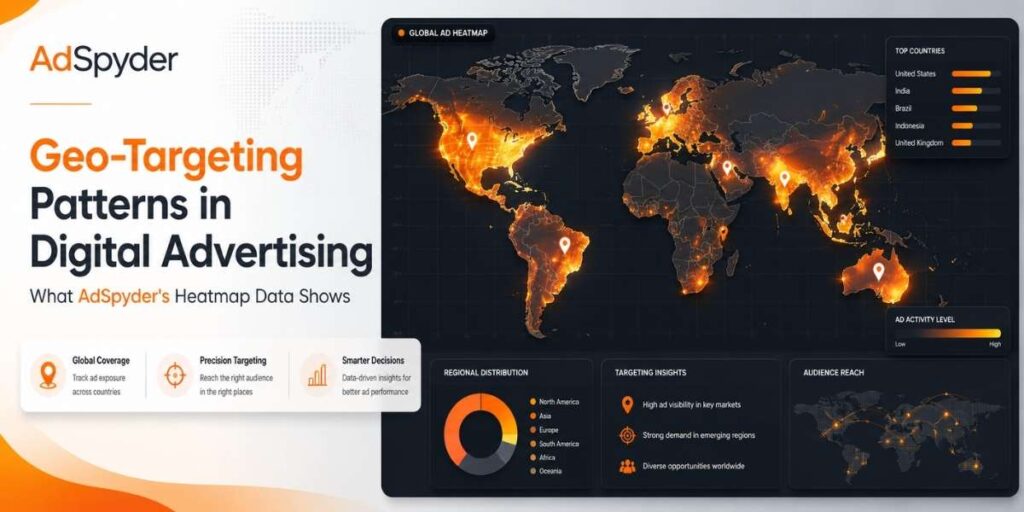
- Geo targeting in digital advertising is not just choosing countries in an ad account. AdSpyder heatmap data shows where ads are actually observed across countries and platforms.
- The biggest pattern: the United States leads every major AdSpyder platform except Twitter/X, while India appears in the top five on every major platform measured.
- Use URL & Domain Analysis with geo distribution signals to see where competitors are visible before building an international ad targeting strategy.
Most geo-targeting guides explain the basics: country targeting, city targeting, radius targeting, and local messaging.
That is useful, but it does not answer the harder question: where are advertisers actually concentrating their campaigns across platforms?
This report uses AdSpyder platform data to show country-level ad distribution patterns across Google Search, Shopping, Meta, Amazon, Display, LinkedIn, Bing, YouTube, and Twitter/X.
Important data note
AdSpyder country data shows where ads were observed in the archive. It should not be read as a direct claim that every advertiser intentionally targeted that country. Use it as competitor visibility and geo-distribution intelligence, not as ROI or conversion data.
In This Article
Key Findings From AdSpyder’s Geo Heatmap Data
AdSpyder’s country-level archive shows a clear pattern: global advertising is not evenly distributed, and each platform has its own geographic personality.
268
Google Search countries
Largest country coverage in this dataset
258
Display countries
Broadest non-search geo spread
232
Meta historical countries
Strong global social footprint
159+
Countries on major platforms
Bing is the floor in this dataset
Source: AdSpyder platform data, July 2026.
The one-line insight
The US is the default leader, India is the universal top-5 market, Latin America is stronger than most teams expect, and Twitter/X behaves unlike every other platform in the dataset.
Geo Competitor Research
See Where Competitors Are Actually Visible
Use AdSpyder to inspect competitor domains, country distribution, landing pages, and ad visibility before planning international campaigns.
Geo Targeting in Digital Advertising: Platform-by-Platform Pattern
Geo targeting changes by platform. A country that is highly visible on Google Search may not have the same weight on LinkedIn, Amazon, or Twitter/X.
| Platform | Top Country | Notable Pattern | Strategy Takeaway |
|---|---|---|---|
| Google Search | United States: 16.0% | Argentina is #2 at 9.5% | Search demand is not always proportional to market size. |
| Google Shopping | United States: 22.1% | UK, India, Mexico, Australia, Brazil follow | Ecommerce geo planning should not stop at the US and UK. |
| Meta historical | United States: 11.3% | LATAM cluster is bigger than the US alone | Meta localization matters heavily in Latin America. |
| Amazon | United States: 51.9% | Top 5 countries make up 98% of archive volume | Amazon is highly concentrated; prioritize marketplace maturity. |
| United States: 33.8% | India is #2 at 22.6% | India is a serious B2B advertising market, not just a volume market. | |
| Twitter/X | Brazil: 31.1% | Only platform where the US is not #1 | Twitter/X geo research should start with Brazil, India, Turkey, and Africa signals. |
Source: AdSpyder platform data, July 2026.
The Country Anomalies Your Geo Strategy Should Notice
The best use of geo heatmap data is not confirming that the US is big. Everyone already knows that.
The useful part is spotting countries that behave differently from your assumptions.
Argentina over-indexes on Google Search
Argentina is #2 on Google Search at 9.5%, with 15.7M ads observed. That is the single most surprising number in this dataset because it exceeds every non-US, non-India country on Google Search.
India appears in the top five everywhere
India is #3 on Google Search, #3 on Shopping, #3 on Meta historical, #2 on Amazon, #2 on Display, #2 on LinkedIn, #3 on YouTube, and #2 on Twitter/X.
Brazil dominates Twitter/X
Twitter/X is 31.1% Brazil in the archive. That is completely different from the other platform maps, where the United States is normally the leader.
Peru and the Philippines stand out on Meta
Peru is #6 on Meta historical at 4.1%, and the Philippines is #8 at 3.5%. Both are stronger in Meta visibility than many teams would expect from market-size assumptions alone.
Regional Clusters: Where Each Platform Really Lives
A practical geo targeting strategy needs a platform-region map. The same global budget split will not make sense across Search, Meta, Amazon, LinkedIn, Bing, and Twitter/X.
| Regional Cluster | Where It Shows Up | What To Do |
|---|---|---|
| North America | Amazon, LinkedIn, Bing, Display | Use mature-market messaging, price proof, reviews, and competitor positioning. |
| Latin America | Google Search, Meta, Google Shopping, Twitter/X | Localize Spanish/Portuguese ads and review country-specific landing pages. |
| Europe | Bing and Google Search | Do not ignore Bing for UK, France, Germany, and mainland Europe research. |
| South and Southeast Asia | Meta, LinkedIn, Google Search | Split B2B and ecommerce strategies; India behaves differently from SEA. |
| Middle East and Africa | Twitter/X stands out most clearly | Use Twitter/X visibility as a signal, but validate with first-party demand and platform data. |
How This Changes Geo Targeting Strategy
Geo targeting should not begin with “which countries do we want?” It should begin with “where are competitors already visible, and where does the platform naturally concentrate demand?”
Use crowded countries for proof
High-volume countries are useful for competitor benchmarking. Study messaging, pricing, offers, and landing page patterns before entering.
Use anomaly countries for research
Argentina on Search, Brazil on Twitter/X, and India on LinkedIn are not random footnotes. They are signals worth checking by industry.
Do not fake opportunity scores
Ad volume alone cannot prove ROI. Pair heatmap patterns with CPC, conversion rate, GDP, internet users, logistics, language, and first-party revenue data.
AdSpyder Workflow: How to Use Geo Heatmap Data
Use this workflow before launching country-level or international ad tests.
Check competitor domain visibility
Use URL & Domain Analysis to understand where competitor activity appears and which markets deserve deeper review.
Compare search and social country patterns
Use Google Ads Spy for search visibility and Facebook Ads Spy for Meta visibility. Do not assume both channels tell the same geo story.
Review country-specific landing pages
Use Landing Page Analysis to see whether competitors localize language, currency, proof, pricing, phone numbers, shipping, or compliance claims.
Build a test map, not a global copy-paste plan
Create separate tests for crowded, anomaly, and opportunity geos. A US ad angle should not automatically be copied into India, Brazil, Argentina, or Turkey.
Geo Targeting Checklist Before You Launch
Use this before launching international campaigns:
- Have you checked where competitors are visible by country?
- Have you separated Google Search, Meta, Shopping, Amazon, Bing, LinkedIn, and Twitter/X patterns?
- Have you identified high-competition countries and anomaly countries?
- Have you checked whether landing pages are localized by country?
- Have you avoided treating observed ad volume as ROI proof?
- Have you validated the opportunity with first-party revenue, CPC, conversion, and logistics data?
- Have you created separate tests for each priority country instead of copying one global ad?
Final Takeaway: Geo Targeting Needs Competitor Heatmaps, Not Guesswork
Geo targeting in digital advertising gets weaker when brands only use internal assumptions. Your team may know where it wants to expand, but competitors may already be showing you where the market is crowded, ignored, or changing.
AdSpyder’s heatmap data shows that every platform has a different geo pattern. The US leads almost everywhere, India is universally strong, Latin America is larger than many teams expect, and Twitter/X breaks the normal map entirely.
Best practical rule
Do not choose countries only by market size. Choose them by competitor visibility, platform fit, landing-page readiness, and first-party business potential.
Map Competitor Visibility Before You Expand
Use AdSpyder URL & Domain Analysis to understand where competitors appear, how they localize ads, and which countries deserve your next test.
Frequently Asked Questions
What is geo targeting in digital marketing?
Geo targeting in digital marketing means delivering ads, content, or offers based on a user’s location or location interest. This can include country, region, city, postal code, radius, or location groups depending on the platform.
What are the main types of geo targeting in digital advertising?
Common types include country targeting, regional targeting, city targeting, postal or ZIP code targeting, radius targeting, location-interest targeting, and geo-based audience segmentation.
What does AdSpyder geo heatmap data show?
AdSpyder geo heatmap data shows where ads are observed by country and platform. It helps you understand country-level ad distribution, competitor visibility, regional clusters, and unusual market patterns.
What are examples of geo targeted ads?
Examples include a restaurant showing ads only near its delivery area, a SaaS company promoting localized pricing in India, an ecommerce brand running country-specific Shopping ads, or a university targeting students in selected international markets.
Can Google Ads use location targeting at ad group level?
Google Ads supports campaign-level location targeting, and Google documentation also describes locations of interest as an optional ad group-level feature for AI Max for Search campaigns. You should still verify availability in your account and campaign type before planning around it.
Can AdSpyder tell me which country has the best ROI?
No. AdSpyder can show ad visibility and country distribution patterns, but ROI needs your own performance data such as CPC, conversion rate, sales, margin, fulfillment, and customer value. Use AdSpyder to find where to investigate, then validate with campaign data.