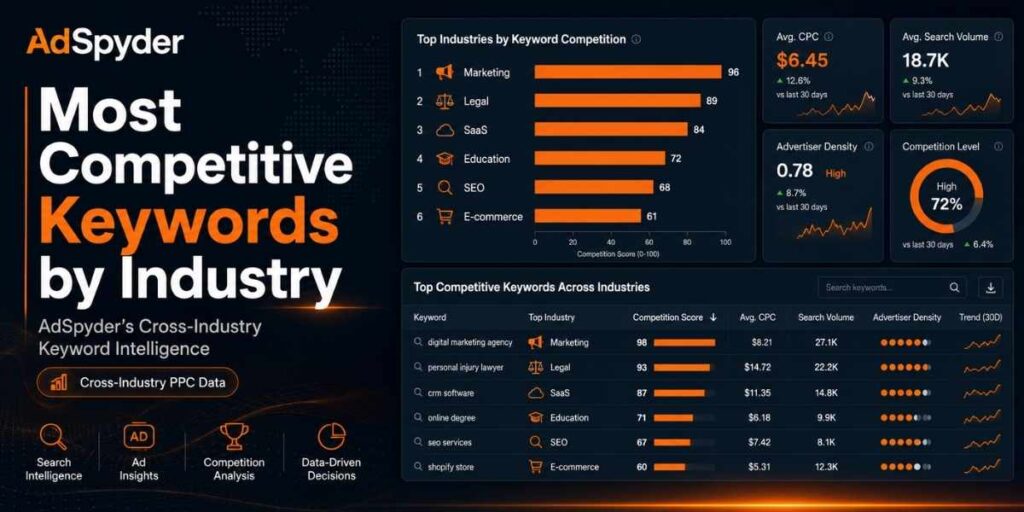
Quick answer: The most competitive keywords by industry depend on how you define competition. In AdSpyder’s July 2026 dataset, marketing terms had the widest advertiser participation, while legal and personal-injury terms had the highest enriched CPC values. You can investigate the domains behind these patterns with AdSpyder URL Domain Analysis.
A keyword with many advertisers is crowded. A keyword with a high CPC is expensive. A keyword with both can consume budget quickly—but those are three different signals, and treating them as one is how PPC teams misread competition.
This analysis separates advertiser density, CPC, and search volume using 139,355 keyword-suggestion rows researched inside AdSpyder projects. The result is a practical view of where bidding pressure appears—and where the dataset requires caution.
Table of contents
The Cross-Industry Keyword Picture in Five Numbers
Keyword-suggestion rows
Distinct keywords
Advertiser domains
Countries represented
Domains tracking “digital marketing”
Source: AdSpyder platform data, July 2026.
The main finding: “Digital marketing” was the most widely tracked clean keyword, appearing across 158 advertiser domains. But “attorney personal injury near me” produced the highest enriched CPC at $90.91. Density and cost identify different competitive problems.
See which keywords your competitors keep returning to
Start with a domain, identify repeated keyword themes, then validate the ads and landing pages behind them.
Most Contested Keywords by Advertiser Density
For this analysis, a contested keyword is one tracked by at least 15 distinct advertiser domains. The table below uses clean keyword strings and ranks them by advertiser participation—not CPC.
| Keyword | Advertiser domains | Avg. CPC | Search volume |
|---|---|---|---|
| digital marketing | 158 | $1.33 | 27,100 |
| digital marketing services | 113 | $2.37 | 170 |
| digital marketing agency | 107 | $18.26 | 6,600 |
| social media marketing | 82 | $9.85 | 5,400 |
| online marketing | 79 | $21.51 | 12,100 |
| social media | 67 | $8.49 | 110,000 |
| marketing agency | 66 | $3.06 | 1,600 |
| domain name | 47 | $2.35 | 720 |
| web design | 44 | $1.18 | 5,400 |
| search engine marketing | 33 | $2.24 | 60,500 |
Advertiser counts: AdSpyder platform data, July 2026. CPC and search volume are third-party keyword-data enrichments available inside AdSpyder.
What this table really says: Agency and marketing terms dominate because AdSpyder’s tracked-project dataset is agency-heavy. This is a real user-research signal, but it is not proof that these are the most contested keywords in every country or every ad account.
Industry keyword intelligence: Density, Price, and Demand
The useful question is not “Which keyword has the biggest number?” It is “Which competitive pressure matters for this campaign?” This table highlights the strongest clean signals available for each represented segment.
| Industry signal | Keyword | Domains | Avg. CPC | Volume | What it signals |
|---|---|---|---|---|---|
| Marketing/Agency | digital marketing | 158 | $1.33 | 27,100 | Widest advertiser participation |
| Legal | attorney personal injury near me | 3 | $90.91 | 274,867 | Highest enriched click-price pressure |
| Online Gambling | best online casino online | 6 | $86.23 | 5,400 | High cost with regulatory constraints |
| SaaS/CRM | crm software | 5 | $35.12 | 74,000 | Commercial comparison demand |
| SEO Services | seo services | 9 | $34.02 | 60,500 | Direct service-purchase intent |
| Education | online university | 3 | $43.48 | 27,100 | High-value enrolment economics |
| Web Services | web design | 44 | $1.18 | 5,400 | Broad supplier competition at lower CPC |
Industry groupings were manually inferred from keyword text because the source table does not contain a structured industry field.
Four Patterns PPC Teams Should Act on
1. High advertiser density does not automatically mean high CPC
“Digital marketing” had 158 advertiser domains but a $1.33 enriched average CPC. “Attorney personal injury near me” had only three represented domains in this dataset but a $90.91 CPC. One reflects broad participation; the other reflects expensive auction economics.
2. Non-branded commercial terms dominate competitive research
Most clean high-density keywords were service or category descriptors rather than brand names. That indicates AdSpyder users primarily research demand-capture terms such as agency, software, services and “near me” queries.
3. Buyer intent appears more often than informational intent
The strongest examples point toward action: “crm software,” “seo services,” and personal-injury queries with local intent. Informational “how to” terms are less visible because this is a campaign-research dataset, not a content-keyword census.
4. Shared modifiers reveal cross-industry auction pressure
Terms such as “agency,” “advertising,” “CRM,” “SEO” and “domain” cross category boundaries. When you research only your exact product term, you miss adjacent competitors bidding on the same commercial intent.
Practical rule: Prioritize keywords where intent, economics and competitive proof align. A high-volume term without relevant competitor ads is weaker evidence than a smaller term repeatedly used by direct competitors with matching landing pages.
How to turn Industry Keyword data into a PPC decision
Lists give you ideas. Competitor evidence tells you whether those ideas deserve budget.
Start with comparable domains
Choose competitors selling to the same buyer, geography and price band. Use URL Domain Analysis to inspect their cross-platform activity and keyword themes.
Build a density shortlist
Record keywords repeated across several direct competitors. Then use the Google Ads Spy to examine the messages advertisers attach to those terms.
Add CPC, volume and intent
Use CPC as an economics signal, volume as a demand signal and the wording itself as an intent signal. Do not promote a keyword merely because one metric is large.
Validate the conversion path
Use Landing Page Analysis to check whether competitors send that traffic to a category page, lead form, pricing page or comparison page. The destination often reveals the real intent better than the keyword alone.
Keyword Selection Checklist
☐ The keyword matches a revenue-producing offer.
☐ At least two relevant competitors show evidence around the same theme.
☐ CPC fits your conversion rate, margin, and acceptable acquisition cost.
☐ The search intent matches the page you plan to use.
☐ Negative keywords are ready before launch.
Methodology and Limitations
- The analysis uses AdSpyder’s project_keyword_suggestions dataset as of July 14, 2026. It contains 139,355 suggestion rows, 109,808 distinct keywords, 2,948 advertiser domains, and records across 159 countries.
- Advertiser density was calculated by grouping cleaned keyword strings and counting distinct advertiser domains. The primary contested-keyword threshold was 15 or more domains. Industry labels were manually inferred from keyword text.
- CPC and search-volume figures are external keyword-database enrichments available inside AdSpyder. They are useful benchmarks, but they are not measured directly from AdSpyder’s ad archive.
- The data is user-project-scoped, marketing and agency projects are over-represented, and India accounts for about 47% of suggestion rows. These findings describe competitive research patterns in this dataset—not an equal global census of every industry.
FAQs for Most Competitive Keywords by Industry
What are the most competitive keywords by industry?
Marketing and agency terms had the widest advertiser participation in this dataset, while legal and personal-injury terms had the highest enriched CPC values. Your answer should specify whether “competitive” means advertiser density, cost or demand.
What was the most contested keyword?
“Digital marketing” appeared across 158 distinct advertiser domains, making it the most widely tracked clean keyword in the July 2026 AdSpyder dataset.
What was the highest-CPC keyword?
“Attorney personal injury near me” had a $90.91 enriched average CPC. The value comes from external keyword-data enrichment available within AdSpyder rather than a CPC measurement from the ad archive.
Does high search volume mean high competition?
Not by itself. Search volume estimates demand. Advertiser density estimates participation, while CPC reflects price pressure. Use all three with conversion intent and account economics.
Are these the most competitive keywords worldwide?
No. The analysis reflects keywords researched in AdSpyder user projects. The sample is agency-heavy and India-weighted, so it should be treated as a transparent competitive-intelligence dataset rather than a universal market ranking.
How do I research a competitor’s keywords in AdSpyder?
Enter the competitor’s domain in URL Domain Analysis, identify repeated commercial themes, inspect their ads in the AdSpyder Ad Library, and verify the destination page before deciding whether the keyword fits your campaign.
Do not choose keywords from a list alone
Use competitor-domain evidence to see which terms connect to active ads, repeatable messages and conversion-focused landing pages.