Quick Audit Summary
- Do not scale a campaign based on cost per lead alone.
- Verify conversion tracking and CRM attribution before judging performance.
- Confirm valid-lead, MQL, SQL and customer outcomes—not only submissions.
- Audit the ad, offer, landing page and follow-up process as one journey.
- Check that creative production and sales capacity can support more volume.
- Increase budgets or targeting gradually with written rollback conditions.
- Treat competitor advertising patterns as test ideas, not proof of profitability.
Scaling is not limited to increasing a daily budget. It can also mean expanding targeting, adding keywords, entering new locations, relaxing efficiency targets, launching on another platform or sending more leads to sales.
A campaign may be ready for a small budget test while still being unprepared for broad targeting or geographic expansion. The decision depends on tracking reliability, lead quality, unit economics, creative capacity and sales readiness.
Start with your internal account, analytics and CRM evidence. Then use the AdSpyder Ad Library to review how relevant competitors position their audiences, offers, creatives and conversion actions.
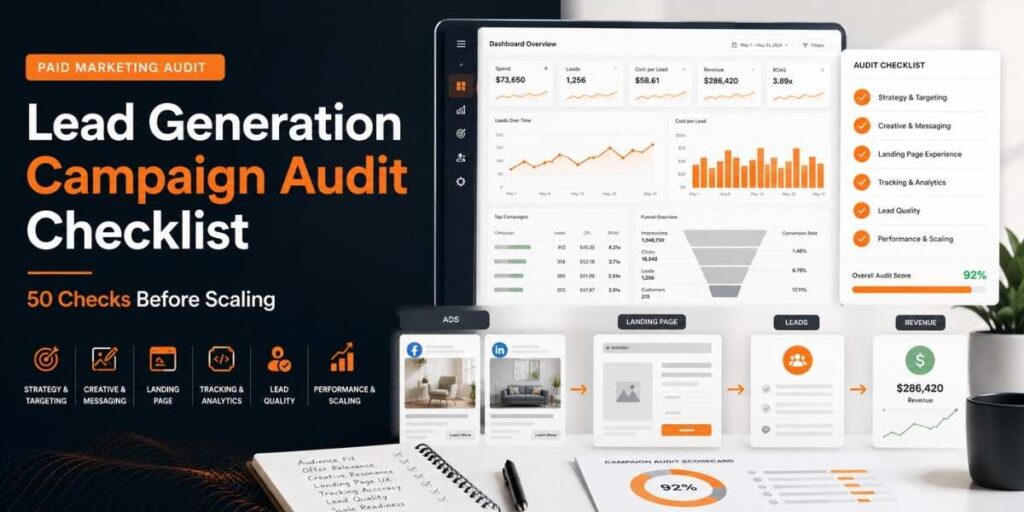
This audit contains exactly 50 checks grouped across strategy, account structure, acquisition quality, creative, landing pages, tracking and scaling readiness.
Table of Contents
What Is a Lead Generation Campaign Audit?
A lead generation campaign audit is a structured review of the complete acquisition system—from business strategy and campaign setup to lead qualification, sales capacity and revenue measurement.
The purpose is not to find as many minor problems as possible. It is to determine whether increasing delivery is likely to create more qualified demand without breaking tracking, economics or operations.
SCALE Audit Framework: Review Strategy and economics, Campaign and creative systems, Audience and acquisition quality, Landing-page experience, and Evidence from tracking and revenue data.
When Should You Audit Before Scaling?
- Before a significant budget increase
- Before broadening keywords, audiences or automated targeting
- Before launching in a new country, city or language
- When taking over an existing client account
- After tracking, CRM or landing-page changes
- When CPL improves but qualified-lead quality declines
- When sales reports weak fit, slow follow-up or excessive lead volume
How to Score the 50 Audit Checks
Score each check using verified evidence. A setting that appears correct but has not been tested should receive a partial score, not a pass.
| Status | Points | Definition |
|---|---|---|
| Pass | 2 | The check is complete and supported by reliable evidence. |
| Partial | 1 | The item exists but is incomplete, inconsistent or unverified. |
| Fail | 0 | The requirement is missing, broken or unsuitable for scaling. |
| Total Score | Readiness | Recommended Action |
|---|---|---|
| 90–100 | Controlled Test Ready | Scale gradually while monitoring written guardrails. |
| 75–89 | Conditionally Ready | Fix high-priority gaps before broader expansion. |
| Below 75 | Not Ready | Resolve structural, tracking or quality problems first. |
Use Ad Analytics to add external market context after the internal score has been calculated. The score itself must come from your account, analytics, CRM and financial evidence.
Critical Blocker Rule: A failed critical item overrides the total score. A campaign with 92 points is still not ready when conversion tracking, lead quality, compliance, economics or sales capacity is unreliable.
Strategy and Unit Economics Checks
These checks confirm that the campaign is solving a defined business problem and has financial guardrails for scaling.
Evidence: campaign brief stating whether the goal is a demo, quote, consultation, application, trial or another valuable action.
A button click or page view should not be the primary success event when a completed form, qualified lead or sale can be measured.
Document industry, company size, role, location, need, budget fit and major disqualification factors.
The offer should be more precise than “contact us” and should explain what the prospect receives next.
Cold audiences may need proof or education before a high-commitment demo or sales call.
Set the limit from margins, conversion rates, customer value and payback requirements—not a generic platform benchmark.
Agree whether success means more MQLs, more SQLs, lower CAC, greater pipeline or faster revenue growth.
Account and Campaign Structure Checks
Avoid combining awareness, lead capture, remarketing and sales-ready audiences when they need different budgets and messages.
Each campaign should have enough delivery and conversion data to support useful decisions.
Names should identify platform, market, objective, audience, offer and testing status where relevant.
Confirm that every included region can be served and that scheduling reflects response and fulfilment capacity.
Separating intent can prevent branded demand from hiding weaker category acquisition performance.
The decision should match whether the campaign is for acquisition, upsell, renewal or reactivation.
A scaling test needs a stable comparison so budget, targeting or creative changes can be evaluated clearly.
Audience, Keyword and Placement Checks
For search campaigns, use Google Ads Spy to compare public competitor keyword themes and search-ad messages after your own keyword and search-term audit is complete.
Review audience definitions against actual valid leads, SQLs and customers.
Know when the platform can move beyond the manually selected audience and how that affects lead quality.
Problem, category, competitor, pricing and action keywords usually require different ads and landing pages.
Confirm that actual queries represent relevant needs rather than jobs, support, education or unrelated products.
Review campaign, ad-group and shared exclusions without blocking useful variations.
Separate high-volume placements from sources producing qualified demand.
Use serviceability, buyer fit and CRM outcomes rather than click volume alone.
Competitor searches and audiences can have different CPCs, messages and customer intent.
When search-query review is the main weakness, the Search Term Optimisation AI Agent can apply account-defined rules to identify potential keywords and negatives, with review and rollback controls where supported.
Creative, Message and Offer Checks
For Meta-focused audits, use Facebook Ads Spy to compare visible competitor hooks, formats, calls to action and offer presentation without assuming those ads are profitable.
Prospects should quickly understand whether the message applies to their role, industry or situation.
Avoid vague pain points that attract curiosity without purchase relevance.
State whether the prospect receives an audit, consultation, quote, trial, benchmark or another defined outcome.
The ad should not promise education while routing the visitor directly into an unexpected sales call.
Check statistics, guarantees, testimonials, certifications and outcome claims before increasing exposure.
Test different problems, benefits, proof types, offers and formats rather than cosmetic variations only.
One successful ad may not support a major increase in frequency or audience reach.
Define refresh triggers using frequency, CTR, conversion quality and declining marginal results.
Landing Page and Form Checks
Use Landing Page Analysis to compare visible competitor page structures, CTA placement, trust signals and ad-to-page consistency before designing an original test.
The visitor should immediately recognize the same audience, problem, offer and expected action.
Remove competing navigation or CTAs when they distract from the campaign objective.
State the outcome, process and eligibility clearly near the primary action.
Use relevant proof such as reviews, client examples, certifications, process details or privacy assurances.
Every required field should support delivery, routing, qualification or preparation.
Check loading, form input, buttons, calendars, error states and completion on real devices.
Test the thank-you message, email, calendar, notification, CRM record and assignment workflow.
Provide required privacy information, consent controls and lawful handling for collected personal data.
Tracking and Attribution Checks
These checks determine whether the campaign can be evaluated accurately after more spend and lead volume are added.
Test the action from the ad click through completion and confirm the correct value, timestamp and source.
Check repeated page loads, duplicate form events, CRM syncs and multiple imports for the same outcome.
Confirm parameters survive redirects, forms, calendar tools, CRM creation and later opportunity updates.
Preserve original source, campaign, keyword or ad information separately from the latest interaction.
Raw form submissions are insufficient when lead quality differs materially by campaign.
Return deeper first-party outcomes to the ad platform when legally permitted and technically appropriate.
Do not compare campaigns using different windows, lag assumptions or stage dates without explaining the difference.
July 2026 Google Ads Audit Note:
Google recommends measuring actions that are valuable to the business and using enhanced conversions for leads when appropriate. From June 15, 2026, certain offline and enhanced-conversion upload workflows moved toward the Data Manager API. Confirm that your implementation uses a currently supported method.
Lead Quality and Scaling Readiness Checks
Review invalid contact details, bots, duplicates, irrelevant enquiries and deliberate false submissions.
Marketing and sales should apply the same qualification rules and record rejection reasons.
Do not scale because CPL looks attractive when downstream acquisition economics are unacceptable.
Confirm response-time targets, routing, staffing, calendars, working hours and follow-up capacity.
Specify what will change, the observation period, minimum data threshold, guardrails, owners and rollback conditions.
Critical Scaling Blockers
- Broken or inflated primary conversion tracking
- No reliable lead-source or CRM attribution
- No valid-lead, qualified-lead or customer feedback
- CPQL, cost per SQL or CAC above the business limit
- Ad and landing-page promises do not match
- Spam or irrelevant leads dominate the volume
- Privacy, consent or data-handling requirements are incomplete
- Sales cannot respond to additional enquiries
- No rollback rules or budget controls exist
How to Build a Controlled Scaling Plan
Budget Scaling
Increase in controlled steps. Monitor CPQL, cost per SQL, CAC and lead volume against a defined observation window.
Audience Scaling
Test adjacent audiences separately, retain the current audience as a control and compare downstream quality.
Geographic Scaling
Confirm serviceability, local messaging, competition, sales coverage and location-level acquisition economics.
Creative Scaling
Prepare additional variants and refresh triggers before higher delivery accelerates fatigue.
Minimum Scaling Plan Fields
- Variable being changed
- Current control
- Budget or audience limit
- Minimum data threshold
- Primary and secondary KPIs
- Maximum CPQL, CAC or quality-loss limit
- Review date and owner
- Pause or rollback conditions
How AdSpyder Improves the Audit Workflow
AdSpyder adds external competitor context after the internal audit reveals where the campaign is weak. It does not replace conversion tracking, CRM reporting or financial analysis.
1. Complete the Internal Audit First
Identify whether the main problem sits in targeting, creative, landing pages, tracking, lead quality or capacity.
2. Review Competitor Domain Activity
Use URL Domain Analysis to review visible platform distribution, active campaigns, keyword themes and destination pages.
3. Compare Repeated Market Patterns
Record recurring audiences, pain points, offers, proof, CTAs and landing-page structures across several competitors.
4. Create an Original Test
Translate one relevant gap into a controlled hypothesis rather than copying a competitor’s campaign.
5. Measure With Internal Outcomes
Judge the test using your own valid leads, MQLs, SQLs, customers, CPQL and CAC.
Important Limitation: AdSpyder cannot reveal a competitor’s targeting settings, negative keywords, CTR, conversion rate, CPL, CPQL, CAC, CRM stages, lead quality, pipeline, revenue or ROAS.
Common Campaign Audit Mistakes
A cheaper lead may still create a more expensive qualified lead or customer.
Platform conversions cannot reveal sales acceptance or customer outcomes alone.
The post-click experience can be the main source of conversion or qualification loss.
Higher delivery may exhaust a single angle quickly.
The result cannot be attributed clearly to budget, targeting, offer or creative.
Teams continue spending while waiting for an undefined amount of additional data.
Downloadable Audit Template Structure
Keep all 50 checks visible in the article. The spreadsheet version should make assignment, scoring and rechecking easier.
| Check Number | Audit Area | Status | Evidence | Critical Blocker | Owner | Recommended Fix | Due Date | Recheck Date |
|---|---|---|---|---|---|---|---|---|
| 1–50 | Strategy, Structure, Targeting, Creative, Page, Tracking or Readiness | Pass, Partial or Fail | Screenshot, report, CRM record or tested result | Yes or No | Named person | Specific action | Target completion | Validation date |
Frequently Asked Questions
What Is a Lead Generation Campaign Audit?
It is a structured review of the campaign’s strategy, account setup, targeting, creative, landing pages, tracking, lead quality and ability to support more volume.
When Is a Campaign Ready to Scale?
It is ready for a controlled test when tracking is reliable, lead quality is proven, acquisition economics are acceptable, enough creative exists and sales can respond to additional volume.
Is a Low Cost per Lead Enough to Scale?
No. Review valid-lead rate, CPQL, cost per SQL, CAC and sales outcomes before increasing delivery.
How Should the Audit Be Scored?
Give each item two points for pass, one for partial and zero for fail. Any failed critical blocker prevents a ready-to-scale decision regardless of the total.
How Often Should Campaigns Be Audited?
Audit before major scaling, after tracking or page changes, when lead quality declines and at regular operating intervals based on spend and sales-cycle length.
Can AdSpyder Confirm That Competitor Campaigns Are Profitable?
No. AdSpyder can reveal observable advertising patterns, but competitor conversion rates, acquisition costs, lead quality and revenue remain private.
Sources and Further Guidance
- Google Ads: About Conversion Measurement
- Google Ads: Offline Conversion Imports and Enhanced Conversions for Leads
Scale With Rules, Evidence and Rollback Controls
After the 50 checks pass, apply account-specific budget caps, data thresholds, attribution lag and pause rules before increasing delivery.