Quick Answer
- Strong lead generation ads connect one clear hook, one specific offer and one suitable CTA.
- Use examples as structures to adapt, not copy.
- Match the message with the audience’s funnel stage and expected commitment.
- Keep the ad promise consistent on the landing page.
- Choose winners using qualified-lead and sales metrics, not CTR alone.
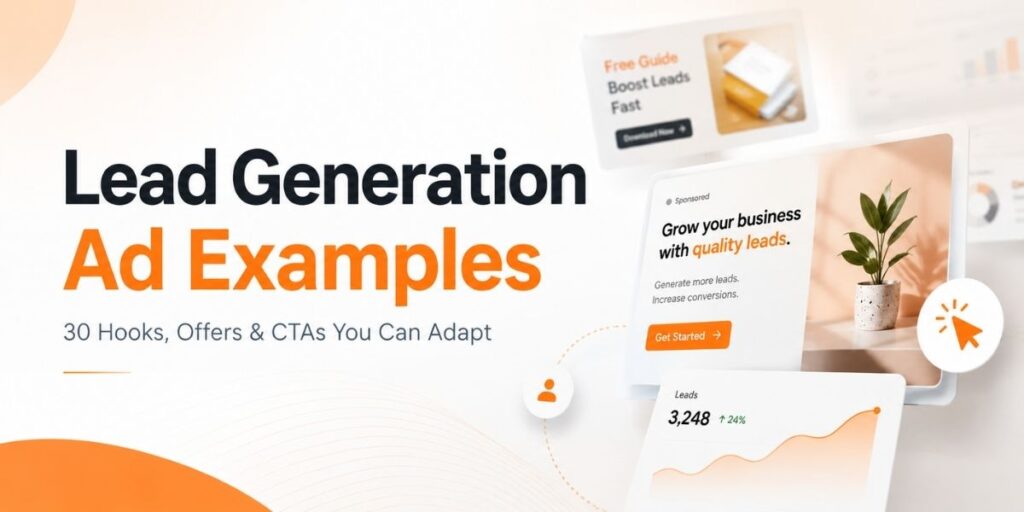
The best lead generation ad examples are not simply catchy lines. They make the intended audience recognize a relevant problem, understand what they will receive and know what to do next.
This swipe file gives you 30 adaptable patterns: 10 hooks, 10 offers and 10 CTAs. Each can be customized for your industry, platform, proof and landing-page experience.
Use the AdSpyder Ad Library to collect relevant examples from your own market, then label the structure behind each ad before creating an original version.
What Makes a Strong Lead Generation Ad?
A strong example identifies who the ad is for, communicates one meaningful problem or outcome, presents a clear offer, supports the promise with credible proof and asks for an appropriate next step.
The H-O-C Fit Framework
| Element | Question | Example |
|---|---|---|
| H — Hook | Why should the right person stop? | Still paying for leads sales rejects? |
| O — Offer | What useful outcome will they receive? | Free 15-point campaign audit |
| C — CTA | What should they do now? | Get your free audit |
The three elements must fit the same audience and funnel stage. A low-commitment educational hook should not unexpectedly lead to a high-pressure sales call.
10 Lead Generation Hook Examples
Use for campaigns where lead quality is the main pain.
Useful for B2B and high-ticket sales funnels.
Fits audits, agencies and analytics products.
Connects campaign activity with a business outcome.
Suitable for automation and SaaS solutions.
Emphasizes efficiency without guaranteeing results.
Qualifies the audience through industry specificity.
Filters prospects using a relevant threshold.
Works for audits and competitor-analysis offers.
Creates curiosity around a diagnostic explanation.
10 Lead Generation Offer Examples
| Offer | Best Fit | What to Clarify |
|---|---|---|
| 1. Free Campaign Audit | Agencies and marketing tools | Exact checks and output |
| 2. Personalized Cost Estimate | Custom services | Information required |
| 3. Product Demo | Category-aware software buyers | Live, recorded or interactive |
| 4. Free Trial | Self-serve products | Duration and limitations |
| 5. Account Assessment | Prospects needing diagnosis | What will be reviewed |
| 6. Strategy Call | High-value services | Length and agenda |
| 7. Comparison Guide | Solution-aware buyers | Comparison criteria |
| 8. Eligibility Check | Finance, education and healthcare | Criteria and privacy |
| 9. Custom Proposal | Complex B2B services | Timeline and inputs |
| 10. Template, Calculator or Checklist | Earlier-stage audiences | Immediate practical value |
10 Lead Generation CTA Examples
Choose the CTA after defining the offer. “Learn More” may fit an educational guide, while “Book a Demo” fits a prospect already evaluating a product.
How to Adapt These 30 Examples
Start by replacing broad nouns with details from your real campaign. “Get more leads” becomes “Get more qualified franchise enquiries.” “Free audit” becomes “Free 12-point Google Ads waste audit.” Specificity helps the right prospect understand whether the offer applies to them.
Replace unsupported outcome language with a process or capability you can prove. Instead of promising guaranteed growth, explain what the prospect will receive, what information is needed and what happens after submission.
- Insert the audience: SaaS founders, clinic owners, agencies or local homeowners.
- Name the problem: Rejected leads, slow follow-up, poor conversion or unclear attribution.
- Define the deliverable: Report, estimate, demonstration, checklist or consultation.
- Add credible proof: Product view, process, review, case example or qualification criteria.
- Match the CTA: Use a next step that accurately describes the experience.
Adapted Example: “Where Is Your Ad Budget Leaking?” becomes “Where Is Your Clinic’s Google Ads Budget Leaking?” The offer becomes a 12-point account assessment, and the CTA becomes “Request Your Clinic Ad Review.”
Three Complete Lead Generation Ad Teardowns
B2B Agency
Hook: Still Paying for Leads Your Sales Team Rejects?
Offer: Free 15-Point Campaign Audit
CTA: Get Your Free Audit
Why it fits: the hook identifies lead-quality pain, while the audit provides a concrete diagnostic next step.
SaaS Product
Hook: Build a Predictable Pipeline Without More Manual Work
Offer: Interactive Product Demo
CTA: See the Platform in Action
Why it fits: the demonstration can prove how the workflow reduces manual effort.
Local Service
Hook: Get More Relevant Enquiries From the Same Ad Budget
Offer: Personalized Cost Estimate
CTA: Check Available Slots
Why it fits: the offer and CTA connect cost expectations with local availability.
Adapt Examples by Funnel Stage
| Stage | Hook Focus | Offer | CTA Style |
|---|---|---|---|
| Problem Aware | Pain or diagnosis | Checklist or audit | Learn or diagnose |
| Solution Aware | Method or outcome | Assessment or guide | See how it works |
| Category Aware | Difference and proof | Demo or comparison | Compare options |
| Sales Ready | Availability and action | Quote or booking | Book or request |
Adapt Examples for Google, Meta and LinkedIn
For intent-led search campaigns, use Google Ads Spy to study how advertisers combine direct keywords, specific offers and action-oriented headlines.
Google Search Example: “B2B Lead Generation Audit for SaaS Teams | Review Campaign Waste and Lead Quality.” Keep the headline close to query intent and send the click to an audit-specific page.
For feed-based campaigns, use Facebook Ads Spy to compare visual hooks, audience callouts, proof and lower-friction offers.
Meta Example: “Your Ads May Not Need More Clicks. They May Need Better Lead Filtering.” Use a simple visual showing the difference between total leads and qualified leads.
For B2B role and industry messaging, use the LinkedIn Ad Library to review how brands frame professional consequences, product value and demo-led CTAs.
LinkedIn Example: “For Revenue Leaders: Find Where Paid Leads Drop Before Becoming Pipeline.” Support the hook with a professional diagnostic offer and clear qualification criteria.
Which Metrics Should Judge the Example?
Use attention metrics to understand the ad, but use downstream metrics to judge the business result. A curiosity-led hook can earn clicks while attracting people who never qualify.
| Metric Type | Examples | Use |
|---|---|---|
| Diagnostic | CTR, CPC, form completion and landing-page conversion | Find where attention or conversion friction occurs. |
| Business | Valid lead rate, CPQL, cost per SQL, opportunity rate and CAC | Decide whether the example attracts commercially useful demand. |
Keep the control and variation comparable. When testing a hook, avoid changing the audience, offer, page and form at the same time. Otherwise, the team may see a result without learning which element caused it.
Keep the Ad and Landing Page Consistent
The destination page should repeat the audience, problem, offer and next step introduced in the ad. A free audit ad should not lead to a generic homepage or hide the audit behind an unrelated sales form.
Use Landing Page Analysis to compare how competitor ads connect with headlines, proof, forms, CTAs and current or historical destination pages.
What Not to Copy
- Unverified statistics or performance claims
- Customer logos or testimonials without permission
- Trademarked slogans and distinctive visual layouts
- Guaranteed outcomes or fake urgency
- Offers your team cannot fulfil
- CTA wording that misrepresents what happens after the click
How to Build a Useful Swipe File
- Search by competitor, keyword or category.
- Filter by platform, country, format and date.
- Save only examples relevant to the audience and funnel stage.
- Label the hook, offer, proof, CTA and landing-page type.
- Write an original hypothesis based on the pattern.
- Measure the new version using qualified-lead and sales outcomes.
Lead Generation Ad Checklist
Frequently Asked Questions
Can I Copy a Lead Generation Ad Example?
Adapt the underlying structure, but create original wording, proof, visuals and landing-page content.
Which CTA Is Best for Lead Generation?
The best CTA matches the offer and funnel stage. A checklist, trial, quote and demo require different commitment levels.
Should CTR Select the Winning Example?
No. Use CTR diagnostically, then select winners through valid leads, CPQL, SQLs, opportunities or customers.
Do Active Competitor Ads Prove Performance?
No. Visible activity does not reveal private costs, conversions, lead quality or profitability.
Turn Useful Patterns Into Original Ad Variations
Choose the hook, offer and CTA you want to test, then create controlled variations for the right platform and audience.