Quick Answer
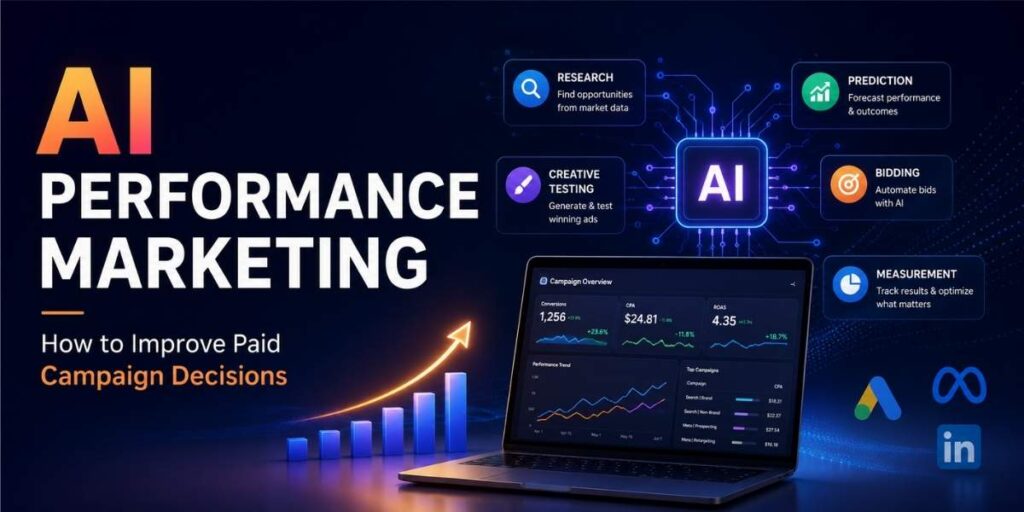
- AI performance marketing uses machine learning and automation to improve paid campaign research, testing, bidding, and measurement.
- AI works best when the conversion signal represents a qualified lead, sale, or revenue outcome.
- Use AI to generate recommendations and controlled variants before allowing automatic campaign changes.
- Set minimum data, attribution lag, budget caps, and rollback rules before automation.
- Judge AI decisions through CPQL, cost per SQL, CAC, and revenue—not clicks alone.
AI performance marketing combines campaign data, machine learning, and automation to help marketers make faster paid-media decisions.
It can organize competitor research, create ad variants, forecast scenarios, adjust bids, and detect performance problems. It cannot decide what your business can afford, which claims are supportable, or what counts as a qualified customer.
Start with the AdSpyder Ad Library when you need market evidence before choosing the audience, offer, or creative hypothesis to test.
What Is AI Performance Marketing?
AI performance marketing is the use of predictive models, generative systems, and rule-based automation to improve measurable advertising outcomes.
The objective is not full autonomy. The objective is better decisions: which problem to investigate, which creative to test, which campaign needs attention and which action is safe to automate.
| AI Level | Role | Example |
|---|---|---|
| Recommendation | Find a pattern or suggest an action | Flag rising CPA or creative fatigue |
| Assisted Execution | Create or apply marketer-defined variations | Generate five headline variants |
| Controlled Automation | Change campaigns within fixed rules | Reduce budget after a CPA threshold |
The SIGNAL Decision Loop
S — Set the Business Goal
Choose the qualified lead, appointment, sale, revenue or gross-profit outcome the campaign should create.
I — Improve the Input Data
Verify conversion tracking, CRM stages, lead source, duplicate handling, values and offline outcomes.
G — Gather Market Evidence
Study visible competitor problems, offers, keywords, formats, CTAs and destination pages.
N — Name the Test Hypothesis
State what will change, why it may work, who it targets and which metric decides the result.
A — Automate With Guardrails
Set lookback periods, attribution lag, minimum data, action caps, alerts and rollback rules.
L — Learn From Business Outcomes
Compare qualified leads, opportunities, customers and revenue before scaling the decision.
AI for Campaign Research
AI can classify large groups of ads by audience, problem, offer, proof, format, CTA and funnel stage. This reduces manual sorting and helps teams find repeated category patterns.
Use Ad Analytics to review visible domain activity, campaign presence, platform distribution, keyword patterns and competitor funnels.
For a domain-first investigation, URL Domain Analysis can help compare a competitor’s observable ads, platforms, keywords, countries and destination pages. Use the result to form a hypothesis, not to infer private performance.
AI for Prediction and Forecasting
Predictive tools can estimate what might happen when budgets, CPA targets, ROAS targets or conversion rates change. These outputs are scenarios based on available data, not guarantees.
Google Ads simulators can estimate possible changes in cost, conversions, conversion value, impressions and clicks under different targets or budgets.
Review forecasts alongside seasonality, sales capacity, margins and conversion lag. A projected increase in conversions is not automatically useful when lead quality or fulfilment capacity is weak.
AI for Creative Testing
Generative AI can create headlines, images, offers and CTA variations quickly. The risk is producing many unrelated assets without learning why one version performed differently.
Test Formula: We are changing [one variable] because we believe it will improve [business metric] for [audience].
After defining the hypothesis, use Ad Generation to create controlled platform-aware variants around the selected message.
Select creative winners through valid lead rate, CPQL, cost per SQL or customer acquisition—not CTR alone.
AI for Bidding and Budget Decisions
Google Smart Bidding uses Google AI to optimize for conversions or conversion value at auction time. It considers signals such as device, location, time, language, operating system and remarketing context.
Conversion tracking must be enabled. Google recommends evaluating results over longer periods containing at least 30 conversions, or 50 conversions for Target ROAS.
July 2026 Note: Google began updating some bidding-strategy labels in June 2026. Target CPA and Target ROAS naming may look different during the transition, but the underlying bidding behavior remains unchanged.
Do not respond to every short-term fluctuation. Review bid strategy status, attribution lag, conversion quality and the learning period before making another major change.
AI for Measurement and Funnel Diagnosis
AI can flag conversion drops, CPA increases, search-term waste, geographic differences, page mismatches and unusual budget pacing.
Use Landing Page Analysis when the campaign earns clicks but the post-click experience may not continue the ad’s audience, promise, proof or CTA.
| Signal | Possible Problem | Next Check |
|---|---|---|
| CTR Down | Message or creative fatigue | Audience, angle and frequency |
| CPL Down, CPQL Up | Lower-quality submissions | Targeting and qualification |
| Clicks Stable, Leads Down | Landing-page friction | Page, form and technical errors |
Practical AI Performance Marketing Example
A B2B software campaign has stable CTR and falling CPL, but sales acceptance is declining. CRM data shows that more leads come from companies below the target size.
- Confirm the qualified-lead and SQL definitions.
- Review competitor audience and qualification language.
- Create one company-size-specific message variation.
- Send it to a matching landing page.
- Keep the current campaign as the control.
- Compare CPQL and cost per SQL before scaling.
The correct decision metric is cost per SQL. A higher CTR or lower raw CPL would not solve the original business problem.
Metrics That Should Guide AI Decisions
Business Metrics
CPQL, cost per SQL, opportunity rate, CAC, revenue ROAS and gross-profit ROI.
Diagnostic Metrics
CTR, CPC, landing-page conversion, CPL, frequency and video engagement.
Data-Quality Metrics
Invalid leads, duplicate conversions, missing source data and conversion lag.
Human Decisions AI Should Not Make Alone
- What qualifies as a valuable lead or customer
- Which claims are legally and factually supportable
- Which customer data may be used
- What CAC and payback period the business can afford
- Whether the offer can be delivered consistently
- When automation should be paused or disabled
How to Design a Safe Automation Rule
A useful automation rule needs more than a target CPA or ROAS. It must explain when the system is allowed to act and how far the action may go.
| Rule Element | Example |
|---|---|
| Lookback Window | Evaluate the previous 14 complete days |
| Minimum Data | At least 20 qualified conversions |
| Action | Increase the daily budget by 10% |
| Cap | No more than one change within seven days |
| Rollback | Reverse if CPQL exceeds the limit after lag is included |
The numbers above are illustrative. Set thresholds from your sales cycle, conversion volume and economics. Protect new campaigns and low-data segments from automatic pauses.
When Not to Automate
Keep changes manual when tracking has recently changed, conversion volume is low, the sales cycle is longer than the evaluation window or a new offer has no stable baseline.
Manual review is also safer during major launches, unusual promotions, legal approvals, inventory constraints or sudden market disruptions. Automation should enforce a trusted decision process, not hide uncertainty behind faster execution.
How AdSpyder Improves the Workflow
- Research: Identify visible competitor audiences, offers, formats and keyword themes.
- Diagnose: Compare ad messages with destination pages and funnel stages.
- Hypothesize: Choose one meaningful campaign variable to test.
- Create: Produce controlled variants around the approved hypothesis.
- Optimize: Apply recurring actions only after tracking, thresholds and caps are defined.
This workflow keeps external competitor evidence separate from internal performance data. Competitor activity can suggest what to investigate, while your own advertising, CRM and revenue systems decide what should be scaled.
Common AI Performance Marketing Mistakes
- Automating before fixing conversion tracking
- Optimizing toward raw leads instead of qualified outcomes
- Generating many creatives without a hypothesis
- Changing bidding, audience and creative together
- Treating forecasts as guaranteed results
- Ignoring attribution lag and minimum data
- Allowing budget changes without caps
- Using AI-generated claims without verification
AI Campaign Decision Checklist
Frequently Asked Questions
Does AI Replace a Performance Marketer?
No. AI can process data and execute defined tasks, but marketers still set goals, economics, claims, guardrails and final decisions.
Can AI Predict Campaign Performance Accurately?
AI can model possible outcomes from historical data. Forecasts remain estimates and should be tested through controlled campaign changes.
Which Metric Should AI Optimize?
Use the deepest reliable business outcome available, such as qualified leads, SQLs, customers, revenue or conversion value.
Can AdSpyder Reveal Competitor ROAS?
No. AdSpyder shows observable advertising patterns, not private conversion rates, costs, revenue or profitability.
Sources and Further Guidance
Automate Paid Campaign Decisions With Clear Guardrails
Define the target, lookback period, minimum data and budget limits before allowing repeated campaign actions.