Quick answer:
- Strong B2B lead generation ads match the offer and CTA to the buyer’s funnel stage.
- TOFU campaigns should earn attention with useful insight, reports, webinars, or problem education.
- MOFU ads should help prospects compare approaches through checklists, case studies, calculators, and product proof.
- BOFU ads should reduce the friction of taking action with demos, audits, consultations, trials, or pricing-led offers.
- Google, LinkedIn, Meta, and display should not use identical creative because each channel captures a different type of intent.
- Before building your campaign, use the AdSpyder LinkedIn Ad Library to study how B2B competitors frame problems, offers, proof, and CTAs.
The best B2B ad is rarely the one with the cleverest headline. It is the one that asks for the right next action from the right buyer at the right moment.
A cold operations director may download a benchmark report but ignore a “Book Demo” ad. A prospect searching “enterprise payroll software pricing,” on the other hand, probably does not need another introductory ebook.
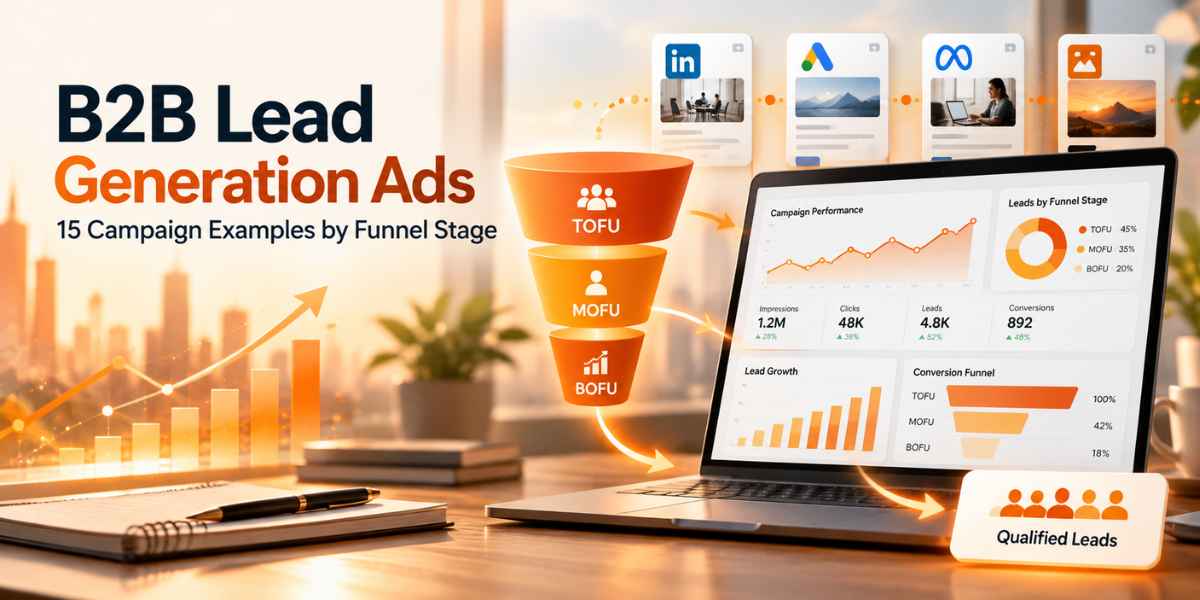
That is why this guide organizes 15 B2B lead generation ads by funnel stage instead of treating every campaign as interchangeable. The examples are based on recurring campaign structures seen across LinkedIn, Google, Meta, and display advertising—not claims that one specific creative will work for every company.
Table of contents
What Makes a Strong B2B Lead Generation Ad Example?
A useful campaign example has four parts that reinforce each other.
| Element | Question to Answer | Example |
|---|---|---|
| Hook | Why should this buyer stop? | “Your pipeline may be leaking after the lead form.” |
| Offer | What useful next step do they receive? | Benchmark, audit, calculator, demo |
| Proof | Why should they believe you? | Customer result, data point, product proof |
| CTA | What is the appropriate commitment? | Read, download, calculate, book, start |
AdSpyder’s cross-platform lead generation research reinforces why channel matters: Google is primarily an intent-capture environment, while Meta and LinkedIn depend more heavily on creative format and audience context.
TOFU: 5 B2B Lead Generation Ads for Problem-Aware Buyers
Top-of-funnel buyers are not necessarily ready to talk to sales. The campaign should make the problem clearer and earn permission for the next interaction.
EXAMPLE 1 · LINKEDIN
Industry Benchmark Report
Hook: “How does your 2026 B2B conversion rate compare with companies in your industry?”
Offer: Benchmark report.
Creative: Clean report cover + one standout statistic.
CTA: Download Report.
EXAMPLE 2 · LINKEDIN
Role-Specific Webinar
Hook: “For RevOps leaders: why good lead volume still creates weak pipeline.”
Offer: 30-minute webinar.
Creative: Speaker + three learning points.
CTA: Register.
EXAMPLE 3 · META
Problem-Education Video
Hook: “More leads will not fix bad lead routing.”
Offer: Free routing checklist.
Creative: Short video showing lead → CRM → sales handoff.
CTA: Learn More.
EXAMPLE 4 · DISPLAY
Research-Led Playbook
Hook: “The 7 demand-gen leaks increasing your CAC.”
Offer: Educational playbook.
Creative: One pain point + report mockup.
CTA: Read the Guide.
EXAMPLE 5 · GOOGLE SEARCH
Problem-Aware Search Ad
Keyword: “how to improve B2B lead quality.”
Headline: “Improve B2B Lead Quality | Practical Qualification Framework.”
Offer: Guide or diagnostic framework.
CTA: Explore Framework.
For search-led examples, use Google Ads Spy to compare how competitors connect commercial and problem-aware keywords with headlines, offers, and landing pages.
MOFU: 5 Campaign Examples for Buyers Evaluating Solutions
Middle-of-funnel prospects understand the problem. Your job is to help them judge options, quantify impact, and trust your approach.
EXAMPLE 6 · LINKEDIN DOCUMENT AD
Vendor Evaluation Checklist
Hook: “12 questions to ask before choosing a marketing attribution platform.”
Offer: Downloadable checklist.
CTA: Get Checklist.
EXAMPLE 7 · GOOGLE SEARCH
Comparison Search Campaign
Keyword: “best B2B attribution software.”
Hook: Transparent comparison of features, setup, and use cases.
CTA: Compare Platforms.
EXAMPLE 8 · META RETARGETING
Case Study Creative
Audience: People who visited solution pages but did not convert.
Hook: “See how a SaaS team found where paid leads dropped before pipeline.”
CTA: Read Case Study.
EXAMPLE 9 · LINKEDIN
ROI Calculator Campaign
Hook: “What does your manual reporting process actually cost?”
Offer: Interactive ROI calculator.
CTA: Calculate Your Cost.
EXAMPLE 10 · META / DISPLAY RETARGETING
Product-Proof Campaign
Hook: “See the workflow in 45 seconds.”
Creative: Short product demonstration or before/after process.
CTA: See How It Works.
Meta examples become more useful when you compare visual hooks, forms, offers, and landing destinations together. Facebook Ads Spy lets you research those recurring patterns instead of copying one isolated creative.
BOFU: 5 Ads for Sales-Ready B2B Demand
Bottom-of-funnel ads should not hide the action. Prospects are comparing vendors, implementation, price, or risk. Make the next step concrete.
EXAMPLE 11 · GOOGLE SEARCH
High-Intent Demo Campaign
Keyword: “enterprise lead attribution software demo.”
Offer: Role-specific demo.
CTA: Book Demo.
EXAMPLE 12 · LINKEDIN LEAD GEN FORM
Free Account Audit
Hook: “Find where your paid campaigns lose qualified pipeline.”
Form: Work email, company, role, one qualification question.
CTA: Request Audit.
EXAMPLE 13 · META
Qualified Demo Campaign
Hook: “Still qualifying every inbound lead manually?”
Offer: Product walkthrough for suitable teams.
CTA: Request Demo.
EXAMPLE 14 · GOOGLE SEARCH
Alternative / Pricing Campaign
Keyword: “[competitor] alternative” or “[category] pricing.”
Page: Honest comparison or pricing-focused landing page.
CTA: Compare Plans / Start Trial.
EXAMPLE 15 · DISPLAY / ABM RETARGETING
Account-Specific Consultation
Audience: Engaged visitors from target accounts.
Hook: Outcome + implementation confidence.
CTA: Talk to an Expert.
The CTA should become more committed as buyer intent increases. AdSpyder’s CTA pattern research shows why “Learn More,” product-led actions, demos, and booking CTAs should not be treated as interchangeable buttons.
Five B2B Ad Patterns Worth Adapting
1. Role + problem hooks
“For RevOps leaders struggling with…” is often clearer than generic “Transform your business” copy.
2. Specific offers
“Get the 2026 SaaS Pipeline Benchmark” gives the buyer a clearer reason to convert than “Download Now.”
3. Proof before the form
Show the reason to believe before asking for company details.
4. Ad-to-page message match
If the ad promises a pipeline audit, the landing page should open with the same audit—not a generic homepage headline.
5. One campaign, one primary conversion goal
Do not ask the same audience to simultaneously download a guide, request pricing, book a call, and start a trial.
Use Landing Page Analysis to compare competitor ad promises with their page headlines, forms, proof, offers, CTAs, and historical page changes.
What Not to Copy From Competitor B2B Ads
Do not copy their wording: extract the underlying hypothesis—problem, proof, offer, or CTA—and write an original execution.
Do not assume longevity equals profitability: an ad staying live is an observable signal, not access to the advertiser’s private ROAS.
Do not copy a BOFU CTA for a cold audience: “Book Demo” can be appropriate for search intent and still be too aggressive for a first-touch social impression.
Do not judge examples by CTR alone: qualified-lead rate, cost per SQL, opportunity creation, and pipeline matter more than inexpensive clicks.
For additional structures beyond these 15, AdSpyder’s lead generation ad examples guide breaks examples down by hook, offer, proof, funnel stage, and channel.
How to Find More B2B Campaign Examples in AdSpyder
Start with direct competitors
Search by brand or domain instead of browsing random “best ad” collections.
Separate by funnel intent
Create buckets for reports/webinars, comparisons/calculators, and demos/trials/audits.
Record the four variables
Capture hook, offer, proof, and CTA for every useful example.
Compare across channels
See whether the competitor uses the same value proposition on search, social, and display or changes it by audience stage.
Turn patterns into test hypotheses
Do not rebuild the competitor ad. Ask what repeated pattern deserves an original experiment in your campaign.
B2B Ad Swipe-File Checklist
☐ Brand / competitor
☐ Channel
☐ Funnel stage
☐ Target role or company type
☐ Hook
☐ Offer
☐ Proof
☐ Creative format
☐ CTA
☐ Landing-page destination
☐ Qualification method
☐ Original hypothesis you can test
FAQs About B2B Lead Generation Ads
What are B2B lead generation ads?
B2B lead generation ads are paid campaigns designed to attract relevant business buyers and move them toward actions such as downloading a resource, registering for an event, requesting an audit, starting a trial, or speaking with sales.
Which channel is best for B2B lead generation?
It depends on intent. Google is strong when buyers are actively searching, LinkedIn provides professional targeting context, while Meta can create and retarget demand with visual creative.
What offers work for B2B lead generation?
Useful offers include benchmark reports, webinars, templates, calculators, assessments, audits, comparisons, free trials, demos, and consultations. Match the offer to the buyer’s readiness.
Should B2B ads send users to a homepage?
Usually a focused landing page is clearer when the campaign promises a specific resource, comparison, audit, trial, or demo. The page should continue the same message and action introduced in the ad.
What metric should determine whether a lead-generation ad is successful?
CTR and CPL are useful diagnostics, but qualified-lead rate, cost per qualified lead, SQL rate, opportunities, pipeline, CAC, and revenue are stronger business measures.
Build your next B2B campaign from patterns—not guesses
Use competitor ads to understand hooks, offers, formats, CTAs, and post-click journeys across funnel stages, then turn those observations into original campaign tests.