Quick answer:
- There is no single “best” lead generation tool because traffic research, capture, enrichment, qualification, outreach, and nurturing are different jobs.
- For competitor ad intelligence: AdSpyder is most relevant when you need to understand competitor creatives, offers, keywords, and landing pages.
- For all-in-one inbound lead management: HubSpot is one of the broadest options.
- For outbound B2B prospecting: Apollo, Clay, Hunter, Snov.io, Lusha, and Instantly solve different parts of the workflow.
- For website capture: OptinMonster, Typeform, Unbounce, Intercom, and Pipedrive LeadBooster are stronger fits.
- Before choosing tools, use AdSpyder Ad Analytics to understand how competitors attract traffic, which offers they promote, and which landing pages they send prospects to.
A lead generation stack can become expensive very quickly if every problem is solved by adding another subscription. The smarter approach is to define the exact gap first: do you need more traffic, better forms, richer contact data, stronger qualification, faster outreach, or better follow-up?
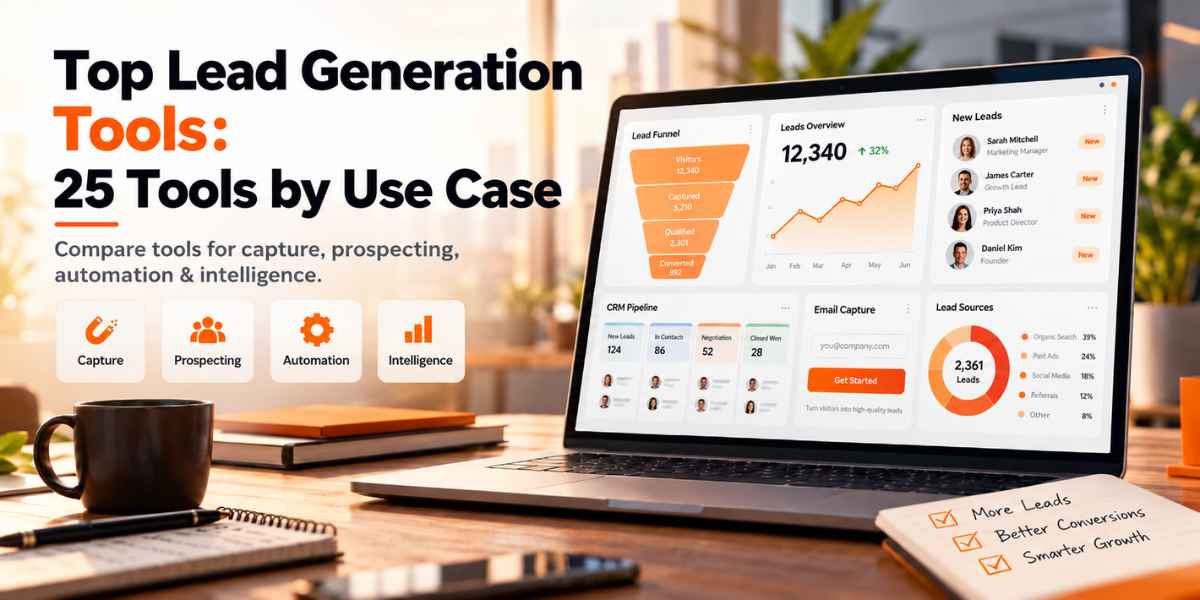
This guide compares 25 lead generation tools by the job they perform. Instead of pretending a landing-page builder and a B2B database are direct competitors, each tool is evaluated on best use case, core strength, limitation, and current pricing model.
Table of contents
How We Evaluated the Lead Generation Tools
A high-quality lead generation tool should solve a specific stage of the acquisition process better than doing ten unrelated jobs poorly.
| Criterion | What We Looked For |
|---|---|
| Use-case fit | Does it solve a clear lead-generation problem? |
| Data / targeting | Can teams identify the right audience or buying signal? |
| Capture quality | Can it turn traffic into identifiable leads efficiently? |
| Automation | Can leads be routed, enriched, nurtured, or synced automatically? |
| Integrations | Does it connect cleanly to CRM and marketing tools? |
| Pricing fit | Does the cost make sense for the target team and volume? |
Pricing note: prices below are a September 2026 snapshot. Credit-based, contact-based, usage-based, and enterprise plans can change significantly with volume.
25 Lead Generation Tools Compared
| Tool | Best For | Pricing Snapshot | Main Limitation |
|---|---|---|---|
| AdSpyder | Competitor ads & campaign intelligence | Plan-dependent | Not a CRM or contact database |
| Semrush | Search demand & competitor research | SEO from ~$139/mo | Broad platform can be expensive |
| Ahrefs | SEO traffic acquisition | Lite $129/mo | Not direct lead capture |
| HubSpot | All-in-one inbound | Free; paid tiers scale sharply | Cost rises with contacts/features |
| OptinMonster | Website popups & conversion capture | From ~$7/mo annual promo | Focused mainly on onsite capture |
| Typeform | Interactive lead forms | Basic ~$39/mo monthly | Response limits |
| Unbounce | Landing pages | Starter $29/mo | Dedicated landing-page tool |
| Intercom | Conversational capture | From $29/seat/mo | Costs grow with seats/AI usage |
| Pipedrive LeadBooster | CRM + forms/chat/prospector | Add-on from $32.50/mo | Requires Pipedrive |
| Apollo | B2B prospecting + outreach | Free; Basic $49/seat/mo annual | Credit management |
| Clay | Enrichment & signal workflows | Free; Launch $167/mo | Steeper workflow learning curve |
| Lusha | Contact data | Free 40 credits/mo; paid scales | Credit consumption for phones |
| Hunter | Email finding & verification | Free; Starter $34/mo annual | Narrower than full sales intelligence |
| Snov.io | Prospecting + multichannel outreach | Starter $39/mo | Credits + LinkedIn slot costs |
| Instantly | Cold email scale | Outreach from ~$47/mo | Deliverability requires careful setup |
| ZoomInfo | Enterprise sales intelligence | Custom | Higher enterprise entry point |
| 6sense | B2B intent & ABM | Custom | Best suited to mature GTM teams |
| Dealfront | Website visitor/account intelligence | Tier/credit based | Complex packaging |
| Lead Forensics | Anonymous B2B visitor identification | Custom by traffic volume | Company-level identification |
| ActiveCampaign | Lead nurturing automation | Contact/feature based | Advanced scoring may require add-ons |
| Brevo | Affordable email/SMS nurture | Free; Starter from $9/mo | Advanced B2B intelligence is limited |
| Salesforce Account Engagement | Enterprise B2B automation | Growth+ $1,250/org/mo | Enterprise cost & complexity |
| Calendly | Lead-to-meeting conversion | Free; Standard $10/seat/mo annual | Does not generate traffic itself |
| Zapier | Lead workflow automation | Free; Professional from $19.99/mo | Task costs rise with volume |
| Make | Advanced visual automations | Free; Core $12/mo | More technical than basic automation |
1. Traffic and Competitive Intelligence Tools
1. AdSpyder — Best for Competitor Ad Intelligence
Best for: PPC teams, growth marketers, agencies, and brands researching paid acquisition.
Strength: connects competitor creatives, platforms, domains, keywords, offers, and landing-page activity so marketers can understand how demand is being generated.
Limitation: it is an intelligence layer, not your CRM, email finder, or lead database.
Use the AdSpyder Ad Library when your first question is not “who should I email?” but “what paid messages, offers, and creative angles are already competing for this audience?”
2. Semrush — Best for Search-Led Demand Research
Strength: strong keyword, competitor, SEO, paid-search, and visibility research.
Limitation: it helps create traffic opportunities but does not manage leads through the entire lifecycle.
3. Ahrefs — Best for Organic Lead Acquisition
Strength: excellent backlink, keyword, content-gap, and competitor research for SEO-driven pipeline.
Limitation: you still need forms, CRM, enrichment, and follow-up tools to turn organic traffic into pipeline.
2. Website Lead Capture and Conversion Tools
4. HubSpot — Best All-in-One Inbound Platform
Strength: CRM, forms, landing pages, marketing automation, lead management, email, and reporting can live in one ecosystem.
Limitation: advanced tiers become substantially more expensive as your contact database and requirements grow.
5. OptinMonster — Best for Onsite Conversion Capture
Strength: popups, exit intent, targeting rules, A/B testing, and onsite retargeting.
Limitation: highly specialized around onsite conversion rather than full lifecycle management.
6. Typeform — Best for High-Engagement Forms
Strength: conversational forms, conditional logic, integrations, and polished user experience.
Limitation: response limits can make high-volume capture expensive.
7. Unbounce — Best for Dedicated Landing Pages
Strength: purpose-built landing-page creation, testing, forms, hosting, and campaign pages.
Limitation: usually complements rather than replaces CRM and lifecycle automation.
When evaluating landing-page tools, compare the pages competitors actually use with AdSpyder Landing Page Analysis so your decision is based on real campaign workflows rather than template libraries alone.
8. Intercom — Best for Conversational Lead Capture
Strength: messenger, live chat, AI, automation, and routing can turn high-intent conversations into meetings or qualified leads.
Limitation: pricing can expand with seats, AI outcomes, and add-ons.
9. Pipedrive LeadBooster — Best for CRM-Centric SMB Lead Capture
Strength: combines chatbot, live chat, forms, and Prospector with the Pipedrive sales pipeline.
Limitation: most useful when Pipedrive is already your CRM.
3. B2B Prospecting and Enrichment Tools
10. Apollo — Best All-Round B2B Prospecting Tool
Strength: contact database, company filters, intent signals, enrichment, sequences, dialer, and AI-assisted outbound in one environment.
Limitation: high-volume teams need to monitor credit usage and deliverability carefully.
11. Clay — Best for Custom Enrichment Workflows
Strength: multi-provider enrichment, AI research, signal tracking, waterfalls, and workflow flexibility.
Limitation: powerful systems require more setup knowledge than a simple contact database.
12. Lusha — Best for Quick Contact Reveals
Strength: easy contact and company data access through workspace, browser extension, CRM, API, and AI connectors.
Limitation: phone numbers consume more credits than email reveals.
13. Hunter — Best for Email Finding and Verification
Strength: email finding, domain search, verification, enrichment, and lightweight outreach.
Limitation: narrower sales-intelligence scope than Apollo or ZoomInfo.
14. Snov.io — Best for Prospecting Plus Outreach
Strength: prospect search, email finding, verification, multichannel campaigns, warm-up, and follow-ups.
Limitation: LinkedIn automation is separately priced.
For outbound teams running paid search as well, Google Ads Spy can show which commercial keywords and ad messages competitors are using before you build prospect-specific outreach around the same demand themes.
15. Instantly — Best for High-Volume Cold Email
Strength: unlimited sending accounts on outreach plans, warm-up, lead database access, enrichment, AI assistance, and reply management.
Limitation: scaling outbound without strong domain and deliverability discipline can create problems quickly.
16. ZoomInfo — Best for Enterprise Sales Intelligence
Strength: broad B2B contact/company intelligence, intent, enrichment, and enterprise workflows.
Limitation: custom enterprise pricing and platform complexity make it less approachable for small teams.
4. Intent, Qualification and Website Intelligence
17. 6sense — Best for Enterprise Intent and ABM
Strength: buying-stage and account-level signals help revenue teams prioritize accounts before direct conversion.
Limitation: designed for sophisticated B2B revenue teams rather than entry-level lead generation.
18. Dealfront — Best for European B2B Visitor Intelligence
Strength: combines website visitor identification, prospecting, company intelligence, and GTM workflows.
Limitation: packages, credits, geographies, and seats can make pricing harder to compare quickly.
19. Lead Forensics — Best for Anonymous B2B Website Visitors
Strength: identifies visiting companies, scores activity, and helps sales teams follow up on account-level website intent.
Limitation: identifies companies rather than guaranteeing the identity of the individual browser.
If you are deciding which acquisition channels deserve more intent analysis, compare competitor activity first with URL & Domain Analysis to connect domains, ads, keywords, and destination pages before adding another qualification tool.
5. Lead Nurturing, Scheduling and Automation
20. ActiveCampaign — Best for Advanced Lead Nurturing
Strength: sophisticated email automation, segmentation, landing pages, predictive features, and attribution.
Limitation: lead scoring and deeper CRM functionality can depend on packaging and add-ons.
21. Brevo — Best Budget-Friendly Multichannel Nurture
Strength: accessible email, SMS, WhatsApp, transactional messaging, and automation.
Limitation: does not provide the depth of B2B sales intelligence found in dedicated prospecting platforms.
22. Salesforce Account Engagement — Best for Enterprise B2B Automation
Strength: lead nurturing, scoring, qualification, forms, landing pages, analytics, and Salesforce alignment.
Limitation: significant price and implementation complexity.
23. Calendly — Best for Converting Qualified Leads Into Meetings
Strength: removes scheduling friction; Teams adds qualification, routing, and round-robin scheduling.
Limitation: it improves conversion after interest exists—it does not create demand itself.
24. Zapier — Best for Easy Lead Workflow Automation
Strength: connects forms, CRM, enrichment, spreadsheets, notifications, and thousands of apps without custom development.
Limitation: task-based pricing becomes material at high workflow volume.
25. Make — Best for Complex Visual Lead Automations
Strength: routers, filters, APIs, visual scenarios, AI apps, and more complex multi-step logic.
Limitation: takes more workflow thinking than simple trigger-action automation.
Best Lead Generation Tool by Use Case
| Need | Strong Options |
|---|---|
| Competitor ad research | AdSpyder, Semrush |
| SEO lead acquisition | Ahrefs, Semrush |
| All-in-one inbound | HubSpot |
| Landing pages | Unbounce |
| Interactive forms | Typeform |
| Outbound SMB prospecting | Apollo, Hunter, Snov.io |
| Advanced enrichment | Clay |
| High-volume cold email | Instantly |
| Enterprise intent / ABM | 6sense, ZoomInfo |
| Anonymous visitor identification | Lead Forensics, Dealfront |
| Affordable nurture | Brevo |
| Complex nurture automation | ActiveCampaign, Salesforce Account Engagement |
| Lead routing automation | Zapier, Make |
For paid-social-heavy teams, competitor research can also be separated by channel. Use Facebook Ads Spy for Meta creative research and the LinkedIn Ad Library when professional targeting, B2B offers, and LinkedIn lead-gen patterns matter more.
Where AdSpyder Fits in a Lead Generation Stack
AdSpyder belongs at the research and acquisition intelligence layer.
A practical stack might look like:
AdSpyder → understand competitor ads, keywords and offers
Unbounce / Typeform / HubSpot → capture demand
Clay / Apollo / Lusha → enrich the lead
CRM / scoring → qualify and route
ActiveCampaign / Salesforce / Brevo → nurture
Calendly → convert qualified interest into meetings
That separation matters. Competitive intelligence should improve your campaign decisions; it should not be presented as a replacement for the systems that actually store, enrich, or nurture individual prospects.
Lead Generation Tool Buying Checklist
☐ Which exact stage of the funnel is currently weak?
☐ Do we need more traffic, or are we failing to convert existing traffic?
☐ Do we need inbound capture or outbound prospecting?
☐ Does the tool integrate with our CRM?
☐ Is pricing based on users, contacts, credits, sends, visitors, or tasks?
☐ What happens to cost when usage doubles?
☐ Is data quality strong in our target geography?
☐ Can sales actually act on the leads produced?
☐ Are duplicate tools already solving the same problem?
☐ Which metric will prove the tool is worth renewing?
FAQs About Lead Generation Tools
What is a lead generation tool?
A lead generation tool helps a business attract, identify, capture, enrich, qualify, route, or nurture potential customers. Different tools handle different stages rather than all solving the same problem.
What is the best free lead generation tool?
It depends on the job. HubSpot offers free CRM and marketing tools, Hunter has a free email-finding tier, Apollo has a free prospecting tier, Brevo offers a free plan, and Zapier or Make can automate limited workflows for free.
Which lead generation tool is best for B2B?
For prospecting, Apollo, Clay, Hunter, Lusha, and Snov.io are useful options. For enterprise intent and ABM, 6sense and ZoomInfo are stronger fits. For competitor advertising intelligence, AdSpyder serves a different upstream research role.
Do I need more than one lead generation tool?
Usually yes, but not many. A lean stack often needs one acquisition/research layer, one capture method, one CRM, and one automation or enrichment layer. Avoid buying overlapping tools before the workflow is clear.
How should I compare lead generation software pricing?
Look beyond the headline monthly price. Compare seats, credits, contact tiers, email sends, enrichment costs, automation tasks, visitor volume, add-ons, onboarding fees, and how the price changes when usage grows.
Build the stack around the problem—not the tool
Use AdSpyder to understand competitor acquisition strategies, then choose capture, enrichment, qualification, and automation tools based on the actual gaps in your funnel.