Quick answer
- Lead generation outsourcing can make sense when you need pipeline faster but do not want to hire, train, manage, and tool a complete internal SDR or demand-generation team.
- The biggest advantages are faster launch, specialist expertise, flexible capacity, and access to established processes and technology.
- The biggest risks are weak message quality, poor-fit meetings, unclear data ownership, brand damage, compliance gaps, and reporting that rewards activity instead of revenue.
- Do not evaluate vendors only on cost per lead or meetings booked. Track attended meetings, qualified opportunities, pipeline, and closed revenue.
- Your contract should define the ICP, qualification rules, CRM ownership, domains/accounts used, data return/deletion, reporting access, and what happens when the relationship ends.
- Before outsourcing paid acquisition or campaign strategy, review the AdSpyder workflow for ad agencies to see how competitor, keyword, funnel, and landing-page intelligence can support agency oversight.
Outsourcing lead generation sounds simple: hire an external team, give them your target market, and let them fill the sales calendar.
In practice, the outcome depends heavily on what you outsource, how tightly the vendor is managed, who owns the data and infrastructure, and what both sides mean by a “qualified lead.”
A vendor that books 30 meetings may be less valuable than one that books 12 if those 12 convert into real sales opportunities. This guide explains when lead generation outsourcing makes sense, the main pricing models, the risks buyers often miss, and the questions to ask before signing a contract.
Table of contents
What Is Lead Generation Outsourcing?
Lead generation outsourcing means hiring an external provider to manage some or all of the work required to identify, attract, qualify, and hand sales opportunities to your internal team.
The outsourced scope might include:
- Ideal customer profile and account research
- Contact list building and enrichment
- Cold email and LinkedIn outreach
- Cold calling
- Appointment setting
- Paid search and paid-social lead generation
- Landing-page and form optimization
- Lead qualification
- CRM handoff and reporting
If the outsourced team is managing advertising as well as outbound, use a cross-platform competitor ad library to independently check whether the campaign angles, formats, and offers being proposed actually match the competitive market.
Benefits of Outsourcing Lead Generation
1. Faster launch
Building an internal outbound team requires recruiting, onboarding, training, list tools, calling systems, email infrastructure, scripts, CRM processes, coaching, and reporting. A mature agency may already have much of this operating system in place.
2. Access to specialist expertise
A good provider sees multiple campaigns, industries, objections, and outreach patterns. That experience can reduce avoidable setup mistakes.
3. Flexible capacity
You can often expand or reduce outreach faster than you could resize an internal team.
4. Easier market testing
Outsourcing can be useful when entering a new market, targeting a new persona, or testing whether outbound is viable before investing in permanent headcount.
Before testing a new region or vertical, URL & Domain Analysis can help you map competitor domains, keywords, ad activity, and landing destinations so the outsourced team is not entering the segment blind.
The Risks Buyers Should Evaluate Before Outsourcing
Message quality risk: a vendor that does not deeply understand your product may send generic outreach that sounds like every other SDR sequence.
Brand risk: prospects usually experience the outreach as your brand speaking—even when an external vendor wrote and sent it.
Qualification risk: vague meeting definitions can encourage vendors to maximize bookings instead of real buying intent.
Data ownership risk: you may discover that prospect lists, engagement history, sending accounts, or campaign assets live inside vendor-controlled systems.
Compliance risk: outsourcing the execution does not automatically transfer all legal responsibility away from your business.
Measurement risk: reports can look impressive if they emphasize emails sent, opens, calls, or meetings while hiding opportunity quality and revenue.
For LinkedIn-heavy programs, use the LinkedIn Ad Library to independently compare your agency’s messaging with the offers and professional positioning already used by competitors.
Lead Generation Outsourcing Pricing Models
Published 2026 pricing varies widely because providers are not all selling the same service. Full-service outsourced SDR programs, appointment setters, list providers, and performance agencies have different cost structures.
| Model | Typical Structure | Strength | Main Risk |
|---|---|---|---|
| Monthly retainer | Often roughly $3,000–$15,000+ / month for appointment-setting programs | Dedicated process, optimization, team continuity | You pay even when short-term output fluctuates |
| Pay per appointment | Fee triggered when a meeting is booked | Easy to understand unit economics | Can reward quantity unless qualification is strict |
| Hybrid | Base retainer + performance component | Shares risk between client and provider | Contract definitions become critical |
| Pay per lead | Fixed price for each contact meeting agreed criteria | Predictable lead volume | “Lead” may be far from sales-ready |
| Dedicated outsourced SDR | Monthly cost for a dedicated rep plus management/tools | More control and specialization | Higher commitment and management dependency |
Pricing rule: compare vendors on cost per attended qualified meeting and cost per opportunity—not simply the quoted cost per booked appointment.
Outsourced vs In-House vs Hybrid Lead Generation
| Factor | In-House | Outsourced | Hybrid |
|---|---|---|---|
| Launch speed | Slower | Usually faster | Medium-fast |
| Message control | Highest | Depends on vendor governance | High |
| Specialist expertise | Must hire/build | Immediate if vendor is strong | Shared |
| Data control | Highest | Must be contractually protected | High if CRM stays internal |
| Scalability | Requires hiring | Usually faster | Flexible |
| Best fit | Stable proven motion | Need speed or missing expertise | Want outside execution but internal ownership |
If paid search is being outsourced, use Google Ads Spy to review competitor search messages and landing-page angles yourself instead of depending entirely on the agency’s competitor deck.
How to Evaluate an Outsourced Lead Generation Vendor
1. Ask them to define a qualified lead in writing
Do not accept “someone interested in your solution.” Define the company profile, role, geography, need, buying situation, exclusions, and what makes a booked meeting billable.
2. Review their messaging before launch
Require approval for email copy, LinkedIn scripts, call positioning, ad creatives, and offers. A vendor should sound like an extension of your company, not a lead-generation agency pretending to be your sales team.
3. Ask who owns the infrastructure
Clarify ownership of:
- Sending domains and mailboxes
- LinkedIn accounts
- Phone numbers
- Prospect lists
- Audience lists
- Landing pages
- Ad accounts
- CRM records
- Creative files and campaign history
4. Evaluate their landing-page quality
If the agency runs paid campaigns, do not judge only the ads. Check whether the post-click page continues the same promise, contains credible proof, and uses the right level of form friction.
Use Landing Page Analysis to compare those proposed pages with competitor funnels and historical landing-page patterns.
5. Make CRM visibility non-negotiable
Every lead, touchpoint, booked meeting, no-show, rejection reason, opportunity, and outcome should flow into a system you can access.
6. Ask what happens after termination
You should know in advance how lists, campaign data, credentials, suppression lists, domains, reports, recordings, CRM records, and personal data will be returned, transferred, retained, or deleted.
Compliance and Data Ownership Are Part of Vendor Quality
Do not treat compliance as a line buried in procurement paperwork.
If a third party sends commercial email on your behalf, your company may still retain legal responsibilities depending on the market and regulation. Requirements also differ by jurisdiction, recipient type, channel, and lawful basis.
Your vendor review should therefore cover:
- How prospect data is sourced
- Whether suppression and opt-out requests are synchronized
- How privacy notices are handled
- Whether subcontractors process the data
- Where data is stored
- What happens to personal data after termination
- Who is responsible for auditing the process
Practical rule: never assume “the agency handles compliance” means your organization has no responsibility. Review the exact laws that apply to your market and obtain legal advice where appropriate.
Metrics Your Vendor Should Report
| Level | Metrics |
|---|---|
| Activity | Accounts researched, calls, emails, impressions, clicks |
| Engagement | Replies, conversations, form completions, meeting requests |
| Quality | Qualified rate, meeting show rate, disqualification reasons |
| Pipeline | SQLs, opportunities, pipeline value, opportunity conversion |
| Revenue | Closed-won deals, CAC, revenue, payback |
If your provider is managing Meta campaigns, independently review creative and offer trends through Facebook Ads Spy instead of evaluating performance only from the vendor’s selected screenshots.
Which Outsourcing Model Fits Your Situation?
| Situation | Better Starting Model |
|---|---|
| You have no repeatable outbound process yet | Short pilot or specialist strategy + execution engagement |
| You know your ICP but lack SDR headcount | Dedicated outsourced SDR or monthly retainer |
| You only need verified meetings | Performance or hybrid model with strict qualification |
| Your internal team owns brand and strategy | Hybrid: internal strategy + external research/outreach |
| Your ACV is high and sales cycle complex | Dedicated multichannel SDR team with account research |
| You mainly need paid lead generation | Performance marketing agency + internal CRM ownership |
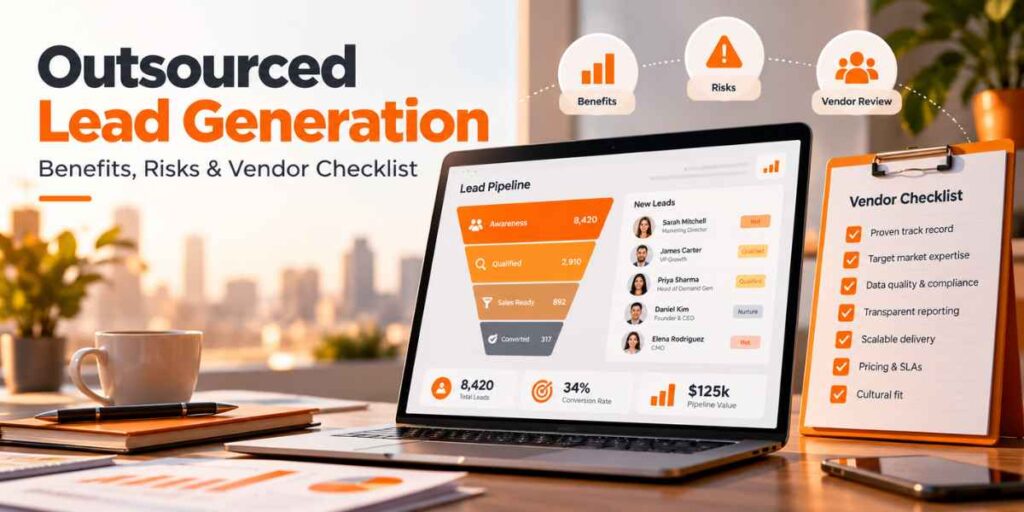
Outsourced Lead Generation Vendor Checklist
☐ Can the vendor describe our ICP without reading our website?
☐ Is “qualified lead” defined in the contract?
☐ Are exclusions and disqualification criteria documented?
☐ Do we approve messaging and campaign offers?
☐ Who owns prospect lists and research data?
☐ Who owns sending domains, inboxes, phone numbers, and ad accounts?
☐ Does all activity sync into our CRM?
☐ Can we see raw campaign data, not only monthly slides?
☐ How are opt-outs and suppression lists handled?
☐ Are subcontractors disclosed?
☐ Is data deletion/return documented for termination?
☐ What happens to no-shows and unqualified meetings?
☐ Is there a pilot, minimum term, or setup fee?
☐ Do reports include opportunities and pipeline?
☐ Can we exit without losing our campaign history and infrastructure?
Where AdSpyder Fits in an Outsourced Lead Generation Setup
AdSpyder does not replace an outsourced SDR agency, appointment setter, CRM, or lead database.
Its useful role is independent market and campaign intelligence.
That can help you:
- Validate competitor research provided by the agency
- Review active ad angles and offers
- Compare funnel-stage messaging
- Study keywords competitors are targeting
- Review landing-page patterns
- Give the vendor a better initial creative brief
- Maintain strategic visibility even when execution is external
Use Ad Analytics as an intelligence layer beside your agency reporting rather than allowing outsourced execution to become a black box.
FAQs About Lead Generation Outsourcing
What is lead generation outsourcing?
Lead generation outsourcing means hiring an external provider to manage activities such as prospect research, outbound outreach, paid lead acquisition, qualification, appointment setting, or CRM handoff.
How much does outsourced lead generation cost?
Pricing varies by market, channel, seniority, volume, and model. Published 2026 guides commonly place outsourced appointment-setting retainers around $3,000–$15,000+ per month, while performance programs may charge per qualified meeting or use a hybrid base-plus-performance structure.
Is outsourced lead generation better than hiring SDRs?
Neither model is automatically better. Outsourcing can launch faster and provide specialist expertise, while an internal team offers stronger direct control and institutional product knowledge. Hybrid models can provide a useful middle ground.
What should a lead generation contract include?
It should clearly define scope, ICP, qualification criteria, pricing, billable outcomes, data ownership, CRM access, account and domain ownership, reporting, compliance responsibilities, subcontractors, termination, and data return or deletion.
What KPIs should I use for an outsourced lead generation company?
Track meeting show rate, qualified rate, SQLs, opportunities created, pipeline value, cost per qualified opportunity, closed revenue, and CAC. Activity metrics should support these business outcomes rather than replace them.
Who should own lead-generation data when using an agency?
Ownership and access should be explicitly defined before launch. Ideally, your business should retain access to CRM records, prospect history, campaign data, suppression lists, ad accounts, and other assets needed to continue operating if the vendor relationship ends.
Outsource execution—not visibility
Use independent competitor, keyword, creative, and landing-page intelligence to keep control of strategy even when an external team runs the campaign.