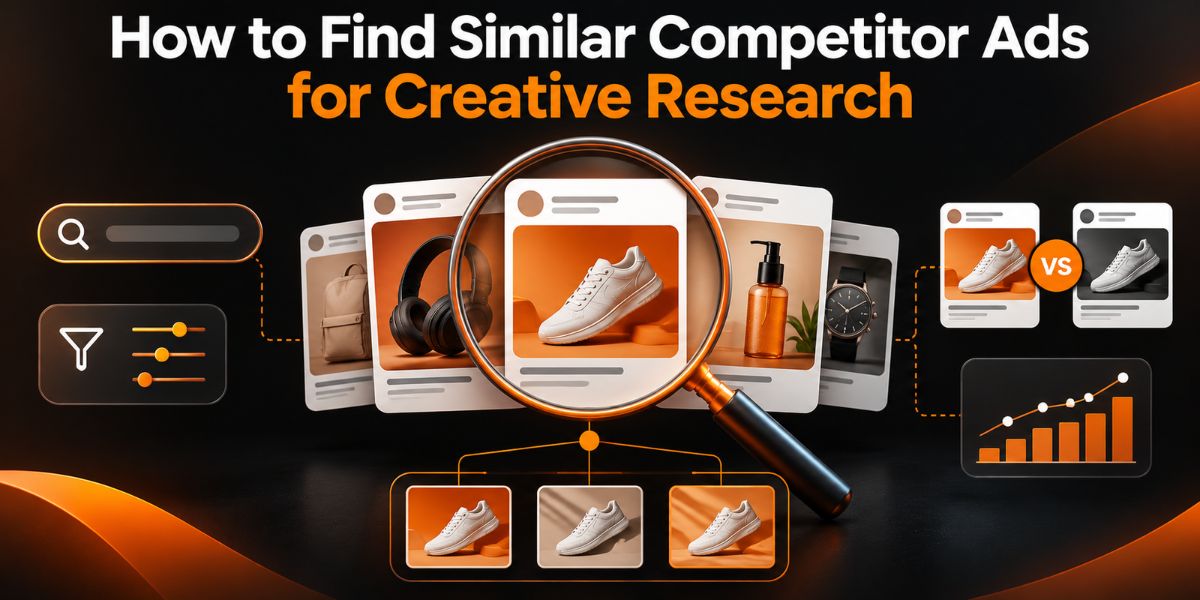
Hooks · Offers · CTAs · Formats · Landing Pages
Quick Answer
- Use the AdSpyder Ad Library to find similar ads by competitor domain, keyword, CTA, platform, country and format.
- Do not define similarity only by how two ads look.
- Compare hooks, problems, promises, proof, offers and CTAs.
- Use observed ad duration to decide what deserves deeper research, not as proof of performance.
- Turn repeated patterns into an original creative hypothesis instead of copying competitor wording or assets.
Finding one interesting competitor ad is easy. The harder question is whether that ad represents a broader pattern or is simply one creative experiment.
A better way to find similar ads is to compare ads that solve the same customer problem, promote a similar offer, use the same CTA or repeat the same message across different platforms.
How AdSpyder Helps
Find Strategically Similar Ads, Not Just Visually Similar
AdSpyder lets marketers research competitor advertising across 15+ platforms and narrow results using more than 30 research parameters.
You can build similar-ad research around
- Competitor domain
- Brand or product keyword
- CTA phrase
- Advertising platform
- Country
- Date range
- Creative format
- Landing-page URL
- Observed run duration
What Does “Similar Ads” Actually Mean?
Two ads can look completely different and still use almost the same strategy.
For creative research, similarity usually falls into six useful categories.
| Similarity Type | What to Compare |
|---|---|
| Hook | How the ad gets attention |
| Problem | The customer pain being addressed |
| Promise | The result or outcome being offered |
| Proof | Testimonials, numbers, demos or other evidence |
| Offer | Trial, demo, discount, quote or lead magnet |
| CTA | What the user is asked to do next |
This framework prevents a common mistake: assuming that ads with similar colours or layouts are automatically the most useful competitors to study.
Example
Meta: “Stop wasting money on ads that never convert.”
Google: “AI PPC Optimization Software.”
LinkedIn: “Cut Paid Acquisition Waste for B2B Teams.”
The execution is different, but the core strategy is similar: ad waste → optimization → lower acquisition cost.
Choose the Right Starting Point for Your Search
The fastest research path depends on what you already know.
Start With a Competitor Domain When You Know the Brand
Domain research helps you understand how one advertiser repeats and adapts its strategy.
Look for
- Repeated headlines
- Recurring offers
- Similar creative formats
- Multiple versions of the same campaign
- Different CTAs for different platforms
- Different landing pages for the same product
If you need the broader domain workflow, use AdSpyder’s Competitor Ad Audit guide.
Start With a Keyword When You Want Category Patterns
Keyword research is better when you want to compare several advertisers solving the same problem.
Useful search ideas include
- Your product category
- A major customer pain point
- A feature competitors frequently advertise
- A high-intent search phrase
- An industry-specific term
This gives you a category-level view rather than limiting research to one competitor’s creative choices.
Start With a CTA Phrase When the Conversion Goal Matters Most
CTA searches are particularly useful because advertisers selling very different products may still be trying to generate the same action.
For example:
- SaaS: “free trial”
- B2B: “book a demo”
- Services: “get a quote”
- Ecommerce: “shop now”
- Education: “enroll now”
- Lead generation: “learn more”
AdSpyder’s How to Use an Ad Library guide goes deeper into CTA-based competitor research.
Make the Result Set Comparable Before You Analyze It
A broad search can give you interesting ads without giving you useful research.
Narrow the set so you are comparing ads that belong in the same conversation.
Useful filters include
- Platform
- Country
- Date range
- Creative type
- Ad format
- Competitor domain
- Keyword
- Landing-page URL
Better research question
Instead of asking “Show me similar ads,” ask “Show me B2B SaaS ads in the US using a free-trial offer on Meta during the last 90 days.”
Find Similar Ads Across Different Platforms
One of the most useful forms of similar-ad research is comparing how the same idea changes by platform.
| Platform | What to Compare |
|---|---|
| Google Search | Headline promise, keyword intent, offer and CTA |
| Meta | Visual hook, body copy, proof and offer framing |
| Role-specific problem, business outcome and proof | |
| YouTube | Opening hook, demonstration and narrative structure |
| TikTok | First-frame idea, creator style and quick product demonstration |
This helps you distinguish the underlying strategy from the platform-specific execution.
Use Ad Longevity to Prioritize What Deserves Attention
If a search returns dozens of similar ads, you need a way to decide what to study first.
Observed run duration is one useful signal.
Prioritize:
- Ads observed over longer periods
- Ideas that appear in several creative variants
- Offers repeated across multiple platforms
- Hooks that survive while other creatives disappear
- Landing pages used by several related campaigns
Do not call these “winning ads” automatically. AdSpyder observes first-seen and last-seen dates. Longevity is a research signal, not verified competitor conversion data.
The Competitor’s Best-Performing Ad Format guide explains how to use format repetition and longevity without overclaiming performance.
Compare Similar Ads With the Same Research Framework
Do not open 30 ads and rely on memory. Use the same fields for every ad you study.
Record
- Hook: what earns attention?
- Problem: what pain is named?
- Audience: who is the ad speaking to?
- Promise: what outcome is offered?
- Proof: what makes the claim believable?
- Offer: what is being given or sold?
- CTA: what should the user do?
- Format: image, video, carousel, text or another format?
- Landing page: where does the click lead?
- Observed duration: how long has AdSpyder seen the ad?
Look for Patterns Across Several Ads, Not One Creative
One competitor ad can be a test. Five related ads can reveal a strategy.
Patterns worth noting include
- The same pain point appears repeatedly.
- Several competitors use the same offer.
- One proof style dominates the category.
- Most advertisers use the same CTA.
- Competitors use different creative formats for the same promise.
- The same message appears on several platforms.
- One audience segment receives a completely different landing page.
These patterns are more useful than simply finding another ad with the same colour palette.
Save the Useful Ads Into a Research Library
Good similar-ad research should create a reusable reference set rather than another folder of screenshots.
Organize saved ads by
- Competitor
- Platform
- Campaign type
- Hook
- Offer
- CTA
- Creative format
- Audience
The Ad Swipe File guide shows how to turn competitor ads into a searchable creative-reference system rather than a static screenshot archive.
Check the Landing Pages Behind Similar Ads
Ads that use the same hook may send users into very different funnels.
Compare:
- Landing-page headline
- Message match with the ad
- Primary offer
- Customer proof
- Pricing visibility
- Form length
- Primary CTA
- Page length
A competitor may run similar ads but test very different post-click strategies. That difference can be more important than the creative itself.
Turn one competitor ad into a useful research set
Search by domain, keyword, CTA, platform and market in AdSpyder, then compare the patterns that repeat across real competitor campaigns.
Turn Similar Ads Into an Original Creative Brief
Competitor research is useful only when it produces a decision for your own campaign.
Do not copy the headline, image or script. Extract the strategic pattern.
COMPETITOR PATTERN

Dominant audience problem:
[What pain keeps appearing?]

Common hook:
[How do competitors open the ad?]

Common promise:
[What outcome do they sell?]

Proof pattern:
[Data, testimonial, demonstration, customer logo?]

Common offer:
[Trial, demo, discount, guide, quote?]

CTA pattern:
[What action is repeated?]

OUR GAP:
[What useful angle is competitors' creative missing?]

OUR HYPOTHESIS:
[How can we address the same market need with our own proof, voice and positioning?]
You can then use this structured research with AdSpyder’s Competitor Ads for AI Ad Prompts workflow to generate original variations from market context instead of generic prompts.
Study the Pattern Without Copying the Competitor
| Useful Research | Copying |
|---|---|
| Notice testimonial hooks are common | Reuse the competitor’s testimonial |
| Study a comparison-ad structure | Recreate the same design and wording |
| Identify a free-trial offer pattern | Copy the competitor’s exact offer presentation |
| Find a missing audience angle | Rewrite another brand’s ad with synonyms |
What Similar-Ad Research Cannot Prove
Competitive ad intelligence is powerful, but it has limits.
You cannot reliably conclude that:
- A long-running ad is definitely profitable.
- Two similar ads prove one advertiser copied another.
- A popular format will work for your audience.
- A competitor’s visible offer produces the best CPA.
- A landing page is the advertiser’s winning variant.
- Visual similarity means the campaigns target the same buyer.
Use competitor data to decide what deserves testing. Use your own campaign results to decide what deserves scaling.
Similar Ad Research Checklist
☐ Research question defined
☐ Competitor or keyword selected
☐ CTA phrase checked
☐ Platform filters applied
☐ Country filtered
☐ Date range applied
☐ Long-running ads reviewed
☐ Hook recorded
☐ Offer recorded
☐ CTA recorded
☐ Landing page checked
☐ Original test hypothesis created
Last reviewed: November 2026. Ad-library coverage, filters and product capabilities can change over time.
Find patterns worth testing, not ads worth copying
Use AdSpyder to research competitor domains, keywords, CTAs, platforms and landing pages, then turn repeated market patterns into original campaign ideas.
Frequently Asked Questions
How Do I Find Similar Ads From Competitors?
Search the competitor domain in AdSpyder, then narrow the results by platform, country, date and format. Compare several ads for repeated hooks, problems, offers, CTAs and landing-page patterns.
Can I Find Similar Ads Using a Keyword?
Yes. Keyword research is useful when you want ads from several advertisers addressing the same product category, feature or customer problem rather than ads from only one competitor.
What Makes Two Ads Similar?
Ads can be similar because they use the same hook, problem, audience, promise, proof, offer, CTA, format or landing-page approach. Visual resemblance is only one possible type of similarity.
Does AdSpyder Have Visual Similarity Search?
AdSpyder’s current public Ad Library documentation emphasizes keyword, domain, platform, country, format, date and other structured filters rather than claiming a BigSpy-style image-upload similarity search. Use AdSpyder when strategic competitor similarity and cross-platform context matter.
Can a Long-Running Competitor Ad Be Considered a Winning Ad?
Not with certainty. A longer observed duration is a useful clue that an advertiser continued using the creative, but it does not reveal private spend, conversions, CPA, ROAS or profit.
How Many Similar Ads Should I Compare?
Compare enough ads to identify repetition rather than relying on one example. A focused research set of around 10–20 relevant ads is usually more useful than hundreds of loosely related creatives.
Can I Copy a Competitor Ad I Find?
Competitor ads should be used for research and inspiration, not direct copying. Extract structures such as the hook, offer or CTA pattern, then create original wording, proof, visuals and positioning for your own brand.