AdSpyder Original
Quick Answer
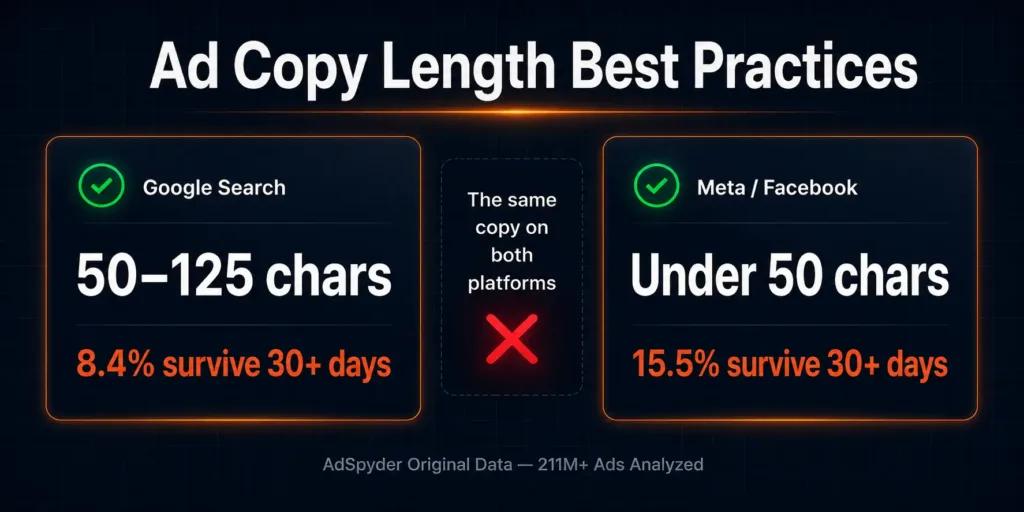
There is no single ideal ad copy length — Google Search and Meta have opposite sweet spots. For Google Search, the 50–125 character description range produces the highest 30-day survival rate at 8.4%. For Meta, body copy under 50 characters wins at 15.5%, with a second strong peak at 250–500 characters (10.8%). The critical finding: Google’s optimal range is Meta’s worst-performing length. Use AdSpyder’s Ad Library to see exactly what copy lengths your competitors are keeping live right now.
Most ad copy length advice gives you character limits: keep Facebook primary text under 125 characters, keep Google descriptions concise, avoid truncation. Useful — but it answers the wrong question. Character limits tell you what fits. They do not tell you what advertisers keep running.
For this AdSpyder Original analysis, we measured copy length against observed ad lifetime across a combined 211 million+ Google Search and Meta ads. The goal was to find which copy lengths produce ads that keep running — a real market signal, not a platform spec sheet.
What came back contradicts the universal “shorter is better” advice entirely — and the platform-by-platform split is sharper than expected.
In This Article
AdSpyder Original Data
There Is No Universal Ideal Ad Copy Length
The strongest signal from this data is that Google Search and Meta reward opposite copy lengths. Writing to a universal character count is not a strategy — it is a compromise that serves neither platform.
211.4M
Ads analyzed
Combined Google Search + Meta historical archive denominator used for this analysis.
8.4%
Google sweet spot
50–125 char descriptions had the highest 30-day survival rate on Google Search.
15.5%
Meta winner
Under-50-char Meta body copy — nearly 2x Google’s best bucket.
Source: AdSpyder platform data, June 2026.
What this means in practice
Google Search users have active intent — they need quick confirmation of relevance. Meta users are scrolling passively — they need either a one-line hook that stops them cold or a complete story that builds conviction. The same copy strategy cannot serve both states.
Methodology: How AdSpyder Measured Copy Length
AdSpyder analyzed copy length against observed ad lifetime across both platforms using random samples from each archive. For each ad, we measured the character length of the headline and body copy, then computed the gap between first and last sighting — the observed lifetime. Long-running is defined as 30+ days.
| Platform | Archive size | Sample used | Copy field analyzed |
|---|---|---|---|
| Google Search | 167,505,019 ads | 2,000 random ads | Headline and description character length |
| Meta historical | 43,938,674 ads | 8,815 random ads | Primary body copy character length |
Important limitation
This analysis does not claim CTR, CPC, ROAS, impressions, or spend performance — AdSpyder does not store those metrics for this dataset. Longevity is used as a market signal: advertisers keep ads running when the creative is worth continuing. It is a research input, not a performance guarantee. Validate with your own campaign data.
Google Ad Copy Character Count: The 50–125 Character Sweet Spot
Google Search ads in the archive clustered around a 50-character headline and a 159-character description (median). The most common description bucket was 125–250 characters — used in 42.4% of ads. That is where most advertisers are writing. It is not the best-performing range.
14.5
Mean days survived
50–125 char descriptions had the highest mean observed lifetime in the Google sample.
4.9%
90-day survival
The 50–125 char bucket also led on 90-day survival — the longest horizon in the analysis.
1.9%
Worst bucket
250–500 char descriptions — the lowest-survival format in the entire analysis.
Source: AdSpyder Google Search Ads archive, 2,000-ad sample, June 2026.
| Description length | n | Mean lifetime | Past 30 days | Past 90 days |
|---|---|---|---|---|
| Empty (no description) | 41 | 1.6 days | 0.0% | 0.0% |
| Under 50 chars | 189 | 9.0 days | 7.9% | 3.2% |
| 50–125 chars ✓ Sweet spot | 654 | 14.5 days | 8.4% | 4.9% |
| 125–250 chars (most common) | 848 | 7.7 days | 5.3% | 2.7% |
| 250–500 chars ✗ Avoid | 268 | 4.4 days | 1.9% | 1.5% |
Source: AdSpyder Google Search Ads archive, 2,000-ad sample, June 2026.
The 250–500 character bucket runs at 1.9% past 30 days — less than a quarter of the sweet-spot rate. For search ads, adding words past 125 characters does not add persuasion. It adds friction. The user has already decided whether to click before they finish reading a 300-character description.
Google Search rule
State one clear benefit in 50–125 characters. Include the primary keyword in the first 80 characters. Treat anything past 125 characters as a warning — not a feature. Use Google Ads Spy to check how top competitors phrase concise descriptions for your target keywords.
Facebook Ad Copy Length: Meta Rewards Extremes
The Meta archive tells a more complex story. The median body copy across 43M+ historical ads is 118 characters — most advertisers write in the 50–125 character range (36.7% of all ads). That is also the worst-performing bucket on the survival metric.
Meta’s pattern is bimodal
The survival rate plotted against copy length shows two peaks — one at under 50 characters (15.5%) and one at 250–500 characters (10.8%). The middle buckets covering 50–250 characters sit at 7–7.7%. This is where 63% of Meta advertisers are writing, and it is the weakest performing zone in the data.
| Body copy length | n | Mean lifetime | Past 30 days | Past 90 days |
|---|---|---|---|---|
| Under 50 chars ✓ Winner | 1,152 | 24.0 days | 15.5% | 5.9% |
| 50–125 chars (most common) ✗ | 3,239 | 10.2 days | 7.7% | 3.1% |
| 125–250 chars | 2,271 | 10.9 days | 7.1% | 2.8% |
| 250–500 chars ✓ Second peak | 788 | 16.5 days | 10.8% | 3.9% |
| 500+ chars (long-form) | 689 | 11.9 days | 8.0% | 2.8% |
Source: AdSpyder Meta historical archive, 8,815-ad sample, June 2026.
The under-50-character winner averages 24.0 days mean lifetime — 65% longer than the second-best bucket. A one-line ad that says “50% off. Today only.” or “Free forever. No card needed.” delivers the complete message without asking the user to engage further.
The long-form 250–500 character bucket works when it adds proof, comparison, use case, or objection handling — each extra line earning its place. The middle zone fails because it is neither punchy enough to stop a scrolling user nor deep enough to build conviction.
Meta copy decision rule
If the offer is self-evident — a discount, a free trial, a known product — write under 50 characters. If the offer needs context — a new category, a price point that needs justification — write 250–500 characters and build the case. Use Facebook Ads Spy or Instagram Ads Spy to see how brands in your category handle both formats.
Ad Library
See what copy lengths competitors are actually keeping live.
AdSpyder’s Ad Library indexes 400M+ ads across Google, Meta, YouTube, LinkedIn, TikTok, and 5 more platforms. Search by keyword or domain and review copy patterns and run durations directly.
Short vs Long Ad Copy: Cross-Platform Comparison
The most actionable finding is the direct opposition between platforms. Google’s survival sweet spot is Meta’s worst-performing length. Writing one copy version for both platforms means it is wrong for at least one of them.
| Copy length bucket | Google Search (30-day survival) | Meta (30-day survival) | Best use |
|---|---|---|---|
| Under 50 chars | 7.9% | 15.5% ✓ | Meta hooks, direct offers, self-evident claims |
| 50–125 chars | 8.4% ✓ | 7.7% ✗ | Google Search descriptions — avoid for Meta |
| 125–250 chars | 5.3% | 7.1% | Weak on both — use carefully or avoid |
| 250–500 chars | 1.9% ✗ | 10.8% ✓ | Meta storytelling, proof-led, education — never for Google |
Source: AdSpyder platform data, June 2026.
How to Research Ad Copy Length Using AdSpyder
Instead of applying generic rules, use competitor run duration as a category-specific signal. The goal is not to copy competitors — it is to see which copy patterns brands in your vertical keep live, then build platform-appropriate variants from that baseline.
Open the Ad Library and search your category
Go to adspyder.io/ad-library and search by a competitor domain or category keyword. You can also use Google Ads Spy or Facebook Ads Spy for platform-specific searches.
Filter by platform — separately
Always separate Google Search from Meta. Their copy length patterns are opposite. Mixing them will dilute the signal.
Sort by longest-running ads
Sort results by last-seen date or run duration. Ads alive for 60+ days are worth studying in detail. Use URL & Domain Analysis to pull a full ad history for any competitor domain.
Group ads by copy length bucket
Mark top-performing ads as under 50 chars, 50–125, 125–250, or 250–500. Compare hook style, proof points, offer clarity, and CTA structure within each bucket for your specific vertical.
Build platform-specific test variants
For Google: one concise 50–125 character description. For Meta: one under-50-char hook and one 250–500 character proof-led version. Use Text Ad Generation to draft structured variations faster, then review manually before launch.
Manual Research vs AdSpyder
Free tools can surface individual ads, but comparing copy length, run duration, and platform patterns at scale requires historical archive depth.
| Task | Manual Research | With AdSpyder |
|---|---|---|
| Find competitor ads | Depends on what appears in your feed or profile checks | Search by domain, keyword, platform, country, and date |
| Historical archive | Not available — only live content visible | 400M+ archived ads, Google and Meta included from 2018 |
| Compare copy lengths | Screenshots and manual spreadsheet notes | Review copy, run durations, and creative patterns in one workflow |
| Cross-platform research | Separate tools and manual checks per platform | Compare Google with Meta, LinkedIn, TikTok, and more in one platform |
Copy Length Mistakes to Avoid
One rule for every platform
Google Search and Meta showed opposite sweet spots. “Keep it short” is correct for Meta primary text but does not apply to Google descriptions the same way — the sweet spot there is 50–125 chars, not ultra-short.
Long copy without proof
Long-form Meta copy works only when each additional line adds proof, specificity, or buyer context. Three sentences restating the same claim is not storytelling — it is padding.
Optimising for limits, not longevity
Fitting inside the character limit gets your ad approved. Fitting inside the optimal bucket gives it the best chance of staying live. These are different problems and require different decisions.
Pre-Launch Copy Length Checklist
✓ Google Search description: is it 50–125 characters? If it is over 125, cut it.
✓ Google Search description: does the primary keyword appear in the first 80 characters?
✓ Meta body copy: is it either under 50 characters OR 250–500 characters? If it sits at 60–200, reconsider.
✓ Meta short copy: does it state the complete offer in one line without requiring context?
✓ Meta long copy: does every sentence add proof, urgency, context, or objection handling? Remove any that do not.
✓ Are you running the same copy on both platforms? If yes, write separate platform-specific versions.
✓ Checked competitor copy lengths on AdSpyder before setting final variants?
Stop guessing. Start reading the archive.
AdSpyder’s Ad Library shows you exactly what copy lengths your specific competitors are keeping live — and for how long. 400M+ ads. Google, Meta, and 8 more platforms.
Also covers: YouTube · LinkedIn · TikTok · Bing · Amazon · Display and more
FAQ: Ad Copy Length Best Practices
What is the ideal ad copy length?
There is no universal ideal. AdSpyder’s analysis found Google Search performs best with 50–125 character descriptions (8.4% 30-day survival), while Meta performs best with body copy under 50 characters (15.5%) and shows a second strong bucket at 250–500 characters (10.8%).
Is short ad copy better than long ad copy?
On Google Search, shorter descriptions clearly outperform longer ones — the 250–500 char bucket had only 1.9% 30-day survival vs 8.4% for 50–125 characters. On Meta, very short copy wins overall, but 250–500 character storytelling ads form a strong second peak at 10.8%.
What is the best Facebook ad copy length?
AdSpyder’s data from 43M+ Meta historical ads shows the highest 30-day survival belongs to ads under 50 characters (15.5%). A second strong bucket appears at 250–500 characters (10.8%). The most common length in use — 50–125 characters — is actually the worst-performing bucket at 7.7%.
What is the Google ad copy character count for descriptions?
Google Search ads allow up to 90 characters per description. AdSpyder’s longevity data from 167M+ ads shows the 50–125 character range produces the best results — highest mean lifetime (14.5 days) and highest 30-day survival (8.4%). Descriptions over 250 characters drop to just 1.9% survival.
Why does Google’s best copy length differ from Meta’s?
Google Search users have active intent — they know what they want and need quick confirmation of relevance. Meta users are scrolling passively and need either a one-line hook that stops them or a complete story that builds conviction. Different user states produce different optimal lengths.
What is Meta’s bimodal copy length pattern?
AdSpyder’s Meta data shows two survival peaks: ads under 50 characters (15.5% past 30 days) and ads in the 250–500 character range (10.8%). The 50–250 character middle — where 63% of Meta ads sit — performs worst at around 7%. Extremes win; the middle is where ads die.
How should I test ad copy length?
Test by platform. For Google Search, test variations within the 50–125 character range. For Meta, test a very short hook (under 50 chars) against a 250–500 character proof-led version. Validate with your own CTR, CPC, and conversion data.
Can AdSpyder show which copy lengths competitors are using?
Yes. AdSpyder’s Ad Library indexes 400M+ ads across 10 platforms. Search by keyword or competitor domain to review copy lengths and run durations at adspyder.io/ad-library.
Sources and Methodology
- AdSpyder platform data, June 2026: Google Search archive, 167,505,019 ads; Meta historical archive, 43,938,674 ads.
- Google Search sample: 2,000 random ads measured for headline and description character length vs observed lifetime.
- Meta historical sample: 8,815 random ads measured for primary body copy character length vs observed lifetime.
- Long-running definition: 30+ days observed between first sighting and last sighting in AdSpyder’s archive.
- CTR, CPC, ROAS, and spend data are not stored for this dataset and are not used in this analysis.