Quick Answer
- Choose PPC first when you need measurable leads or sales quickly and can fund media spend.
- Choose SEO first when you want durable search visibility that can compound without paying for every click.
- Add GEO when customers research through AI answers and you already have useful, crawlable, credible content.
- Do not treat GEO as a replacement for SEO. Google says its AI Search features still rely on core Search systems.
- Best long-term mix: PPC for speed + SEO for durable demand + GEO for AI-answer visibility.
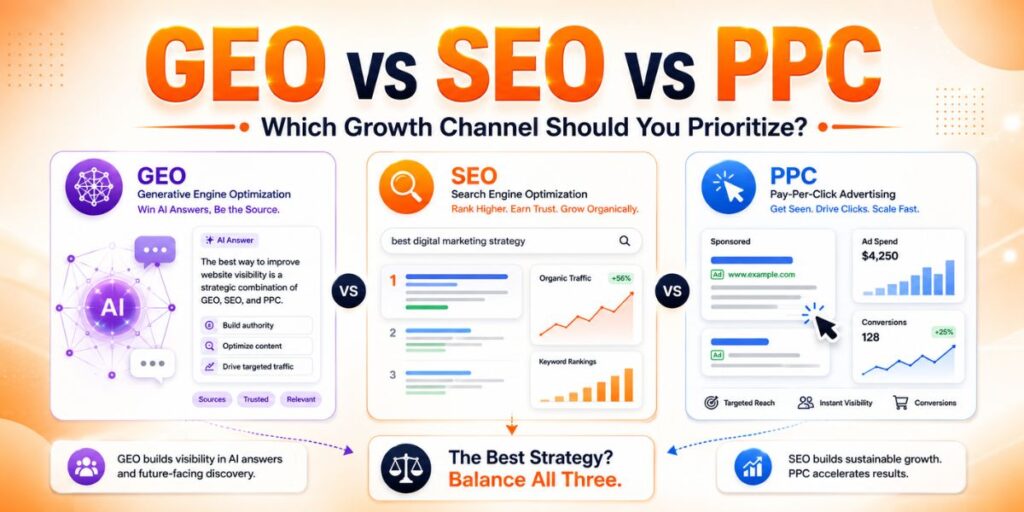
The useful question in GEO vs SEO vs PPC is not “Which channel is best?” It is “Which problem are you trying to solve first?” PPC buys speed and control. SEO builds discoverability that can compound. GEO improves the chance that credible content is retrieved, cited or represented inside generative answers—but its measurement is still less predictable than either SEO or paid search.
Make the Decision
GEO vs SEO vs PPC: Quick Comparison
| Decision Factor | SEO | GEO | PPC |
|---|---|---|---|
| Primary goal | Organic search visibility | AI-answer inclusion/citation | Paid visibility and conversions |
| Speed | Slower | Variable and unpredictable | Fastest |
| Durability | High when maintained | Medium / still uncertain | Low after spend stops |
| Control | Medium | Low | High |
| Cost model | Content + technical + authority | Content + authority + monitoring | Media spend + campaign management |
| Measurement maturity | High | Developing | High |
| Best for | Compounding demand | Research-heavy AI discovery | Immediate demand capture |
What Are SEO, GEO and PPC?
SEO: Earn Visibility in Search Results
Search Engine Optimization improves a site’s ability to be crawled, understood and surfaced for relevant organic searches. It includes technical SEO, useful content, internal linking, page experience and authority signals.
GEO: Improve Visibility Inside Generative Answers
Generative Engine Optimization focuses on making information clear, credible and useful enough to be retrieved, cited or represented by AI-powered answer systems.
PPC: Pay to Reach Searchers Now
Pay-Per-Click advertising lets advertisers bid for visibility around commercial searches and other paid placements. Google Search campaigns, for example, can target people actively searching for relevant products or services.
2026 GEO Reality Check
Some GEO guides recommend special AI files or markup. For Google’s AI Overviews and AI Mode, Google explicitly says there are no additional technical requirements, no special AI schema, and no new machine-readable AI file required. Strong SEO fundamentals remain the base.
The Key Difference Is How You Earn Visibility
This is why GEO and SEO overlap heavily. Both benefit from useful original content, clear entities, crawlability and trustworthy sourcing. PPC is structurally different because visibility depends on campaign eligibility, auction dynamics and ongoing spend.
What Current Search Data Changes About the Decision?
18%
of Google searches in Pew’s March 2025 sample triggered an AI summary.
8% vs 15%
traditional-result click rate with an AI summary vs without one.
1%
of AI-summary visits resulted in a click on a cited source.
45
GEO studies reviewed in a July 2026 critical research survey.
Sources: Pew Research Center clickstream analysis; 2026 critical survey of GEO research. GEO research remains an emerging field, so visibility gains should not be treated as guaranteed traffic or revenue gains.
Costs, Speed, Control and Limitations – GEO vs SEO vs PPC
SEO Cost: You Pay to Build the Asset
SEO does not charge for each organic click, but it is not free. Budget goes into content, technical work, research, digital PR, tools and ongoing updates. Its advantage is that a strong page can continue producing visibility after the initial investment.
GEO Cost: Mostly an Incremental Layer
For teams already investing in SEO, GEO should often be an incremental cost: improve factual clarity, original data, quotable answers, entity consistency, citations and AI-visibility monitoring rather than building a completely separate content operation.
PPC Cost: You Pay for Access to Demand
PPC requires media budget plus campaign management. Costs can change dramatically by industry, geography and keyword. In AdSpyder’s July 2026 keyword dataset, advertiser density and CPC often told very different stories—so high search volume alone should never decide where you bid.
The recent AdSpyder keyword competition study separates search volume, advertiser density and CPC across 139,355 researched keyword-suggestion rows rather than treating “competition” as one metric.
Which Channel Is Best for Your Situation?
| Situation | Prioritize | Why |
|---|---|---|
| New site needing leads now | PPC + SEO | Paid captures demand while organic authority develops. |
| Limited media budget | SEO | Build useful assets instead of depending entirely on paid clicks. |
| Already ranking but absent in AI answers | GEO layer | Improve answer structure, evidence, citations and entity clarity. |
| Launching a new offer this month | PPC | Fastest feedback on messaging, offers and conversion intent. |
| B2B research-heavy purchase | SEO + GEO + PPC | Buyers may search, ask AI comparisons and respond to high-intent ads. |
A Simple Decision Framework: Start With the Constraint
A Practical 90-Day Mix
- Days 1–30: fix technical SEO, publish commercial pages and launch controlled PPC tests.
- Days 31–60: expand content around proven questions; make answers citation-ready and easier for AI/search systems to parse.
- Days 61–90: move winning PPC messaging into organic pages and feed strong organic/customer questions back into ad tests.
- Every month: measure leads, qualified opportunities and revenue—not rankings, AI mentions or clicks in isolation.
How AdSpyder Supports the Winning Workflow
AdSpyder is not an SEO rank tracker or GEO citation tracker. Its strongest role in this three-channel strategy is helping you understand and execute the paid side—and use real market messaging as an input to broader growth decisions.
1. See Where Competitors Actually Advertise
Run URL & Domain Analysis before splitting budget. Check competitor presence across paid platforms, repeated keyword themes and landing-page destinations.
2. Study the Message Before You Buy the Click
Use the AdSpyder Ad Library to compare hooks, offers, CTAs and creative formats. Recent AdSpyder guidance on competitor ads for lead generation recommends turning repeated patterns into original campaign hypotheses rather than copying competitor ads.
3. Generate Variants After Research, Not Before
Once the positioning is clear, use Text Ad Generation to build testable variations. The recent AI Performance Marketing guide explains why paid-media AI should be judged using qualified leads, CAC and revenue rather than clicks alone.
Before you increase PPC budget, see what your market is already testing.
Research competitor ads, keywords, landing pages and platform activity, then turn those patterns into an original campaign hypothesis.
Final Verdict: Which Should You Prioritize?
For most growth teams, the answer is not GEO versus SEO versus PPC forever.
- PPC answers: How do we capture demand now?
- SEO answers: How do we keep earning relevant discovery?
- GEO answers: How do we make our best evidence usable in AI-driven discovery?
If resources are limited, prioritize PPC when speed is the constraint and SEO when long-term acquisition cost is the constraint. Add GEO to the SEO program as AI-driven research behavior becomes important for your buyers. The mistake is not choosing the “wrong” acronym—it is funding a channel without matching it to the business problem.
FAQs for GEO vs SEO vs PPC
Is GEO replacing SEO?
No. GEO addresses visibility inside generative answers, but strong SEO fundamentals remain important. Google explicitly says its AI Overviews and AI Mode rely on its core Search systems and do not require separate AI-only optimization files or schema.
Is SEO or PPC better for lead generation?
PPC is usually better when speed and targeting control matter most. SEO is stronger when you want organic visibility that can compound over time. Many lead-generation teams use PPC while building SEO simultaneously.
Does GEO require llms.txt?
Not for Google AI Overviews or AI Mode. Google’s current documentation says no new machine-readable AI file is required to appear in those experiences. Other AI platforms may have their own crawler controls, so requirements should be checked platform by platform.
Which channel gives the fastest results?
PPC generally provides the fastest route to measurable traffic because campaigns can enter paid auctions once approved. SEO and GEO depend on discovery, indexing, relevance, authority and external systems you do not fully control.
Should a new website invest in GEO?
A new website should first make sure its technical SEO, core commercial pages and useful content are strong. GEO-friendly practices such as concise answers, original evidence and clear sourcing can be incorporated into that work rather than treated as a separate project.
Can AdSpyder replace an SEO lead generation tool?
No. AdSpyder is primarily built for advertising intelligence, competitor ads, domains, landing pages and ad generation. Use a dedicated SEO platform when you need rank tracking, backlinks, site auditing or broad organic keyword research.