Quick Answer
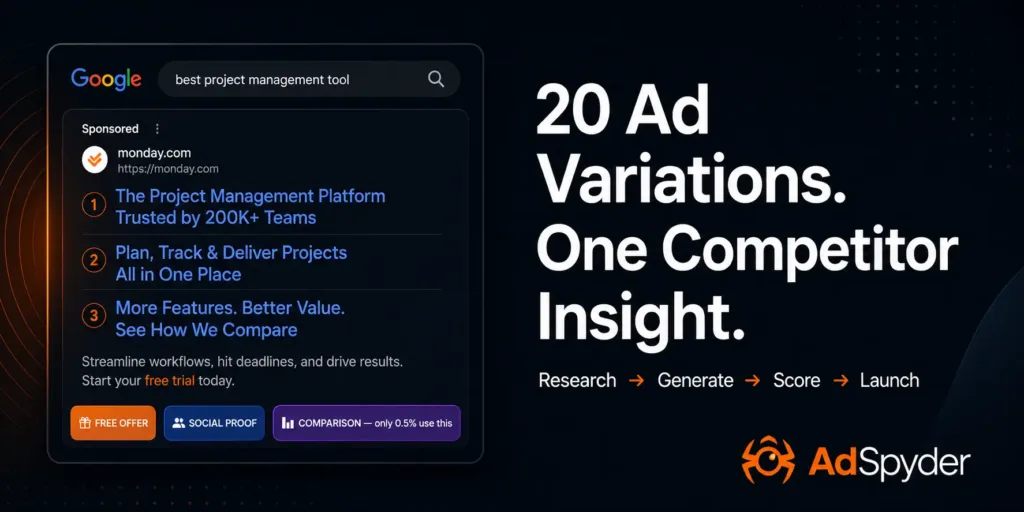
Search a competitor’s keyword in the AdSpyder Ad Library, identify the messaging angle they’re running (price anchor, free offer, urgency, etc.), then feed your brand positioning into the Text Ad Generator to produce 15–20 headline variants in one run. Score them with the Winning Ads AI Agent — which screens 78.6% of all generation runs on the platform — and launch only your top 5. That’s the full intelligence-to-variation pipeline. Source: AdSpyder platform data, May 2026.
Most teams treat AI ad copy as a speed tool. Type a prompt, get headlines, pick the one that sounds best. The problem isn’t the speed — it’s the signal. Generic prompts produce generic angles. You end up testing minor rewrites of the same idea instead of genuinely different strategies.
The stronger workflow starts with one competitor insight: a hook pattern your competitors are running, mapped to an angle, then multiplied into 20 variants that cover the full range of what your market responds to — and the gaps they’re ignoring.
This guide is built on real AdSpyder data — a keyword-based pattern classifier run over 164.7 million Google Search ads and platform telemetry from 2,051 Text Ad Generation runs. Nothing here is invented.
In This Article
Why 20 Variants, Not 3 — What AdSpyder’s Own Data Shows
AdSpyder Text Ad Generation telemetry · 2,051 generation runs · May 2026
Google Responsive Search Ads accept up to 15 headlines and 4 descriptions per ad group. Google’s machine learning rotates combinations and learns which perform. If you write 3 headlines, you hand Google less signal and limit what it can optimise against.
AdSpyder’s own user telemetry confirms this is how high-volume ad teams already operate. In 2,051 Text Ad Generation runs, 52.5% produced exactly 15 headlines — the Google RSA slot count — and the average run produced 10.5 headlines and 4.2 descriptions. The 15-headline batch is the production standard, not the exception.
52.5%
of generation runs produce a 15-headline RSA batch
The dominant production mode on AdSpyder
10.5
average headlines per generation run
+ 4.2 descriptions on average
78.6%
of ad sets scored before launch
1,613 of 2,051 runs used the Winning Ads scoring layer
Source: AdSpyder platform data, May 2026. Text Ad Generation telemetry, 2,051 runs (April 2025 – May 2026).
Here’s what the telemetry also shows: only 14.4% of users who generate a text ad on AdSpyder had run any competitor research beforehand. The majority generate first and research after — or skip research entirely. That’s the gap this workflow closes. Research before you generate, and the angle choices in your variant set become deliberate rather than instinctive.
The contrarian finding in our own data
85.6% of AdSpyder text ad creators skip competitor research before their first generation run. Among the 14.4% who did research first, the typical user had reviewed roughly 675 competitor ads before generating. The blog’s recommendation — research before you generate — is advice most AdSpyder users are not currently following. (AdSpyder platform data, May 2026)
See what your competitors are running right now
360 million+ ads across 10 platforms. Search any keyword, any domain, any angle — before your next campaign.
The 11 Messaging Angles — What 164 Million Competitor Ads Actually Show
AdSpyder keyword-based pattern classifier · 164.7M Google Search ads · May 2026
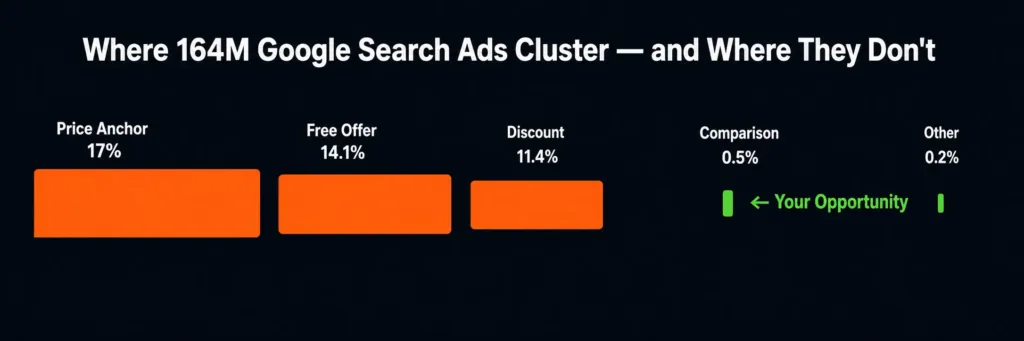
AdSpyder ran a keyword-based pattern classifier across every Google Search ad in its archive — 164.7 million ads as of May 2026. An ad is tagged under an angle if that pattern appears in its title or body copy. Ads can match multiple angles; percentages don’t sum to 100%.
The table below is the foundation for building a 20-variant test set. The angle frequency tells you how crowded each lane is — and which lanes are almost empty.
| Messaging Angle | % of Google Search Ads | Example Pattern | Competition Level |
|---|---|---|---|
| Price anchor | 17.0% | “Plans from $29/mo” | Very High |
| Free offer | 14.1% | “Start free — no credit card” | Very High |
| Discount / sale | 11.4% | “Save 40% this week” | Very High |
| Urgency | 7.2% | “Limited time — today only” | High |
| Authority | 6.9% | “The #1 platform for teams” | High |
| Social proof | 5.7% | “Trusted by 50,000+ teams” | Medium |
| Benefit-led | 3.9% | “Cut reporting time by half” | Lower |
| Curiosity | 3.4% | “The thing most teams miss” | Lower |
| Aspiration | 1.5% | “Become the team others benchmark” | Low |
| Fear | 1.0% | “Don’t lose ground to competitors” | Low |
| Comparison | 0.5% | “Better than [category default]” | Very Low |
Source: AdSpyder Ad Library — keyword-based pattern classifier on 164.7M Google Search ads, May 2026. An ad can match multiple angles; percentages do not sum to 100%.
What the table tells you about building a 20-variant set
The top three angles — price anchor, free offer, discount — together appear in 43% of all Google Search ads. If your 20 variants are mostly these three, you’re testing execution quality in a lane where every competitor is already competing. A strong test set deliberately allocates variants to the bottom half of the table: benefit-led, curiosity, comparison. That’s where there’s room.
One more data point worth knowing before you generate: the most-searched copy phrase in the AdSpyder Ad Library is “free trial” — 991 searches, 4× the next most common query. That’s SaaS teams hunting competitor free-trial copy. It tells you the free-offer angle is the single most-researched pattern in the platform — and the most crowded one in your category.
The 6-Step Workflow: From One Competitor Insight to 20 Test-Ready Variants
A repeatable workflow for performance marketers, PPC managers, and creative teams
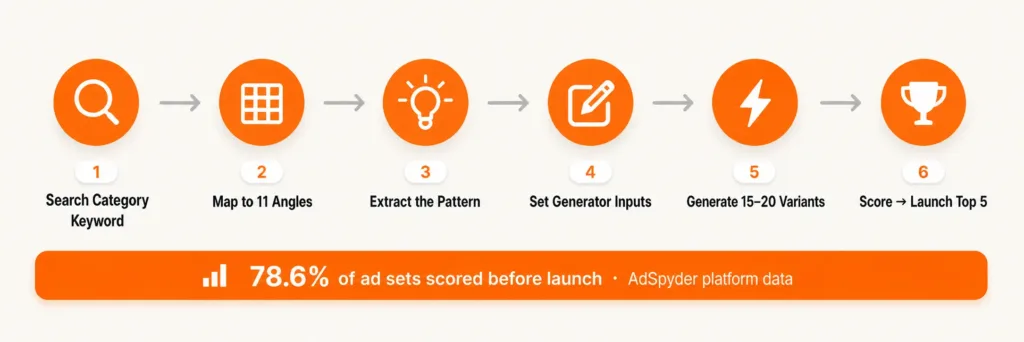
Each step in this workflow feeds the next. The competitor insight you pull in Step 2 directly shapes what you input in Step 4. Skip Step 2 and you’re generating from intuition, not data.
Search your category keyword in the Ad Library
Go to the Google Ads Spy tool and search a category-level keyword — not your brand name, a term buyers in your category use. You’re mapping the competitive landscape, not your own positioning. Look at the top 20–30 ads and note which angle patterns repeat across multiple advertisers.
Map competitor ads to the angle table and find the gap
Tag each competitor ad you’ve found against the 11 angles above. You’ll typically see 60–70% clustering in price anchor, free offer, and discount. Note which angles are absent — that’s where you have differentiation room. Also note which hooks repeat across multiple competitors: that pattern is your starting insight, not any individual ad’s copy.
Extract the pattern, not the sentence
Translate the competitor hook into a neutral buyer insight. If competitors are running “Stop wasting ad budget on copy that doesn’t convert” — the pattern is: performance marketers experience wasted spend when they launch untested copy. That’s your input to the generator. You are not copying the competitor’s text. You are working from the buyer problem their copy reveals.
Open the Text Ad Generator and set your inputs
In the Text Ad Generator, enter your brand domain, brand name, brand description, ad goal, target personas, seed keywords, and location. The brand description is where your competitor insight goes: if competitors cluster on price, your description should articulate your non-price differentiator. The inputs here directly shape the angle distribution in your output.
Run the 15-headline batch — and a second pass for angles the first missed
The full-batch output (15 headlines + 4 descriptions) matches Google RSA’s exact slot count and is the mode 52.5% of AdSpyder users choose. For 20 variants, run the generator twice with slightly different brand description focus — once leading with your dominant differentiator, once leading with a gap angle you identified in Step 2. Combine both outputs and discard near-duplicates. You now have 20+ unique variants covering multiple angles.
Score, shortlist, launch — and archive the rest
Run the Winning Ads AI Agent to score persona-fit across your variants and surface a shortlist. From the shortlist, select 5 headlines for the live RSA — ensuring they cover at least 3 different angles. Archive the remaining scored variants. When your ad group needs refreshing in 4–6 weeks, you have a pre-scored batch ready. You are running a cycle, not a one-time sprint.
Sample: 20 Ad Copy Variations From One Competitor Insight
Product: SaaS ad intelligence platform · Competitor insight: Performance marketers waste ad budget when they generate copy without researching what angles competitors are running
The structure of 20 variants should mirror the angle-frequency distribution — with deliberate over-indexing on the underused angles. Variants 1–4 cover the dominant free-offer lane as the control group. Variants 17–20 are in territory that appears in less than 1% of competitor ads. That’s your differentiation test.
Note on these examples
The copy below is illustrative — written to demonstrate angle diversity and structure, not as ready-to-deploy headlines. Replace brand and outcome references with your actual product details before use. The angle labels and the distribution logic are the transferable framework.
| # | Headline Variant | Description | Angle | Angle Freq. |
|---|---|---|---|---|
| 1 | Try AdSpyder Free for 14 Days | No credit card required. Start your competitor research today. | Free offer | 14.1% |
| 2 | Start Free. Upgrade When Ready. | Access 360M+ competitor ads free. No commitment needed. | Free offer | 14.1% |
| 3 | Free Competitor Ad Research Tool | Search any competitor’s ads across 10 platforms. Free to start. | Free offer | 14.1% |
| 4 | Free Trial — No Card Needed | Start your ad intelligence workflow today. Cancel anytime. | Free offer | 14.1% |
| 5 | 23,000+ Advertisers Use AdSpyder | Join teams already tracking competitor ads across 10 platforms. | Social proof | 5.7% |
| 6 | Trusted by PPC Teams in 100+ Countries | 360M+ ads indexed. Your competitors are already being watched. | Social proof | 5.7% |
| 7 | 8,600+ Active Competitor Trackers | Real teams using AdSpyder to track rivals and improve ad copy. | Social proof | 5.7% |
| 8 | Stop Testing Copy Without Competitor Data | Find the angles competitors repeat — before your next campaign launches. | Benefit-led | 3.9% |
| 9 | Turn Competitor Ads Into Your Test Strategy | Extract hook patterns. Generate 20 variants. Launch the top 5. | Benefit-led | 3.9% |
| 10 | One Insight. 20 Testable Headlines. | AdSpyder’s Text Ad Generator builds a full RSA-ready variant set. | Benefit-led | 3.9% |
| 11 | Why Your Ads Sound Like Everyone Else’s | When 17% of search ads use the same price anchor, yours gets lost. Here’s the fix. | Curiosity | 3.4% |
| 12 | The Ad Angle Most Competitors Skip | Only 0.5% of Google ads use comparison framing. That’s your gap. | Curiosity | 3.4% |
| 13 | What 164 Million Ads Reveal About Copy | The patterns are in the data. See which angles dominate and which are wide open. | Curiosity | 3.4% |
| 14 | Your Campaign Launches in 3 Days. Ready? | Build your test-ready copy set before the deadline hits. | Urgency | 7.2% |
| 15 | Competitors Are Live. Are You Watching? | Track their ads in real time. Update your copy before they outrank you. | Urgency | 7.2% |
| 16 | AdSpyder vs Manual Research: No Contest | 0.5% of ads use comparison framing → | Comparison | 0.5% ← Rare |
| 17 | Switch From Spreadsheet Tracking Today | 360M+ ads. One search. No spreadsheet needed. | Comparison | 0.5% ← Rare |
| 18 | Don’t Let Competitors Define Your Copy | Every unresearched ad launch is a test with borrowed angles. Take yours back. | Fear | 1.0% ← Rare |
| 19 | The Team That Wins the Next Auction | Build the ad intelligence workflow your competitors don’t have yet. | Aspiration | 1.5% ← Rare |
| 20 | The Smartest Ad Copy in Your Category | Research-led. AI-generated. Scored before launch. That’s the gap. | Aspiration | 1.5% ← Rare |
Angle frequency data: AdSpyder Ad Library keyword-based pattern classifier, 164.7M Google Search ads, May 2026. Illustrative copy — replace brand references before use.
The angle to over-invest in for 2026
Comparison framing appears in only 0.5% of Google Search ads — the rarest major angle in AdSpyder’s 164.7M-ad classifier run. If your category has a clear legacy alternative (spreadsheets, manual research, expensive agencies), three comparison variants in a 20-variant set is very low-cost exposure to the least-contested ground in your auction. Most competitors won’t have it covered.
Scoring and Shortlisting: How the Winning Ads AI Agent Works
AdSpyder Winning Ads scoring telemetry · 1,613 ad sets scored · May 2026
After generating 20 variants, the next problem is deciding which 5 go live. Manual review of 20 headlines is fast — but it’s also where bias enters. You’ll unconsciously favour the variants that sound like your existing copy, or the ones the team argued for in the brief.
The Winning Ads AI Agent is the scoring step built inside the Text Ad Generator. It works by pairing your generated variants against your defined target personas, scoring persona fit, and surfacing a shortlist. The output isn’t a 1–10 number — it’s a persona-matched set of the strongest candidates, which your team then reviews and selects from.
How the scoring layer works
Personas defined
Age, role, pain points set during generation setup
Variants scored
Persona-fit analysis across all generated headlines
Shortlist returned
Strongest persona-matched candidates surfaced for review
The 78.6% scoring adoption rate in AdSpyder’s telemetry isn’t accidental. It reflects how users have discovered the workflow: generate a batch, run the scoring layer, and the selection decision becomes structured rather than subjective. For teams where the person writing the ads isn’t the same as the person approving them, the scoring output also gives a defensible reason for the choices made.
What the Winning Ads Agent doesn’t do
It doesn’t predict click-through rate, conversion rate, or ROAS. AdSpyder doesn’t track what happens to your ad after it leaves the platform — once you’ve launched, that data lives in your ad account. Scoring tells you which variants fit your persona best against the inputs you set. Live testing tells you which actually perform. Use the scoring to build your launch set, not to replace the test.
| Shortlisting Check | What to Look For |
|---|---|
| Angle diversity | Are the top 5 genuinely different from each other — not 5 rewrites of the same idea? |
| Persona fit | Does each shortlisted headline speak directly to the pain or goal of the target persona you defined? |
| Original wording | Is each headline inspired by the competitor pattern — not reproducing it? |
| Platform fit | Does it fit Google RSA format (30-char headline cap)? Is the intent match strong for the keyword? |
| Gap angle coverage | Does at least one of the top 5 come from a low-frequency angle (comparison, fear, aspiration) to test differentiation? |
AI-Only Generation vs. the Competitor-Intelligence Workflow
What each approach gives you — and where each falls short
| Approach | What Happens | Main Risk | Best For |
|---|---|---|---|
| AI-only (blank prompt) | AI generates from general training data | Polished copy, generic angles — no market signal | Quick brainstorming |
| Manual competitor research | You study ads manually and write copy | Slow, doesn’t scale to 20+ variants | Strategy planning |
| Competitor insight + AI generation | You extract a pattern, AI multiplies it into variants | Needs human review before launch | Structured copy testing |
| AdSpyder full workflow | Research → generate → score → launch top 5 | Still needs marketer judgment at launch | MOFU/BOFU campaign testing at scale |
4 AI Ad Copy Testing Mistakes to Avoid
❌ Generating 20 variants of the same angle
If your 20 variants are all free-trial or price-anchor framing, you’re testing execution quality, not strategy. Google’s RSA rotation will pick between minor rewrites of the same idea. A strong 20-variant set deliberately spreads across the angle table — including 2–3 variants in the bottom-frequency territory where your competitors aren’t competing.
❌ Skipping competitor research before generating
AdSpyder’s own data shows 85.6% of text ad creators skip competitor research before their first generation run. The dominant pattern is generate first, research after. That’s a workable iteration pattern — but it means your angle choices start from intuition, not from knowing that 17% of your category already uses price-anchor and 0.5% uses comparison framing. Knowing that changes what you test.
❌ Treating scoring as a replacement for live testing
The Winning Ads AI Agent shortlists your strongest candidates based on persona fit. That’s the best available signal before launch — but it’s not a CTR predictor. Your final winner is determined by live campaign data. Use scoring to build your launch set. Use your ad platform to validate it.
❌ Not archiving the variants you don’t launch
You generated 20, scored them, launched 5. The remaining 15 aren’t wasted — they’re your next rotation. Creative fatigue on RSAs typically appears after 4–6 weeks. If you archived the scored-but-not-launched variants from your initial run, you have a pre-screened batch ready without starting from scratch. Most teams don’t archive — and go back to zero when the ad group needs refreshing.
Final Checklist: AI Ad Copy Testing From One Competitor Insight
Run the full intelligence-to-variation pipeline
Find competitor hooks in 360M+ ads. Generate a scored, RSA-ready variant set. Launch only the top 5. All in one platform.
23,000+ registered users · 360M+ ads indexed · 10 platforms · AdSpyder platform data, May 2026