Quick Answer
- Choose an agency when you need strategy, specialist execution and external accountability.
- Choose a platform when your team understands paid media and wants faster research, production and analysis.
- Choose a hybrid model when strategy needs expert support but routine execution can remain in-house.
- Do not compare an agency retainer with a software subscription without including media spend, internal labour, creative production and management time.
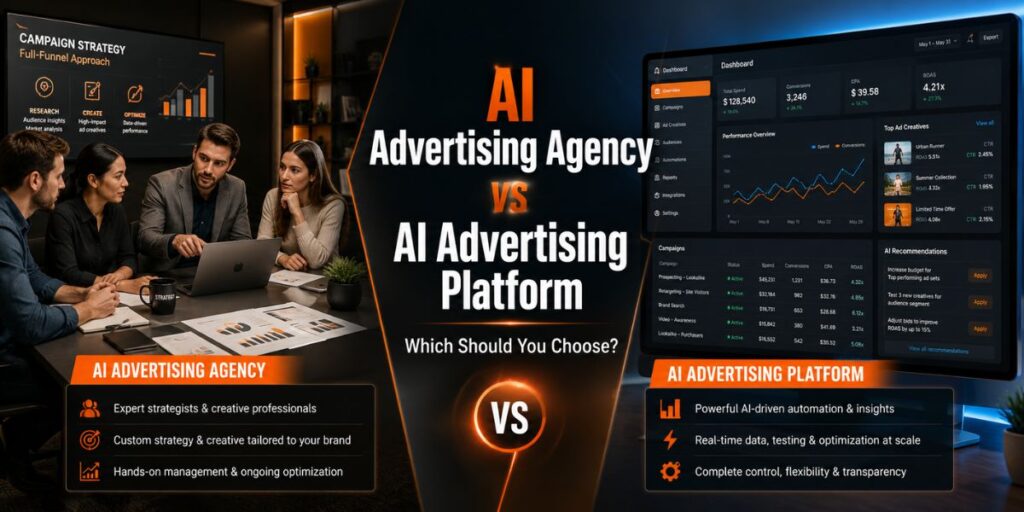
An AI advertising agency and an AI advertising platform may use similar technology, but they sell different outcomes. An agency primarily sells expertise and execution. A platform sells software that helps your team perform advertising work.
The right choice depends on whether your main constraint is strategy, specialist knowledge, internal capacity, speed, control or cost.
Key Statistics Before You Decide
Typical reviewed advertising-project range on Clutch
Common advertising-agency hourly rate on Clutch
Average monthly cost across reviewed advertising projects
These Clutch figures cover advertising agencies generally, not only AI advertising agencies. They provide a useful market reference, but your quote will depend on scope, location, channels, creative requirements and senior-team involvement.
Before evaluating either option, review the broader AI advertising workflow so you can separate research, creation, activation and optimisation instead of expecting one vendor to perform every task equally well.
AI Advertising Agency vs Platform Comparison
| Factor | AI Advertising Agency | AI Advertising Platform |
|---|---|---|
| Primary Value | Expertise and execution | Software and workflow speed |
| Strategy | Usually included | Internal responsibility |
| Launch Speed | Requires onboarding and briefing | Fast when the team is experienced |
| Control | Shared through approvals | Direct internal control |
| Data Ownership | Depends on contract and account setup | Usually customer-controlled |
| Internal Workload | Lower execution burden | Requires an internal operator |
| Best Fit | Teams lacking expertise or capacity | Teams with paid-media capability |
What Is an AI Advertising Agency?
An AI advertising agency uses AI-supported research, production, media buying and reporting while providing human strategy, creative direction and campaign accountability.
Typical services include:
- Market, audience and competitor research
- Channel and campaign planning
- Copy, image and video production
- Media buying and budget management
- Tracking, reporting and optimisation
- Client communication and approvals
An agency may use the processes described in an AI performance marketing framework, but the customer is paying primarily for people who interpret the evidence and take responsibility for execution.
What Is an AI Advertising Platform?
An AI advertising platform is software that supports one or more paid-media tasks, such as competitor research, creative generation, campaign activation, budget analysis or performance diagnosis.
A platform may help you:
- Find competitor campaigns and landing pages
- Generate editable copy, images or videos
- Analyse keywords and campaign data
- Apply predefined optimisation rules
- Centralise repeated research and reporting
The current comparison of AI advertising platforms shows why research specialists, native ad managers, creative tools and enterprise orchestration systems should be evaluated as separate categories.
The SCOPE Decision Framework
The AI ad optimisation workflow study found that 85.6% of text-ad-generation users skipped competitor research before producing their first draft. This shows that software access alone does not create a disciplined process.
Cost: Compare Total Ownership, Not Subscription Price
Total Advertising Cost = Media Spend + Agency Fees or Software + Creative Production + Internal Labour + Tracking + ReviewAgency Cost Components
- Monthly retainer, project fee or hourly billing
- Percentage of media spend or performance fee
- Creative and production charges
- Setup, tracking or onboarding fees
- Media spend paid separately
Platform Cost Components
- Subscription, seats and usage credits
- Internal operator salaries
- Training and implementation time
- Additional creative or analytics tools
- Media spend paid separately
When calculating platform value, use a research-first process such as turning competitor ads into structured prompt context. Faster generation has limited value when the inputs are generic.
Strengths and Limitations
Agency
Strengths
- Specialist strategy and execution
- Cross-channel coordination
- External accountability
- Lower internal workload
Limitations
- Higher recurring cost
- Longer approval cycles
- Possible knowledge dependency
- Transparency varies by partner
Platform
Strengths
- Faster research and iteration
- Lower initial cost
- Direct data ownership
- Repeatable internal workflows
Limitations
- Requires an experienced operator
- Does not define business strategy
- Can multiply weak creative
- Internal team retains accountability
Best Choice by Business Type
| Business Situation | Recommended Model |
|---|---|
| Founder with no advertising team | Agency |
| One capable in-house marketer | Platform plus specialist support |
| Experienced performance team | Platform |
| Complex enterprise governance | Hybrid |
| New market or unfamiliar channel | Agency-led pilot |
| High campaign volume with proven tracking | Platform or hybrid |
Account for emerging formats described in the latest AI advertising trends. An agency may help interpret unfamiliar channels, while an internal platform workflow can handle repeatable research once the approach is proven.
When the Hybrid Model Works Better?
- The agency defines positioning, channel strategy and initial campaign architecture.
- Your business owns the advertising accounts and conversion data.
- A platform supports routine research, production and reporting.
- The agency reviews major creative, budget and targeting changes.
- Your internal team preserves the learning generated by each test.
A hybrid workflow becomes stronger when competitor evidence directly informs production. The guide to combining AI generation with competitor data explains how to move from observable market patterns to original, controlled creative variants.
How AdSpyder Supports the Workflow?
- Find visible competitor campaigns across relevant platforms.
- Group ads by audience, problem, offer, proof and CTA.
- Inspect competitor domains and destination pages.
- Identify repeated market patterns and underused angles.
- Generate original text, image or video variations.
- Shortlist variants before sending them to native ad platforms.
- Share the same research evidence with an agency or internal team.
AdSpyder’s platform data shows that 62% of image-generation users researched competitor ads before their first generation run, compared with only 14.4% of text-generation users. Research discipline matters regardless of whether an agency or internal team operates the software.
Before approving a campaign, use the process for reviewing competitor landing pages to check whether the ad promise, page headline, proof, form and CTA remain consistent.
Questions to Ask Before Buying
Ask an Agency
- Who will manage the account each week?
- Are media costs separate?
- Who owns the ad accounts and creative files?
- How are AI-generated claims reviewed?
- Which metrics define success?
- What happens when the contract ends?
Ask a Platform Vendor
- Which advertising tasks are genuinely supported?
- Which features require credits or higher plans?
- Can outputs be edited and approved?
- Can automation be limited or reversed?
- Who owns uploaded and generated data?
- What internal expertise is required?
Common Decision Mistakes
- Comparing an agency retainer with only the software subscription
- Assuming AI software automatically provides strategy
- Hiring an agency without retaining account ownership
- Buying a platform without assigning an internal operator
- Automating before fixing conversion tracking
- Generating more creative without a test hypothesis
- Choosing solely by speed or feature count
- Ignoring switching and knowledge-transfer costs
Final Decision Checklist
- The main constraint—strategy, expertise, capacity or speed—is documented.
- The total cost includes media, labour, creative and technology.
- Ad-account and data ownership are clear.
- Human approval remains in place for claims and budgets.
- The success metric reflects customers, revenue or qualified leads.
- A limited pilot is available before a long commitment.
FAQs for AI Advertising Agency vs Platform
Is an AI Advertising Agency Better Than a Platform?
An agency is better when you lack strategy or execution capacity. A platform is better when an experienced team needs greater speed and control.
How Much Does an Advertising Agency Cost?
Clutch reports that most reviewed advertising projects cost $10,000–$49,999, with common hourly rates of $100–$149. These are general advertising-agency figures, and media spend is separate.
Can a Platform Replace an Agency?
It can replace repetitive tasks, but it does not automatically replace strategy, creative judgement, commercial decisions or accountability.
When Should You Choose a Hybrid Model?
Choose hybrid when an agency is valuable for strategy and review, but your internal team can own routine research, production and reporting.
Does AdSpyder Replace an Advertising Agency?
No. AdSpyder supports competitor research, ad generation, landing-page analysis and campaign intelligence. Strategy and final decisions remain with your agency or internal team.
Research Sources
- Clutch Advertising Agency Pricing Guide
- Clutch PPC Pricing Guide
- AdSpyder Platform Workflow Data
- AdSpyder Pricing
Give Your Agency and Internal Team the Same Evidence
Research competitor ads, messages and landing pages before deciding which creative and campaign direction deserves investment.