Prospecting · Qualification · Follow-Up · Pipeline
Quick Answer
- An AI sales agent can research prospects, qualify leads, personalize outreach and trigger follow-ups.
- The best tool depends on whether you need prospecting, inbound qualification or complete SDR automation.
- CRM context, data quality and human approval matter more than the number of AI features.
- Judge agents by qualified meetings and pipeline—not emails sent or contacts processed.
- Before automating outreach, use AdSpyder’s competitor lead-generation workflow to understand which audiences and offers deserve attention.
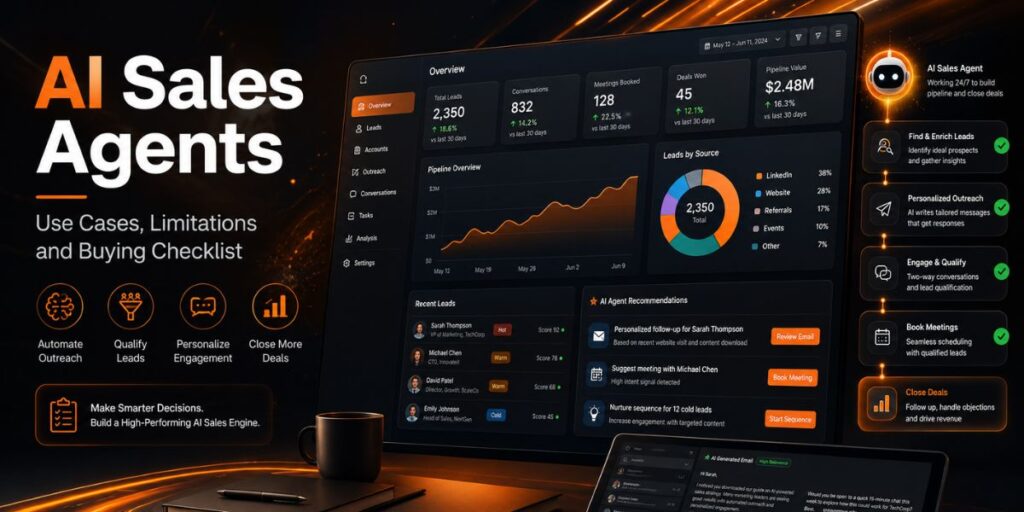
An AI sales agent is most valuable when it removes repetitive work without removing judgment. It can research accounts, identify prospects, draft personalized messages, qualify inbound interest and keep follow-ups moving. But an agent cannot rescue a weak ICP, poor acquisition signal or irrelevant offer. Start with the sales job you actually need automated, then choose the platform.
What Should an AI Sales Agent Actually Do?
01 · FIND
Prospecting
Research accounts, identify contacts, enrich records and detect useful buying signals.
02 · PRIORITIZE
Qualification
Compare fit, engagement and intent before sending every contact to sales.
03 · ENGAGE
Outreach
Draft or send emails, schedule touches and adapt messaging using approved context.
04 · HAND OFF
Follow-Up
Answer routine questions, book meetings and transfer qualified opportunities to a human rep.
AI should automate the repeatable parts of this journey. Strategy still starts with understanding what your market responds to. AdSpyder’s AI advertising platform comparison explains why research, creation, activation and optimization should be evaluated as separate jobs rather than one large “AI” category.
How We Evaluated AI Sales Agents
✓ Prospect and account research quality
✓ CRM and first-party data integration
✓ Email, phone and multichannel execution
✓ Human review and automation controls
✓ Lead qualification and routing
✓ Pricing and usage predictability
✓ Reporting from activity to pipeline
✓ Fit for the team’s existing sales stack
AI Sales Agent Comparison
| Platform | Best For | Core Strength | Main Limitation | Current Pricing Signal |
|---|---|---|---|---|
| HubSpot Breeze Prospecting Agent | HubSpot sales teams | CRM context, buying signals, research and outreach | Best value comes when HubSpot is already central to the stack | $1 per lead recommended for outreach |
| Salesforce Agentforce SDR | Enterprise CRM workflows | Lead nurturing, objections, answers and meeting booking | Implementation and Salesforce dependencies can be substantial | Usage-based; Flex Credits start at $500 per 100K credits |
| Clay + Claygent | Flexible GTM research workflows | Enrichment, signals, AI research and sequencing | Requires more workflow design than a packaged digital SDR | Free plan; Launch currently listed from $167/month |
| 11x Alice | Autonomous outbound teams | Prospecting, enrichment, outreach, deliverability and meeting booking | Higher minimum commitment than lightweight tools | Starts at $3,750/month billed annually |
| Regie.ai Force Multiplier | SDR teams mixing agents and reps | Research agents, enrichment, dialer, email and intent signals | Requires a multi-seat annual commitment | $499/user/month; 5-seat minimum |
Buying rule: Do not compare these platforms only by monthly price. Compare the cost of usable research, verified contacts, outreach infrastructure, CRM integration, implementation and the number of qualified opportunities created.
Which AI Sales Agent Fits Which Team?
1. HubSpot Breeze — Best for HubSpot-Native Prospecting
Breeze Prospecting Agent can monitor buying signals, source contacts and draft personalized outreach using HubSpot CRM and engagement context. Teams can review messages before sending or move toward autonomous outreach once guardrails are trusted. It is a practical choice when marketing, sales activity and CRM data already live in HubSpot.
2. Salesforce Agentforce SDR — Best for Enterprise CRM Automation
Agentforce SDR is designed to nurture leads, answer product questions, handle common objections and schedule meetings using Salesforce data and business knowledge. Its strength is deep enterprise context. Buyers should model implementation, connected Salesforce products and usage costs before assuming the headline credit price represents total deployment cost.
3. Clay — Best for Custom Prospect Research
Clay is useful when your competitive advantage comes from defining exactly how accounts are sourced, enriched and researched. Claygent can research custom information from the web, while signals, enrichment waterfalls and Sequencer support outbound execution. It is closer to a configurable GTM operating system than a completely packaged AI SDR.
Whatever tool handles generation, avoid feeding it generic context. AdSpyder’s competitor-data prompt framework demonstrates how market evidence can improve AI-generated messaging without copying competitor ads.
4. 11x Alice — Best for High-Autonomy Outbound
Alice combines prospecting, personalization, multichannel sequencing, lead nurturing, mailbox infrastructure, CRM sync and meeting scheduling. It fits organisations prepared to give a digital SDR meaningful outbound responsibility. The annual commitment makes a controlled proof of value important before rollout.
5. Regie.ai — Best for Hybrid SDR Teams
Regie.ai combines AI-orchestrated prospecting with human rep execution. Force Multiplier includes research agents, enrichment, signals, mailbox infrastructure and parallel dialing. It is particularly relevant when the goal is increasing each SDR’s coverage rather than replacing the SDR workflow entirely.
Where AI Sales Agents Still Need Human Control
An agent can score against your criteria. It should not invent which customer segments are commercially attractive.
Product capabilities, prices, customer claims and guarantees require approved source material.
Negotiation, strategic objections, complex procurement and important relationships still benefit from a human seller.
Your team remains responsible for consent, outreach rules, suppression lists, privacy and market-specific requirements.
Automation also needs a measurement boundary. AdSpyder’s AI performance marketing framework recommends defining business outcomes, minimum data requirements, approval rules and rollback conditions before allowing automated decisions to scale.
Best Choice by Use Case and Budget
| Need | Best Starting Point | Why |
|---|---|---|
| Low-risk experimentation | Clay | Free entry point and configurable research workflows. |
| Existing HubSpot team | Breeze | Uses CRM and engagement history already in the platform. |
| Salesforce enterprise | Agentforce SDR | Deep connection with Salesforce data and sales workflows. |
| Autonomous outbound | 11x Alice | More of the outbound SDR infrastructure is bundled together. |
| Agent + SDR collaboration | Regie.ai | Combines automated research and outreach with human calling and coaching. |
Whichever product you select, compare downstream outcomes using qualified-lead and pipeline stages. AdSpyder’s lead generation KPI guide separates CPL from CPQL, SQLs, opportunities, CAC and revenue.
Where AdSpyder Fits in the AI Sales Stack
AdSpyder is not a replacement for HubSpot, Salesforce or an outbound SDR agent. Its role comes earlier: improving the acquisition and competitive signals that sales automation receives.
Use the AI Agent for Competitor Analysis to examine observable competitor keywords, ads, creative patterns and campaign activity. Those findings can help define which industries, pain points and offers your team should investigate.
Then use AdSpyder Ad Analytics to compare visible competitor campaign presence and funnel positioning before feeding the resulting hypothesis into your prospecting workflow.
If AI is also creating outbound or advertising messages, the competitor-data plus AI generation workflow shows how to move from market evidence to original messaging rather than starting from a blank prompt.
Give your sales agent better market context
Research competitor ads, keywords and positioning before deciding which prospects, offers and messages deserve automated outreach.
AI Sales Agent Buying Checklist
☐ The exact sales job is documented.
☐ ICP and disqualification rules are clear.
☐ Prospect data sources are understood.
☐ CRM sync is bidirectional where needed.
☐ Human review can be enabled.
☐ Outreach limits and suppression rules exist.
☐ Usage credits and add-on costs are modelled.
☐ Deliverability responsibilities are clear.
☐ Qualified meetings are measured.
☐ CRM pipeline determines ROI.
Frequently Asked Questions
It is software that uses AI to perform sales tasks such as account research, prospect identification, qualification, outreach, follow-up or meeting scheduling.
It can automate significant SDR work, but complex qualification, strategic conversations, negotiation and relationship management still benefit from human sellers.
There is no universal winner. HubSpot fits HubSpot-native teams, Salesforce fits enterprise CRM workflows, Clay fits custom GTM research, while 11x and Regie.ai target more automated outbound motions.
Track valid leads, qualified meetings, opportunity rate, pipeline, customer acquisition cost and revenue rather than activity volume alone.
Start with review enabled. Move toward greater autonomy only after message accuracy, targeting, compliance and escalation rules perform consistently.
AdSpyder adds competitor-ad, keyword and campaign intelligence that can improve the market hypotheses supplied to acquisition and sales workflows.