Quick Answer
- Research competitors before creative production, not after campaigns start losing money.
- Check Meta/TikTok creative, Google Search and Shopping ads, offers, prices and CTAs.
- Follow the click to understand each competitor’s landing page and funnel.
- Look for repeated patterns and missing angles—do not copy individual ads.
- Turn the findings into a pre-launch test plan for creative, offer, channel and landing page.
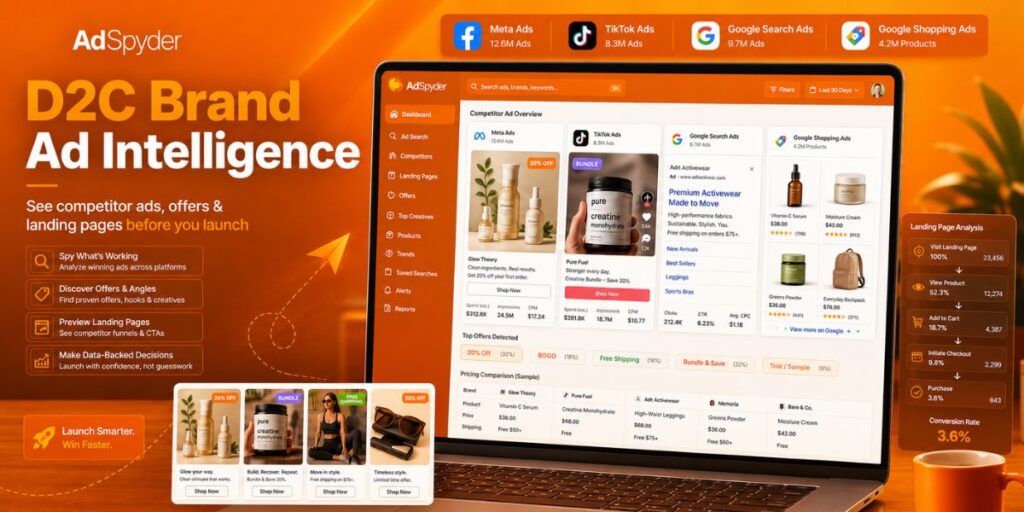
A D2C campaign should not begin with “What ad should we make?” Start with: “What has our customer already been seeing?” Competitor ad intelligence can reveal how brands in your category sell the product, frame discounts, structure bundles, use proof and continue the promise after the click. AdSpyder’s D2C Brand toolkit brings those signals together across paid channels.
Your Pre-Launch Research Plan
Why D2C Brands Can’t Afford to Guess on Creative
D2C ads have to communicate quickly. A shopper scrolling Meta or TikTok does not know your internal strategy, product roadmap or brand story. They see a visual, a promise, a price and an action.
Launching without category research creates four avoidable risks:
- Creative sameness: your new ad looks identical to every competitor.
- Weak offer: shoppers see a better bundle or discount one swipe later.
- Wrong platform assumption: you concentrate spend where competitors barely show up.
- Poor message match: the ad promises one thing and the landing page immediately changes the conversation.
AdSpyder’s recent D2C cross-platform advertising study found that mature brands rarely depend on one channel alone. In its 30-brand sample, half appeared across six or more major ad platforms.
What Current D2C Ad Data Shows
50%
of the sampled D2C brands appeared on 6+ major ad platforms.
27%
of sampled D2C brands appeared across five platforms.
1.4M+
Meta ads surfaced in D2C-relevant page categories.
95M
Google Shopping ad records in AdSpyder’s confirmed July archive.
Sources: AdSpyder platform data, July 2026. Ad counts and platform presence show observed advertising activity—not spend, CTR, CPA, ROAS or profitability.
What to Check Before Launching a New D2C Ad
| Research Layer | What to Capture | Decision It Helps |
|---|---|---|
| Creative | Hook, format, visual, creator/product focus | What should we test? |
| Offer | Discount, bundle, gift, trial, shipping | Is our proposition competitive? |
| Price | Displayed product price and pack size | Where do we sit in the category? |
| Proof | Reviews, claims, creator, demo, authority | Why should shoppers believe us? |
| CTA | Shop, Buy, Learn, Get Offer, Explore | What action is expected? |
| Landing page | Hero, offer, proof, upsell, checkout path | How does the campaign convert? |
Competitor Creative Research: Find Patterns, Not Ads to Copy
Start with brands selling to the same customer, not only the biggest company in your industry. A ₹799 skincare brand and a ₹7,999 premium skincare brand may technically compete, but their creative economics and offer structures are different.
Inside the AdSpyder Ad Library, look for repeated patterns across Meta, TikTok, Google, Shopping, Amazon, YouTube and other relevant channels:
- Product-only image vs lifestyle creative
- UGC/creator-led vs polished brand production
- Problem-first vs benefit-first hooks
- Discount-led vs proof-led copy
- Static vs video vs carousel
- New-customer offer vs repeat-purchase positioning
Don’t mistake longevity for profit
An ad observed for a long time is worth studying, but public ad intelligence cannot prove its ROAS, margin or conversion rate. Treat longevity and repetition as research signals, not financial proof.
The recent competitor Facebook ad strategy guide uses the same principle: identify repeated strategic logic, then build an original test rather than reusing someone else’s copy or visuals.
Competitor Offer and Pricing Research
Creative attracts attention. The offer determines what the shopper is actually being asked to buy.
Build a small offer matrix for 5–10 competitors:
Brand → Product → Displayed Price → Discount → Bundle → Free Shipping Threshold → Gift → Subscription → CTA → Landing Page
For product-led categories, Google Shopping research is especially useful because shoppers often see product image, title and price before visiting the site. AdSpyder’s Shopping Ads research workflow explains how to compare product titles, prices, images, destinations and last-seen signals.
The goal is not automatically to offer the biggest discount. If every competitor screams 30% off, a stronger differentiator may be a better bundle, clearer proof, free shipping, subscription value or a simpler buying experience.
Competitor Landing Page and Funnel Research
Never stop at the ad. The ad is the promise; the landing page shows how the competitor tries to convert that promise into revenue.
For each important competitor, record:
- Message match: does the page continue the ad’s main promise?
- Hero structure: product, benefit, price and CTA above the fold.
- Proof: reviews, before/after, press, creators, demonstrations.
- Objection handling: shipping, returns, ingredients, sizing, guarantee.
- AOV mechanics: bundle, cross-sell, subscription or quantity breaks.
- Next step: PDP, quiz, category page, offer page or direct checkout.
AdSpyder’s current Landing Page Analysis workflow helps connect observed ads with their post-click destinations. Its recent landing-page dataset also found product-led CTA language substantially outnumbered demo-led language in the analyzed advertising data—a useful reminder that D2C funnels usually need to move users toward shopping rather than a B2B-style lead step.
A 30-Minute D2C Competitor Intelligence Workflow
Choose brands with comparable product, price level, customer and geography.
Use domain-level research to check Google Search, Shopping, Meta, Amazon, TikTok, YouTube and other relevant channels.
Capture repeated hooks, offers, formats, price anchors, proof and CTA language.
Look for message match, offer continuation, reviews, bundles, shipping and conversion path.
Turn the research into original ideas your team can actually test.
Example: Turn Research Into a Test
Observed pattern: Four skincare competitors lead with discounts and ingredient-focused static ads.
Gap: Few demonstrate the product being used or show the routine clearly.
Original hypothesis: Test a 15-second creator demo showing the complete routine, lead with the user outcome, and keep the existing competitive bundle price.
If you need a wider platform map first, the recent cross-platform advertiser analysis shows why ecommerce brands commonly appear across Google Search, Shopping, Meta and Amazon rather than relying on a single paid channel.
D2C Pre-Launch Ad Intelligence Checklist
Do the competitor research before your launch budget starts burning.
Search competitor domains, compare their ads across channels, review offers and landing pages, then turn the patterns into original D2C campaign tests.
FAQs for D2C Ad Intelligence
What is D2C ad intelligence?
D2C ad intelligence is the process of analyzing observed competitor advertising across channels to understand creative patterns, offers, pricing, CTAs, platform presence and post-click landing pages before making campaign decisions.
Which competitor ads should a D2C brand research?
Prioritize competitors selling a similar product to a similar audience at a comparable price point. Include direct competitors plus a few category leaders to understand both immediate competition and broader creative trends.
Can competitor ad tools show which ads have the highest ROAS?
Not reliably. Public ad intelligence can show observed ads, dates, domains, creatives and other available signals, but private ROAS, CAC, margin and conversion data remain unknown unless the advertiser publishes them.
Should D2C brands only research Meta ads?
No. Meta is important for many consumer brands, but current D2C advertising often spans Google Search, Google Shopping, Meta, Amazon, YouTube and other platforms. Research the channels that match your category and customer journey.
How should I use competitor pricing research?
Use it to understand the category’s price anchors, bundles, discount frequency and shipping offers. Do not automatically undercut competitors; use the data to decide whether price, value, proof or convenience should differentiate your offer.
Why analyze the landing page as well as the ad?
The ad only shows the acquisition message. The landing page reveals how the competitor supports that promise with price, proof, objections, bundles, shipping information and a conversion path.
How does AdSpyder help D2C brands?
AdSpyder provides multi-platform competitor ad research, domain and keyword analysis, landing-page intelligence and AI ad creation tools. D2C teams can use those capabilities to research the category before creating and testing their own campaigns.