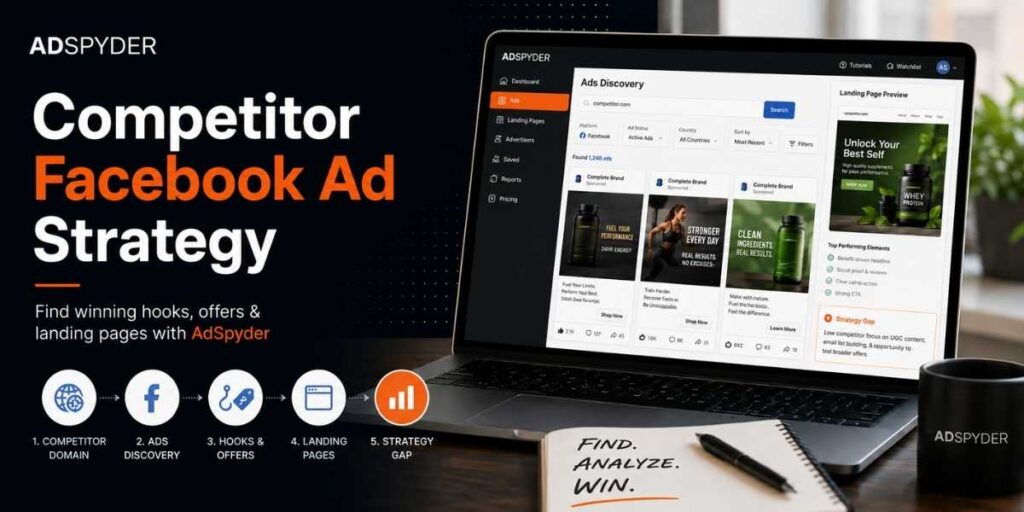
Quick answer: To find competitor Facebook ad strategy using AdSpyder, search the competitor’s domain in Facebook Ads Spy, shortlist ads observed for 60+ days, record recurring hooks and offers, inspect their landing pages, and turn the uncovered gap into an original test. Use longevity as a clue—not proof that an ad is profitable.
Most competitor research fails because it ends with a folder of attractive ads. You save screenshots, admire the creative, and still do not know what to test.
This workflow shows you how to move from a competitor domain to a usable Facebook ad hypothesis: which promise they repeat, which offer supports it, where the click goes, and what they have left open for you.
“Steal” the strategic logic—not their words, visuals, testimonials, or brand assets.
Table of contents
What Facebook competitor data should you trust?
AdSpyder’s archive is large enough to reveal repeated category patterns, but no external tool can see a competitor’s private ROAS, conversion rate, audience settings, or exact budget. Your goal is to build stronger hypotheses from observable evidence.
Meta ads indexed across historical and real-time archives.
Ads carrying the Facebook platform tag.
Facebook searches from 88,035 Ad Library searches.
Of sampled real-time carousels were observed for 30+ days, versus 26% of video and 23% of single-image ads.
Source: AdSpyder platform data, June 2026. Facebook and Instagram tags overlap because one Meta ad can run across several placements.
The useful signal is repetition. One long-running ad may be an exception. Several persistent ads repeating the same promise, proof type, offer, and destination reveal a strategy worth testing.
Start with the competitor domain, not a random swipe file
Use AdSpyder to connect the ads, repeated messages, destination pages, and wider domain activity in one research flow.
How to find a competitor’s Facebook ad strategy using AdSpyder
Search the competitor’s domain
Open Facebook Ads Spy and search by domain. A domain-led search is cleaner than starting with a broad keyword because it keeps the research tied to one advertiser and its destination pages.
Start with three direct competitors and two adjacent brands. Adjacent brands often reveal formats or offer structures your immediate category has not adopted yet.
Save first: brand, ad URL, first seen, last seen, format, primary text, headline, CTA, landing-page URL, and your one-line observation.
Create a 60+ day persistence shortlist
Use the date controls, sort toward older ads, and compare first-seen with last-seen dates. AdSpyder does not label an ad a “winner” or provide a profitability score. Build your own shortlist of ads observed for at least 60 days.
Then split the ads into three buckets:
| Observed span | How to use it | Confidence |
|---|---|---|
| Under 30 days | Treat as a fresh test or seasonal launch. | Low |
| 30–59 days | Watch for repeated variants and offer continuity. | Medium |
| 60+ days | Prioritize for deeper hook, offer, and funnel analysis. | Strong research signal |
Do not write “profitable” in your notes. Persistence can reflect performance, but it can also reflect awareness, retargeting, evergreen branding, or a campaign that has not been actively managed.
Extract the repeated hook and offer pattern
Do not judge one ad. Compare at least three persistent ads from the same advertiser and mark what repeats.
- Hook: the opening pain, claim, question, visual interruption, or transformation.
- Promise: the outcome the buyer is expected to value.
- Proof: reviews, demonstration, numbers, authority, comparison, or before-and-after evidence.
- Offer: discount, bundle, trial, consultation, bonus, guarantee, or urgency.
- Audience clue: the language, problem, imagery, price point, and desired identity.
AdSpyder data shows why this distinction matters: in a 22,945-ad historical Meta sample, ads observed for 30+ days used less discount language than shorter-lived ads (12.6% versus 17.0%) and slightly more social-proof language (2.9% versus 2.1%). Persistent ads may be selling credibility, not just a lower price.
Follow the click into the landing page
The creative gets attention; the landing page reveals the conversion strategy. Use Landing Page Analysis to inspect the destination page and compare it with the ad promise.
Check five things:
- Does the hero section repeat the same promise as the ad?
- Is the offer visible without scrolling?
- What proof appears before the main CTA?
- Which objections does the page answer?
- Is the next step a purchase, lead form, trial, quiz, WhatsApp chat, or demo?
Use URL Domain Analysis when you also want to understand how the same domain appears across ad platforms, locations, keywords, and campaign activity.
Find the gap and turn it into a test
A useful gap is not “make a prettier ad.” It is a meaningful difference in audience, promise, proof, mechanism, format, or offer.
Illustrative example: Five skincare competitors lead with discounts, polished product shots, and “Shop Now.” Their pages place customer proof below the fold.
Gap to test: lead with ingredient proof or a product demonstration, place the proof near the first CTA, and test a starter bundle instead of another percentage discount.
Write the hypothesis before producing the creative: “Because competitors rely on X, we will test Y for audience Z, and measure it against our current control.”
Meta Ad Library vs AdSpyder for competitor research
| Research task | Meta Ad Library | AdSpyder |
|---|---|---|
| Quickly view active Meta ads | Good free starting point | Also supported |
| Search by domain or keyword | More page-name focused | Domain, brand, URL, and keyword-led research |
| Build a persistence shortlist | Manual review of start dates | Date controls plus first-seen and last-seen analysis |
| Study landing-page history | Click and inspect manually | Dedicated landing-page screenshots and analysis |
| Connect domain activity across platforms | Meta only | Domain Analysis across supported ad channels |
Competitor Facebook ad research worksheet
Use one row per ad. Do not score an ad based on taste; record what you can observe.
| Ad | Span | Hook | Proof | Offer | CTA | Page match | Gap |
|---|---|---|---|---|---|---|---|
| Example A | 74 days | Problem demo | Customer review | Starter bundle | Shop Now | Strong | No comparison proof |
Common mistake: copying the most visible pattern without checking saturation. If every competitor uses the same discount, testimonial format, and CTA, that may be category convention—or a crowded message your brand should challenge.
Pre-launch competitor research checklist
Frequently asked questions
Can AdSpyder show which competitor Facebook ad has the best ROAS?
No. Competitor ROAS, conversion data, and exact spend are private. Use observable signals such as persistence, repeated creative patterns, CTAs, and landing-page continuity to decide what deserves a controlled test.
Does a Facebook ad running for 60 days mean it is profitable?
No. It is a stronger research signal than a newly launched ad, but it is not proof of profitability. Always treat competitor findings as hypotheses.
How many competitors should I research?
Start with three direct competitors and two adjacent brands. Expand only when the first group stops producing new patterns.
Can I copy a competitor’s Facebook ad?
Do not copy their wording, visuals, testimonials, or brand identity. Extract the strategic pattern and create an original execution that fits your product and evidence.
How often should I repeat competitor Facebook ad research?
Review fast-moving D2C categories weekly. For slower B2B markets, every two to four weeks is usually enough. Track changes rather than rebuilding the swipe file from zero.
Can AdSpyder connect Facebook ads to competitor landing pages?
Yes. Use Landing Page Analysis to inspect screenshots, messaging, CTAs, and page structure, then compare the destination with the promise made in the ad.
Decode the full competitor funnel—not just the creative
Search the domain, shortlist persistent Facebook ads, compare hooks and offers, inspect landing pages, and turn the gap into your next controlled test.