
Creative patterns · Human review · Testing
Quick Answer
- AI generates more ad variations faster; humans provide strategy, proof and judgment.
- Blank-prompt AI often repeats crowded price, discount and free-offer angles.
- Human-written ads are usually more specific but slower to produce at scale.
- The strongest model is human-directed AI, not AI-only or manual-only creation.
- Use AdSpyder’s AI ad copy testing workflow to research, generate and shortlist variations.
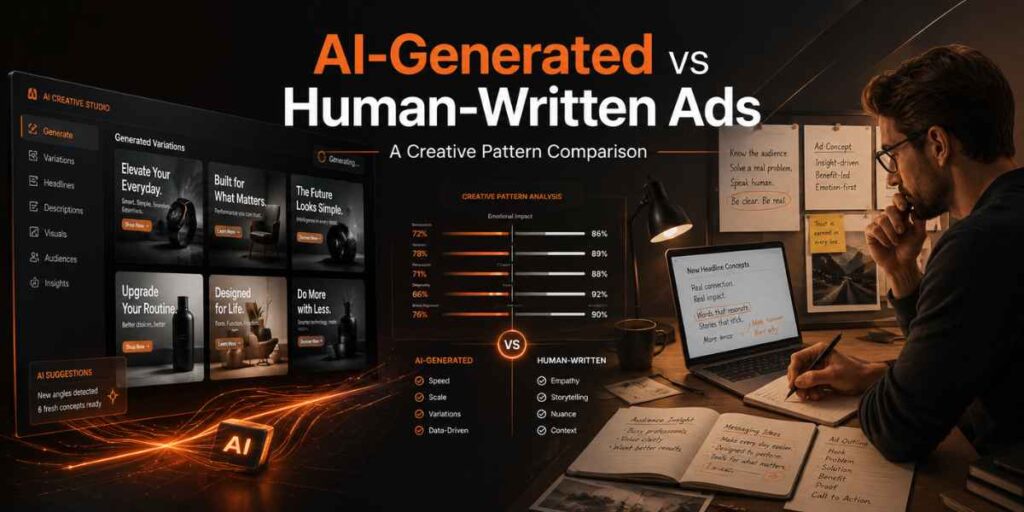
AI generated ads vs human ads is not a simple competition between machines and copywriters. AI is strongest at producing options quickly. Humans are stronger at choosing the customer insight, verifying claims and deciding what deserves advertising budget. The practical advantage comes from combining both.
Methodology and Dataset
This article compares two proprietary AdSpyder datasets. They measure creative patterns and production behaviour—not private campaign performance.
AI-Generated Dataset
2,051 generation runs
AdSpyder Text Ad Generation telemetry from April 2025 to May 2026, including generated headline counts, description counts, research sequence and scoring usage.
Market Baseline
164.7M search ads
Google Search ads classified by messaging angle in May 2026, including price, free offer, urgency, benefit, comparison and social-proof patterns.
Important limitation: Ad libraries cannot reliably prove that every market ad was written without AI assistance. The archive is therefore treated as a human-directed market baseline, not a verified human-only dataset.
The research extends AdSpyder’s recent analysis of how marketers combine AI generation with competitor intelligence.
Executive Findings
AdSpyder platform and archive data, analysed through May 2026.
10.5
Headlines per AI run
Plus 4.2 descriptions on average
52.5%
Created 15 headlines
The dominant AI production pattern
85.6%
Generated before research
No prior Ad Library search
78.6%
Used AI scoring
1,613 of 2,051 ad sets
AI-Generated vs Human-Written Ads
| Creative Factor | AI-Generated | Human-Written | Best Approach |
|---|---|---|---|
| Production speed | Produces large batches quickly | Slower, especially across formats | AI advantage |
| Customer insight | Depends on the supplied brief | Can use interviews and sales knowledge | Human advantage |
| Variation volume | Strong for headline and format expansion | Usually produces fewer alternatives | AI advantage |
| Brand voice | Can sound generic without examples | Better at nuance and intentional tone | Human review |
| Claims and accuracy | May invent proof, prices or features | Can verify against approved information | Human approval |
| Strategic testing | Scales controlled variants efficiently | Defines the hypothesis and winner | Hybrid workflow |
What the Market Baseline Reveals
The archive shows where both humans and AI are likely to default when they rely on familiar advertising formulas.
17.0%
14.1%
11.4%
3.9%
0.5%
Price, free-offer and discount language appears in 43% of the archive when the three angle rates are combined. That does not make these angles ineffective, but it makes differentiation harder. The practical lesson from AdSpyder’s creative testing framework is to test the offer, proof and angle before changing small visual details.
Patterns and Anomalies
Generating 15 headlines is useful only when those headlines cover genuinely different customer motivations.
Without market context, AI commonly returns safe language around price, convenience, free access and urgency.
Copywriters can repeat the same category conventions when they do not study the competitive market.
Persona-fit scoring can improve shortlisting, but the live campaign must determine CTR, lead quality, revenue and profit.
Creative longevity and repeated cross-platform use can provide additional research signals. AdSpyder’s guide to finding durable creative patterns explains why observable longevity is more useful than choosing ads solely because they look attractive.
The Better Model: Human-Directed AI Ads
1 · RESEARCH
Find market patterns
2 · BRIEF
Define one hypothesis
3 · GENERATE
Create varied options
4 · REVIEW
Check proof and voice
5 · TEST
Let outcomes decide
- Research 20–30 relevant ads. Tag the hook, offer, proof, CTA, format and landing page.
- Extract the pattern—not the wording. Convert competitor copy into a neutral customer insight.
- Build a structured prompt. Include audience, problem, approved proof, platform, offer and underused angle.
- Generate controlled variations. Change one strategic variable instead of producing random creative.
- Apply human review. Verify prices, features, testimonials, visual accuracy, disclosures and brand voice.
- Select with business outcomes. Use qualified leads, customers, revenue or profit—not AI confidence alone.
AdSpyder’s guide to using competitor patterns as AI prompt context provides a reusable brief for this process.
Where AdSpyder Fits
AdSpyder connects the research and generation stages, helping marketers move from visible market evidence to original creative variations without treating either AI or competitor ads as the final answer.
Compare advertiser activity, platforms, keywords and campaign patterns.
Create text and image variations from a structured market-informed brief.
Check whether competitor promises continue through the destination page.
Start with AdSpyder Ad Analytics, build original variations through Ad Generation, and verify message continuity with Landing Page Analysis.
Create AI ads from market evidence—not a blank prompt
Research competitor patterns, generate original variations and shortlist stronger ideas before spending.
Limitations and Methodology Notes
- The archive cannot verify whether every market ad was created entirely by a human.
- Messaging-angle classification measures visible language, not creative quality or originality.
- One ad can match several angles, so percentages do not total 100%.
- Generation telemetry does not contain private CTR, conversions, CPL, CAC or ROAS.
- AI scoring measures persona fit; it does not predict live campaign performance.
- Platform policies and AI disclosure requirements must be checked before publishing.
Use AdSpyder’s AI performance marketing framework to connect creative decisions with qualified leads, customers and revenue.
AI-Generated vs Human-Written Ads Review Checklist
☐ Competitor patterns were researched first.
☐ One hypothesis guides every variation.
☐ Ads cover more than one messaging angle.
☐ Prices and product claims are verified.
☐ Brand voice has received human review.
☐ The landing page supports the promise.
☐ Required AI disclosures are applied.
☐ Business outcomes determine the winner.
FAQs for AI-Generated vs Human-Written Ads
Not automatically. AI is faster at variation, while humans are stronger at insight, accuracy and final judgment.
Generic input can produce generic claims, repeated angles and wording that does not reflect the actual customer or brand.
AI should reduce repetitive drafting. Humans should continue to lead strategy, proof, compliance, brand voice and approval.
Create enough variations to test several distinct angles. Avoid producing many near-duplicates of one message.
No. Scoring can help shortlist ads for persona fit, but live campaign and CRM data must identify the winner.
AdSpyder connects competitor research, creative generation, scoring and landing-page analysis in one evidence-led workflow.