
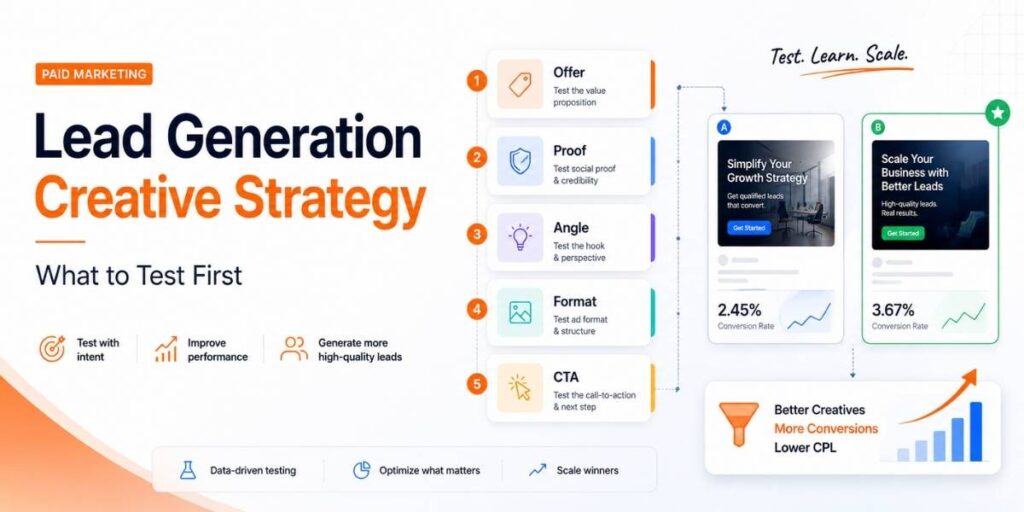
Quick Answer: What Should You Test First?
- Test the offer before changing visual details.
- Test proof to make the promise believable.
- Test the angle to find the motivation that attracts better-fit prospects.
- Test the format and CTA after the message is clear.
- Use qualified-lead and sales metrics—not CTR alone—to select the winner.
A lead generation creative strategy should test the business proposition before the visual treatment.
A new background color cannot fix an unappealing offer, vague proof or an angle that attracts the wrong audience. Start with the variables that change why someone responds.
Use the AdSpyder Ad Library to collect market examples, then convert repeated patterns into original and measurable test hypotheses.
What Is a Lead Generation Creative Strategy?
It is a structured plan for deciding which message, offer and presentation variables to test, how to isolate them and which business metrics will determine the result.
The goal is not to produce the highest number of ads. It is to learn which creative combination attracts prospects who can become qualified leads, opportunities and customers.
The Creative Impact Ladder
| Priority | Variable | Question to Answer | Examples |
|---|---|---|---|
| 1 | Offer | Is the next step valuable enough? | Audit, demo, quote, trial or assessment |
| 2 | Proof | Why should the prospect believe the claim? | Result, review, demonstration or certification |
| 3 | Angle | Which motivation should lead the message? | Save time, reduce cost, avoid risk or gain control |
| 4 | Format | Which presentation explains the message best? | Static, video, carousel, testimonial or demo |
| 5 | CTA | Is the required action clear and appropriate? | Get a Quote, Start Free or Book a Demo |
| 6 | Cosmetics | Can the execution become clearer or easier to notice? | Color, font, spacing, border or icon position |
How to Build a Creative Test Hypothesis
Hypothesis Formula: We are changing [one variable] because we believe it will improve [business metric] for [audience].
Example: We are replacing “Book a Demo” with “Get a Free Account Audit” because cold agency prospects may prefer a lower-risk first step. The primary metric is cost per qualified lead.
Keep the audience, core message and landing-page experience stable wherever possible. Otherwise, the result may improve without showing which change caused it.
Lead Generation Creative Test Matrix
| Test | Control | Variation | Primary Metric |
|---|---|---|---|
| Offer | Book a Consultation | Get a Free Audit | CPQL |
| Proof | General Benefit | Specific Customer Result | Qualified Lead Rate |
| Angle | Save Time | Reduce Wasted Spend | Cost per SQL |
| Format | Static Image | Product Demonstration | CPQL |
| Cosmetic | Dark Background | Light Background | CTR |
Match the Creative With Funnel Readiness
| Funnel Stage | Creative Focus | Suitable CTA |
|---|---|---|
| Problem Aware | Pain, consequence and diagnosis | Learn More |
| Solution Aware | Method, use case and demonstration | See How It Works |
| Category Aware | Proof, features and differentiation | Compare Options |
| Sales Ready | Audit, pricing, implementation or quote | Book a Demo |
For Meta campaigns, use Facebook Ads Spy to compare how competitors adapt angles, formats and CTAs for different audience-awareness levels.
Which Metrics Should Decide the Winner?
Business Metrics
Valid lead rate, CPQL, MQL-to-SQL rate, cost per SQL, opportunity rate and paid media CAC.
Diagnostic Metrics
CTR, CPC, landing-page conversion, form completion, video engagement and frequency.
Use Ad Analytics to observe competitor campaign patterns, but use your own advertising and CRM outcomes to choose the commercial winner.
How Many Creative Variations Should You Test?
There is no universal number. Use a test size your budget and conversion volume can evaluate without dividing delivery across too many weakly funded variations.
Begin with a small set built around one strategic question. Once the winning offer or angle is clear, create format and visual variations around that learning.
Keep the Creative and Landing Page Aligned
An ad promising a free assessment should not lead to a generic homepage or an unexpected high-commitment sales form.
Use Landing Page Analysis to compare how visible competitor ads connect their promises, proof, CTAs and destination pages.
How to Research Creative Patterns With AdSpyder
- Search relevant competitor domains, keywords, countries and platforms.
- Record each ad’s offer, proof, angle, format and CTA.
- Identify repeated category patterns without assuming they are profitable.
- Choose one strategic variable for the next test.
- Generate original variations and measure them using your own lead-quality data.
After the hypothesis is defined, use Image Ad Generation to create editable visual variations adapted to major ad formats.
Common Creative Testing Mistakes
- Testing colors before testing the offer
- Changing multiple strategic variables together
- Declaring a winner from CTR alone
- Copying competitor ads instead of extracting patterns
- Using vague proof that does not support the claim
- Sending every angle to the same generic page
- Using a high-commitment CTA for a cold audience
- Running new tests without documenting previous learnings
Lead Generation Creative Checklist
FAQs for Lead Generation Creative Strategy
What Should You Test First?
Test the offer first, then proof, angle, format and CTA. Leave minor cosmetic changes until the proposition is working.
Should CTR Decide the Winner?
No. CTR shows attention. Use qualified-lead and sales metrics to decide commercial value.
How Many Variables Should Change?
Change one strategic variable whenever possible so the result produces a reusable learning.
Do Repeated Competitor Ads Prove Performance?
No. Repetition can indicate a category pattern, but private conversion, cost and revenue results are unavailable.
Create Variations From a Clear Testing Hypothesis
Define the offer, proof or angle you want to test, then build original ad variations for the relevant platform and audience.