
Quick Answer
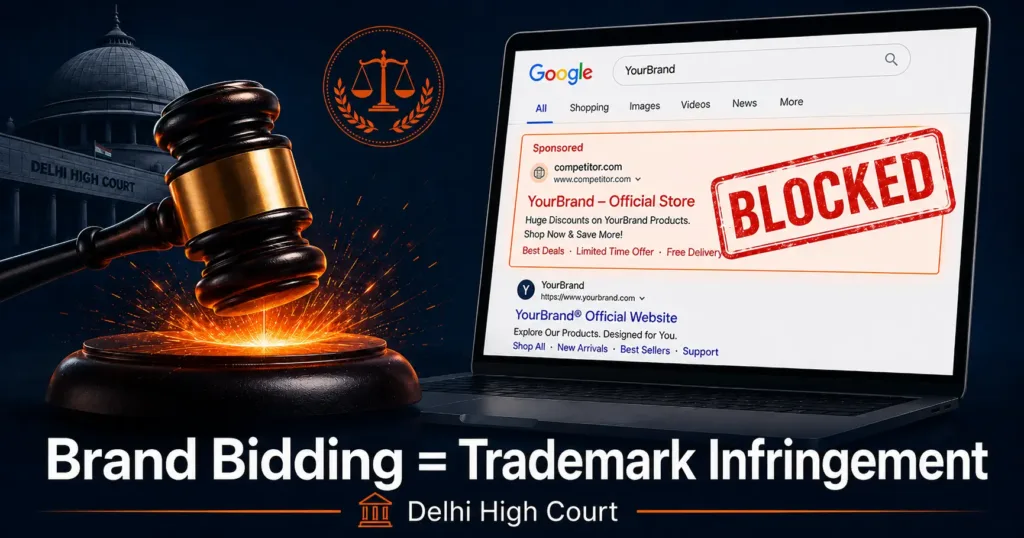
On 22 May 2026, the Delhi High Court ruled in favour of Hindware in a landmark trademark keyword dispute involving Google Ads.
- The court permanently restrained Google LLC and Google India from using Hindware-related trademarks as advertising keywords and awarded ₹30 lakh in nominal damages.
- For Indian brands, the bigger lesson is clear: brand keyword bidding is no longer just a PPC issue. It is now a brand protection, legal risk, and revenue leakage issue.
- AdSpyder has built brand keyword alerts to help brands see when competitors bid on their brand terms — and get notified before traffic, trust, or conversions are affected.
A customer searches for your brand name on Google.
They already know you. They are not casually browsing. They are showing direct, high-intent search behaviour — the kind of traffic that marketing teams spend years and crores building.
But before they reach your website, a competitor’s sponsored ad appears above your organic result. Your brand created the demand. Another advertiser may capture the click.
This is the core problem behind brand bidding — and after the Delhi High Court’s Hindware vs Google judgement, Indian brands now have the strongest legal precedent yet to challenge it.
This blog explains what happened in the Hindware case, the key legal findings, what they mean for every brand in India, and how AdSpyder’s upcoming brand keyword alert feature fits in.
163
Pages in the judgment
Justice Mini Pushkarna, Delhi HC, May 22, 2026
₹30L
Nominal damages to Hindware
Payable jointly by Google LLC & Google India
13 yrs
Discovery to final verdict
Infringement first discovered in 2013
Source: Hindware Ltd. v. Google LLC, CS(COMM) 591/2017 & 592/2017, Delhi High Court, May 22, 2026.
Your competitors may already be bidding on your brand keyword. Do you know?
Use AdSpyder to research competitor Google Ads activity, investigate which advertisers appear on your branded searches, and review their ad copy and landing pages — across 15+ platforms.
In This Article
What Is Brand Bidding — and Why It Is Now a Legal Issue in India
The core problem behind the Hindware vs Google case
Brand bidding happens when an advertiser targets another company’s brand name as a paid search keyword in Google Ads or similar platforms. This causes the advertiser’s sponsored ad to appear when users specifically search for that brand — intercepting high-intent traffic that the brand owner created through their own marketing investment.
Brand keywords are different from generic keywords. They usually come from existing brand awareness built through SEO, PR, offline campaigns, word of mouth, or sales teams. When a competitor appears on those searches, they are entering at the final stage of demand — and they paid nothing to build it.
Generic Keyword vs Brand Keyword: Why the Difference Matters
| Search Type | Example | User Intent | Risk Level |
|---|---|---|---|
| Generic keyword | best ad spy tool | Exploring options | Normal competition |
| Category keyword | Google Ads spy tool | Comparing options | Competitive but expected |
| Brand keyword | [your brand] pricing | Already knows the brand, near-decision | Traffic diversion + potential trademark infringement |
What Happened in the Hindware vs Google Case?
The facts of the case — directly from the judgment
| Detail | Information |
|---|---|
| Case | Hindware Ltd. vs Google LLC / Google India |
| Court | Delhi High Court |
| Judge | Hon’ble Ms. Justice Mini Pushkarna |
| Judgment Date | 22 May 2026 |
| Case Citation | 2026:DHC:4614 | CS(COMM) 591/2017 & 592/2017 |
| Competitors Named | Cera Sanitaryware, Grohe India (both settled during proceedings) |
| Final Contesting Party | Google LLC and Google India |
| Damages Awarded | ₹30 lakh nominal damages + actual litigation costs |
| Core Issue | Competitor ads appearing on branded Hindware search queries via Google Ads keywords |
Hindware Ltd. is one of India’s leading sanitaryware manufacturers. Established in 1960, the brand holds 40% market share in the organised sector, has over 450 stores across India, and spent more than ₹50 crore on advertising by 2011-12. The word “HINDWARE” is coined — it appears in no dictionary — and has been a registered trademark since 1991.
In early 2013, Hindware discovered that competitors Cera Sanitaryware and its website developer Omkara Infoweb had purchased “HINDWARE” as a Google AdWords keyword. When users searched for Hindware, Cera’s sponsored result appeared at the top — above Hindware’s own organic listing. In October 2014, Hindware discovered Grohe India doing the same with “HINDWARE SANITARY”, “HINDWARE SANITARYWARE”, and “HINDWARE SANITARYWARE INDIA”.
Cera, Grohe, and Omkara Infoweb all settled with Hindware during proceedings. Google alone continued to contest the case — arguing it was merely a neutral intermediary. That argument took nine years to finally fail.
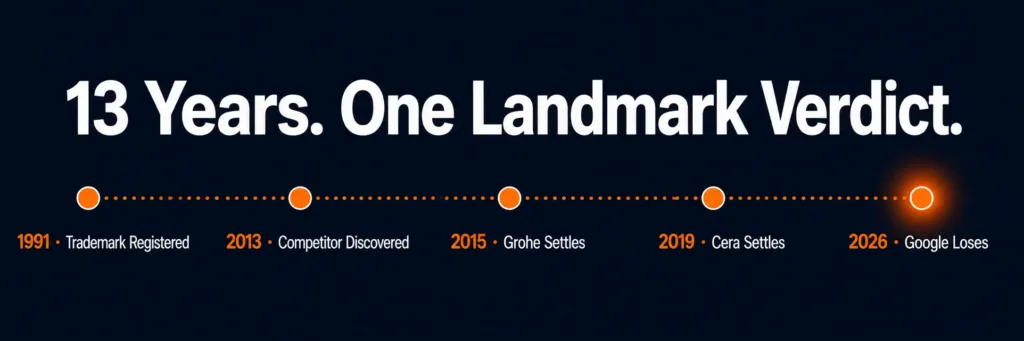
The 13-Year Timeline: From Discovery to Landmark Ruling
How a 2013 keyword discovery became India’s most consequential digital trademark case
Hindware trademark registered
Hindware registers the coined trademark “HINDWARE” in India. By 2011-12, annual sales exceed ₹500 crore and ad spend crosses ₹50 crore. The brand commands 40% of organised sanitaryware market share.
First discovery — Cera bidding on HINDWARE
Hindware discovers Cera Sanitaryware and Omkara Infoweb have purchased “HINDWARE” as a Google AdWords keyword. Cera’s website appears first when users search for Hindware. Suit CS(COMM) 592/2017 is filed.
Second discovery — Grohe bidding on brand variants
Grohe India found purchasing “HINDWARE SANITARY”, “HINDWARE SANITARYWARE”, and “HINDWARE SANITARYWARE INDIA” as keywords. Competitor ads intercept branded searches across every major variant. Suit CS(COMM) 591/2017 is filed.
Grohe settles. Google keeps fighting.
Grohe India settles with Hindware through a consent decree and agrees to stop the keyword bidding. Cera settles in 2019. Google remains the sole contesting defendant — contesting the fundamental question of whether a platform is liable for facilitating keyword infringement.
May 22, 2026 — Justice Mini Pushkarna delivers 163-page judgment
Google loses on every substantive issue. Permanent injunction granted. ₹30 lakh in damages awarded. Safe harbour under the IT Act denied. Brand bidding law in India changes permanently.
Key Findings from the Delhi High Court Judgment
What the court actually decided — and what it means in plain language
Invisible Keyword Use Is Still Trademark Infringement
Google argued that because keywords are backend triggers never visible to the consumer, they cannot constitute trademark “use” under Indian law. The court rejected this entirely. It held that using a trademark as a keyword to trigger an advertisement constitutes “use in advertising” under Section 29(6)(d) of the Trade Marks Act, 1999 — regardless of whether the trademark visibly appears in the final ad text.
“Invisible use of trademark to divert the traffic from proprietors’ website to the advertisers’ website shall amount to use of the mark for the purpose of Section 29.”
— Justice Mini Pushkarna, Hindware v. Google LLC, May 22, 2026
Plain language for brands
A competitor does not need to spell your brand name in the ad headline for infringement to exist. The keyword trigger in the backend is enough.
Google Is an Active Participant, Not a Neutral Platform
Google’s defence was that advertisers choose keywords independently and the platform bears no responsibility. The court pointed to two specific Google mechanisms as evidence of active participation:
🔧 Keyword Planner Tool
Actively recommends competitor trademarks to advertisers during campaign setup. The Quality Score system makes this tool functionally essential for top ad placement — not truly optional.
📊 Real-Time Auction System
Google designs and runs the bidding auction for trademarked keywords, earning revenue from every click — making it a direct commercial beneficiary of the infringement.
“Google cannot be permitted to shrug off responsibility by making available a tool that leads to infringement, and then turning around to claim that the said tool was not mandatory.”
— Justice Mini Pushkarna, para. 209
Safe Harbour Under the IT Act — Denied
Google claimed immunity as an intermediary under Section 79 of the IT Act, 2000. The court denied this on two grounds:
Ground 1: Section 79(2)(b) requires that a protected intermediary does not select the receiver of transmission. Google’s Keyword Planner specifically directs ads to users searching for the plaintiff’s trademark — it selects who sees what.
Ground 2: Rule 3(1)(b)(iv) of India’s Intermediary Guidelines requires platforms to prevent trademark-infringing content. Google’s AdWords Policy in India did not prohibit trademarked terms as keywords and made no effort to verify trademark ownership before selling a mark to competitors.
“The action of Google in conducting auction and selling the use of the plaintiff’s trademark as a keyword to direct competitors are not exempted under Section 79(1) of the IT Act.”
— Justice Mini Pushkarna, para. 199
Brand Goodwill Is a Protectable Commercial Asset
The court held that a brand name is not just a search term — it represents years of advertising investment, distribution, customer trust, and market recognition. When a competitor uses that brand demand to attract clicks, they take unfair advantage of the brand’s goodwill under Section 29(8) of the Trade Marks Act.
The judgment also noted that Google had internally estimated in 2009 that permitting trademark keyword bidding would generate at least USD 100 million in incremental annual revenue — establishing that Google knowingly and deliberately monetised others’ brand equity.
Forced Self-Bidding Is a Recognised Commercial Harm
The judgment explicitly identifies being forced to bid on your own registered trademark just to maintain top placement as a real commercial harm. Google’s system compels brand owners to pay for traffic that should naturally belong to them, while simultaneously auctioning their brand equity to rivals. You effectively pay a tax on your own identity to remain visible on searches for your own brand name.
Distinctive Trademarks Get the Strongest Protection
The court placed significant weight on “HINDWARE” being a coined word with no dictionary meaning. Unique, invented brand names are in a much stronger legal position than descriptive or generic business names. The strength of your trademark directly determines the strength of your position when challenging competitor keyword bidding.
The Final Order: What the Court Decreed
Verbatim from page 162 of the 163-page judgment
Decreed in favour of Hindware. Against Google LLC and Google India:
Permanent Injunction restraining Google LLC and Google India from using “HINDWARE”, “HINDWARE SANITARYWARE”, “HINDWARE SANITARY”, “HINDWARE SANITARYWARE INDIA”, or any combination thereof, as advertising keywords, AdWords, or in any manner amounting to infringement.
Nominal Damages of ₹30,00,000 (Rupees Thirty Lakhs) payable jointly and severally by Google LLC and Google India within eight weeks.
Actual Litigation Costs payable jointly and severally by Google LLC and Google India, to be computed by the Taxing Officer.
Note: Damages are nominal — the court acknowledged clear infringement but insufficient evidence of the exact quantum of actual loss. Future cases with proper damages evidence could attract substantially higher awards.
What This Ruling Means for Indian Brands?
This is not just one sanitaryware brand’s victory
The legal principles established here are not limited to Hindware or sanitaryware. Every brand in India — SaaS, D2C, ecommerce, fintech, edtech, healthcare, B2B — that holds a registered trademark now has binding legal precedent to cite when a competitor bids on their brand keyword.
The New Baseline in Indian Digital Advertising
Before this judgment, trademark keyword bidding existed in a legal grey zone in India. The 2026 Delhi HC ruling ends that ambiguity. Using a registered, distinctive trademark as a paid search keyword — even invisibly — is now clearly established as trademark infringement. Any Indian brand can cite 2026:DHC:4614 to demand action.
This ruling matters across three types of brand situations:
⚔️ Brands Being Targeted
You now have legal grounds to issue a cease-and-desist to a competitor bidding on your brand name and to file a trademark complaint with Google. Both Cera and Grohe settled once litigation commenced — a well-cited legal notice may resolve the issue without a court filing.
🚨 Brands Bidding on Competitors
If your Google Ads strategy includes bidding on competitor brand terms, this ruling creates legal exposure for you. Review and remove competitor trademark keywords from your campaigns now.
🔍 Brands Who Don’t Know Yet
The most common — and most dangerous — situation. Hindware discovered the infringement in 2013 but it had been ongoing before that. Many brands are being targeted right now and have no idea. Visibility is the first problem to solve.
Business Risks of Competitor Brand Bidding
Why every team — not just legal — should care about brand keyword monitoring
Most brands track rankings, traffic, and conversion rates. Very few actively monitor who appears when someone searches their own brand name. That is a significant gap — and the Hindware case shows exactly what it costs over time.
| Risk | How It Affects Your Brand |
|---|---|
| Traffic loss | Users searching specifically for your brand may click a competitor’s sponsored ad first, before ever reaching your website |
| Higher CPC | You are forced to bid on your own brand name defensively, paying for traffic that should be free |
| Brand confusion | Searchers may assume the competitor’s sponsored ad is associated with or endorsed by your brand |
| Revenue leakage | High-intent users — the most valuable segment — may convert on a competitor’s landing page instead of yours |
| Legal escalation | Your legal and trademark teams need documented evidence to take action — which they may not have without active monitoring |
| Reporting gaps | PPC and SEO teams see branded traffic drops without knowing why — misdiagnose the problem and fix the wrong thing |
⚠️ The Platform Policy Problem
The judgment noted that Google’s AdWords policy in India did not prohibit the use of trademarked terms as keywords. This is exactly why brands cannot rely on platform policies alone. Even where the platform permits certain practices, a brand still needs independent visibility into what competitors are doing — and legal recourse when it matters.
The Legal Criteria: Does This Precedent Apply to Your Brand?
Important nuance — brand bidding is not automatically illegal in every single case
This is a critical point many headlines miss. The right takeaway from the Hindware ruling is not that every competitor keyword bid is automatically illegal. The legal strength of your position depends on specific factors the court evaluated:
Your Trademark Must Be Registered in India
The court’s findings under Section 29 apply to registered trademarks. An unregistered business name does not carry the same statutory protection. If your brand is not yet registered at the Trade Marks Registry (ipindia.gov.in), this ruling makes registration more urgent than ever.
Your Brand Name Must Be Coined or Distinctively Non-Generic
The court placed significant weight on “HINDWARE” being a coined word with no dictionary meaning. A purely descriptive or generic business name (e.g., “Best Plumbing Services”) faces a higher burden of proof. Unique, invented brand names are in the strongest legal position.
You Must Prove Intentional Traffic Diversion
There must be clear evidence that a competitor is deliberately using your trademark or phonetically similar variants to intercept consumers specifically searching for your brand. Timestamped screenshots showing competitor ads on brand-specific search queries are the standard form of evidence.
⚠️ Additional Factors Courts Consider
Whether the ad creates user confusion · Whether the landing page misleads or makes comparison claims · Whether the ad copy references your brand name · The scale and repeat nature of the bidding activity. Consult a qualified IP attorney to evaluate your specific situation before taking legal action.
What Brands Should Monitor After This Ruling?
Brand keyword monitoring should now be part of every serious PPC and brand protection workflow
After the Hindware ruling, every brand that generates meaningful search traffic should actively monitor branded search terms. This is especially important for SaaS, D2C, ecommerce, fintech, edtech, healthcare, real estate, and high-competition B2B categories.
| What to Monitor | Why It Matters |
|---|---|
| Exact brand name | Finds direct, unambiguous competitor bidding |
| Brand + pricing | Catches high-intent, near-purchase conversion interception |
| Brand + reviews / alternatives | Tracks reputation-based and comparison search targeting |
| Brand + coupon / offer | Finds loyalty-undermining interception at discount-seeking moments |
| Brand misspellings | Finds hidden bidding on common typo variations of your name |
| Product + brand terms | Tracks product-level competitor interception beyond top-level brand |
| City-level brand searches | Finds local or regional competitor targeting in specific geographies |
| Competitor ad copy | Checks whether messaging creates confusion or makes misleading claims |
| Competitor landing page URL | Shows exactly where branded traffic is being redirected |
| Time and location patterns | Helps identify recurring deliberate activity vs isolated tests |
Where AdSpyder Fits In: From Legal Precedent to Practical Visibility
You cannot enforce your rights if you do not know they are being violated
Here is what the legal headlines miss: Hindware discovered the infringement in 2013. The final verdict came in 2026. Thirteen years of brand traffic being intercepted, consumer intent being hijacked, and marketing spend being undermined — before resolution.
The ruling fixes the legal question. It does not fix the discovery problem. Many brands do not know a competitor is bidding on their brand keyword until traffic drops unexpectedly, branded CPC rises without explanation, a sales team hears customer confusion, or a founder notices a competitor ad by accident.
The Discovery Problem
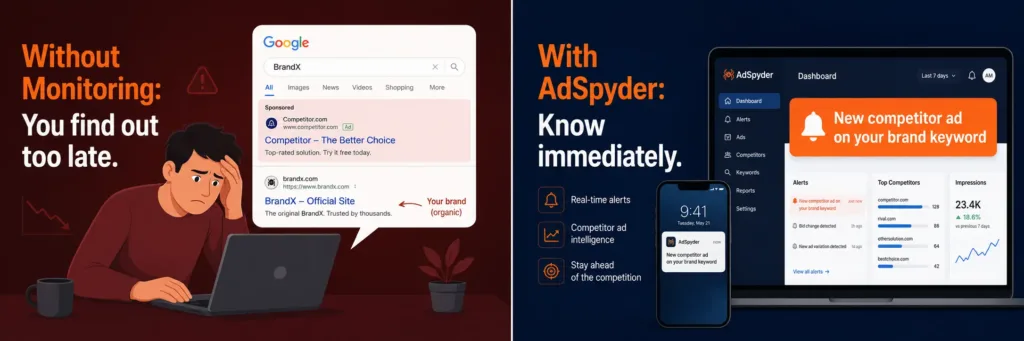
When a competitor bids on your brand keyword, no platform sends you an alert. No notification fires. Google does not tell you. You find out by accident — or not at all, while the traffic leakage continues quietly in the background.
AdSpyder is an ad intelligence platform that tracks ads running across Google, Bing, Meta, and 15+ other platforms. Right now, you can search your brand keyword in AdSpyder’s Ad Library and see every competitor ad that has been running against your brand terms — including historical data showing when campaigns started and what the ads say.
Without Monitoring vs With AdSpyder
| Situation | Without Monitoring | With AdSpyder |
|---|---|---|
| Competitor bids on your brand | You discover it weeks or months later | You can track it and get notified when it happens |
| Sponsored result appears above yours | Traffic leakage continues undetected | You can review the advertiser, ad copy, and landing page |
| Legal team needs evidence | Manual screenshots, missing context, gaps in timeline | Structured ad data with timestamps supports documentation |
| PPC team needs a response | Reactive defensive bidding without full picture | Better visibility before increasing branded search spend |
| Brand confusion begins | Customers rarely report it — traffic just leaks quietly | Your team sees competitor activity early and can act fast |
Brand Protection Workflow: 5 Steps for Every Brand
A practical process any PPC team, brand manager, or agency can follow today
List All Your Brand Keywords
Start with your exact registered brand name. Then add: brand + pricing, brand + reviews, brand + coupon, brand + alternative, brand + competitor name, brand + product name, and common brand misspellings. This is the full universe you need to protect.
Run a Competitor Ad Check
Search each of your brand keyword variants on Google in an incognito window from multiple locations and devices. Note every sponsored result that appears. Use AdSpyder’s Google Ads Spy to get a broader, historical view — including ads running in cities you are not physically located in.
Document Everything Properly
For any competitor ad you find, collect: search query, date and time, device, location, ad headline, ad description, display URL, final landing page URL, and screenshots or screen recordings. Document whether your brand name appears in the ad copy and whether the landing page makes comparison or misleading claims. This is your evidence file.
Decide the Right Response
Depending on what you find, your options include: adjust your own branded campaign to protect top placement · send evidence to your legal and trademark team · file a Google IP trademark complaint citing 2026:DHC:4614 · issue a formal cease-and-desist to the competitor · build a comparison or defensive landing page for the hijacked search queries.
Set Ongoing Alerts — Do Not Rely on Manual Checks Alone
Competitor ad activity changes constantly — by city, time of day, device, and campaign budget. Manual checks are a snapshot, not a system. AdSpyder’s upcoming Brand Keyword Alerts will notify you when new competitor activity appears on your brand terms, so your team can respond before significant damage accumulates.
Brand Protection Checklist: Actions After the Hindware Ruling
The legal precedent is set. Now you need the intelligence to act on it.
The Delhi High Court has given Indian brands the tools to fight brand keyword bidding. But you can only use those tools if you know the infringement is happening. AdSpyder lets you search your brand keyword and see exactly what competitors are running against you — across 15+ platforms, including historical data.
23,000+ registered users · 360M+ ads indexed · 15+ platforms · adspyder.io